
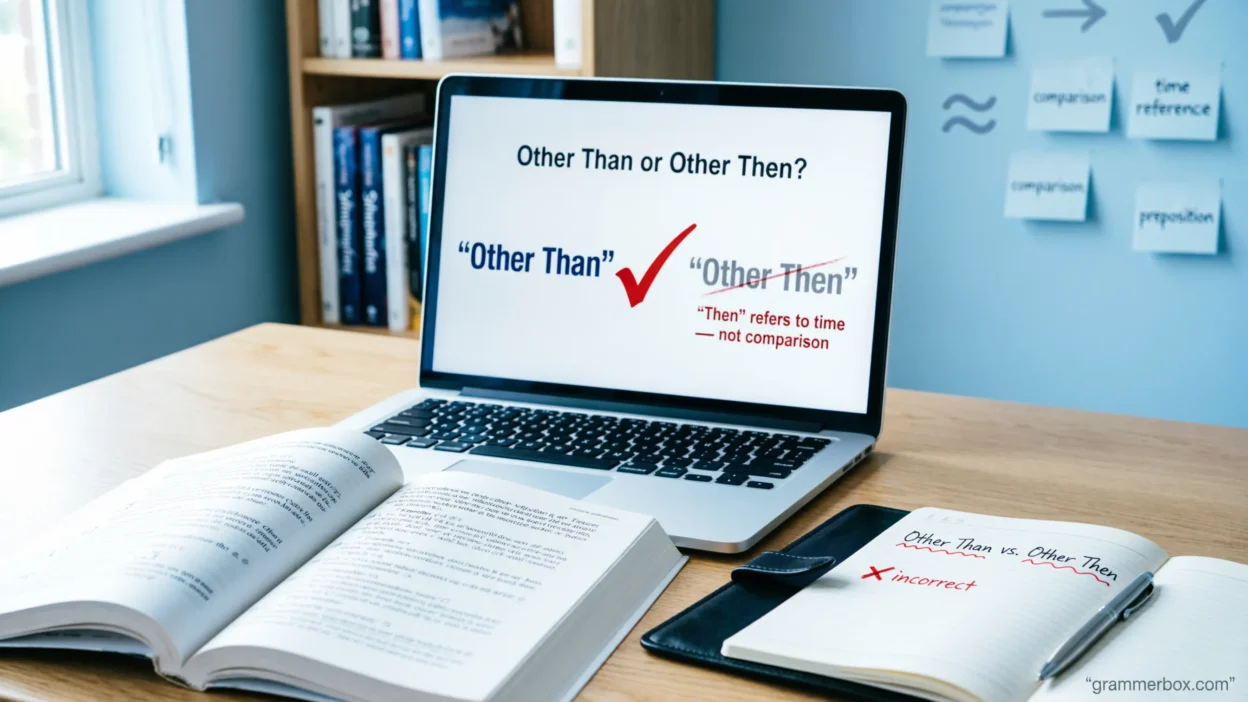
Choosing between other than and other then can be confusing because than and then sound similar in everyday speech. However, they have completely different meanings and grammatical functions. If you are writing an email, essay, school assignment, professional document, or casual message, using the correct phrase matters.
The correct expression in most situations is other than. It is commonly used to mean “except,” “apart from,” or “besides.” For example, “I have no hobbies other than reading” means reading is the only hobby being mentioned.
Other then is generally incorrect when you mean “except” or “besides.” The word then usually relates to time, sequence, or a result, so it does not normally belong in this expression. Let’s look at the difference, examples, common mistakes, and an easy memory trick.
Quick Answer
Other than is the correct phrase when you mean “except,” “apart from,” or “besides.” Other then is usually a spelling or usage mistake. Use than for comparisons and exceptions, while then refers to time, sequence, or results.
Why People Confuse It
People often confuse other than with other then because than and then are pronounced similarly in many varieties of English.
There is also a common spelling pattern behind the mistake. Since then is a familiar English word, writers may automatically choose it when typing quickly.
Remember that these two words have different jobs:
- Than is commonly used for comparisons and expressions of exception.
- Then usually refers to time, order, or a consequence.
- Other than is an established phrase.
- Other then is not normally the correct phrase when you mean “except” or “besides.”
For most sentences involving other than, choose than.
First Word: “Other”
The word other refers to a person or thing that is different from one already mentioned or understood.
It can appear before nouns, pronouns, and certain expressions.
Examples:
- Do you have other ideas?
- I need other options.
- Is there another way to solve this?
- She spoke to other students.
- We considered several other possibilities.
In the phrase other than, other introduces something that is different, excluded, or additional.
For example:
I don’t eat anything other than vegetables.
Here, the phrase means “anything except vegetables.”
Second Word: “Than”
Than is a conjunction or preposition commonly associated with comparisons.
Examples:
- Sarah is taller than Mark.
- This book is better than that one.
- I would rather walk than drive.
- Nobody knows this better than you.
However, than also appears in the fixed expression other than, where it means “except,” “apart from,” or “besides.”
Examples:
- Do you need anything other than water?
- Everyone other than James attended.
- I have no plans other than studying tonight.
Comparison Table
| Phrase | Correct? | Meaning | Example |
|---|---|---|---|
| Other than | Yes | Except, apart from, besides | I have no plans other than work. |
| Other then | Usually no | Not normally a standard phrase | ❌ I have no plans other then work. |
| Than | Yes | Used in comparisons and some fixed expressions | She is taller than me. |
| Then | Yes | At that time, next, or as a result | We ate dinner, then watched a movie. |
The important distinction is that other than is a standard English expression, while other then usually results from confusing than with then.
When to Use Each
Use “Other Than” for Exceptions
Use other than when you mean except or apart from.
- Nobody other than Maria knew the answer.
- I don’t need anything other than a pen.
- Other than Monday, I’m free all week.
Use “Other Than” for Alternatives
It can also introduce something besides the thing already mentioned.
- Is there another option other than this?
- What can I use other than sugar?
- Do you speak any language other than English?
Use “Then” for Time
Use then when talking about a particular time or moment.
- I was younger then.
- We lived there back then.
- If I knew then what I know now, I would have acted differently.
Use “Then” for Sequence
Then can show what happens next.
- First, wash the vegetables. Then, cut them.
- She finished her work and then went home.
- We had dinner, then watched television.
Use “Then” for Results
Then can also mean “in that case” or introduce a result.
- If you’re tired, then you should rest.
- If that’s true, then we have a problem.
Examples of “Other Than”
Here are more examples showing how other than works naturally in everyday English:
- I don’t have any hobbies other than reading.
- Nobody other than John knew about the meeting.
- Is there anything other than coffee available?
- She eats no meat other than fish.
- We have no choice other than to wait.
- I don’t know anyone other than my coworkers here.
- What can we do other than apologize?
- He speaks no language other than English.
- The restaurant serves nothing other than vegetarian food.
- I have no plans other than finishing this project.
- Everyone other than the manager left early.
- There was nothing other than silence in the room.
In each example, other than means something like “except,” “apart from,” or “besides.”
Common Mistakes
Mistake 1: Writing “Other Then” for “Except”
Incorrect:
I don’t want anything other then water.
Correct:
I don’t want anything other than water.
Mistake 2: Choosing “Then” Because It Sounds Similar
The pronunciation can make these words easy to mix up, especially in casual speech.
Incorrect:
Nobody other then Sarah came.
Correct:
Nobody other than Sarah came.
Mistake 3: Confusing “Than” With “Then”
Remember that than commonly connects comparisons:
This is easier than that.
But then usually indicates time or sequence:
Finish your homework, then go outside.
Mistake 4: Assuming “Then” Is Always Wrong
Then is not an incorrect word. It simply does not normally belong in other than when the intended meaning is “except.”
For example:
We went to the store and then came home.
Here, then is completely correct because it shows sequence.
Memory Trick
Use this simple trick:
THAN = comparison or exception
THEN = time or sequence
Think:
- Better than before.
- Other than this.
- First this, then that.
- Now and then.
- Back then.
So if you want to say “except,” “apart from,” or “besides,” choose other than.
A quick test is to replace the phrase with “except.”
Nobody other than Alex knew.
Becomes:
Nobody except Alex knew.
Because the meaning works, other than is the right choice.
American vs. British English
There is no meaningful American-versus-British English difference in the standard use of other than.
Both American English and British English use other than to mean “except,” “apart from,” or “besides.”
Examples:
- American English: I don’t need anything other than your help.
- British English: I don’t need anything other than your help.
The spelling and grammatical distinction between than and then remains the same in both varieties.
Therefore, whether you are writing for an American or British audience, other than is the standard choice when expressing an exception.
Similar Words and Phrases
Several expressions can have a similar meaning to other than.
Except
Everyone except Daniel agreed.
Apart From
Apart from Daniel, everyone agreed.
Besides
Besides Daniel, everyone agreed.
In Addition To
This expression usually adds something rather than excludes it.
In addition to English, she speaks Spanish.
Rather Than
Rather than is different from other than. It is generally used to express preference or an alternative.
I would walk rather than take the bus.
These phrases may overlap in some contexts, but they should not automatically be substituted for one another.
Final Verdict
Other than is the correct phrase when you mean except, apart from, or besides.
Other then is generally incorrect when used with this meaning. The confusion happens because than and then look and sound similar, but they serve different grammatical purposes.
Use than in other than:
Is there anything other than tea?
Use then when referring to time, order, or a result:
We finished dinner and then went home.
If you remember this simple distinction, you can avoid one of the most common spelling and grammar mistakes involving these two words.
FAQs
Is “other than” grammatically correct?
Yes. Other than is grammatically correct and commonly means “except,” “apart from,” or “besides.”
Is “other then” ever correct?
Other then is not normally correct when you mean “except” or “apart from.” It is usually a mistake for other than.
What is the difference between “than” and “then”?
Than is commonly used for comparisons and in expressions such as other than. Then usually refers to time, sequence, or a result.
Can I say “other than” in formal writing?
Yes. Other than is completely acceptable in formal writing, including academic, professional, and business contexts.
Is “other than” the same as “except”?
Often, yes. In many sentences, other than can be replaced with except without changing the basic meaning.
For example:
Nobody other than Sarah attended.
means:
Nobody except Sarah attended.
What does “other than” mean?
Other than can mean “except,” “apart from,” or “besides,” depending on the context.
How can I remember “other than” vs. “other then”?
Remember: THAN = comparison/exception; THEN = time/sequence. If you can replace other than with “except,” use than.
Conclusion
The difference between other than and other then is simple once you understand what than and then do. Other than is the standard expression for “except,” “apart from,” or “besides,” while then is normally connected with time, sequence, or results. This makes other than the correct choice in sentences such as “I have no plans other than studying.”
Learning this distinction can improve both everyday communication and formal writing. Whenever you are unsure, ask yourself if you mean “except.” If the answer is yes, use other than. Save then for situations involving what happened next, a particular time, or a consequence.
Remember This
Other than = except / apart from / besides
Then = time / next / result
✅ Correct: I have no choice other than to wait.
❌ Incorrect: I have no choice other then to wait.