English has many words that look correct but have completely different meanings. One of the most confusing examples is paid vs payed. Since both words appear in dictionaries, many writers assume they can be used interchangeably. However, that’s not true.
If you’ve ever wondered whether you should write paid or payed in an email, essay, social media post, or business document, you’re not alone. This guide explains the difference in simple English, shows real examples, highlights common mistakes, and helps you remember the correct choice every time.
Quick Answer
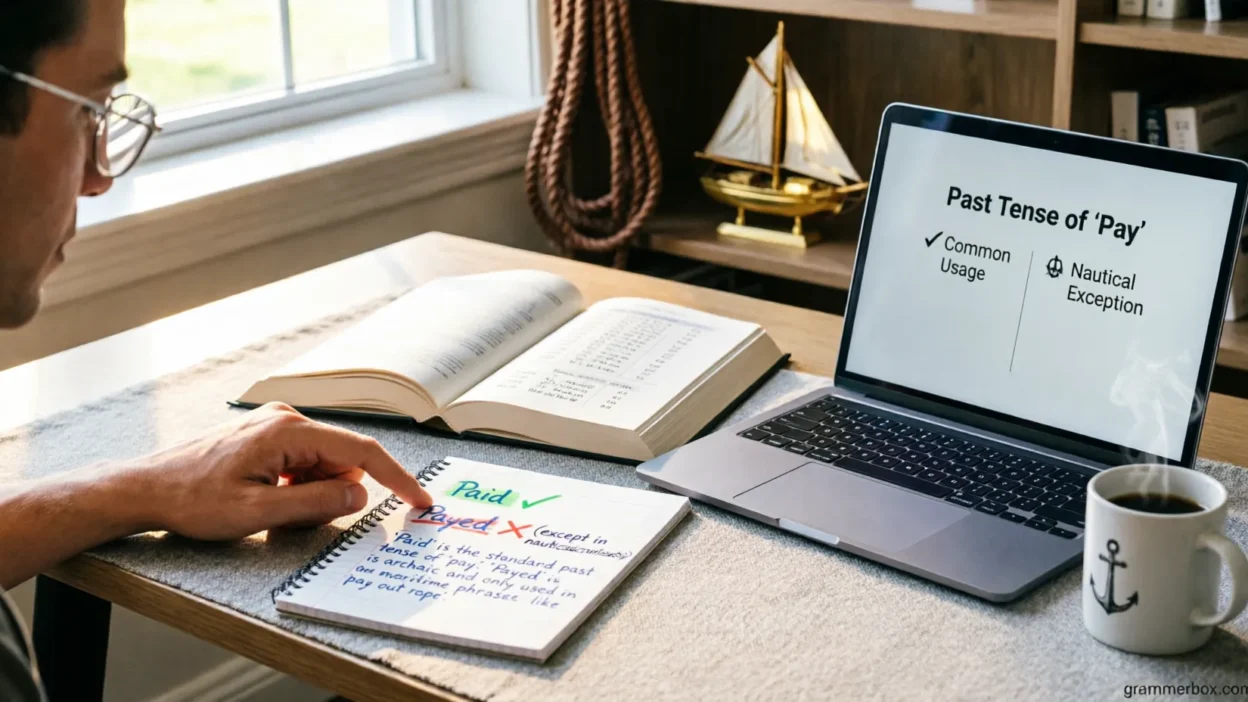
Paid is the correct past tense and past participle of the verb pay when referring to money, salaries, bills, debts, or services. Payed is a rare spelling used only in nautical contexts, such as letting out rope or sealing a ship’s deck. In everyday English, you should almost always use paid.
Why People Confuse It
Many English verbs simply add -ed to form the past tense.
For example:
- Play → Played
- Stay → Stayed
- Clean → Cleaned
Because of this pattern, many people assume pay becomes payed.
However, pay is an irregular verb.
Its correct forms are:
- Base verb: Pay
- Past tense: Paid
- Past participle: Paid
The word payed exists, but it belongs to a specialised nautical vocabulary rather than everyday English.
Paid
Paid is the standard past tense and past participle of pay.
Use paid whenever you’re talking about:
- Money
- Bills
- Salaries
- Taxes
- Loans
- Prices
- Wages
- Respect
- Attention
- Visits
Examples
- I paid the electricity bill yesterday.
- She paid for everyone’s dinner.
- We paid our taxes on time.
- He paid close attention during class.
- They paid a visit to their grandparents.
- The company paid employees early.
- She paid the rent before leaving.
- I paid extra for express shipping.
- We paid the contractor in full.
- He paid his debt last month.
Payed
Payed is a correct word, but only in very specific nautical situations.
It means:
- Letting out a rope or cable gradually.
- Sealing wooden ships with tar to make them waterproof.
Unless you’re writing about sailing, ships, or maritime engineering, you almost never need this word.
Examples
- The sailors payed out the anchor rope.
- The crew payed the deck with hot tar.
- The captain ordered the cable to be payed slowly.
Paid vs Payed Comparison Table
| Feature | Paid | Payed |
|---|---|---|
| Common English | ✅ Yes | ❌ Rare |
| Past tense of “pay” (money) | ✅ Yes | ❌ No |
| Used for bills and salaries | ✅ Yes | ❌ No |
| Used in business writing | ✅ Yes | ❌ No |
| Nautical meaning | ❌ No | ✅ Yes |
| Appears in everyday conversation | ✅ Frequently | ❌ Almost never |
When to Use Each
Use Paid when talking about:
- Paying money
- Bills
- Rent
- Tuition
- Wages
- Shopping
- Taxes
- Loans
- Respect
- Attention
Examples:
- She paid the invoice.
- I paid £50 for the ticket.
- He paid his credit card bill.
- They paid workers fairly.
Use Payed only when referring to:
- Rope being released
- Cable being let out
- Waterproofing a wooden ship
Example:
- The sailors payed out the heavy cable.
Examples (10+)
Paid
- I paid the restaurant bill.
- She paid the rent early.
- They paid all their employees.
- We paid our taxes online.
- He paid attention during the lecture.
- My parents paid for my education.
- The customer paid by card.
- She paid the mechanic yesterday.
- We paid extra for faster delivery.
- He paid off his loan.
- They paid respect to the veterans.
- I paid the membership fee.
Payed
- The crew payed out the rope carefully.
- Sailors payed the anchor cable.
- Workers payed the wooden hull with tar.
Common Mistakes
Many learners make these errors:
- ❌ I payed the bill.
- ✅ I paid the bill.
- ❌ She payed for lunch.
- ✅ She paid for lunch.
- ❌ We payed our taxes.
- ✅ We paid our taxes.
- ❌ He has payed the invoice.
- ✅ He has paid the invoice.
Memory Trick
Think of this simple sentence:
Or remember:
If money is involved, choose PAID.
This quick rule works in nearly every everyday situation.
American vs British English
There is no difference between American and British English for this word.
Both varieties use:
- Paid for money-related meanings.
- Payed only in specialised nautical language.
Whether you’re writing in the UK, the US, Canada, Australia, or New Zealand, the rule stays the same.
Similar Words
Other irregular verbs often confuse learners too:
| Base Verb | Past Tense |
|---|---|
| Pay | Paid |
| Say | Said |
| Lay | Laid |
| Make | Made |
| Sell | Sold |
| Tell | Told |
| Keep | Kept |
| Leave | Left |
Learning these irregular forms improves both writing and speaking accuracy.
Final Verdict
For almost every situation, paid is the correct spelling.
Use paid whenever you’re discussing money, salaries, shopping, debts, bills, or expressions like paid attention and paid respect.
Reserve payed only for maritime writing involving ropes, cables, or waterproofing ships. If you’re not writing about sailing, you almost certainly want paid.
FAQs
Is “payed” ever correct?
Yes. It is correct only in nautical contexts involving ropes, cables, or sealing wooden ships.
Is “paid” the past tense of “pay”?
Yes. Paid is the standard past tense and past participle of pay.
Why does spell check sometimes accept “payed”?
Because payed is a legitimate English word, although it has a specialised maritime meaning.
Can I write “I payed my bills”?
No. The correct sentence is I paid my bills.
Is “paid attention” correct?
Yes. The phrase paid attention is always correct.
Which spelling should students use?
Students should almost always use paid, unless discussing maritime topics.
Is “payed” old-fashioned?
Not exactly. It’s still used in nautical writing but is extremely uncommon in general English.
Conclusion
The difference between paid vs payed is easier than it first appears. Although both words exist, they belong to different contexts. Paid is the standard choice for everyday English and covers nearly every situation involving money, payment, respect, attention, and financial transactions.
Meanwhile, payed survives only in specialised maritime language. By remembering that money is paid and ships are payed, you’ll avoid one of the most common spelling mistakes in English and write with greater confidence.