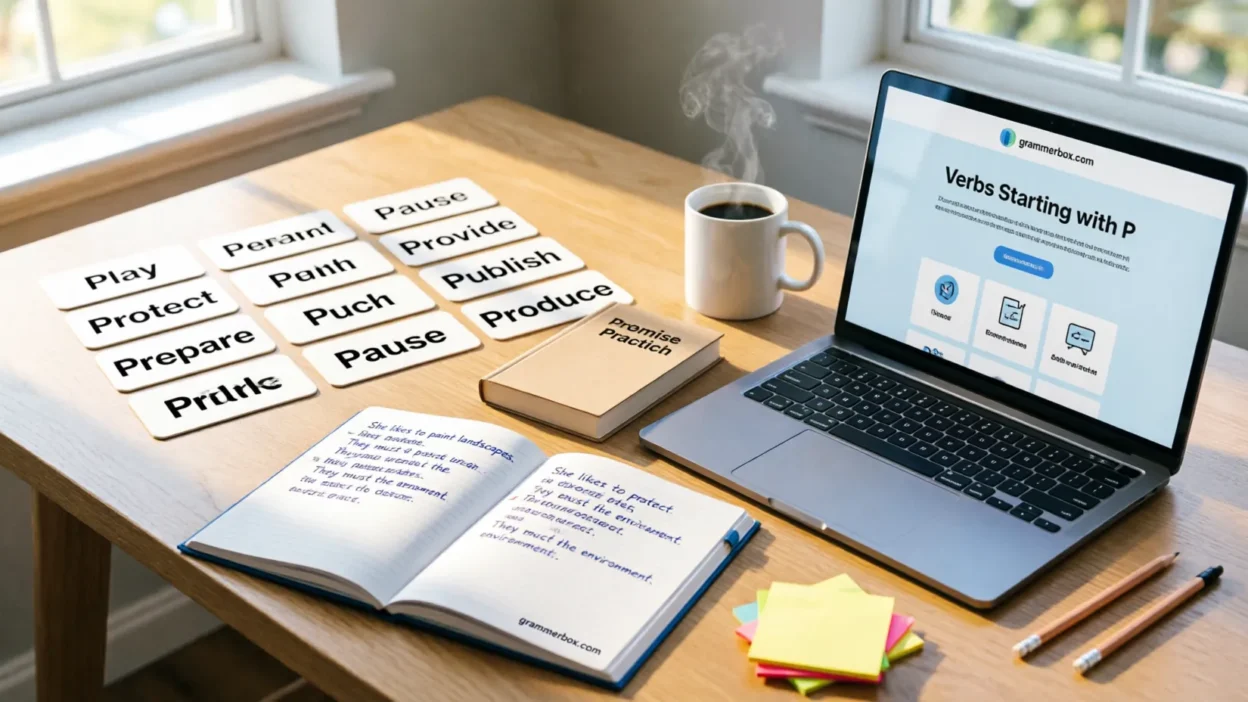
Verbs are action words that help us describe what people, animals, or things do. Learning verbs that start with P is an excellent way to improve your vocabulary, strengthen your writing, and become a more confident English speaker. If you’re a student, writer, ESL learner, or teacher, expanding your knowledge of verbs makes communication more natural and expressive.
From everyday words like play and push to advanced verbs such as perceive, persuade, and proclaim, P-verbs appear in conversations, academic writing, and professional communication. This guide explains their meanings, provides practical examples, and helps you understand when and how to use them correctly.
Quick Answer
Verbs that start with P are action or state-of-being words beginning with the letter P, such as play, paint, protect, prepare, perform, persuade, provide, and participate. These verbs describe actions, processes, emotions, or conditions and are commonly used in everyday English, business communication, storytelling, and academic writing.
Why People Search for Verbs That Start With P
People often look for verbs beginning with P because they want to:
- Improve English vocabulary
- Complete school assignments
- Write stronger essays
- Enhance creative writing
- Find words for games like Scrabble or Wordle
- Expand business and professional vocabulary
- Improve spoken English
First Word: What Are Verbs?
A verb is a word that expresses an action, occurrence, or state.
Examples:
- She plays football.
- They prepare dinner.
- We participated in the competition.
- He perceived the problem quickly.
Without verbs, sentences cannot express complete ideas.
Second Word: What Does “Start With P” Mean?
When we say verbs that start with P, we simply mean verbs whose first letter is P.
Examples include:
- Paint
- Pass
- Pay
- Perform
- Play
- Protect
- Produce
- Push
- Pull
- Prefer
These verbs range from beginner-level vocabulary to advanced English words.
150+ Verbs That Start With P
Common Everyday Verbs
- Pack
- Paddle
- Paint
- Pair
- Park
- Part
- Participate
- Pass
- Paste
- Patrol
- Pause
- Pay
- Peel
- Peek
- Perform
- Permit
- Persuade
- Phone
- Pick
- Pin
- Place
- Plan
- Plant
- Play
- Plead
- Plug
- Point
- Polish
- Pop
- Pour
- Practice
- Pray
- Predict
- Prefer
- Prepare
- Present
- Press
- Pretend
- Prevent
- Process
- Produce
- Program
- Promise
- Pronounce
- Protect
- Prove
- Provide
- Publish
- Pull
- Pump
- Punch
- Punish
- Purchase
- Pursue
- Push
- Put
Advanced Verbs
- Pacify
- Paralyse
- Particularise
- Patronise
- Penetrate
- Perceive
- Perfect
- Perish
- Personalise
- Petition
- Philosophise
- Photograph
- Pioneer
- Pitch
- Placate
- Populate
- Portray
- Possess
- Postpone
- Praise
- Preach
- Precede
- Precipitate
- Preface
- Preserve
- Prescribe
- Presume
- Prioritise
- Proceed
- Proclaim
- Procrastinate
- Profile
- Prohibit
- Project
- Promote
- Propel
- Prosper
- Protest
- Provoke
- Purify
Comparison Table
| Verb | Meaning | Example |
|---|---|---|
| Play | Take part in a game | They play football every weekend. |
| Prepare | Get ready | She prepared for the exam. |
| Protect | Keep safe | Helmets protect your head. |
| Persuade | Convince someone | He persuaded me to join. |
| Provide | Supply something | The hotel provides breakfast. |
| Produce | Create or make | Farmers produce vegetables. |
| Perform | Carry out an action | She performed well. |
| Participate | Take part | Everyone participated in the meeting. |
| Predict | Say what may happen | Scientists predict more rain. |
| Prefer | Like one thing more | I prefer tea to coffee. |
When to Use Each
Choose the right verb depending on your purpose.
Use Play
- Sports
- Games
- Musical instruments
Use Prepare
- Before exams
- Before meetings
- Before travelling
Use Protect
- Safety
- Security
- Health
- Environment
Use Persuade
- Convincing someone
- Sales
- Discussions
- Debates
Use Provide
- Giving services
- Offering help
- Supplying information
Examples (10+)
- We played basketball after school.
- She prepared breakfast early.
- The company provides excellent service.
- They protected the forest.
- He persuaded his friend to apply.
- Scientists predict climate changes.
- She performed beautifully on stage.
- We participated in the charity event.
- Please pass the salt.
- They painted the living room.
- I prefer reading before bedtime.
- The police patrolled the neighbourhood.
Common Mistakes
Many learners make these errors:
- Using perform instead of play for sports.
- Confusing provide with give in formal writing.
- Forgetting the past tense forms.
- Mixing persuade and convince.
- Using practice as a verb in British English instead of practise.
Memory Trick
Remember this simple phrase:
“P Verbs Push People to Perform Perfectly.”
Think of five common P verbs together:
- Play
- Prepare
- Protect
- Provide
- Perform
Repeating this group helps you recall many useful verbs quickly.
American vs British English
Some P-verbs have spelling differences.
| British English | American English |
|---|---|
| Practise (verb) | Practice |
| Prioritise | Prioritize |
| Personalise | Personalize |
| Patronise | Patronize |
| Paralyse | Paralyze |
Both versions are correct depending on the variety of English you use.
Similar Words
These words are closely related to many P-verbs:
- Act
- Build
- Carry
- Complete
- Create
- Deliver
- Develop
- Execute
- Finish
- Give
- Help
- Improve
- Make
- Offer
- Produce
- Support
Final Verdict
Learning verbs that start with P helps you communicate more clearly in everyday conversations, school assignments, business writing, and creative projects. From beginner-friendly verbs like play and pass to advanced words such as proclaim, preserve, and perceive, these verbs cover a wide range of situations.
Instead of memorising long lists, focus on learning a few new verbs each day, using them in sentences, and practising them in real conversations. This approach will improve both your vocabulary and your confidence.
FAQs:
What are verbs that start with P?
They are action or state-of-being words beginning with the letter P, such as play, prepare, protect, and provide.
What is the most common P verb?
Play is one of the most common verbs starting with P.
How can I remember P verbs?
Group similar verbs together and use them in daily conversations and writing exercises.
Are there advanced verbs that start with P?
Yes. Examples include perceive, procrastinate, proclaim, preserve, and prioritise.
Are these verbs useful for IELTS and TOEFL?
Yes. Many P-verbs frequently appear in academic reading, writing, speaking, and listening tests.
What’s the difference between “practice” and “practise”?
In British English, practise is the verb and practice is the noun. In American English, practice is used for both.
Conclusion
Verbs beginning with P are some of the most useful words in English. They help describe actions, decisions, emotions, movement, communication, and achievement. Whether you are writing an essay, speaking in class, or preparing for an English exam, these verbs allow you to express yourself more accurately.
Keep revisiting this list, practise using new verbs in everyday situations, and gradually expand your vocabulary. With consistent use, you’ll find these verbs becoming a natural part of your spoken and written English.