
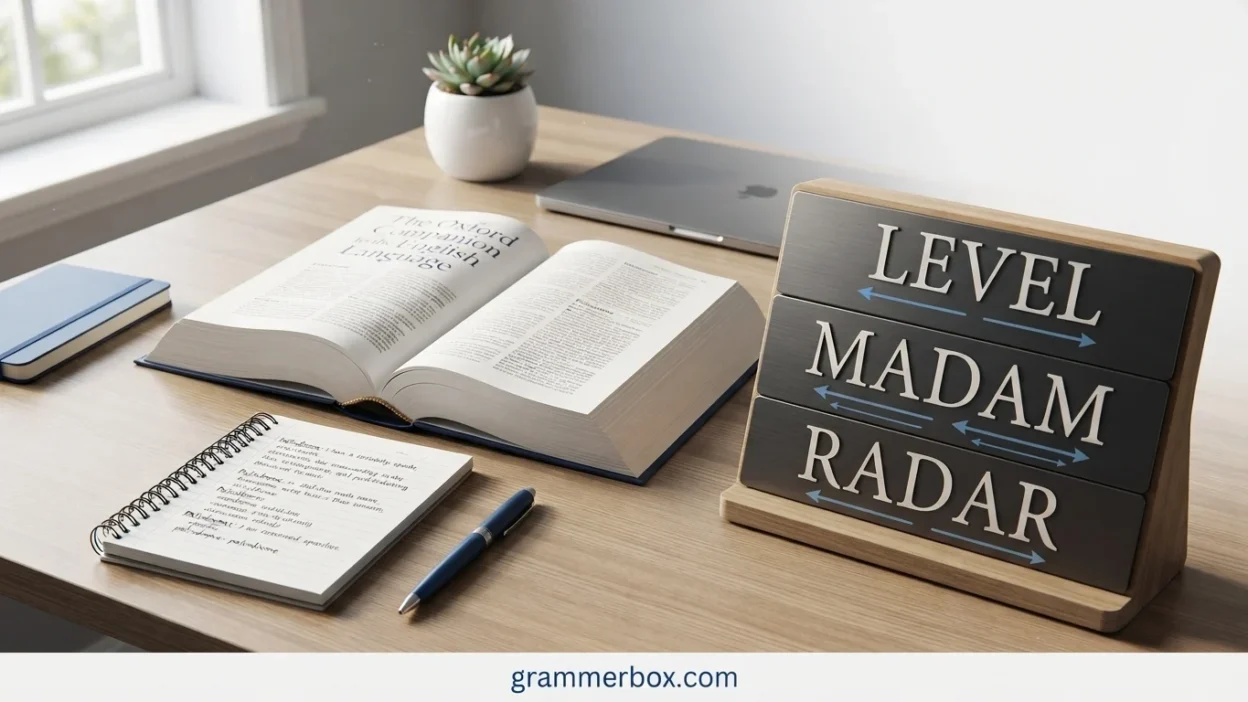
Have you ever noticed a word or number that looks exactly the same when you read it from left to right and from right to left? Words such as “level,” “radar,” and “civic” are examples of this interesting language pattern. They are called palindromes. Understanding the palindrome meaning is useful for students, writers, language learners, and anyone interested in wordplay.
A palindrome can be a single word, a phrase, a sentence, or even a number. In many cases, spaces, punctuation, and capitalization are ignored when checking whether a phrase reads the same backward and forward. For example, “Madam” remains the same when its letters are reversed. Palindromes are not only entertaining; they also demonstrate how letters, sounds, and patterns can create memorable forms of language.
Quick Answer
Palindrome meaning: A palindrome is a word, phrase, number, or sequence that reads the same backward as forward, usually ignoring spaces, punctuation, and capitalization. Examples include level, radar, civic, madam, and 1221.
Why People Confuse It
People sometimes confuse palindrome with other terms related to word patterns, repetition, or reversal. The main reason is that a palindrome has a special structural property: its sequence remains unchanged when reversed.
For example:
- Level → level
- Radar → radar
- Civic → civic
- 1221 → 1221
However, simply reversing a word does not automatically make it a palindrome. The original and reversed forms must match.
First Word: Palindrome
Palindrome is the correct term for something that reads the same forward and backward.
The word can describe:
- A word: racecar
- A phrase: “Never odd or even”
- A sentence: “Madam, I’m Adam.”
- A number: 1331
- A sequence of characters or symbols
Palindrome Examples
| Type | Example | Reversed |
| Word | level | level |
| Word | radar | radar |
| Word | civic | civic |
| Word | racecar | racecar |
| Number | 1221 | 1221 |
| Number | 1331 | 1331 |
| Phrase | Never odd or even | Never odd or even |
Second Word: What a Palindrome Is Not
A word that merely contains repeated letters is not necessarily a palindrome.
For example, “coffee” has repeated letters, but reversing it produces “eeffoc.” Because the two forms do not match, it is not a palindrome.
Likewise, “banana” has a recognizable letter pattern, but it does not read identically backward.
The important rule is simple: the entire sequence must match its reverse.
Comparison Table
| Feature | Palindrome | Ordinary Word |
| Reads the same backward | Yes | Usually no |
| Has a special letter pattern | Yes | Not necessarily |
| Can be a word | Yes | Yes |
| Can be a phrase | Yes | No, as a single word |
| Can be a number | Yes | No |
| Example | radar | garden |
When to Use Palindrome
Use palindrome when you are talking about a word, phrase, number, or sequence that remains the same when reversed.
Common situations include:
- English lessons: “Racecar is a palindrome.”
- Word games: “Can you find another palindrome?”
- Mathematics: “121 is a palindromic number.”
- Linguistics: “The phrase has a palindromic structure.”
- Puzzles: “The answer is a five-letter palindrome.”
The adjective palindromic can also be used when describing something related to a palindrome.
Example:
“1221 is a palindromic number.”
Palindrome Examples
Here are more than 10 easy examples to help you understand the palindrome definition:
- Level – reads level backward.
- Radar – remains radar in reverse.
- Civic – remains civic.
- Madam – remains madam.
- Racecar – remains racecar.
- Refer – reads the same backward.
- Rotator – remains rotator.
- Kayak – remains kayak.
- Deified – reads the same in reverse.
- 1221 – a palindromic number.
- 1331 – another palindromic number.
- 2002 – reads identically backward.
- “Never odd or even” – a well-known palindromic phrase.
- “Was it a rat I saw?” – a classic palindrome sentence.
When phrases are considered palindromes, spaces and punctuation are commonly ignored.
Common Mistakes
1. Thinking every repeated word is a palindrome
Repetition alone does not create a palindrome.
Correct: level
Not a palindrome: hello
2. Forgetting that the complete sequence matters
A word may begin and end with the same letter but still fail to be a palindrome.
For example, “apple” begins with “a” and ends with “e,” so it clearly does not qualify.
3. Confusing palindrome with an anagram
An anagram rearranges letters to create another word or phrase. A palindrome must preserve the same sequence when read backward.
4. Checking a phrase without ignoring spaces
In a phrase palindrome, spaces and punctuation are generally disregarded.
For example:
“Never odd or even”
becomes:
neveroddoreven
This sequence reads the same backward.
Memory Trick
Think of a palindrome as a linguistic mirror.
Imagine placing a mirror in the middle of a word. If the letters on one side match the letters on the other side in reverse order, you have a palindrome.
PALINDROME = SAME FORWARD + SAME BACKWARD
A quick example:
R A C E C A R
Read it from either direction, and you get RACECAR.
American vs British English
There is no major difference in the meaning or standard usage of “palindrome” between American and British English.
Both varieties use palindrome to describe a word, phrase, number, or sequence that reads the same backward and forward.
For example:
- American English: “Radar is a palindrome.”
- British English: “Radar is a palindrome.”
The pronunciation and spelling are also essentially the same in standard usage.
Similar Words
Several words are related to palindrome, but they do not mean exactly the same thing.
Palindromic
Palindromic is an adjective meaning related to or having the characteristics of a palindrome.
Example:
“1221 is a palindromic number.”
Anagram
An anagram is formed by rearranging the letters of a word or phrase to create another word or phrase.
Example:
“listen” → “silent”
An anagram does not have to read the same backward.
Reversal
A reversal simply means changing something to its opposite order or direction. A reversed word is not necessarily a palindrome.
Symmetry
Symmetry refers broadly to balance or correspondence between parts. Palindromes can have a form of linguistic symmetry, but the two terms are not interchangeable.
FAQs:
What is the simple meaning of palindrome?
A palindrome is a word, phrase, number, or sequence that reads the same backward and forward.
What is an example of a palindrome?
Level, radar, civic, kayak, and racecar are common examples of palindromes.
Is “madam” a palindrome?
Yes. Madam is a palindrome because its letters remain in the same order when read backward.
Is a number able to be a palindrome?
Yes. Numbers such as 121, 1221, 1331, and 2002 are palindromic numbers.
Is “hello” a palindrome?
No. When reversed, hello becomes olleh, so it does not read the same backward.
What is a palindromic number?
A palindromic number is a number that remains unchanged when its digits are reversed, such as 121 or 1331.
What is the adjective form of palindrome?
The adjective is palindromic. For example, “121 is a palindromic number.”
Remember This
Palindrome = same forward and backward.
Examples to remember: level, radar, civic, madam, kayak, racecar, and 1221.
Conclusion
Understanding the meaning of palindrome becomes easy once you remember its defining feature: the sequence stays the same when reversed. If you encounter a simple word such as level, a number such as 1221, or a longer phrase, the same basic rule applies.
Palindromes are a fun part of English vocabulary and wordplay, while also appearing in mathematics and language studies. When checking one, simply remove irrelevant spaces and punctuation when appropriate, reverse the remaining sequence, and see whether it matches the original.