
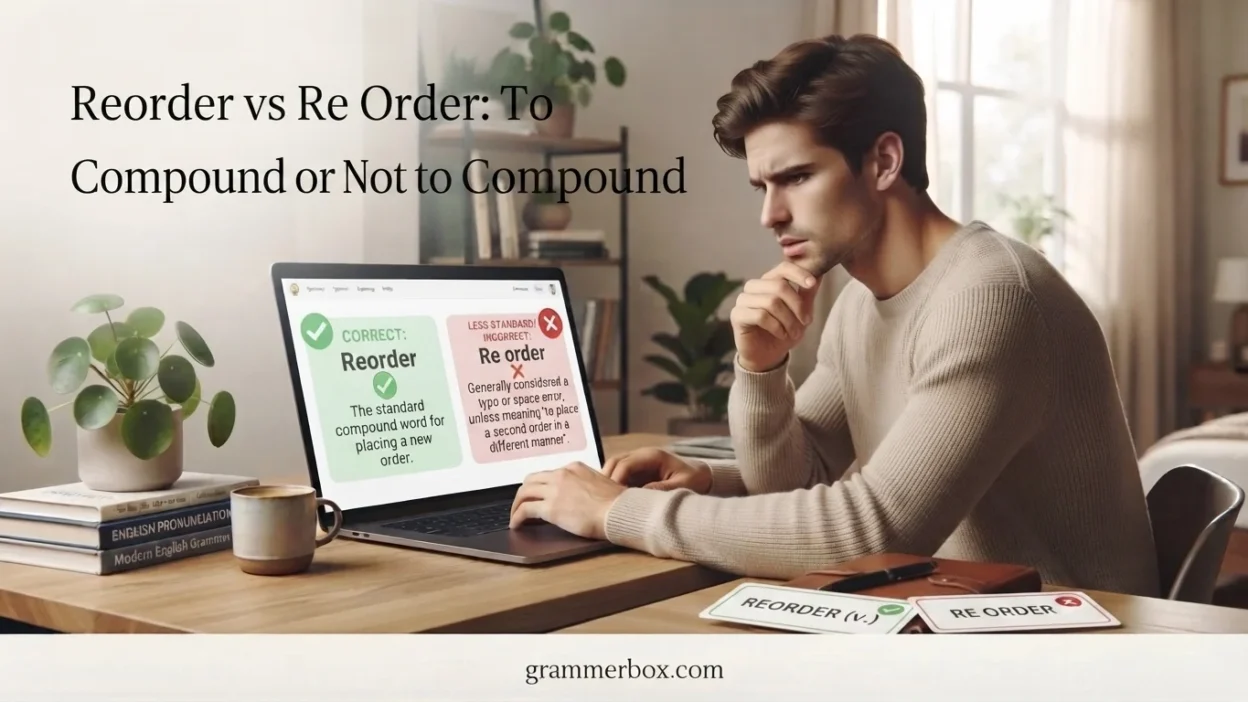
When you want to say that something should be arranged again or purchased again, you may wonder whether reorder or re order is the correct spelling. The confusion comes from the prefix re-, which can sometimes be attached directly to a word and sometimes appear separately in specific contexts. In modern English, however, reorder is by far the standard form when you mean “to order again” or “to arrange again.”
Understanding the difference is useful for students, writers, business professionals, and anyone who wants to write clear, natural English. In this guide, we’ll explain the meaning of reorder, why re order can appear, when each form is appropriate, and how to avoid common spelling mistakes. You’ll also find practical examples, a comparison table, usage tips, and answers to frequently asked questions.
Quick Answer
Reorder is normally the correct spelling when you mean “order again” or “arrange again.” Re order is rarely used as two words and is generally not standard in ordinary writing. Use reorder as a verb, noun, or adjective when appropriate.
Why People Confuse It
The confusion mainly comes from the prefix re-, which means “again” or “back.”
English contains many words beginning with re-, such as:
- rewrite
- reread
- rebuild
- reorganize
- reorder
- reconsider
Because re- can function as a prefix, it is usually attached directly to the word that follows it.
People may write re order because they interpret “re” as a separate word meaning “again.” However, in standard modern English, reorder is normally written as one word.
There is also a second issue: reorder can have more than one meaning. It can mean ordering something again, or arranging things differently. Context determines the intended meaning.
Reorder: Meaning and Usage
Reorder is the standard spelling in most situations.
As a verb, reorder can mean:
- To order something again.
- To arrange something in a different sequence.
Examples
- I need to reorder the books on the shelf.
- We should reorder the supplies before they run out.
- She decided to reorder the list alphabetically.
- Customers can reorder their favorite products online.
- Please reorder these paragraphs for better clarity.
The word can also be used in business and e-commerce contexts:
The store automatically reorders products when inventory becomes low.
Here, reorder clearly means “order again.”
Reorder as a noun
Reorder can also function as a noun, especially in business or retail contexts.
- The customer placed a reorder.
- The system generated a reorder for the missing products.
- We received a large reorder from the retailer.
Reorder as an adjective
In some contexts, reorder is used attributively:
- reorder point
- reorder level
- reorder quantity
For example:
The warehouse uses a minimum reorder point for essential products.
Re Order: Meaning and Usage
Re order written as two separate words is generally not the standard spelling when you mean “order again.”
For example:
- ❌ I need to re order some supplies.
- ✅ I need to reorder some supplies.
- ❌ Please re order the products.
- ✅ Please reorder the products.
In ordinary English, there is usually no reason to separate re- from order.
However, you may occasionally see unusual spacing in informal writing, editing, technical instructions, or situations where a writer deliberately emphasizes the prefix. Such spacing does not make re order the preferred standard form.
Reorder vs Re Order: Comparison Table
| Feature | Reorder | Re order |
|---|---|---|
| Standard spelling | Yes | Generally no |
| Common usage | Very common | Rare |
| Meaning “order again” | Yes | Not normally |
| Meaning “arrange again” | Yes | Not normally |
| Used in business English | Yes | No |
| Used in e-commerce | Yes | No |
| Preferred in formal writing | Yes | No |
| Example | Please reorder the items. | Please re order the items. |
When to Use Each
Use “reorder” when you mean “order again”
This is especially common when talking about products, supplies, food, or services.
We need to reorder printer paper.
Use “reorder” when you mean “arrange again”
You can also use it when changing the sequence or organization of something.
The editor decided to reorder the chapters.
Avoid “re order” in normal writing
If re- means “again,” attach it to order.
Correct: reorder
Incorrect in standard usage: re order
This simple rule will work in the vast majority of situations.
Reorder vs Re Order: 12 Examples
- Please reorder the books by publication date.
- I need to reorder my usual coffee beans.
- The restaurant had to reorder its supplies.
- Customers can reorder items directly from their account.
- We should reorder the paragraphs to improve the article.
- The company will reorder stock next week.
- She decided to reorder the photographs chronologically.
- The website lets customers quickly reorder previous purchases.
- The teacher asked students to reorder the sentences.
- Our inventory system automatically triggers a reorder.
- Please reorder these steps so they make logical sense.
- The customer placed a reorder after receiving the first shipment.
Incorrect vs Correct
- ❌ We need to re order more supplies.
- ✅ We need to reorder more supplies.
- ❌ Can I re order the same product?
- ✅ Can I reorder the same product?
- ❌ Please re order the sentences.
- ✅ Please reorder the sentences.
Common Mistakes
1. Writing “re order” as two words
The most common mistake is separating the prefix from the base word.
Incorrect: I want to re order the items.
Correct: I want to reorder the items.
2. Confusing “reorder” with “rearrange”
These words can overlap, but they are not always interchangeable.
- Reorder = change the order or sequence.
- Rearrange = organize or position something differently.
Please reorder the steps.
Please rearrange the furniture.
3. Assuming every “re-” word follows the same pattern
English spelling can be inconsistent. Some expressions involving re- may be written differently depending on meaning, pronunciation, or established usage.
For reorder, however, the standard spelling is straightforward: one word.
4. Using a hyphen unnecessarily
Re-order may occasionally appear in older or specialized writing, but reorder is the normal modern spelling.
Memory Trick
Think:
Re + order = reorder
The prefix re- means again.
So:
reorder = order again
If you want to arrange something differently:
reorder = order differently
Remember that re- is attached directly to order.
One word, one clear idea: reorder.
American vs British English
There is no major American-versus-British spelling difference for reorder.
Both American English and British English generally use:
reorder
For example:
- American English: I need to reorder the supplies.
- British English: I need to reorder the supplies.
The spelling remains the same across the two major varieties of English.
Differences between American and British English are more noticeable in words such as color/colour, organize/organise, and center/centre. Reorder does not normally create this kind of regional spelling difference.
Similar Words
Several words are related to reorder and may be useful depending on the context.
Rearrange
Means to organize something differently.
She rearranged the furniture.
Reorganize
Means to change the structure or organization of something.
The company reorganized its departments.
Reshuffle
Means to change the order, positions, or arrangement of people or things.
The coach reshuffled the team lineup.
Repurchase
Means to buy something again.
I plan to repurchase the same model.
Replenish
Means to fill something again or restore a supply.
The store needs to replenish its inventory.
Renew
Means to continue or restore something, especially a service, contract, or subscription.
She renewed her membership.
Choosing the right word depends on what you actually mean.
Frequently Asked Questions
Is “reorder” one word or two?
Reorder is normally one word. It is the standard spelling when you mean to order something again or arrange something differently.
Is “re order” grammatically correct?
Re order is generally not the standard form when re- means “again.” In ordinary writing, use reorder instead.
Is “re-order” correct?
Re-order can occasionally be found in older or specialized writing, but reorder is the preferred modern spelling in most contexts.
What does reorder mean?
Reorder means to order something again or to change the existing order or sequence of something.
Is reorder a verb?
Yes. Reorder is commonly used as a verb.
Please reorder the documents.
It can also be used as a noun in business contexts, such as a reorder.
What is the opposite of reorder?
The opposite depends on the context. Possible alternatives include keep in order, leave unchanged, or cancel an order if you are talking about purchasing.
Should I write “reorder” in formal English?
Yes. Reorder is standard and appropriate in formal, academic, professional, and everyday English when used correctly.
Final Verdict
When choosing between reorder and re order, the correct choice in standard English is almost always reorder. It is the established one-word form used when something is ordered again or when the sequence of something is changed.
Re order is not normally used as a separate two-word expression. If you are writing an email, article, report, product description, or academic assignment, choose reorder.
Remember This
Reorder is the standard one-word spelling.
- Reorder = order again
- Reorder = arrange again or differently
- Re order = generally avoid in standard English
- Re-order = uncommon; usually unnecessary
The easy rule: If “re-” means “again,” write “reorder” as one word.
Conclusion
The difference between reorder and re order is simple once you understand how the prefix re- works. In standard modern English, reorder is the correct and natural spelling for both ordering something again and changing its sequence. It is widely used in everyday conversation, professional communication, retail, e-commerce, and academic writing.
When in doubt, remember that reorder is the form you should normally choose. Whether you are asking a customer to reorder a product or asking an editor to reorder paragraphs, keeping the word together makes your writing clear, conventional, and grammatically polished.