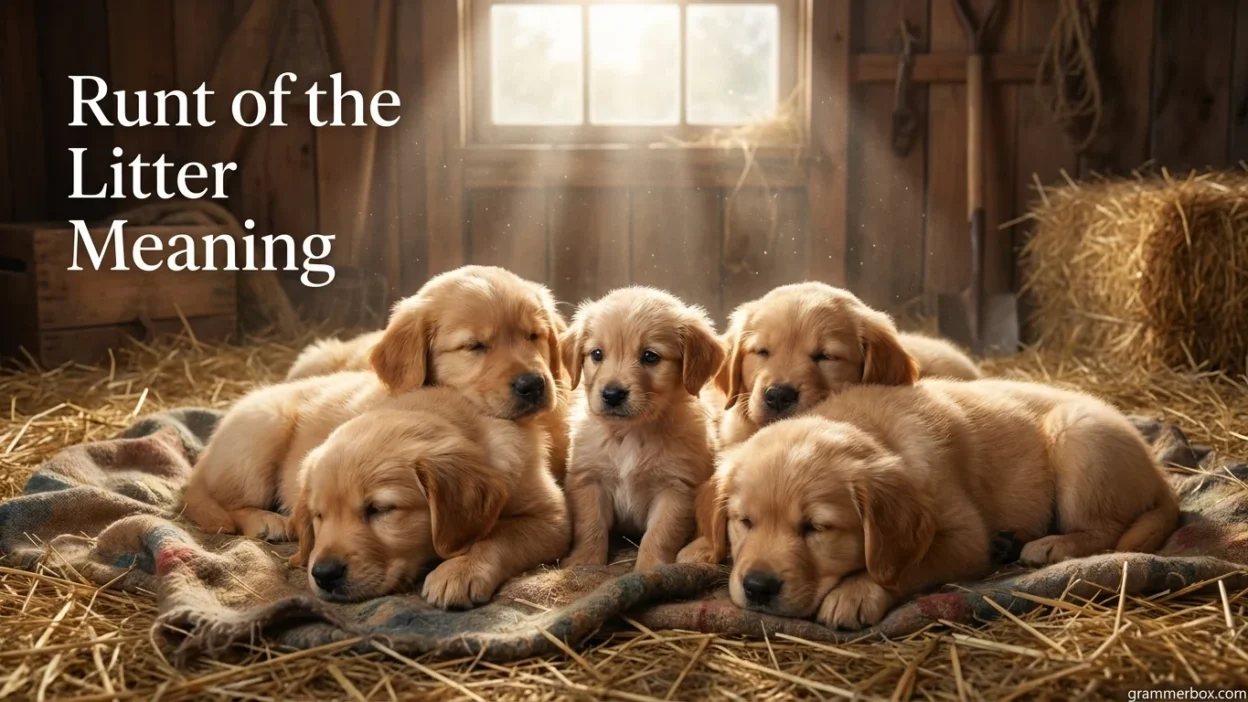
When people hear the phrase “runt of the litter,” they usually picture the smallest puppy, kitten, or other young animal among its brothers and sisters. The expression describes an animal that is noticeably smaller or weaker than the other offspring in the same litter. Although it can sound negative, the phrase is often used affectionately, especially when talking about a small pet that grows into a healthy and energetic animal.
The phrase can also be used figuratively to describe a person, team, company, or organization that is smaller or less powerful than others in the same group. Understanding the runt of the litter meaning helps you recognize both its literal and metaphorical uses. In this guide, we’ll explain where the expression comes from, how to use it naturally, common mistakes to avoid, and several real-world examples.
Quick Answer
“Runt of the litter” means the smallest or weakest animal among the offspring born in the same litter. It can also describe a smaller or less powerful member of a group. The phrase is often affectionate rather than insulting.
Why People Confuse It
People sometimes assume that “runt of the litter” simply means the youngest animal in a group. That is not necessarily true.
A runt is specifically associated with unusually small size or weaker physical development compared with its siblings. An animal can be born last and still not be the runt.
The confusion often comes from these related ideas:
- Last-born: The animal born last.
- Smallest: The animal with the least body size.
- Weakest: The animal that appears less physically developed.
- Runt: The unusually small or weak member of a litter.
So, being the youngest does not automatically make an animal the runt.
First Word: “Runt”
The word runt is a noun. It traditionally refers to an animal that is unusually small or poorly developed compared with others of the same kind.
For example:
- “The runt struggled to compete for food.”
- “The runt of the litter was much smaller than her siblings.”
- “We decided to adopt the little runt.”
The word can also be used informally for a person who is smaller than others. When referring to people, however, runt can sound insulting depending on the context.
What Does “Runt” Mean?
A runt is generally:
- The smallest member of a group of offspring
- An unusually small or weak animal
- A less-developed member of a litter
The word does not necessarily mean that the animal will remain small or unhealthy. Some animals described as runts grow normally and live perfectly healthy lives.
Second Word: “Litter”
A litter is a group of young animals born to the same mother at approximately the same time.
The word is commonly used for mammals such as:
- Puppies
- Kittens
- Piglets
- Rabbits
- Puppies and other young mammals
For example:
“The dog gave birth to a litter of six puppies.”
Therefore, “runt of the litter” means the unusually small or weak member of that group of offspring.
Comparison Table
| Term | Meaning | Example |
|---|---|---|
| Runt | An unusually small or weak animal | The runt needed extra care. |
| Runt of the litter | The smallest or weakest animal among siblings | Max was the runt of the litter. |
| Last-born | The animal born most recently | The last-born puppy was very playful. |
| Smallest | Having the least physical size | She was the smallest puppy. |
| Weakest | Having the least physical strength | He appeared to be the weakest puppy. |
| Litter | A group of offspring born together | The litter had seven puppies. |
When to Use Each
Use “runt of the litter” for animals
This is the most traditional use.
- “Bella was the runt of the litter.”
- “We chose the runt of the litter because she was so sweet.”
Use “runt” by itself
You can use runt when the context is already clear.
- “The runt was surprisingly energetic.”
- “Everyone worried about the runt at first.”
Use “smallest” when you want to be neutral
If you simply want to describe size without suggesting weakness, smallest is better.
- “He was the smallest puppy in the litter.”
Use “last-born” when birth order matters
If you are talking about birth order rather than physical size, say last-born.
- “She was the last-born puppy in the litter.”
Examples of “Runt of the Litter”
Here are natural examples showing how the expression works:
- The runt of the litter was smaller than all the other puppies.
- We adopted the runt of the litter and named him Charlie.
- Although she was the runt of the litter, she quickly became the most energetic puppy.
- The breeder gave extra attention to the runt of the litter.
- Everyone expected the runt of the litter to remain tiny, but she grew quickly.
- The runt of the litter was the first kitten to explore the room.
- He may have been the runt of the litter, but he had plenty of personality.
- The family fell in love with the runt of the litter immediately.
- The veterinarian checked the runt of the litter to make sure it was developing normally.
- Being the runt of the litter did not stop the puppy from becoming strong and playful.
- The smallest puppy was often called the runt of the litter.
- She started life as the runt of the litter but eventually caught up with her siblings.
Common Mistakes
Mistake 1: Assuming the runt is always the youngest
This is incorrect.
Incorrect assumption:
“The youngest puppy is automatically the runt.”
Better:
“The runt is the unusually small or weak puppy, regardless of birth order.”
Mistake 2: Thinking “runt” always means unhealthy
Not necessarily. A runt may be smaller at birth but can later develop normally.
Mistake 3: Using “litter” for humans
In standard English, litter is normally used for animals when discussing a group of offspring born together.
Mistake 4: Assuming “runt” is always affectionate
When used for pets, runt can sound cute or affectionate. When applied to a person, it can be derogatory.
Mistake 5: Confusing “runt” with “last-born”
These words describe different things. Runt focuses on size or development, while last-born focuses on birth order.
Memory Trick
A simple way to remember “runt of the litter” is:
Runt = smaller sibling
Litter = animal siblings born together
Put them together:
Runt of the litter = the unusually small member of an animal family.
Think of a group of six puppies. Five are similar in size, while one is noticeably smaller. That smaller puppy is the runt of the litter.
American vs. British English
The phrase “runt of the litter” is understood in both American and British English.
There is no major difference in its basic meaning.
In both varieties, runt can refer to an unusually small animal among its siblings. The expression is particularly common when discussing puppies, kittens, livestock, and other young animals.
The figurative meaning is also possible in both forms of English. For example:
“The small company was considered the runt of the industry.”
However, the tone depends heavily on context. Calling an animal a runt can be affectionate, while describing a person or business as a runt may sound dismissive.
Similar Words and Expressions
Several expressions are related to runt of the litter, but they are not exact synonyms.
Smallest of the group
A neutral way to describe something with the least physical size.
Weakest of the group
Focuses on strength rather than size.
Last-born
Refers specifically to birth order.
Underdog
Describes a person or group expected to have less chance of succeeding.
Little one
An affectionate expression for a small animal or child.
Smaller sibling
A straightforward description without the potentially negative meaning of runt.
Undersized
Means smaller than the normal or expected size.
Bottom of the pack
A broader expression that can refer to the lowest-ranked member of a group.
Final Verdict
“Runt of the litter” traditionally means the smallest or weakest animal among siblings born in the same litter. It is most commonly used for puppies, kittens, and other young animals.
The key point is that runt does not simply mean youngest. It describes relative size or physical development. The expression can be affectionate when talking about pets, but runt may sound insulting when applied to people.
If you want to describe only size, use smallest. If you mean birth order, use last-born. If you mean the unusually small member of an animal family, runt of the litter is the natural expression.
FAQs:
1. What does “runt of the litter” mean?
It means the smallest or weakest animal among a group of siblings born to the same mother at about the same time.
2. Is the runt of the litter always the youngest?
No. The runt is identified by its unusually small size or weaker development, not necessarily by birth order.
3. Is “runt of the litter” an insult?
It depends on context. For pets, it can be affectionate or neutral. When used to describe a person, runt can be insulting or derogatory.
4. Can the runt of the litter grow normally?
Yes. Being the runt does not automatically mean an animal will remain small or unhealthy. Some runts eventually catch up with their siblings.
5. Can “runt of the litter” be used figuratively?
Yes. It can describe the smallest, weakest, or least powerful member of a larger group, such as a company or sports team.
6. What is the opposite of “runt of the litter”?
There is no single exact opposite, but you could describe the largest animal as the biggest of the litter or the largest of the litter.
7. What is another word for “runt”?
Depending on context, alternatives include smallest, undersized animal, little one, or smallest member of the group. None has exactly the same meaning in every situation.
Conclusion
The expression “runt of the litter” is a familiar English phrase used mainly for animals. It describes the unusually small or weak member of a group of offspring, rather than simply the youngest animal. Although the word runt can sometimes carry a negative tone, it is frequently used affectionately when talking about small pets.
Remember that context matters. If you are discussing size, smallest may be more neutral; if you are discussing birth order, last-born is more precise. But when you want to identify the unusually small member of an animal family, runt of the litter is the standard expression.
Remember This
Runt of the litter = the unusually small or weak animal among its siblings.
It does not automatically mean the youngest. The phrase can be literal when discussing animals and figurative when describing the smallest or least powerful member of a group.