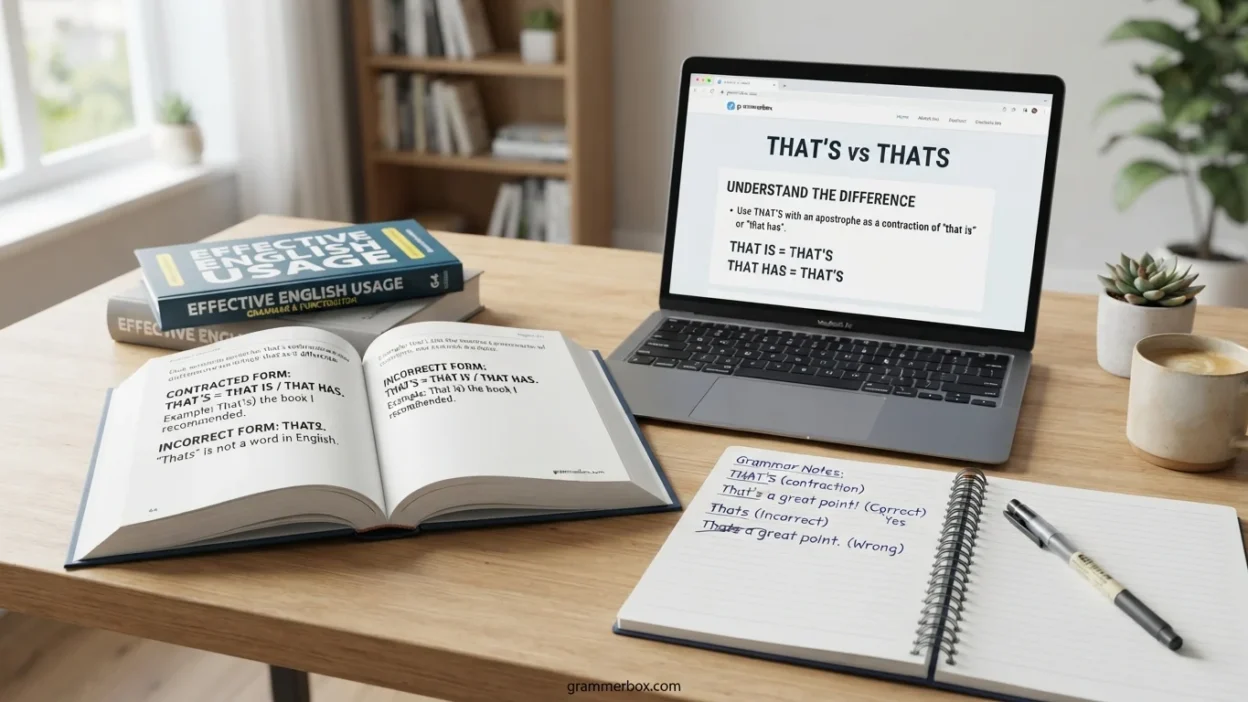
If you have ever wondered whether “that’s” or “thats” is the correct spelling, you are not alone. The two forms look almost identical, but only one is standard English in ordinary writing. The apostrophe in “that’s” is important because it shows that the word is a contraction. Depending on the sentence, “that’s” can mean “that is” or “that has.”
The form “thats” without an apostrophe is generally considered incorrect in standard English when you mean “that is” or “that has.” This small punctuation difference can change whether your sentence looks polished and grammatically correct. In this guide, you’ll learn the difference between that’s vs thats, when to use each form, common mistakes, and simple examples that make the rule easy to remember.
Quick Answer
“That’s” is the correct standard form when you mean “that is” or “that has.” “Thats” without an apostrophe is not standard English in this use. The apostrophe signals missing letters in the contraction, making “that’s” grammatically correct.
Why People Confuse It
People often confuse that’s vs thats because the apostrophe is easy to overlook when typing quickly. Since the pronunciation is usually the same, it can be difficult to notice the difference when speaking.
Another reason is that English has many contractions, such as:
- it’s = it is / it has
- what’s = what is / what has
- who’s = who is / who has
- that’s = that is / that has
The apostrophe tells readers that letters have been omitted. Without it, “thats” does not function as the standard contraction.
First Word: That’s
That’s is the standard and correct form when it means “that is” or “that has.”
That’s = That Is
Use that’s when you can replace it with “that is.”
- That’s a great idea. → That is a great idea.
- That’s my favorite book. → That is my favorite book.
- That’s exactly what I meant. → That is exactly what I meant.
That’s = That Has
“That’s” can also be a contraction of “that has.”
- That’s been a difficult experience. → That has been a difficult experience.
- That’s changed everything. → That has changed everything.
- That’s happened before. → That has happened before.
The apostrophe is essential in both uses.
Second Word: Thats
“Thats” without an apostrophe is generally incorrect in standard modern English when you are trying to write the contraction “that’s.”
For example:
- ❌ Thats a beautiful house.
- ✅ That’s a beautiful house.
- ❌ I think thats correct.
- ✅ I think that’s correct.
- ❌ Thats what I wanted.
- ✅ That’s what I wanted.
In informal digital communication, people sometimes omit apostrophes because of fast typing or casual texting. However, this does not make “thats” the standard spelling.
Comparison Table
| Form | Correct? | Meaning | Example |
|---|---|---|---|
| That’s | Yes | That is / That has | That’s a good question. |
| Thats | No, in standard usage | Usually intended as “that’s” | Thats a good question. |
| That is | Yes | Full form | That is a good question. |
| That has | Yes | Full form | That has changed recently. |
When to Use Each
Use “That’s” When You Mean “That Is”
This is the most common use.
Example:
That’s the restaurant I told you about.
You can expand the sentence:
That is the restaurant I told you about.
If the expanded version works, “that’s” is appropriate.
Use “That’s” When You Mean “That Has”
“That’s” can also represent “that has.”
Example:
That’s been a problem for years.
Expanded:
That has been a problem for years.
Again, the apostrophe is required.
Avoid “Thats” in Standard Writing
Do not remove the apostrophe simply because the sentence is informal.
Use “that’s” in:
- Essays
- Emails
- Blog posts
- Business writing
- School assignments
- Professional communication
- Formal documents
- General online writing
Examples of That’s in Sentences
Here are more examples showing how “that’s” works naturally in everyday English:
- That’s a beautiful painting.
- I think that’s the right answer.
- That’s exactly what I needed.
- That’s my brother standing by the door.
- That’s not what I expected.
- That’s a very interesting idea.
- She said that’s where we should meet.
- That’s been happening more often lately.
- That’s changed since last year.
- I know that’s difficult to understand.
- That’s the reason I called you.
- That’s what makes this story interesting.
Examples With “That Is”
- That’s a difficult decision.
- That’s the best option.
- That’s not my problem.
- That’s exactly right.
- That’s why I left early.
Examples With “That Has”
- That’s been a long day.
- That’s happened to me before.
- That’s changed my opinion.
- That’s never happened before.
- That’s become a common problem.
Common Mistakes
1. Leaving Out the Apostrophe
Incorrect:
Thats my car.
Correct:
That’s my car.
The apostrophe indicates the missing letters from “that is.”
2. Assuming Apostrophes Are Optional
In standard writing, apostrophes are not decorative. They can indicate contractions or possession.
For example:
- that’s = that is / that has
- its = possessive form
- it’s = it is / it has
3. Confusing “That’s” With “Its”
A similar mistake happens with its and it’s.
- That’s = that is / that has
- Its = belonging to it
- It’s = it is / it has
Example:
That’s the dog with its owner.
4. Treating “Thats” as a Standard Contraction
Although you may see “thats” in casual messages, social media posts, or unedited writing, it is not the standard spelling of the contraction.
Memory Trick
Here is an easy way to remember the difference:
If “that is” or “that has” fits, use “that’s.”
Try this:
That’s amazing.
Replace it:
That is amazing.
It works, so that’s is correct.
Another quick trick is to remember:
Apostrophe = missing letters.
“That’s” combines that + is or that + has, so the apostrophe marks the contraction.
American vs British English
There is no major difference between American and British English when it comes to the standard spelling “that’s.”
Both varieties use:
- That’s = that is
- That’s = that has
For example:
That’s a good idea.
This sentence is standard in both American and British English.
Likewise, “thats” without the apostrophe is generally not the standard contraction in either variety. You may encounter it in informal digital writing, but formal and edited English uses “that’s.”
Similar Words
Understanding related contractions can make the rule easier.
| Contraction | Full Form |
|---|---|
| That’s | That is / That has |
| It’s | It is / It has |
| What’s | What is / What has |
| Who’s | Who is / Who has |
| There’s | There is / There has |
| He’s | He is / He has |
| She’s | She is / She has |
Notice the pattern: the apostrophe marks letters that have been removed.
FAQs:
Is “thats” a correct word?
Not when you intend the standard contraction “that’s.” In standard English, use the apostrophe in “that’s.”
Is “that’s” short for “that is”?
Yes. “That’s” is commonly a contraction of “that is.”
Example:
That’s wonderful.
means:
That is wonderful.
Can “that’s” mean “that has”?
Yes. “That’s” can also be a contraction of “that has.”
Example:
That’s been difficult.
means:
That has been difficult.
Why does “that’s” need an apostrophe?
The apostrophe shows that letters have been omitted when two words are contracted. “That’s” combines “that” with “is” or “has.”
Is “thats” acceptable in texting?
You may see “thats” in informal texts or online posts where people omit punctuation, but “that’s” is the standard form and is preferable for correct writing.
Which is correct: “That’s good” or “Thats good”?
“That’s good” is correct. The sentence means “That is good.”
Is “that’s” formal or informal?
“That’s” is a normal English contraction and can be used in both everyday and many professional contexts. In especially formal writing, you may choose the full form “that is” or “that has.”
Final Verdict
When choosing between that’s vs thats, the correct standard form is almost always “that’s” when you mean “that is” or “that has.”
The apostrophe is not optional punctuation in this situation. It identifies the contraction and makes the sentence grammatically standard.
Thats may appear in casual typing, but it should generally be avoided in edited or formal English. If you are unsure, expand the word:
If the expanded version makes sense, “that’s” is the right choice.
Remember This
That’s = that is / that has.
Thats = not the standard spelling of this contraction.
Whenever you mean “that is” or “that has,” keep the apostrophe:
Conclusion
The difference between “that’s” and “thats” is simple once you understand what the apostrophe represents. “That’s” is the standard contraction of “that is” or “that has,” while “thats” without an apostrophe is generally incorrect in standard English. This small punctuation mark helps readers understand the structure of the sentence.
If you are writing an essay, email, article, social media post, or professional message, choose “that’s” whenever you mean “that is” or “that has.” A useful habit is to expand the contraction whenever you are uncertain. If “that is” or “that has” fits naturally, you can confidently use “that’s.”