When you need to describe the act of assessing something again, you may hesitate between reevaluation and re evaluation. The confusion is understandable because English often uses prefixes such as re- to create words with the meaning “again.” However, not every word formed with a prefix should be written as two separate words. In this case, spelling and style conventions matter.
The good news is that the standard spelling is straightforward. Reevaluation is the preferred one-word form in modern English, while re evaluation is generally considered incorrect when used as a single noun. You may also encounter re-evaluation, especially in some dictionaries, style guides, or contexts where the writer wants to make the word easier to read. Understanding the difference will help you write more accurately in academic, professional, and everyday English.
Quick Answer
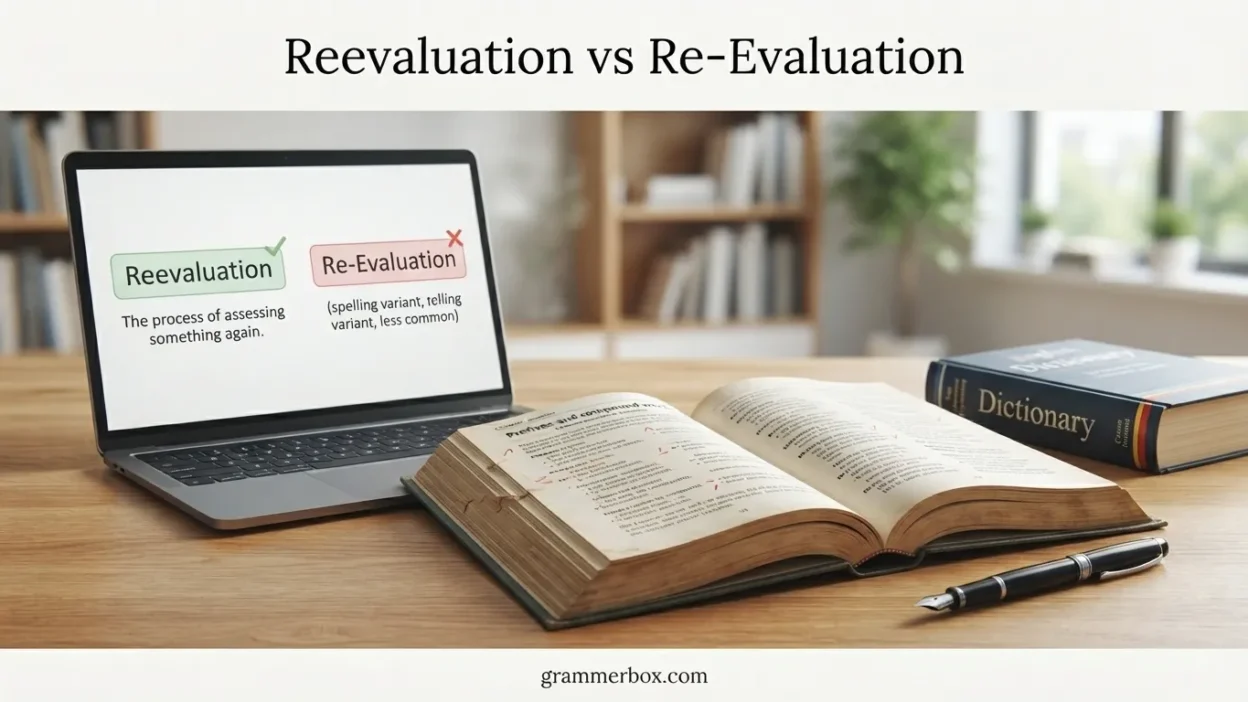
Reevaluation is the standard one-word spelling. Re evaluation is generally incorrect. Re-evaluation is also acceptable in some style guides, but reevaluation is widely preferred in modern English. Use reevaluation when you mean “the process of evaluating something again.”
Why People Confuse It
The confusion comes from the prefix re-, which means “again” or “back.”
For example:
- rewrite
- reread
- reconsider
- reorganize
- reassess
Because re- can sometimes be separated or hyphenated for clarity, writers may wonder whether re evaluation should also be written as two words.
However, when re- combines naturally with a word to create a new word, English usually writes the result as a single word.
So:
- reevaluation = standard one-word form
- re-evaluation = accepted hyphenated form in some usage
- re evaluation = generally incorrect
Reevaluation: The Standard Form
Reevaluation is a noun meaning the act or process of evaluating something again.
It comes from:
re- + evaluation = reevaluation
The prefix re- means “again,” while evaluation means an assessment or judgment of something.
Examples
- The teacher requested a reevaluation of the student’s final grade.
- The company announced a reevaluation of its hiring policies.
- A medical reevaluation was necessary after the treatment.
- The committee completed a reevaluation of the proposal.
- The project requires a careful reevaluation of its costs.
In formal writing, reevaluation is usually the safest choice.
Re Evaluation: Is It Correct?
Re evaluation is generally not the correct spelling when you mean the noun “evaluation again.”
The problem is that re is functioning as a prefix rather than as an independent word.
For example:
❌ The manager requested a re evaluation of the plan.
Better:
✅ The manager requested a reevaluation of the plan.
You may occasionally see the separated form in informal writing, but it is not the standard spelling recommended for polished English.
Comparison Table
| Form | Correct? | Meaning | Recommended Use |
|---|---|---|---|
| reevaluation | Yes | Evaluation done again | Best general choice |
| re-evaluation | Yes, in some styles | Evaluation done again | Acceptable where hyphenation is preferred |
| re evaluation | Generally no | Intended to mean evaluation again | Avoid |
| reevaluate | Yes | To evaluate again | Standard verb |
| re-evaluate | Yes, in some styles | To evaluate again | Hyphenated alternative |
When to Use Each
Use “reevaluation”
Choose reevaluation in most academic, professional, business, and general writing.
Example:
The committee ordered a reevaluation of the safety procedures.
This is the clearest and most widely useful form.
Use “re-evaluation”
Re-evaluation may appear in dictionaries, publications, or style systems that prefer hyphens with certain prefixes.
It can also be useful when a writer wants to make the word easier to visually parse.
Example:
The policy is due for a re-evaluation next year.
Although this form is acceptable in some contexts, consistency is important. If your publication follows a particular style guide, follow its preferred spelling.
Avoid “re evaluation”
When re- is being used as a prefix, avoid separating it from evaluation.
Incorrect:
We need a re evaluation of the results.
Preferred:
We need a reevaluation of the results.
Reevaluation Examples
Here are more examples showing how reevaluation works naturally in sentences:
- The doctor recommended a reevaluation after several weeks.
- The company is conducting a reevaluation of its business strategy.
- The student’s appeal led to a reevaluation of her examination.
- The new evidence prompted a reevaluation of the case.
- Our team needs a reevaluation of the original budget.
- The manager scheduled a reevaluation of the employee’s performance.
- The research findings require a careful reevaluation.
- The committee agreed to a reevaluation of the existing rules.
- The sudden change caused a reevaluation of our plans.
- The organization began a complete reevaluation of its priorities.
- The results deserve further reevaluation before publication.
- The project underwent a financial reevaluation.
Common Mistakes
1. Writing “re evaluation”
❌ We need a re evaluation.
✅ We need a reevaluation.
The prefix should normally be attached to the word.
2. Assuming every “re-” word needs a hyphen
Not every word beginning with re- requires a hyphen.
For example:
- reread
- rewrite
- reconsider
- reevaluate
These are commonly written as one word.
3. Switching between forms randomly
If you choose reevaluation, use it consistently throughout your article or document unless your style guide says otherwise.
4. Confusing the noun and verb
Reevaluate is the verb.
Reevaluation is the noun.
Compare:
We need to reevaluate the plan.
The plan needs a reevaluation.
Memory Trick
Think of re- as meaning again.
Evaluate again → reevaluate
The act of evaluating again → reevaluation
A simple pattern can help:
If you are tempted to write re evaluation, remember that re- is a prefix here, not a separate word.
American vs British English
There is no major difference in meaning between American and British English for reevaluation.
Both varieties use the word to describe evaluating something again.
However, spelling preferences can vary between dictionaries, publishers, and individual style guides. Some sources allow or prefer the hyphenated re-evaluation, while modern general usage commonly favors the closed form reevaluation.
For consistent professional writing, check the style guide required by your school, employer, publisher, or publication.
Similar Words
Several words have meanings related to reevaluation:
- Reassessment — evaluating something again, often after new information.
- Review — examining something carefully, sometimes without making a new judgment.
- Reconsideration — thinking about a decision or opinion again.
- Reappraisal — forming a new judgment about the value or importance of something.
- Reexamination — examining something again in greater detail.
- Revision — changing or improving something after reviewing it.
- Reanalysis — analyzing information or data again.
These words are related, but they are not always interchangeable.
For example, reevaluation emphasizes making another evaluation, while revision usually emphasizes changing or improving something.
Final Verdict
If you are wondering whether to write reevaluation or re evaluation, choose reevaluation.
Reevaluation is the standard one-word spelling and is the safest choice for most modern English writing. Re-evaluation is also found and can be acceptable depending on the dictionary or style guide you follow.
The form re evaluation should generally be avoided when re- is functioning as a prefix.
FAQs:
Is “reevaluation” one word?
Yes. Reevaluation is correctly written as one word and is widely used in modern English.
Is “re evaluation” grammatically correct?
Generally, no. When re- means “again” and forms a word with evaluation, reevaluation is the preferred spelling.
Is “re-evaluation” correct?
Yes, re-evaluation is an accepted hyphenated form in some dictionaries and style guides. However, reevaluation is a common modern spelling.
What is the verb form of reevaluation?
The verb is reevaluate, meaning to evaluate something again.
Example: “The committee will reevaluate the proposal.”
What does reevaluation mean?
Reevaluation means the process of evaluating, assessing, or judging something again.
Which is better for formal writing: reevaluation or re-evaluation?
Reevaluation is generally the safest modern choice. If your organization follows a specific style guide, use the spelling recommended by that guide.
What is the difference between reevaluation and reassessment?
Both mean reviewing something again. Reevaluation focuses on making another evaluation, while reassessment emphasizes assessing a situation or judgment again, often because circumstances have changed.
Conclusion
The spelling question becomes much easier once you recognize that re- is functioning as a prefix. In most modern English writing, reevaluation should be written as one word. The separated form re evaluation is generally not recommended, while re-evaluation may be used according to certain style preferences.
If you are writing an academic paper, business report, professional email, or everyday sentence, choosing reevaluation will usually give you the clearest and safest result. When in doubt, remember the simple pattern: reevaluate is the verb, and reevaluation is the noun.
Remember This
Reevaluation = correct one-word spelling.
Re-evaluation = acceptable in some style guides.
Re evaluation = generally avoid.