
If you have ever hesitated between “sorry for bothering you” and “sorry to bother you,” you are not alone. Both expressions are grammatically correct, natural, and widely used in English. The difference is mainly about when you use them and what you want to emphasize.
These phrases are common in everyday conversations, emails, messages, customer service, and professional communication. Although they look very similar, their grammatical structures are slightly different. “Sorry for bothering you” uses for + -ing, while “sorry to bother you” uses to + base verb. Understanding this small difference can help you choose the expression that sounds most natural in a particular situation.
Quick Answer
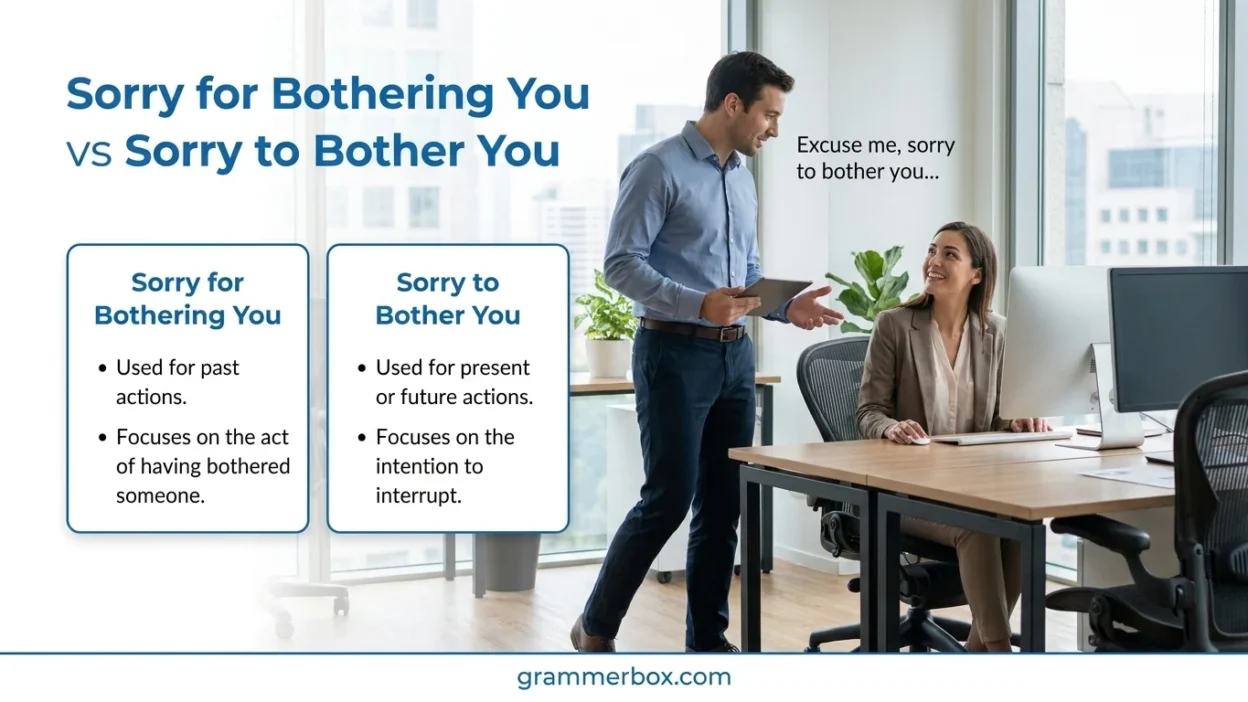
Both “sorry for bothering you” and “sorry to bother you” are correct. Use “sorry to bother you” when apologizing before or while interrupting someone. Use “sorry for bothering you” when referring to an interruption or inconvenience that has already happened or is continuing.
Why People Confuse It
People often confuse these expressions because they communicate almost the same basic idea: an apology for causing someone inconvenience or interrupting them.
The main difference is grammatical:
- Sorry for bothering you → for + gerund (-ing)
- Sorry to bother you → to + base verb
Compare:
Sorry for bothering you while you were working.
Sorry to bother you, but could I ask a quick question?
The first expression focuses more naturally on the act of bothering. The second often introduces an interruption, request, or question.
Sorry for Bothering You
“Sorry for bothering you” is grammatically correct and commonly used when you are apologizing for having bothered someone.
The structure is:
sorry + for + verb-ing
Examples:
- Sorry for bothering you so late.
- I’m sorry for bothering you during your lunch break.
- Sorry for bothering you with this small issue.
- I’m sorry for bothering you again.
It can refer to something that has already happened or to an inconvenience that is currently taking place.
Examples
Sorry for bothering you yesterday.
Here, the bothering happened in the past.
Sorry for bothering you again, but I still need your help.
Here, the speaker recognizes that they are bothering the person again.
The phrase can sound especially appropriate when discussing or acknowledging an inconvenience.
Sorry to Bother You
“Sorry to bother you” is also completely correct. It is particularly common when someone is about to interrupt another person or make a request.
The structure is:
sorry + to + base verb
Examples:
- Sorry to bother you, but can I ask something?
- Sorry to bother you while you’re busy.
- Sorry to bother you, but I need your signature.
- I’m sorry to bother you so early.
It often works as a polite introduction to a request.
For example:
Sorry to bother you, but could you help me with this form?
The speaker is apologizing for interrupting the listener before making the request.
Comparison Table
| Expression | Structure | Typical Use | Example |
|---|---|---|---|
| Sorry for bothering you | for + -ing | Apologizing for an inconvenience or interruption | Sorry for bothering you again. |
| Sorry to bother you | to + base verb | Polite apology before an interruption or request | Sorry to bother you, but can I ask a question? |
| Sorry for disturbing you | for + -ing | Apologizing for causing disturbance | Sorry for disturbing you earlier. |
| Sorry to disturb you | to + base verb | Polite introduction before interrupting | Sorry to disturb you, but I need your help. |
When to Use Each
Use “Sorry to Bother You” Before an Interruption
This is often the most natural choice when you are about to ask something.
Sorry to bother you, but do you know where the station is?
Sorry to bother you, but could you check this document?
Use “Sorry for Bothering You” After or During an Inconvenience
Choose this form when you are acknowledging that your actions have caused inconvenience.
Sorry for bothering you so many times today.
I’m sorry for bothering you while you were resting.
In Emails and Professional Messages
Both expressions can be polite, but context matters.
For example:
Sorry to bother you, but I wanted to ask about the meeting.
This sounds like a polite introduction to a question.
Meanwhile:
Sorry for bothering you again about this matter.
This emphasizes that you have already contacted the person or raised the issue before.
Examples of “Sorry for Bothering You” vs “Sorry to Bother You”
- Sorry to bother you, but could you help me?
- Sorry for bothering you so late at night.
- I’m sorry to bother you while you’re working.
- Sorry for bothering you with another question.
- Sorry to bother you, but I need your advice.
- I’m sorry for bothering you again about the same issue.
- Sorry to bother you during your break.
- Sorry for bothering you earlier.
- Sorry to bother you, but may I use your phone?
- I’m sorry for bothering you with this problem.
- Sorry to bother you, but do you have a minute?
- Sorry for bothering you repeatedly today.
Notice that “sorry to bother you” frequently introduces a request, while “sorry for bothering you” often refers to an inconvenience that has occurred.
Common Mistakes
1. Using “Sorry for bother you”
❌ Sorry for bother you.
✅ Sorry for bothering you.
After for in this construction, use the -ing form.
2. Using “Sorry to bothering you”
❌ Sorry to bothering you.
✅ Sorry to bother you.
After to in this construction, use the base form of the verb.
3. Thinking One Is Correct and the Other Is Wrong
Both are grammatical.
The choice depends on context and emphasis, not correctness.
4. Using “to” and “-ing” Together
Avoid:
❌ Sorry to bothering you.
The correct structures are:
✅ Sorry to bother you.
✅ Sorry for bothering you.
Memory Trick
A simple way to remember the difference is:
TO = about to do it
FOR + -ING = the action/inconvenience
So:
Sorry to bother you → I’m about to interrupt you.
Sorry for bothering you → I am apologizing for the bothering.
This isn’t an absolute rule for every possible context, but it is a useful shortcut for everyday English.
American vs British English
Both “sorry for bothering you” and “sorry to bother you” are used in both American and British English.
There is no major American-versus-British grammar rule that makes one expression exclusively American or British.
You may hear either expression in:
- Everyday conversations
- Workplace communication
- Emails
- Customer service
- Text messages
- Formal and informal situations
The choice is primarily determined by context, timing, and personal phrasing preference.
Similar Words and Expressions
Several expressions have a similar meaning to these phrases.
Sorry to Disturb You
A slightly more formal alternative:
Sorry to disturb you, but may I speak with you for a moment?
Sorry for Disturbing You
Useful when referring to an interruption that has occurred:
Sorry for disturbing you earlier.
Excuse Me
A short and versatile expression:
Excuse me, could you help me?
I Hate to Bother You
This is another polite way to introduce a request:
I hate to bother you, but could you look at this?
Sorry to Interrupt
Especially useful when someone is already speaking:
Sorry to interrupt, but I have a quick question.
FAQs:
Is “sorry for bothering you” grammatically correct?
Yes. “Sorry for bothering you” is grammatically correct. It uses the structure for + gerund, where bothering is the -ing form of bother.
Is “sorry to bother you” correct English?
Yes. “Sorry to bother you” is completely correct and very common. It often introduces a polite request or interruption.
Which is more polite: “sorry to bother you” or “sorry for bothering you”?
Neither is inherently more polite. Both can be polite. “Sorry to bother you” is particularly natural before making a request, while “sorry for bothering you” often acknowledges an inconvenience.
Can I use “sorry to bother you” in an email?
Yes. It is common in professional and personal emails, especially when introducing a request or asking someone for assistance.
Can I say “sorry for bothering you again”?
Yes. This is a natural expression when you have already contacted or interrupted someone and want to acknowledge it.
What is the difference between “sorry to bother you” and “sorry to disturb you”?
They are very similar. Bother can mean inconvenience or annoy someone, while disturb often emphasizes interrupting someone’s activity, peace, or concentration.
Is “sorry for bother you” correct?
No. In this construction, use the gerund: “Sorry for bothering you.” After for, the verb should be in the appropriate noun-like form, here bothering.
Remember This
Sorry to bother you → usually introduces an interruption or request.
Sorry for bothering you → acknowledges the act or inconvenience of bothering someone.
Both are natural English. Choose the one that best matches the situation.
Conclusion
Understanding “sorry for bothering you vs sorry to bother you” is mainly about recognizing how English uses infinitives and gerunds. The two expressions overlap in meaning, but they can create slightly different impressions depending on when and why you use them.
If you are about to ask someone a question, “Sorry to bother you” is a natural choice. If you are apologizing for having already inconvenienced someone, “Sorry for bothering you” often fits better. Once you remember “to + base verb” and “for + -ing,” choosing between them becomes much easier.