
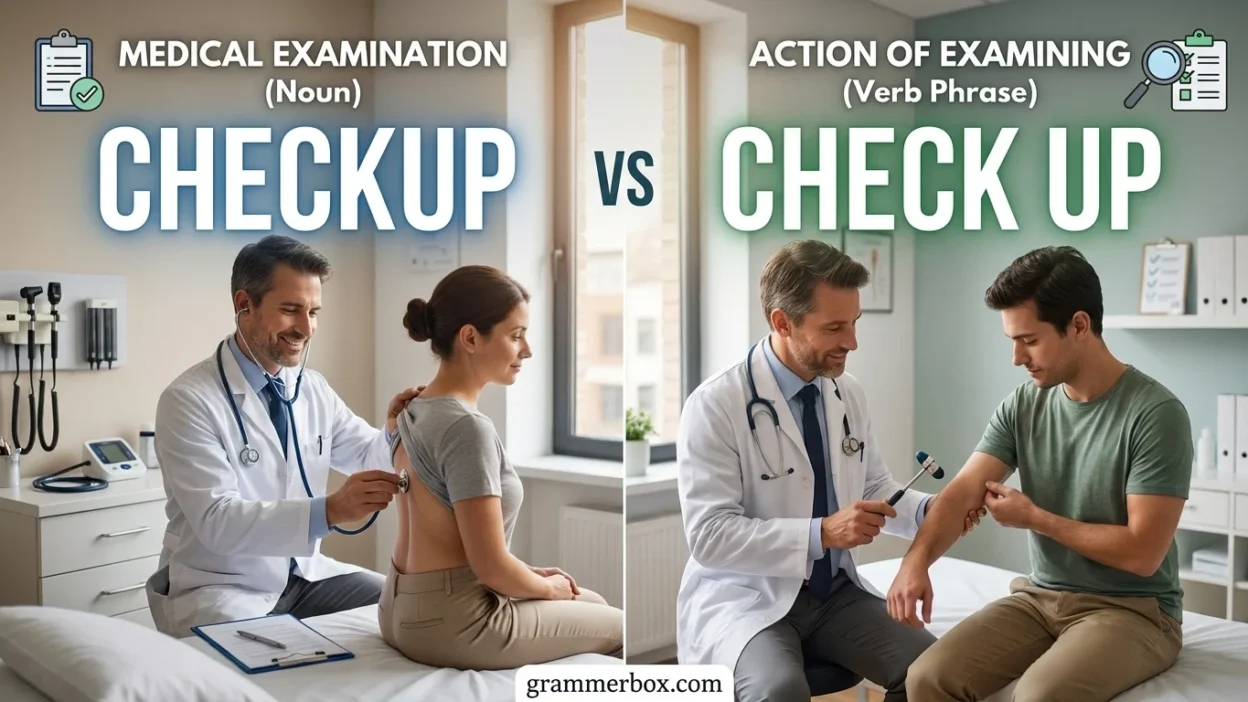
A small space can change how a phrase functions in English. “Checkup” and “check up” look almost identical, but they are not always used in the same grammatical way. Knowing the difference can help you write more naturally and avoid common spelling and grammar mistakes.
The word checkup is usually a noun referring to a medical examination or routine examination. For example, “I have a doctor’s checkup tomorrow.” On the other hand, check up is a phrasal verb, usually used with on, meaning to investigate, verify, or make sure someone or something is doing well.
For example, “The nurse will check up on the patient.” In this guide, we’ll explain checkup vs check up, when to use each form, and how to remember the difference.
Quick Answer
Checkup is usually a noun meaning a routine medical examination or inspection. Check up is a verb phrase meaning to investigate or examine, commonly followed by on. Use checkup for the examination itself and check up for the action of investigating.
Why People Confuse It
The confusion comes from the fact that checkup and check up contain exactly the same words.
The difference is mainly grammatical:
- Checkup → noun
- Check up → phrasal verb
- Check up on → investigate or make sure someone is okay
Compare these examples:
- I have a checkup tomorrow.
- The doctor will check up on me tomorrow.
The first sentence names an examination. The second describes an action.
Checkup
Checkup is a noun. It commonly means a routine medical examination, but it can sometimes refer more generally to a routine inspection or evaluation.
Examples of “checkup”
- I have a checkup with my doctor tomorrow.
- She goes for a dental checkup twice a year.
- The annual checkup showed that everything was fine.
- My doctor recommended a routine checkup.
The most common use is in a medical context.
Common phrases with “checkup”
- medical checkup
- routine checkup
- annual checkup
- health checkup
- dental checkup
- regular checkup
- physical checkup
Checkup can also appear in phrases such as a routine checkup or a follow-up checkup.
Check Up
Check up is a verb phrase. It means to investigate, examine, or verify something.
It is especially common as check up on someone or something.
Examples of “check up”
- I need to check up on the children.
- The manager will check up on the new employees.
- She called to check up on her friend.
- The technician will check up on the machine.
In many cases, check up on means making sure that someone or something is safe, healthy, correct, or functioning properly.
What about “check up” without “on”?
The verb check up can occur in some constructions, but check up on is much more common when the meaning is “investigate” or “make sure.”
For example:
The doctor checked up on the patient.
Here, on the patient identifies the person being checked.
Checkup vs Check Up: Comparison Table
| Feature | Checkup | Check up |
|---|---|---|
| Part of speech | Noun | Verb phrase |
| Basic meaning | Routine examination | Investigate or examine |
| Common context | Medical/health | Investigation or monitoring |
| Example | I need a checkup. | I will check up on him. |
| Usually followed by “on”? | No | Often, yes |
| Can be plural? | Yes: checkups | No, as a verb phrase |
When to Use Each
Use checkup when you are talking about an examination as a thing or event.
Use “checkup” for:
- a doctor’s examination
- a dental examination
- a routine health examination
- an annual medical examination
- a general inspection
Example:
“I scheduled a checkup for next week.”
Use check up when you are describing the action of investigating or making sure something is okay.
Use “check up” for:
- investigating a person
- monitoring someone’s condition
- verifying information
- making sure something is working
- checking on someone’s well-being
Example:
“I called to check up on my grandmother.”
Checkup vs Check Up Examples
Here are more examples showing the difference clearly:
- I have a checkup on Monday.
→ The examination is on Monday. - The doctor will check up on me later.
→ The doctor will examine or monitor me later. - She scheduled a dental checkup.
→ Checkup is a noun. - I should check up on the children.
→ Check up is a verb phrase. - His annual checkup went well.
→ The routine examination went well. - The nurse checked up on the patient.
→ The nurse made sure the patient was okay. - My parents want me to get a health checkup.
→ Checkup refers to the examination. - The supervisor checked up on the workers.
→ The supervisor monitored them. - She goes for a checkup every year.
→ The examination is a yearly event. - He called to check up on his friend.
→ He wanted to make sure his friend was doing well. - The dentist recommended a regular checkup.
→ Checkup is a noun. - I checked up on the information before submitting the report.
→ The speaker investigated or verified the information.
Common Mistakes
Mistake 1: Using “check up” as a noun
❌ I have a check up tomorrow.
✅ I have a checkup tomorrow.
When you mean the medical examination itself, checkup is normally written as one word.
Mistake 2: Using “checkup” as a verb
❌ I will checkup on her later.
✅ I will check up on her later.
When it functions as a verb phrase, write check up as two words.
Mistake 3: Forgetting “on”
❌ I called to check up my friend.
✅ I called to check up on my friend.
When you mean “make sure someone is okay” or “investigate someone/something,” check up on is the usual construction.
Mistake 4: Confusing “checkup” with “check”
A checkup is generally a routine examination. A check can have many meanings, including examining something briefly, verifying information, or making a payment.
Memory Trick
Use this simple trick:
One thing = one word → checkup.
An action = two words → check up.
Think:
- A checkup = an examination
- Check up on = investigate or monitor
For example:
I have a checkup.
But:
I will check up on you.
If you can put “a” or “my” before it, checkup is likely the correct form:
- a checkup
- my checkup
- her checkup
- an annual checkup
American vs British English
Both checkup and check up are recognized in American and British English.
The main distinction is grammatical rather than a major difference between American and British usage.
In both varieties:
- checkup is commonly used as a noun.
- check up is used as a verb phrase.
- check up on is used when someone investigates or monitors another person or thing.
For medical contexts, checkup is widely understood in both forms of English.
British English also commonly uses check-up, with a hyphen, especially in some published styles.
So you may encounter:
- checkup
- check-up
- check up
The first two can function as the noun, while check up functions as the verb phrase.
Similar Words
Several expressions are related to checkup and check up, but they are not always interchangeable.
Examination
An examination is a formal inspection or assessment. In medicine, it can refer to a doctor’s examination.
Medical exam
A medical exam is an examination of someone’s health, often for a specific purpose.
Health screening
A health screening is designed to look for particular health conditions or risk factors.
Inspection
An inspection is a careful examination of something, often to identify problems.
Follow-up
A follow-up is an additional appointment, examination, or action after an earlier event.
Check
Check is a broad word that can mean examining, verifying, or confirming something.
FAQs:
Is “checkup” one word or two?
When it is used as a noun meaning a routine examination, checkup is commonly written as one word. Some styles also use check-up.
Is “check up” grammatically correct?
Yes. Check up is a verb phrase, particularly common in check up on, meaning to investigate, monitor, or make sure someone or something is okay.
Is it “doctor checkup” or “doctor check up”?
When referring to the medical examination, doctor’s checkup or medical checkup is appropriate. The noun is generally written checkup.
Is “checkup” only used for medical examinations?
No. Although medical use is very common, checkup can also refer more generally to a routine inspection or evaluation.
What does “check up on someone” mean?
Check up on someone means to investigate, monitor, or make sure that the person is safe, healthy, or doing well.
Is “check-up” also correct?
Yes. Check-up is a hyphenated form used as a noun, particularly in British English and in some editorial styles. Checkup is also standard.
Which is correct: “I need a checkup” or “I need a check up”?
For the noun meaning a routine examination, “I need a checkup” is the standard closed form in American English. Check-up may also be encountered in British English.
Remember This
Checkup = the examination.
Check up = the action.
- ✅ I have a checkup tomorrow.
- ✅ I will check up on you tomorrow.
- ❌ I have a check up tomorrow. (when used as the noun in standard American usage)
- ❌ I will checkup on you tomorrow.
Conclusion
Although checkup and check up sound the same, their grammatical roles make the difference easy to understand. Checkup works as a noun, particularly for routine medical examinations, while check up works as a verb phrase meaning to investigate, monitor, or verify something.
Once you remember the simple rule—one word for the examination, two words for the action—you can use both forms confidently. Pay particular attention to the common expression check up on, which is frequently used when talking about checking someone’s condition or investigating a situation.