Choosing between “when I can” and “when can I” can be confusing because both phrases contain the same words, but their grammar and meaning are different. The key is to look at whether you are making a statement about possibility or availability or asking a direct question. Understanding this small difference will make your English sound much more natural.
In everyday conversations, emails, school assignments, and professional writing, you may encounter both forms. “When I can” usually appears inside a larger sentence, while “when can I” normally introduces a question about the right time or opportunity to do something. This guide explains the difference between the two expressions, shows you exactly when to use each one, and provides practical examples so you can confidently choose the correct form.
Quick Answer
“When I can” is usually used in a statement or dependent clause, meaning “at the time I am able to.” “When can I” is normally used to ask a question about when something is possible or permitted. The word order changes because one is a statement and the other is a question.
Why People Confuse It
The confusion comes from the fact that both expressions contain the same three words:
- when
- I
- can
The difference is their word order.
In a normal statement, the subject generally comes before the modal verb:
I can help.
When forming a direct question with can, the modal verb comes before the subject:
Can I help?
The same pattern applies after when:
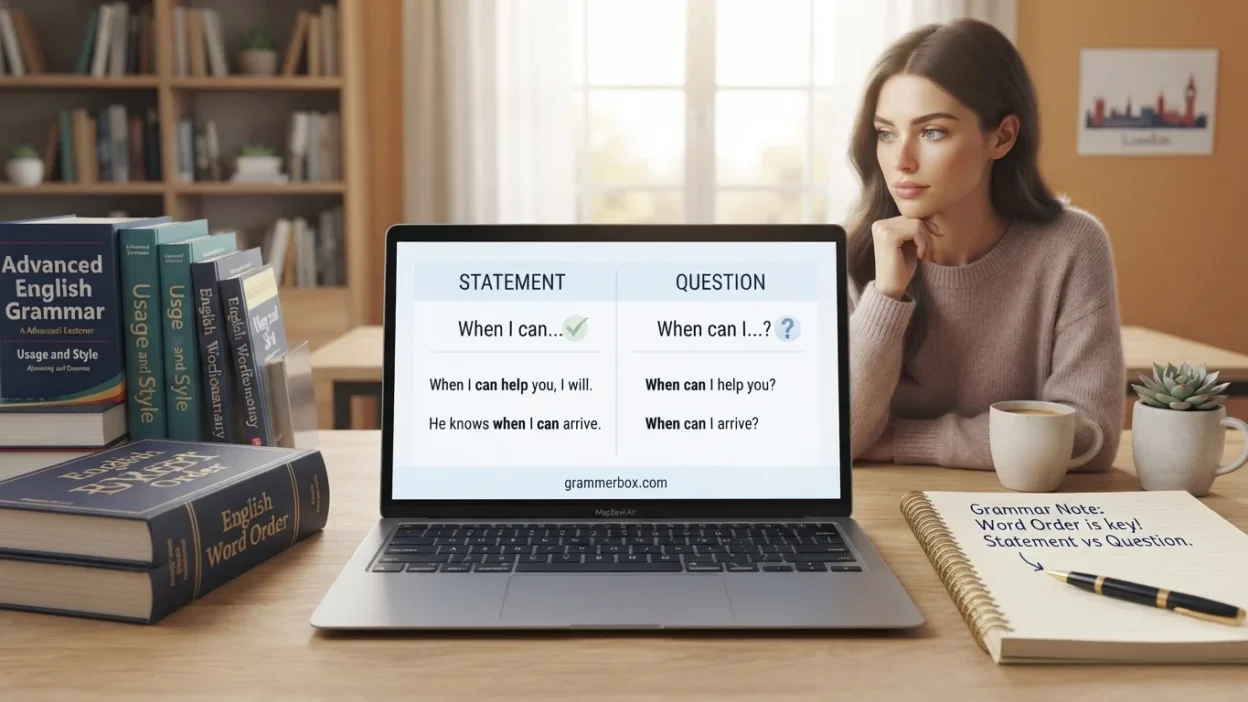
- When I can = statement/dependent clause
- When can I…? = direct question
This distinction is especially important because “when I can” can sometimes appear in a sentence that expresses a future action.
First Word: When I Can
“When I can” is generally used as part of a statement rather than as a direct question.
It means something like “at the time when I am able to” or “whenever I am able to.”
For example:
I’ll call you when I can.
Here, “when I can” does not ask a question. It explains when the speaker will call.
More examples:
- I’ll finish the report when I can.
- She helps me when she can.
- I’ll visit you when I can.
- Please send the documents when you can.
- I’ll respond when I can.
Notice that the normal subject–modal order remains:
I + can
not:
can + I
“When I can” as a Shortened Expression
Sometimes the rest of the sentence is understood from context:
I’ll come when I can.
This means:
I’ll come when I am able to come.
The missing information is understood naturally.
Second Word: When Can I
“When can I” is used to begin a direct question.
It asks about the time when something is possible, allowed, or appropriate.
For example:
When can I call you?
This asks for a suitable time to call.
Other examples include:
- When can I start?
- When can I leave?
- When can I apply?
- When can I visit?
- When can I submit the form?
The word order is:
When + can + subject + verb
So:
When can I start?
is correct.
When I can start?
is not normally correct as a standalone direct question.
Comparison Table
| Expression | Grammar | Meaning | Example |
|---|---|---|---|
| When I can | Statement/dependent clause | At the time I am able to | I’ll help when I can. |
| When can I | Direct question | Asking when something is possible | When can I help? |
| When I can finish | Clause | When I am able to finish | I’ll finish when I can. |
| When can I finish? | Question | Asking about the possible finishing time | When can I finish? |
| When I can go | Clause | At the time I am able to go | I’ll go when I can. |
| When can I go? | Question | Asking for permission or timing | When can I go? |
When to Use Each
Use “when I can” for statements
Use “when I can” when you are explaining when you will do something or when you are describing your ability to do something.
Examples:
- I’ll call you when I can.
- I work from home when I can.
- I exercise when I can.
- I’ll visit when I can.
Use “when can I” for questions
Use “when can I” when you want someone to tell you the appropriate or possible time for an action.
Examples:
- When can I call you?
- When can I register?
- When can I pick it up?
- When can I expect a response?
A useful shortcut is:
Statement → when I can
Question → when can I
Examples of “When I Can” and “When Can I”
Here are practical examples showing the difference clearly.
Examples with “When I Can”
- I’ll help you when I can.
- I’ll visit when I can.
- She studies whenever she can.
- I’ll call you when I can.
- He travels when he can.
- I’ll finish the project when I can.
- Please reply when you can.
- I exercise when I can.
- I’ll come over when I can.
- She volunteers when she can.
- I’ll deal with the problem when I can.
- We meet whenever we can.
Examples with “When Can I”
- When can I see you?
- When can I start?
- When can I leave?
- When can I apply?
- When can I submit my application?
- When can I call you?
- When can I pick up the package?
- When can I access the account?
- When can I expect the results?
- When can I schedule an appointment?
- When can I get my certificate?
- When can I ask another question?
Common Mistakes
Mistake 1: Using “when I can” as a direct question
❌ When I can leave?
✅ When can I leave?
Because this is a direct question, can comes before I.
Mistake 2: Using “when can I” inside a normal statement
❌ I’ll call you when can I.
✅ I’ll call you when I can.
The clause is not a direct question, so the normal word order is used.
Mistake 3: Confusing a direct and indirect question
Compare:
This is a direct question.
But:
This is an indirect question. Notice that the word order changes back to I can.
This is one of the most important grammar rules to remember.
Memory Trick
Use this simple trick:
Question? Flip it.
If you are directly asking:
If you are making a statement:
Think of the basic forms:
- I can → statement
- Can I…? → question
Add when:
- when I can → statement/clause
- when can I…? → question
Quick memory formula
WHEN + I + CAN = statement
WHEN + CAN + I = question
American vs British English
There is no major difference between American and British English in the basic grammatical distinction between these expressions.
Both varieties use:
for direct questions.
Both also use:
in statements and dependent clauses.
For example, these are natural in both varieties:
- When can I see you?
- I’ll see you when I can.
- Do you know when I can see you?
Differences in pronunciation, vocabulary, and certain usage preferences may exist between American and British English, but the word-order rule here remains essentially the same.
Similar Words and Expressions
Several related structures can cause similar confusion.
When Can I…?
Used to ask about timing or possibility:
When can I start?
When Could I…?
A more polite or tentative version:
When could I schedule a meeting?
When May I…?
Often more formal, especially when asking for permission:
When may I enter?
When Will I…?
Used when asking about a future event:
When will I receive the results?
When Am I…?
Used when asking about a scheduled event or situation:
When am I supposed to arrive?
When I Can
Used in a statement or dependent clause:
I’ll do it when I can.
Final Verdict
Both “when I can” and “when can I” are correct, but they serve different grammatical purposes.
Use “when I can” when it is part of a statement:
I’ll help you when I can.
Use “when can I” when you are asking a direct question:
When can I help you?
The most important thing is to identify whether you are asking a direct question or making a statement. Once you recognize that difference, choosing the correct word order becomes straightforward.
FAQs:
1. Is “when I can” grammatically correct?
Yes. “When I can” is grammatically correct when it functions as part of a statement or dependent clause.
Example:
I’ll call you when I can.
2. Is “when can I” grammatically correct?
Yes. “When can I” is correct when introducing a direct question.
Example:
When can I start?
3. Which is correct: “When I can go?” or “When can I go?”
“When can I go?” is correct as a direct question.
Example:
When can I go home?
4. Can “when I can” be used in a question?
Yes, particularly in an indirect question.
Example:
Do you know when I can leave?
Here, “when I can leave” is an embedded question, so the word order is not inverted.
5. What is the difference between “when can I” and “when I can”?
“When can I” asks a direct question about timing or possibility. “When I can” usually forms part of a statement describing when someone is able to do something.
6. Is “Do you know when can I leave?” correct?
No, not in standard English.
Use:
The question is indirect, so use normal statement word order inside the clause.
7. Can I say “I’ll do it when can I”?
No. The natural form is:
The phrase “when I can” is a dependent clause, not a direct question.
Remember This
“When can I…?” = direct question
“…when I can.” = statement or dependent clause
If you are asking someone what time you can do something, use “when can I.” If you are saying that you will do something at the time you are able to, use “when I can.”
Conclusion
The difference between “when I can” and “when can I” is mainly a matter of sentence structure and word order. “When can I” is used for direct questions, while “when I can” normally appears in statements or dependent clauses. The words themselves do not change; their order changes according to the grammatical function.
When in doubt, first ask yourself whether you are asking a direct question. If you are, put can before I: “When can I…?” If you are describing when you are able to do something, use “when I can.” This simple rule will help you avoid one of the most common word-order mistakes in English.