If you have ever wondered whether to write itself or its self, you are not alone. These forms look almost identical, but they do not work the same way in standard English. In most everyday sentences, itself is the correct spelling. It is a reflexive or emphatic pronoun used when referring back to something previously mentioned, such as an object, animal, organization, or idea.
The form its self is much less common and is usually used only when self is being treated as a separate noun, often in philosophical, psychological, or highly specialized writing. Understanding the difference can help you avoid spelling mistakes and make your English sound more natural. In this guide, we will explain itself vs its self, show when each form is appropriate, compare their meanings, and provide clear examples you can use in everyday writing.
Quick Answer
Itself is the standard and correct form in almost all ordinary English sentences. Use it as a reflexive or emphatic pronoun: “The machine turned itself off.” Its self is only occasionally correct when “self” is deliberately used as a separate noun, usually in specialized or philosophical contexts.
Why People Confuse It
The confusion comes from the possessive determiner its and the noun self.
Because its means “belonging to it,” some writers assume that its self should always be written as two words. However, itself is an established pronoun with its own grammatical function.
Compare:
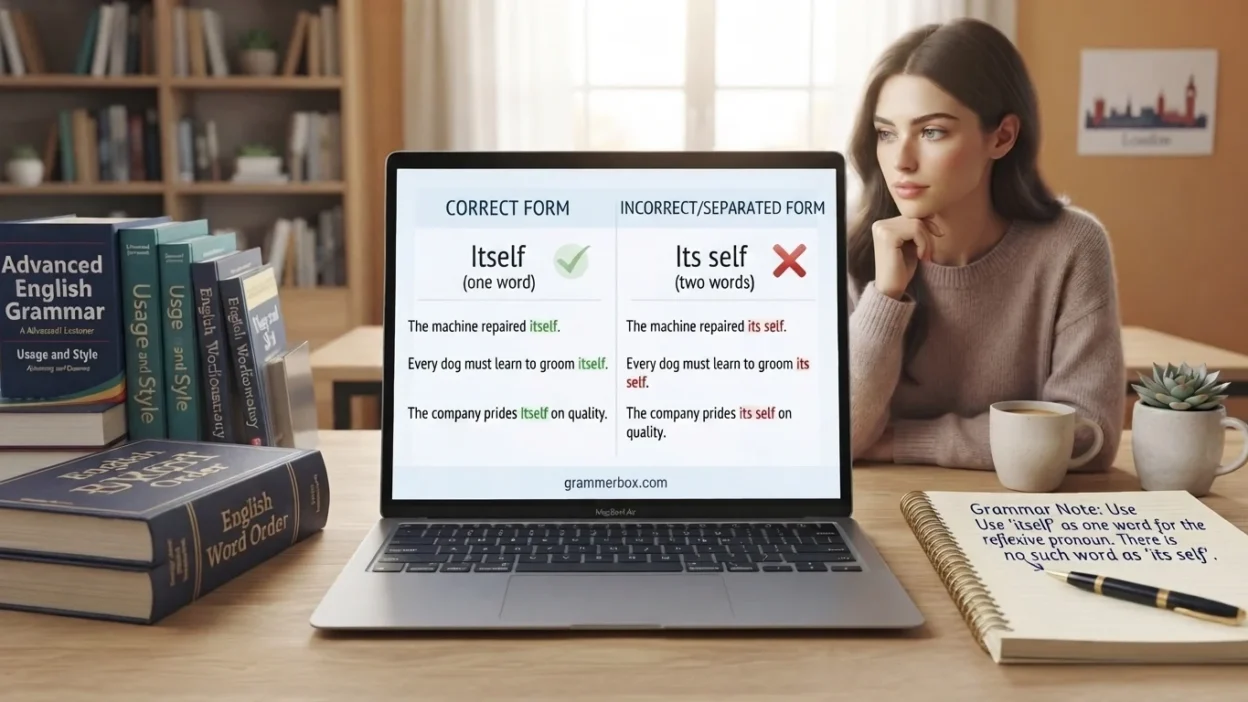
- The cat cleaned itself. ✅
- The cat cleaned its self. ❌
In the first sentence, itself refers back to “the cat.” It is a reflexive pronoun.
Itself
Itself is a reflexive and emphatic pronoun referring to a singular non-human subject or object.
Common uses of itself
1. Reflexive use
It refers back to the subject.
The door closed itself.
Here, “itself” refers to “the door.”
2. Emphatic use
It adds emphasis to a noun.
The company itself admitted the mistake.
The word emphasizes that the company, rather than someone else, admitted the mistake.
3. Referring to an idea, situation, or thing
The problem will eventually solve itself.
Here, “itself” refers to “the problem.”
Definition
Itself means “that thing or entity itself” and is normally written as one word.
Its Self
Its self consists of two separate words:
- its = possessive determiner
- self = noun
This construction is uncommon in ordinary English.
It can appear when self is intentionally treated as an independent noun, particularly in philosophical, psychological, literary, or abstract discussions.
For example:
The robot’s programming distinguished its self from its surroundings.
In a sentence like this, “self” is being discussed as a distinct concept rather than simply functioning as a reflexive pronoun.
In normal everyday writing, however, itself is almost always what you want.
Itself vs Its Self: Comparison Table
| Feature | Itself | Its Self |
|---|---|---|
| Word form | One word | Two words |
| Grammar | Reflexive/emphatic pronoun | Possessive determiner + noun |
| Frequency | Very common | Very rare |
| Everyday English | Correct | Usually incorrect |
| Example | The dog hurt itself. | The machine developed its self. |
| Main purpose | Refers back to “it” | Treats “self” as a separate noun |
| Typical context | General writing and speech | Specialized or philosophical writing |
When to Use Each
Use “itself” when:
- Referring back to a singular non-human subject
- Emphasizing a thing or organization
- Saying that something happens without outside assistance
- Writing normal conversational or academic English
Examples:
The computer restarted itself.
The building itself is historic.
The situation will resolve itself.
Use “its self” only when:
- self is functioning as a separate noun
- You are discussing the concept of a thing’s identity or selfhood
- The context is philosophical, psychological, literary, or deliberately abstract
If you are unsure, itself will almost certainly be the correct choice in ordinary English.
Itself vs Its Self Examples
Here are more examples to make the difference clear:
- The dog scratched itself.
“Itself” refers back to “the dog.” - The computer turned itself off.
The computer is the subject and “itself” is reflexive. - The company itself announced the decision.
“Itself” adds emphasis. - The door opened itself.
“Itself” refers to the door. - The problem may eventually solve itself.
The problem is being treated as the subject. - The machine repaired itself automatically.
“Itself” refers back to the machine. - The idea itself is not difficult to understand.
“Itself” emphasizes “the idea.” - The organization itself confirmed the report.
The pronoun provides emphasis. - The system protects itself from damage.
“Itself” refers to the system. - The animal can defend itself.
“Itself” is a reflexive pronoun. - The concept of its self became central to the philosopher’s argument.
Here, “self” is deliberately treated as a separate abstract noun. - The artificial character struggled to understand its self.
This specialized construction focuses on the character’s concept of its own identity.
Common Mistakes
Mistake 1: Writing “its self” as the reflexive pronoun
The machine fixed its self.
In standard everyday English, this should be:
The machine fixed itself.
Mistake 2: Thinking “its” always needs a noun after it
Although its is normally followed by a noun phrase, itself is a single established pronoun. It should not be separated simply because “its” looks possessive.
Mistake 3: Confusing itself with “it’s”
Remember:
- itself = reflexive/emphatic pronoun
- its = possessive determiner
- it’s = contraction of “it is” or “it has”
Examples:
The bird hurt itself.
The bird spread its wings.
It’s getting late.
Memory Trick
Use this simple rule:
If “it” is doing something to itself, write “itself.”
Think:
it → itself
Just as:
- he → himself
- she → herself
- they → themselves
- it → itself
If you can replace the word with “that thing itself,” you probably need itself as one word.
American vs British English
There is no major American-versus-British spelling difference between itself and its self.
Both American and British English normally use itself as the reflexive or emphatic pronoun.
For example:
The machine switched itself off.
This sentence is standard in both varieties of English.
The unusual two-word construction its self is not a normal alternative spelling in either variety. Its use depends on the grammatical and conceptual context rather than regional spelling conventions.
Similar Words
Understanding related forms can make the pattern easier to remember.
- myself — reflexive pronoun for “I”
- yourself — reflexive pronoun for “you”
- himself — reflexive pronoun for “he”
- herself — reflexive pronoun for “she”
- itself — reflexive pronoun for “it”
- ourselves — reflexive pronoun for “we”
- themselves — reflexive pronoun for “they”
These forms are generally written as single words.
Also remember the possessive forms:
- its — belonging to it
- it’s — it is / it has
FAQs
Is “itself” one word?
Yes. Itself is normally written as one word and is the standard reflexive pronoun referring to “it.”
Is “its self” grammatically correct?
It can be grammatically possible when self is intentionally being used as a separate noun. However, this is uncommon and usually appears in specialized contexts.
Should I write “the machine fixed itself”?
Yes. “The machine fixed itself” is the natural and standard form.
Is “its self” a spelling mistake?
Not automatically. Context matters. However, if you are trying to use the normal reflexive pronoun, its self is a mistake and itself is correct.
What is the difference between “its” and “itself”?
Its shows possession, while itself is a reflexive or emphatic pronoun.
The dog wagged its tail.
The dog cleaned itself.
Is “itself” used for people?
Normally, itself is used for things, animals, organizations, or other non-human entities. For a person, use himself or herself, depending on the intended reference.
Which is more common: “itself” or “its self”?
Itself is overwhelmingly more common in standard everyday English. Its self is a specialized construction rather than a normal alternative spelling.
Final Verdict
When choosing between itself vs its self, the answer is straightforward for almost all ordinary writing: use itself.
Itself is the standard reflexive and emphatic pronoun. It appears in sentences such as “The dog washed itself,” “The company itself confirmed the news,” and “The problem will solve itself.”
Use its self only when you genuinely mean its + the noun self, usually in a specialized discussion of identity, consciousness, or selfhood. Do not split itself into two words simply because its looks like a possessive word.
Remember This
Itself = one word when it is the reflexive or emphatic pronoun.
Its self = two words only when self is deliberately being used as a separate noun.
The safest everyday rule: If you mean “that thing itself,” write “itself.”
Conclusion
The difference between itself and its self is mainly grammatical rather than a matter of spelling preference. In normal English, itself is the correct form when a thing, animal, organization, or idea refers back to itself or needs emphasis. Learning this pattern will help you write more naturally and avoid one of the common spacing mistakes in English.
Although its self can occur in specialized writing, it should not be used as a routine alternative to itself. When writing everyday sentences, academic work, business communication, or general web content, choose itself unless the context clearly requires self to function as an independent noun.