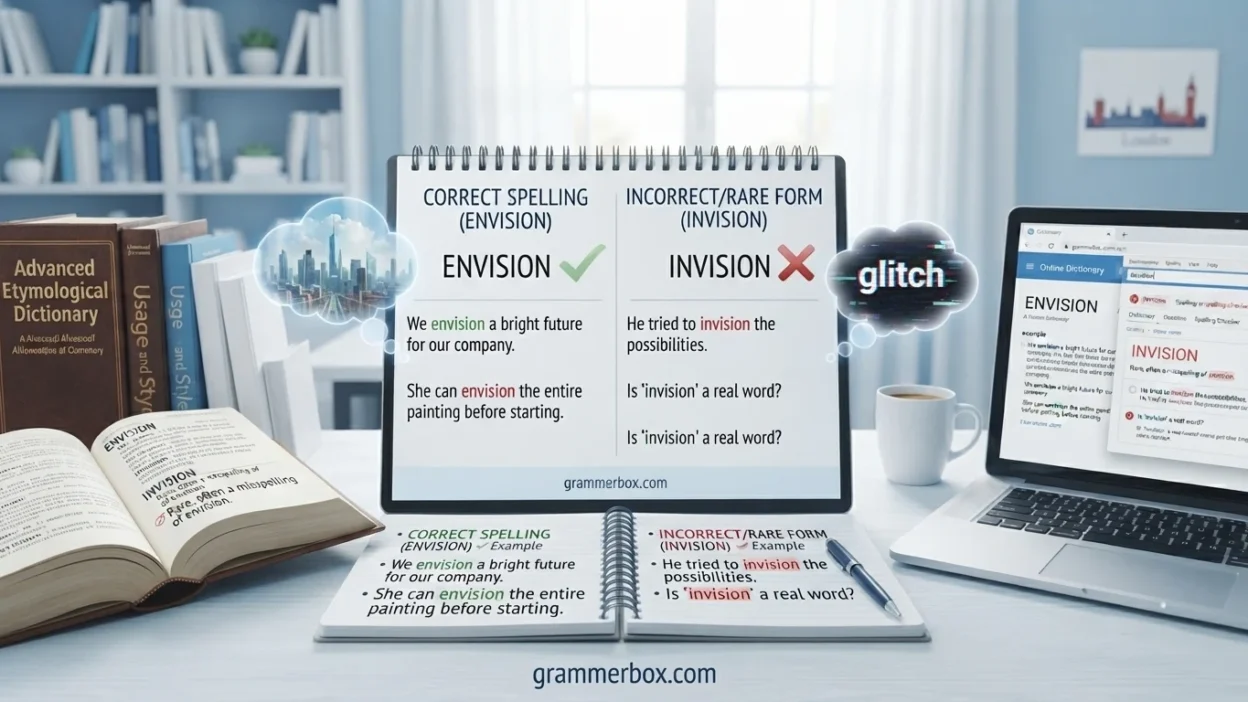
When you want to describe imagining something that could happen in the future, you may wonder whether the correct spelling is envision or invision. The two forms look and sound similar, so it is easy to type the wrong one, especially when writing quickly. However, standard English recognizes envision as the correct spelling of the verb.
Envision means to imagine, picture, or mentally see something before it happens. It is common in everyday English, professional writing, academic work, and discussions about future plans. Invision, when intended as the ordinary English verb, is generally a misspelling of envision. Learning this simple distinction can help you avoid spelling errors and choose the right word confidently. In this guide, we will compare envision vs invision, explain their meanings, show when to use envision, and provide practical examples you can use in real writing.
Quick Answer
Envision is the correct standard English spelling when you mean “to imagine,” “to picture,” or “to foresee.” Invision is generally an incorrect spelling of envision. Use envision in formal, academic, professional, and everyday English.
Why People Confuse It
The confusion between envision vs invision mainly comes from pronunciation and spelling patterns.
Both forms can look plausible because English contains many words beginning with in-, such as include, invent, and involve. When people hear envision, they may naturally assume that it begins with in-.
There is also a pronunciation issue. In normal speech, the first vowel sound in envision can be easy to mishear, particularly for English learners.
Another reason is that envision is related to the word vision. Since vision begins with vis-, writers sometimes create the incorrect form invision by adding an “in-” prefix.
The safest rule is simple:
If you mean “to imagine or picture something,” spell it envision.
Envision: The Correct Word
Envision is a verb meaning to imagine, picture, or foresee something mentally, especially something that may happen in the future.
It is often used when discussing goals, plans, possibilities, careers, projects, or future situations.
Examples of “Envision”
- I envision a future where clean energy is affordable for everyone.
- She envisioned herself working as a successful designer.
- We envision several improvements to the current system.
- He envisions a peaceful retirement near the coast.
Forms of “Envision”
The word can appear in several grammatical forms:
- Envision — base form
- Envisions — third-person singular
- Envisioned — past tense
- Envisioning — present participle
For example:
They envisioned a better solution to the problem.
Invision: Is It a Word?
Invision is generally not the standard spelling when you mean “to imagine” or “to picture.”
For standard English writing, use envision instead.
Incorrect
I invision a successful career in medicine.
Correct
I envision a successful career in medicine.
If you are writing professionally, academically, or for publication, choosing envision will prevent this common spelling mistake.
It is worth noting that InVision can also appear as a proper name or brand name in contexts where capitalization matters. That specialized use does not make invision the standard spelling of the ordinary English verb.
Envision vs Invision: Comparison Table
| Feature | Envision | Invision |
|---|---|---|
| Standard English spelling | ✅ Yes | ❌ Generally no |
| Part of speech | Verb | Not standard as the ordinary verb |
| Meaning | To imagine or picture | Usually intended as envision |
| Example | I envision a better future. | I invision a better future. ❌ |
| Suitable for formal writing | Yes | No, when used as the ordinary verb |
| Common mistake | Correct form | Common misspelling |
When to Use Each
Use “Envision” When You Mean “Imagine”
Use envision when someone mentally pictures something.
She envisions herself owning a business one day.
Use “Envision” for Future Plans
The word is especially useful when discussing a possible future.
The company envisions expanding into international markets.
Use “Envision” for Goals and Possibilities
You can use it when describing what you hope or expect to achieve.
I envision a career that allows me to help others.
Do Not Use “Invision” as the Standard Verb
If you are writing a normal English sentence, invision should generally be replaced with envision.
Examples of Envision vs Invision
Here are more examples to make the difference clear:
- Correct: I envision a brighter future for my family.
- Incorrect: I invision a brighter future for my family.
- Correct: She envisioned herself becoming a published author.
- Incorrect: She invisioned herself becoming a published author.
- Correct: The architect envisions a modern building on the site.
- Incorrect: The architect invisions a modern building on the site.
- Correct: Can you envision living in another country?
- Incorrect: Can you invision living in another country?
- Correct: They envision major changes to the education system.
- Incorrect: They invision major changes to the education system.
- Correct: He is envisioning a completely different approach.
- Incorrect: He is invisioning a completely different approach.
- Correct: We envisioned a simple solution to the problem.
- Incorrect: We invisioned a simple solution to the problem.
- Correct: The team envisions a successful launch next year.
Common Mistakes
1. Writing “Invision” Instead of “Envision”
This is the most common mistake.
Wrong:
I invision a better future.
Right:
I envision a better future.
2. Adding “in-” Because of the Meaning
The word envision may look as though it should begin with in-, but its established spelling is envision.
3. Confusing Spelling With Pronunciation
English pronunciation does not always make spelling obvious. When you are unsure, remember the written form: envision.
4. Using “Envision” When “Imagine” Would Be More Natural
Although envision and imagine overlap, envision often emphasizes forming a mental picture of a possible or future situation.
I envision myself leading the team someday.
This sounds more future-oriented than the simple:
I imagine myself leading the team someday.
Memory Trick
Use this easy memory trick:
Envision = EN + VISION
Think of vision as something you can picture mentally.
You can also remember:
“Envision your vision.”
Both words contain vision, which makes the correct spelling easier to remember.
When you see invision in your writing, stop and ask:
“Do I mean to imagine something?”
If the answer is yes, choose envision.
American vs British English
There is no standard American-versus-British spelling difference here.
Both American English and British English use envision as the standard spelling of the verb meaning “to imagine” or “to picture.”
For example:
- American English: She envisions a successful future.
- British English: She envisions a successful future.
The spelling does not change between these varieties of English.
You may encounter invision online, in informal writing, or as a typo. That does not make it an accepted alternative spelling of envision.
Similar Words
Several words have meanings similar to envision.
Imagine
To form a mental picture or idea.
I can imagine living near the ocean.
Visualize
To create a mental image of something.
Try to visualize your goal before you begin.
Picture
To imagine something mentally.
I can picture myself working there.
Foresee
To anticipate or recognize something that may happen.
Nobody could foresee the unexpected changes.
Conceive
To form an idea or concept mentally.
The team conceived a new approach.
Anticipate
To expect or prepare for something.
We anticipate strong demand next year.
Although these words overlap, envision is particularly useful when talking about mentally picturing a future possibility, plan, or outcome.
Final Verdict
When deciding between envision vs invision, choose envision when you mean to imagine, picture, or mentally foresee something.
Envision is the standard English verb. Invision is generally a misspelling when used with that meaning.
The distinction is easy to remember: envision contains “vision,” and to envision something is to create a mental vision of it.
FAQs
Is “invision” a correct English word?
Invision is generally not the standard spelling of the verb meaning “to imagine.” The correct spelling is envision.
Is it “envision” or “invision”?
It is envision. Use this spelling when you mean to imagine, picture, or foresee something.
What does envision mean?
Envision means to imagine or picture something mentally, especially a future possibility, plan, goal, or situation.
Is “envision” formal English?
Yes. Envision is appropriate in formal, academic, professional, and everyday English.
Can I use “envision” and “imagine” interchangeably?
Sometimes. Both can mean forming a mental picture, but envision often has a stronger connection to future plans, goals, or possibilities.
What is the past tense of envision?
The past tense is envisioned.
She envisioned a better future.
Is “envision” the same in American and British English?
Yes. Envision is used in both American and British English with the same spelling and basic meaning.
Remember This
Envision = correct standard spelling
Invision = generally a misspelling
If you mean “to imagine,” “to picture,” or “to foresee,” always choose envision in standard English.
Conclusion
The difference between envision vs invision is straightforward once you remember which spelling is standard. Envision is the correct verb for describing the act of imagining, picturing, or mentally seeing a possible future. It works naturally in sentences about ambitions, plans, goals, careers, projects, and future possibilities.
Invision is generally a spelling mistake when used as the ordinary English verb. If you are writing an essay, email, article, report, or professional document, use envision. A simple memory trick—“envision your vision”—can help you remember the correct spelling every time.