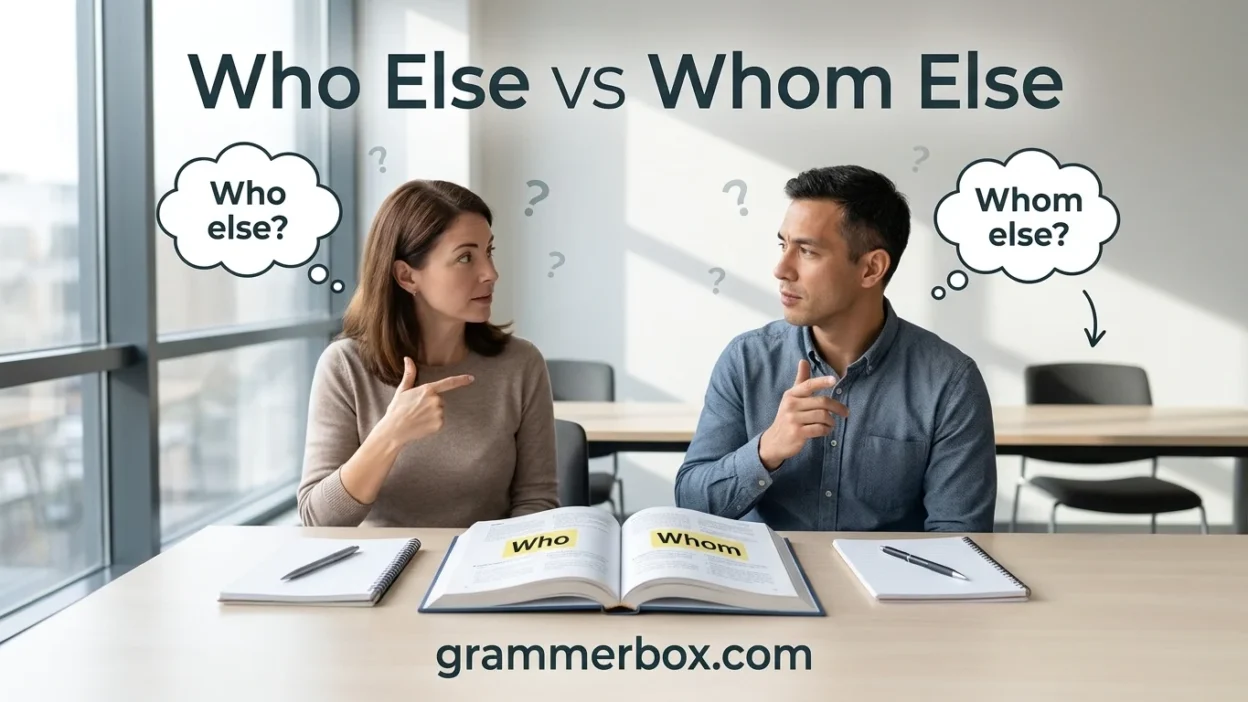
The difference between who else and whom else often confuses English learners because both phrases refer to another person. The main difference depends on the grammatical role of the pronoun in a sentence. Who is generally used as a subject, while whom is traditionally used as an object.
However, modern English has made this distinction less strict in everyday conversation. Who else is much more common and natural in spoken English, while whom else usually appears in formal writing or carefully constructed sentences. Understanding when to use each phrase can help you sound more confident and grammatically accurate.
Quick Answer
Who else is used when the person performs the action or when informal English makes who the natural choice. Whom else is traditionally used when the person receives the action or follows a preposition. In modern everyday English, who else is usually more common.
Why People Confuse “Who Else” and “Whom Else”
The confusion comes from the traditional grammar rule surrounding who and whom.
- Who usually acts as the subject of a verb.
- Whom usually acts as the object of a verb or preposition.
- Else simply means another person or thing.
Because modern speakers frequently use who instead of whom, even in situations where whom would traditionally be correct, the distinction can feel unclear.
For example:
- Who else is coming?
- Whom else did you invite?
The first sentence needs a subject, while the second traditionally needs an object.
Who Else: Meaning and Usage
Who else means what other person or which other person. It is commonly used when the person is the subject of the sentence.
Examples
- Who else wants to join us?
- Who else knows the answer?
- Who else is attending the meeting?
- Who else can help me?
- Who else lives here?
In each example, who else performs or is connected to the action.
Simple Rule
Use who else when the phrase acts as the subject of the sentence.
Example:
Who else called you?
Here, who else is the person performing the action of calling.
Whom Else: Meaning and Usage
Whom else also refers to another person, but it is traditionally used when the person is the object of a verb or preposition.
Examples
- Whom else did you invite?
- Whom else should I contact?
- To whom else can I speak?
- With whom else did she travel?
- Whom else were they expecting?
In these sentences, the person is receiving the action rather than performing it.
Simple Rule
Use whom else when the phrase is the object of a verb or follows a preposition in formal grammar.
Who Else vs Whom Else: Comparison Table
| Feature | Who Else | Whom Else |
|---|---|---|
| Grammatical role | Usually subject | Usually object |
| Common in conversation | Very common | Less common |
| Common in formal writing | Yes | Yes, especially in formal contexts |
| Used after a preposition | Less traditional | Traditionally correct |
| Example | Who else is coming? | Whom else did you invite? |
When to Use “Who Else” and “Whom Else”
Use “Who Else” When the Person Is the Subject
Choose who else when the person performs the action.
Examples:
- Who else understands this problem?
- Who else wants coffee?
- Who else is waiting outside?
- Who else works on this project?
Use “Whom Else” When the Person Is the Object
Traditionally, choose whom else when someone receives the action.
Examples:
- Whom else did you ask?
- Whom else should we invite?
- Whom else did he mention?
Use “Whom Else” After a Preposition in Formal English
Examples:
- With whom else did you speak?
- To whom else should I send the message?
- For whom else are you working?
In everyday conversation, many speakers would naturally say:
- Who else did you speak with?
- Who else should I send the message to?
- Who else are you working for?
Both styles may be understood, but the second set is more common in modern spoken English.
Examples of “Who Else” and “Whom Else”
Here are more than ten examples to help you understand the difference clearly.
- Who else is going to the party?
- Who else knows about the plan?
- Who else can solve this problem?
- Who else wants to come with us?
- Who else was there when you arrived?
- Whom else did you invite to dinner?
- Whom else should I call for help?
- Whom else did the manager interview?
- To whom else did you send the email?
- With whom else should we discuss the issue?
- Who else did you invite? (common in modern everyday English)
- Who else should I contact? (common and natural in conversation)
- Whom else were they looking for? (formal)
- Who else could it be?
- To whom else does this information belong?
Common Mistakes
Using “Whom” as the Subject
Incorrect:
Whom else is coming?
Traditional grammar prefers:
Who else is coming?
This is because who else performs the action of coming.
Overusing “Whom” in Casual Conversation
Although whom is grammatically useful, using it too often can sound overly formal in everyday speech.
For example:
Whom else did you invite?
This is grammatically correct, but many speakers naturally say:
Who else did you invite?
Forgetting About Modern Usage
Traditional grammar and modern conversational English are not always identical. In formal writing, the who/whom distinction may matter more. In casual communication, who is often accepted.
Memory Trick for “Who Else” vs “Whom Else”
A useful trick is to replace the phrase with alternative or him/her.
- If alternative works, use who.
- If him/her works, use whom.
Example:
Who else is coming?
You would say:
She is coming.
So use who.
Example:
Whom else did you invite?
You would say:
You invited him.
So traditional grammar uses whom.
Easy reminder:
Who = alternative
Whom = him/her
Who Else vs Whom Else in American and British English
Both American and British English follow the traditional grammatical distinction between who and whom.
However, in both varieties, whom has become less common in everyday speech.
American English
American English strongly favors who in casual conversation.
Common:
Who else did you ask?
More formal:
Whom else did you ask?
British English
British English also uses who frequently in informal speech, although whom may appear more often in formal or traditional writing.
In both varieties, who else is the safer choice for natural everyday conversation.
Similar Words and Related Grammar
Several related words can create similar grammar questions.
Who vs Whom
- Who is traditionally used as a subject.
- Whom is traditionally used as an object.
Whoever vs Whomever
These follow similar rules:
- Whoever usually acts as a subject.
- Whomever traditionally acts as an object.
Who vs That
Both can introduce relative clauses, but their usage depends on the sentence structure and writing style.
Anyone Else vs Someone Else
These phrases also refer to another person.
- Anyone else refers to any additional person.
- Someone else refers to another unspecified person.
FAQs:
Is “who else” grammatically correct?
Yes. Who else is grammatically correct when the phrase acts as the subject of a sentence. It is also widely used in modern everyday English.
Is “whom else” correct?
Yes. Whom else is traditionally correct when the phrase acts as the object of a verb or preposition.
Which is more common: “who else” or “whom else”?
Who else is much more common in modern English, especially in everyday speech and informal writing.
Can I say “Who else did you invite?”
Yes. This sentence is extremely common in modern English. Traditional formal grammar may prefer Whom else did you invite?
Is “Whom else is coming?” correct?
Traditionally, no. The phrase acts as the subject of is coming, so Who else is coming? is the preferred form.
Should I always use “whom” after a preposition?
In formal grammar, whom is traditionally preferred after a preposition, as in With whom else did you speak? In everyday English, many speakers place the preposition later and use who instead.
Does “whom else” sound formal?
Yes. Whom else can sound formal, especially in conversation. Who else is generally more natural in everyday speech.
Remember This
Who else is generally used for the subject of a sentence, while whom else is traditionally used for the object. If you are speaking casually, who else is usually the natural choice. For formal writing, use the alternative vs him/her test to decide.
Conclusion
Understanding who else vs whom else becomes easier when you focus on the role the phrase plays in a sentence. Who else traditionally refers to the subject, while whom else refers to the object. This rule remains useful, especially in formal writing and grammar-focused situations.
Still, language changes over time. In modern English, who else is commonly used in both subject and object positions, especially in speech. The best approach is to consider your audience and level of formality while remembering the traditional who vs whom grammar rule.