
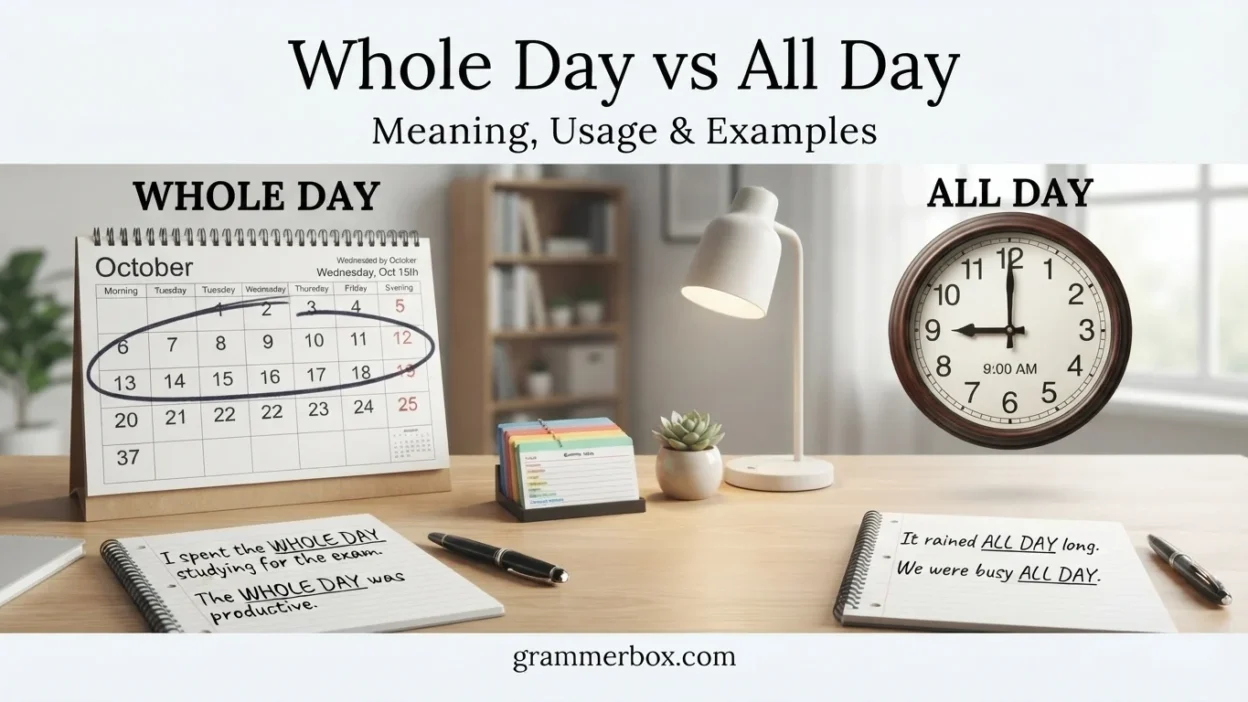
If you’ve ever wondered whether to say “whole day” or “all day,” you’re not alone. These expressions are very similar, and in many everyday conversations, they can seem interchangeable. However, they have slightly different meanings and are used in different grammatical patterns. Understanding that difference can make your English sound more natural and precise.
The key is to focus on what you want to emphasize. “All day” usually describes something that happens continuously or repeatedly throughout the day. “The whole day” emphasizes the complete duration of the day, from beginning to end. In this guide, we’ll explain the difference between whole day vs all day, show you when to use each expression, and provide practical examples so you can confidently choose the right phrase in everyday English.
Quick Answer
“All day” means throughout the entire day and is usually used as an adverbial expression: I worked all day. “The whole day” emphasizes the complete day as a single period: I spent the whole day at home. In many contexts, both can be correct.
Why People Confuse It
The confusion happens because “all day” and “the whole day” both refer to an entire day.
For example:
- I studied all day.
- I studied the whole day.
The first sentence sounds more natural in standard everyday English. The second is understandable, but many native speakers would prefer “I studied all day” or “I studied for the whole day.”
Another reason for the confusion is that whole and all can both communicate completeness.
- All focuses on something covering the entire period.
- Whole emphasizes something as one complete unit.
This distinction becomes clearer when you look at their grammatical patterns.
First Word: Whole Day
Whole means complete or entire.
When referring to a specific day, the most natural expression is usually “the whole day.”
Examples:
- I spent the whole day cleaning.
- She stayed at the beach the whole day.
- We talked about it for the whole day.
Notice that whole day generally needs a determiner such as the, my, your, or a depending on the sentence.
Common patterns
- the whole day
- my whole day
- your whole day
- a whole day
- the whole afternoon
- the whole week
For example:
The whole day was spent preparing for the event.
Here, whole emphasizes the day as one complete period.
Second Word: All Day
All day means throughout the entire day.
It is extremely common in everyday English.
Examples:
- I worked all day.
- It rained all day.
- He was busy all day.
- They played outside all day.
Unlike whole day, all day normally does not require the.
You would say:
- ✅ I waited all day.
- ❌ I waited the all day.
All day commonly functions as an adverbial phrase, telling us how long something happened.
You can also use variations such as:
- all day long
- all day yesterday
- all day today
- all day tomorrow
For example:
She was studying all day long.
This adds extra emphasis to the duration.
Whole Day vs All Day: Comparison Table
| Feature | Whole Day | All Day |
|---|---|---|
| Basic meaning | The complete day | Throughout the day |
| Common form | The whole day | All day |
| Main emphasis | The day as a complete unit | Duration throughout the day |
| Common grammatical role | Noun phrase | Adverbial phrase |
| Example | I spent the whole day there. | I stayed there all day. |
| Sounds natural in everyday speech? | Yes, in the right structure | Very common |
| Can mean the entire duration? | Yes | Yes |
| Usually needs “the”? | Often | No |
When to Use Each
Use “All Day” for Duration
Use all day when you want to say that an activity or situation continued throughout the day.
Examples:
- I was working all day.
- The baby cried all day.
- It snowed all day.
- We drove all day.
Here, the focus is on how long something happened.
Use “The Whole Day” for the Complete Day
Use the whole day when you want to emphasize the day as a complete period.
Examples:
- We spent the whole day at the museum.
- She dedicated the whole day to the project.
- He had the whole day free.
The phrase can also be used for contrast or emphasis:
I had the whole day to finish the assignment.
This emphasizes that the person had an entire day available.
Examples: Whole Day vs All Day
Here are practical examples showing how these expressions work.
- I worked all day.
The work continued throughout the day. - I spent the whole day working.
The entire day was devoted to working. - It rained all day.
Rain continued throughout the day. - The whole day was ruined by the storm.
The complete day was affected. - She studied all day for her exam.
Studying continued throughout the day. - She spent the whole day preparing for her exam.
The complete day was devoted to preparation. - We were traveling all day.
Traveling continued throughout the day. - We spent the whole day traveling.
The entire day was used for traveling. - He was busy all day.
His busy state continued throughout the day. - He had the whole day to complete the task.
He had an entire day available. - They played games all day.
The activity continued throughout the day. - They spent the whole day at the park.
The entire day was spent at the park.
Common Mistakes
1. Saying “the all day”
This is incorrect.
- ❌ I worked the all day.
- ✅ I worked all day.
All day does not normally take the.
2. Forgetting “the” before “whole day”
When you mean a specific complete day, the whole day is usually the natural structure.
- ❌ I stayed there whole day.
- ✅ I stayed there the whole day.
However, whole day can appear without the in other structures, such as:
- It was a whole day of travel.
- We need a whole day to finish this.
3. Treating “whole” and “all” as completely identical
Although both can refer to an entire day, their grammatical behavior differs.
Compare:
- I waited all day.
- I waited for the whole day.
Both can be correct, but all day is more natural and concise in many contexts.
4. Overusing “for”
You don’t normally need for with all day.
- ❌ I worked for all day.
- ✅ I worked all day.
But for the whole day is possible:
- ✅ I worked for the whole day.
Memory Trick
Use this simple rule:
ALL = throughout
WHOLE = complete
So:
I worked all day. → I worked throughout the day.
I spent the whole day working. → The complete day was spent working.
If you’re describing an activity’s duration, all day is usually your best choice.
If you’re emphasizing the day as a complete unit, the whole day works well.
American vs British English
There is no major difference between American and British English when it comes to the basic meanings of all day and the whole day.
Both varieties commonly use:
- I worked all day.
- We spent the whole day there.
- It rained all day.
- She had the whole day free.
The main difference is not regional grammar but natural phrasing and context. All day is particularly common when describing duration, while the whole day is useful when emphasizing the complete period.
British and American speakers may also use all day long for extra emphasis:
He talked about football all day long.
Similar Words and Expressions
Several expressions are closely related to whole day and all day.
All day long
Means throughout the entire day, often with stronger emphasis.
The children played all day long.
The entire day
A more formal alternative to the whole day.
She spent the entire day working on the report.
Throughout the day
A slightly more formal expression that means during the entire day or at different times during it.
Please drink plenty of water throughout the day.
All morning
Means throughout the morning.
I was busy all morning.
The whole morning
Emphasizes the complete morning.
We spent the whole morning discussing the problem.
All week
Means throughout the week.
I’ve been working all week.
The whole week
Emphasizes the week as a complete period.
We stayed there the whole week.
FAQs:
Is “whole day” grammatically correct?
Yes, but it usually needs a determiner. “The whole day” is the most common form when referring to a specific entire day.
Is “all day” correct English?
Yes. All day is a standard and very common expression meaning throughout the entire day.
Is it “all day” or “the whole day”?
Both can be correct. Use all day when emphasizing duration and the whole day when treating the day as one complete period.
Can I say “I worked the whole day”?
Yes. It is understandable and grammatically possible, although “I worked all day” is often more natural in everyday English.
Can I say “I worked all the day”?
Generally, no. Standard modern English normally uses “I worked all day.”
What is the difference between “all day” and “all day long”?
Both mean throughout the day. All day long adds emphasis and can suggest that something continued for a particularly long or noticeable time.
Is “whole day” more formal than “all day”?
Not necessarily. The whole day and all day are both natural expressions. The choice depends mainly on meaning, emphasis, and sentence structure.
Final Verdict
The easiest way to remember whole day vs all day is to focus on the role each expression plays.
All day usually describes duration:
I worked all day.
The whole day emphasizes the complete day:
I spent the whole day at home.
In many situations, the meanings overlap, so both may communicate essentially the same idea. However, all day is often the more natural choice when answering the question “How long?”
Remember This
- All day = throughout the day.
- The whole day = the complete day.
- Use all day without the.
- Use the whole day when referring to a specific complete day.
- All day long adds emphasis.
- For everyday duration, all day is often the simplest and most natural choice.
Conclusion
Understanding whole day vs all day is less about memorizing complicated grammar rules and more about recognizing what you want to emphasize. All day naturally describes an activity, condition, or event that continues throughout the day, while the whole day presents the day as a complete period.
When you’re unsure, ask yourself whether you’re describing duration or emphasizing a complete unit of time. If you’re talking about something continuing throughout the day, choose all day. If you’re highlighting the entire day as a single period, the whole day is often the better choice.