
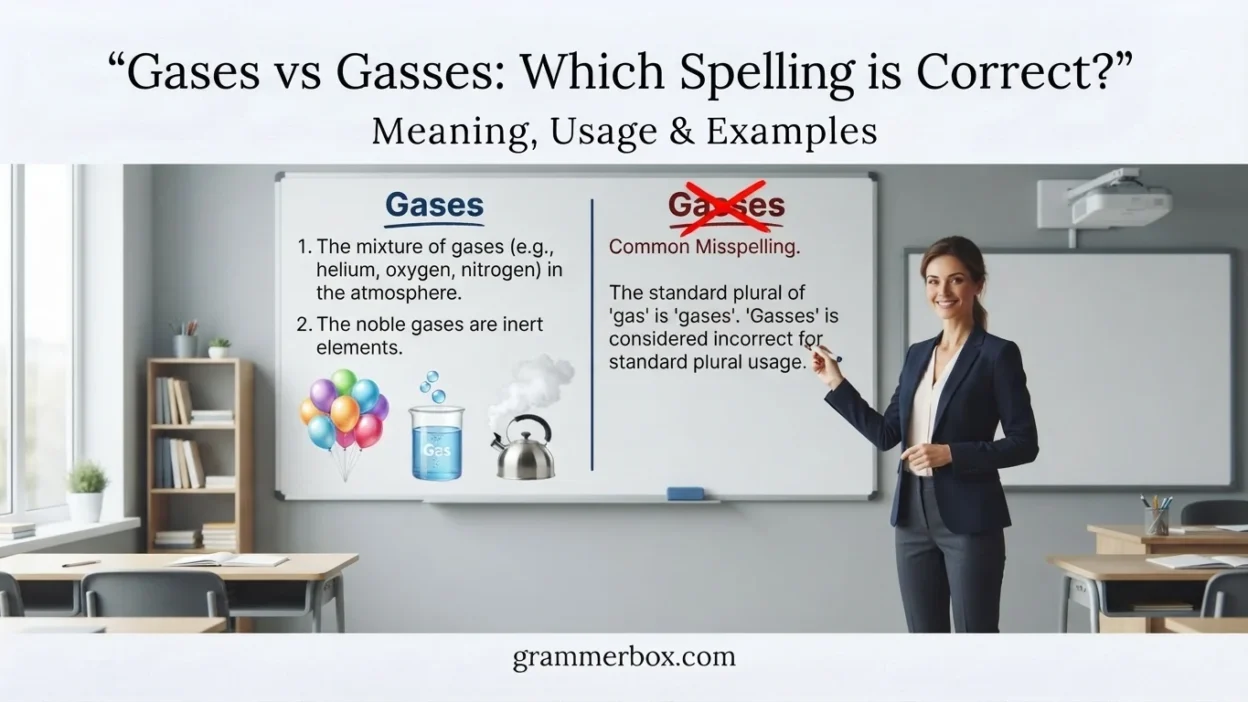
If you have ever hesitated between gases vs gasses, you are not alone. These two spellings look almost identical, but they are not interchangeable in standard English. The confusion usually comes from the fact that gas has two different plural-related forms depending on how it is being used. One is the ordinary plural of the noun gas, while the other is a verb form associated with gass—a much less common word.
In everyday writing, science, and general communication, choosing the right spelling depends on the grammatical role of the word. Gases is by far the more common form when you are talking about multiple gases or substances in a gaseous state. Gasses can be correct in a specific verbal context, but it is uncommon and often mistaken for a spelling error. This guide explains the difference clearly, with examples and an easy memory trick.
Quick Answer
Gases is the standard plural of gas, meaning more than one gas or gaseous substance. Gasses is generally a verb form meaning “treats with gas” or “exposes to gas,” though it is uncommon. For most everyday and scientific writing, use gases.
Why People Confuse It
The confusion comes from English spelling rules and pronunciation.
When a noun ending in -s forms a plural, writers sometimes expect the plural to require -es, while others may simply add another s.
For gas, the standard plural is:
- gas → gases
- one gas → several gases
However, gasses can also appear as a verb form. This makes the spelling technically possible but much less common.
The important point is that gases and gasses usually have different grammatical functions.
First Word: Gases
Gases is the plural form of the noun gas.
A gas is a substance that does not have a fixed shape or volume and expands to fill its container. Examples include oxygen, nitrogen, carbon dioxide, and helium.
Examples of “Gases”
- The atmosphere contains several different gases.
- Scientists studied the gases released during the reaction.
- Some gases are invisible.
- Greenhouse gases can affect Earth’s climate.
- The laboratory stores compressed gases in cylinders.
In these sentences, gases refers to more than one type or quantity of gas.
Singular vs. plural
- Singular: The gas escaped from the pipe.
- Plural: Several gases were detected in the sample.
So, when you need the plural noun, gases is the spelling you normally want.
Second Word: Gasses
Gasses is a legitimate but uncommon word. It is generally used as a verb, particularly as the third-person singular form of gass.
For example:
- The machine gasses the material before processing.
- The technician gasses the chamber.
That said, many readers may find gasses unusual because gas is much more commonly used as the verb, with forms such as gasses or gases depending on the intended verb and dictionary convention.
There is also an important distinction between gasses as a verb and gases as the plural noun.
If you are writing about oxygen, carbon dioxide, or other substances, gases is almost certainly the word you need.
Gases vs Gasses: Comparison Table
| Feature | Gases | Gasses |
|---|---|---|
| Base word | Gas | Gass |
| Common function | Plural noun | Verb |
| Meaning | More than one gas | Exposes or treats with gas |
| Frequency | Very common | Rare/uncommon |
| Scientific writing | Standard | Usually not appropriate |
| Example | “Different gases were tested.” | “The device gasses the material.” |
| Best everyday choice | Yes | Usually no |
When to Use Each
Use “gases” when:
Use gases when you are referring to multiple gases or gaseous substances.
Common contexts include:
- Chemistry
- Physics
- Environmental science
- Medicine
- Industrial processes
- Everyday descriptions
Example:
“Different gases were present in the container.”
Use “gasses” when:
Use gasses only when it functions as a verb in a context where gass is the intended base verb.
Example:
“The equipment gasses the chamber.”
Because this usage is uncommon, check your dictionary or the terminology used in your specific field if you are unsure.
Examples of Gases and Gasses
Here are examples that make the distinction easier to see:
- The atmosphere contains many different gases.
- Oxygen and nitrogen are common gases.
- The scientists measured the gases inside the container.
- Several gases were produced during the chemical reaction.
- Greenhouse gases include carbon dioxide and methane.
- The laboratory uses compressed gases for experiments.
- The detector identifies dangerous gases in the air.
- Different gases behave differently under pressure.
- The industrial system gasses the material before the next stage.
- The machine gasses the chamber automatically.
- Researchers analyzed the gases released by the sample.
- The technician checked the cylinders containing various gases.
Notice that the first group uses gases as a plural noun, while the less common gasses examples use it as a verb.
Common Mistakes
Mistake 1: Using “gasses” as the plural of gas
❌ The laboratory contains several gasses.
✅ The laboratory contains several gases.
When you mean multiple gases, use gases.
Mistake 2: Assuming “gases” is always a verb
Because gases can sometimes appear as a verb form, context matters.
For example:
- The atmosphere contains gases. → plural noun
- The machine gases the chamber. → verb
Mistake 3: Avoiding “gases” because it looks unusual
Some writers incorrectly assume that gases should be spelled gasses because the pronunciation may sound like it contains a double consonant.
The correct plural spelling is gases.
Mistake 4: Confusing plural nouns with verb forms
Always ask yourself:
Am I talking about more than one gas, or am I describing an action?
If it is a plural noun, gases is the standard choice.
Memory Trick
Here is a simple way to remember the difference:
Gases = gases in the air.
Think:
If you are talking about oxygen, helium, nitrogen, carbon dioxide, or other substances, remember gases.
For gasses, remember:
Gasses = an uncommon verb form.
So if you are writing a normal sentence about multiple gases, gases is almost always the correct answer.
American vs. British English
There is no major American-versus-British spelling difference for the plural noun.
Both American and British English normally use:
gas → gases
For example:
- American English: “The gases were analyzed.”
- British English: “The gases were analyzed.”
The distinction is therefore mainly about grammar and word function, not regional spelling.
If you see gasses, do not automatically assume it is British English. Its use is generally related to the verb rather than a British plural spelling.
Similar Words
Understanding related forms can make this distinction easier.
Gas
The singular noun refers to a gaseous substance.
Example:
“The gas escaped from the tank.”
Gases
The plural noun refers to more than one gas.
Example:
“The gases reacted with each other.”
Gassed
A past-tense or past-participle form of gas in certain verb senses.
Example:
“The workers were gassed by the fumes.”
Gassing
The -ing form of gas when used as a verb.
Example:
“The engine is gassing the mixture.”
Gassy
An adjective meaning containing or producing a lot of gas.
Example:
“The drink made him feel gassy.”
Final Verdict
When deciding between gases vs gasses, the safest choice for the plural of gas is gases.
Use gases when discussing multiple gaseous substances, whether you are writing about chemistry, the atmosphere, pollution, or everyday situations.
Gasses is much less common and belongs to a specialized verbal usage. Therefore, if your sentence means “more than one gas,” choose gases.
FAQs:
1. Is “gases” or “gasses” correct?
Gases is correct when you mean the plural of gas. Gasses can occur as a verb form, but it is much less common.
2. What is the plural of gas?
The standard plural of gas is gases.
Example: “Several gases were found in the sample.”
3. Is “gasses” a real word?
Yes. Gasses can be a valid verb form in certain contexts, but it is uncommon. It should not normally be used as the plural of gas.
4. Why is the plural “gases” instead of “gasses”?
The standard English plural of gas is formed with -es, producing gases. The spelling gasses has a different grammatical use.
5. Do Americans spell it “gasses”?
No, not as the standard plural. American English uses gases for the plural noun, just like British English.
6. Is “gases” used in scientific writing?
Yes. Gases is the normal spelling in scientific contexts when referring to multiple gaseous substances.
7. How do you remember “gases” vs “gasses”?
Remember gas → gases for the plural noun. Think of gasses as the unusual verb form rather than the ordinary plural.
Remember This
Gases = plural noun → more than one gas.
Gasses = uncommon verb form → an action involving gas.
If you are talking about oxygen, nitrogen, carbon dioxide, helium, or other gaseous substances, gases is the spelling you want.
Conclusion
The difference between gases vs gasses becomes straightforward once you identify the word’s grammatical role. Gases is the standard plural noun and is the form you will encounter most often in science, education, news, and everyday writing. If your sentence refers to several gaseous substances, choose gases.
Gasses is not simply an alternative spelling of the plural noun. It can function as a verb in a relatively uncommon usage. When in doubt, replace the word with “more than one gas.” If that meaning fits your sentence, gases is the correct choice.