
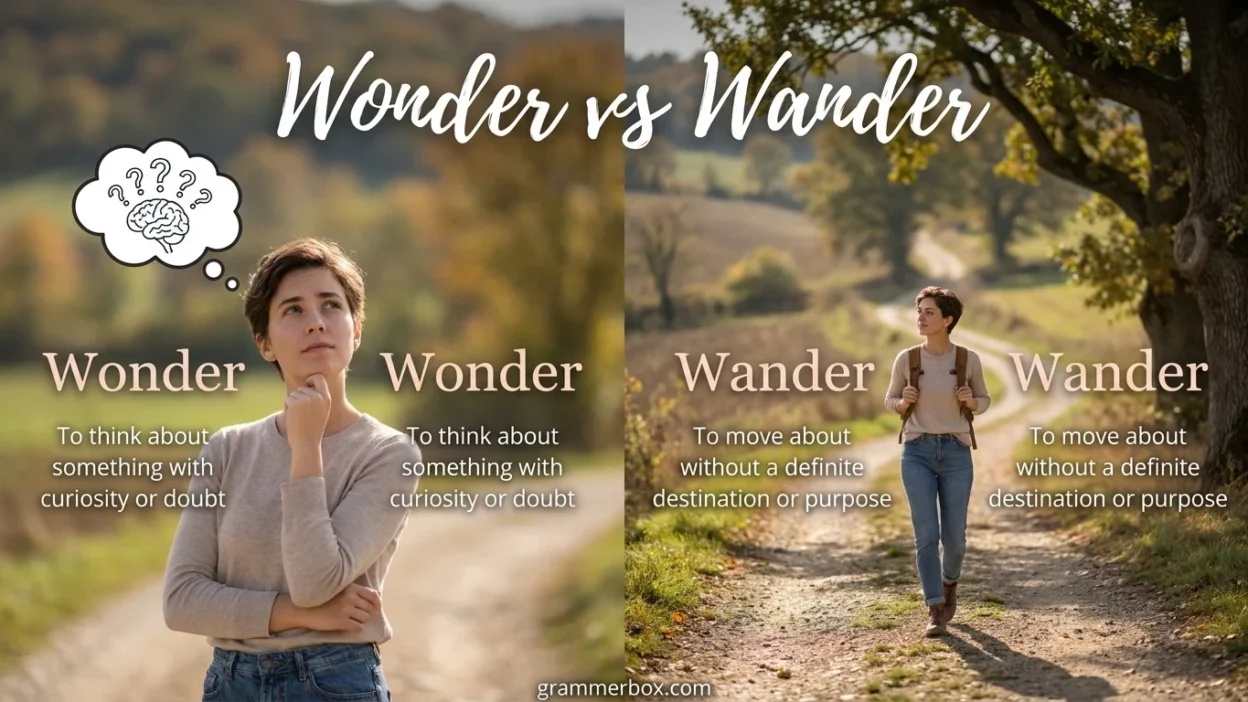
Wonder and wander are two commonly confused English words because they look and sound quite similar. However, they have completely different meanings and are used in different situations. Wonder is mainly connected with curiosity, amazement, or thinking about something, while wander describes moving around without a clear direction or purpose.
Knowing the difference between wonder vs wander can help you write more clearly and avoid a common spelling and vocabulary mistake. For example, you might wonder why someone is late, but you might wander around a park while waiting for them. One word describes a thought or feeling; the other usually describes physical or figurative movement.
In this guide, you’ll learn the meaning, pronunciation, grammar, and correct usage of both words. You’ll also see practical examples, common mistakes, memory tricks, and a comparison table to make the difference easy to remember.
Quick Answer
Wonder means to think about something with curiosity or feel amazement. Wander means to move around without a specific destination or direction. Remember: you wonder with your mind, but you wander with your feet.
Why People Confuse Wonder and Wander
The confusion comes mainly from their similar spelling and pronunciation. Both words contain the letters w, n, and d, and their sounds are close enough to cause mistakes in everyday speech.
Their meanings, however, are very different:
- Wonder → think, question, or feel amazed.
- Wander → walk or move without a fixed destination.
- Wonder is often related to the mind.
- Wander is often related to movement.
A simple example makes the distinction clear:
I wonder where she went.
I wandered around the city looking for her.
Wonder: Meaning and Usage
Wonder can be a verb or a noun.
As a verb, it means to think about something because you are curious or uncertain.
Examples:
- I wonder what happened.
- She wondered why he left early.
- Do you wonder what the future will bring?
- I wonder if they are coming tonight.
Wonder can also mean to feel great admiration or amazement.
- We wondered at the beauty of the mountains.
- The children wondered at the magician’s performance.
As a noun, wonder refers to a feeling of amazement or something remarkable.
- The Grand Canyon is a natural wonder.
- The children stared at the fireworks in wonder.
Common Meanings of Wonder
Wonder can express:
- Curiosity
- Uncertainty
- Amazement
- Admiration
- A remarkable or extraordinary thing
Wander: Meaning and Usage
Wander is primarily a verb meaning to move around without a particular destination, direction, or purpose.
For example:
- We wandered through the old town.
- She likes to wander around the park.
- The tourists wandered through the market.
- I wandered down the street after dinner.
Wander can also be used figuratively. Your thoughts, attention, or conversation can wander away from the main subject.
- My mind wandered during the lecture.
- His thoughts wandered to his childhood.
- The conversation wandered from one topic to another.
So, wander does not always mean physically walking. It can also describe something that moves or drifts without a clear direction.
Wonder vs Wander: Comparison Table
| Feature | Wonder | Wander |
|---|---|---|
| Part of speech | Verb and noun | Mainly verb |
| Main meaning | Think, question, or feel amazement | Move without a fixed direction |
| Connected with | Curiosity or amazement | Movement or drifting |
| Example | I wonder what she means. | I wander around the park. |
| Past tense | Wondered | Wandered |
| Common phrase | I wonder if… | Wander around |
| Memory clue | Mind | Movement |
When to Use Wonder vs Wander
Use wonder when you are talking about curiosity, uncertainty, questioning, or amazement.
Use wonder when:
- You want to know something.
- You are thinking about a possibility.
- You feel amazed.
- You are describing something extraordinary.
Examples:
- I wonder where John is.
- She wondered whether she had made the right choice.
- We stood in wonder at the view.
Use wander when someone or something moves without a definite destination.
Use wander when:
- Someone walks around without a plan.
- Someone gets lost or moves away from a route.
- Your thoughts drift away from a subject.
- A conversation moves from one topic to another without a clear structure.
Examples:
- We wandered around the museum.
- The dog wandered into the garden.
- My mind began to wander during the meeting.
Wonder vs Wander Examples
Here are more examples showing the difference in real sentences:
- I wonder why she hasn’t called.
- We wandered through the quiet streets.
- I wonder if it will rain tomorrow.
- The children wandered around the playground.
- She wondered whether he was telling the truth.
- He wandered into the kitchen looking for a snack.
- I often wonder what life will be like in ten years.
- They wandered along the beach for hours.
- The students wondered about the strange noise.
- My mind wandered while I was reading the book.
- We wondered at the incredible view from the mountain.
- The lost traveler wandered through the village.
Notice the pattern: wonder involves thinking or amazement, while wander involves drifting or moving without a specific destination.
Common Mistakes
Mistake 1: Using “wander” for curiosity
❌ I wander what happened.
✅ I wonder what happened.
When you mean “I am curious” or “I want to know,” use wonder.
Mistake 2: Using “wonder” for walking
❌ We wondered around the city.
✅ We wandered around the city.
When you mean walking or moving without a specific destination, use wandered.
Mistake 3: Confusing “wander” with “wonder”
❌ I wondered through the forest.
✅ I wandered through the forest.
The person is physically moving, so wandered is correct.
Mistake 4: Forgetting the “a”
A useful spelling difference is:
- wonder → no a
- wander → has an a
That extra a can remind you of away, as in wandering away from a planned route.
Memory Trick: Wonder vs Wander
Try this easy trick:
Wonder = Why?
Wander = Where?
When you wonder, you ask yourself questions:
“I wonder why she left.”
When you wander, you move around:
“We wandered wherever the road led us.”
Another quick memory trick:
Wonder = Mind 🧠
Wander = Movement 🚶
If the sentence is about thinking or curiosity, choose wonder. If it is about walking or drifting, choose wander.
American vs British English
There is no major difference in meaning between American and British English for wonder and wander. Both varieties use the words in essentially the same ways.
The spelling and pronunciation remain standard in both forms of English.
For example:
- American English: I wonder where he is.
- British English: I wonder where he is.
And:
- American English: We wandered around the town.
- British English: We wandered around the town.
The distinction is therefore not an American-versus-British spelling issue. It is simply a difference in meaning and usage.
Similar Words
Several words are related to the meanings of wonder and wander.
Words Similar to Wonder
Depending on the context, synonyms include:
- Question
- Consider
- Ponder
- Think
- Speculate
- Marvel
- Admire
- Be curious
Example:
I wonder what happened.
Similar:
I wonder = I question / think about what happened.
Words Similar to Wander
Depending on context, synonyms include:
- Roam
- Stroll
- Meander
- Drift
- Ramble
- Explore
- Stray
- Loiter
Example:
We wandered around the village.
Similar:
We roamed around the village.
Be careful, though: these words are not always interchangeable. The exact meaning depends on the sentence.
Final Verdict
The difference between wonder vs wander is simple once you connect each word with its main idea.
Wonder is about the mind: you think, question, feel curious, or experience amazement.
Wander is about movement: you walk, roam, drift, or move without a definite destination.
Remember:
If you are asking yourself a question, you wonder. If you are walking without a clear destination, you wander.
FAQs:
1. What is the difference between wonder and wander?
Wonder means to think about something with curiosity or feel amazement. Wander means to move around without a specific destination or direction.
2. Is it “I wonder” or “I wander”?
Use I wonder when you mean “I am curious” or “I want to know.”
I wonder what time the store closes.
Use I wander when you mean “I move around without a clear destination.”
I wander around the park on weekends.
3. Is “wander” the same as “walk”?
Not exactly. Walk simply means moving on foot, while wander usually suggests moving without a particular destination, plan, or direction.
4. Can wonder be a noun?
Yes. Wonder can be a noun meaning amazement or something extraordinary.
The natural wonder attracted thousands of visitors.
5. Can wander describe thoughts?
Yes. Wander can describe thoughts, attention, or the mind drifting away from the subject.
My mind wandered during the long meeting.
6. Are wonder and wander homophones?
No. They are not exact homophones. Their pronunciations are similar, but they have different vowel sounds and completely different meanings.
7. What is an easy way to remember wonder and wander?
Think wonder = mind and wander = movement. If you are thinking or questioning, use wonder. If you are moving without a clear destination, use wander.
Conclusion
Although wonder and wander look and sound similar, they describe two very different ideas. Wonder is connected to curiosity, thought, uncertainty, and amazement, while wander describes movement without a fixed destination. Understanding this distinction will help you avoid one of the more common English word-choice mistakes.
The easiest way to remember the difference is to connect wonder with your mind and wander with movement. You can wonder about a question, but you wander around a city. Once you learn this simple association, choosing the correct word becomes much easier in both speaking and writing.
Remember This
Wonder = think, question, or feel amazed.
Wander = move, roam, or drift without a clear direction.
Mind → Wonder
Movement → Wander