
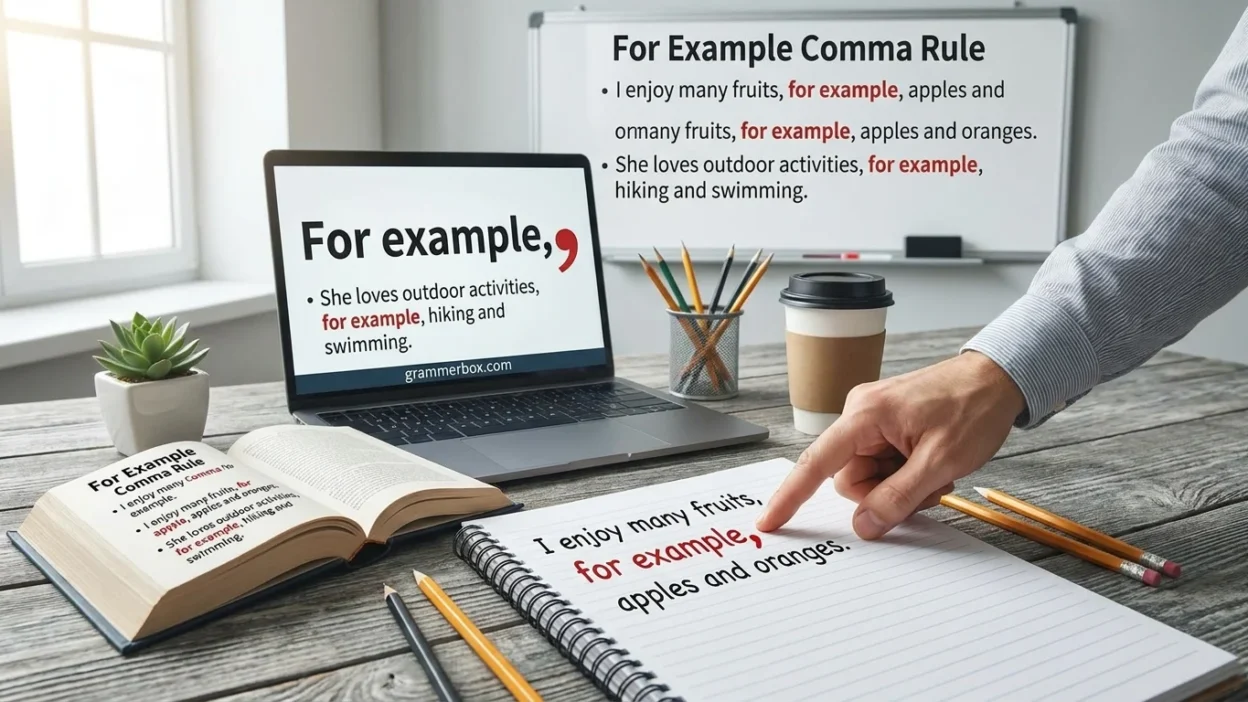
Using commas with “for example” can be surprisingly confusing. Should you write “For example, apples are healthy” or “For example apples are healthy”? What about a sentence such as “Many fruits, for example, apples, are nutritious”? The answer depends on where “for example” appears and what role it plays in the sentence.
The for example comma rule becomes much easier once you recognize whether the phrase introduces an example, interrupts a sentence, or appears at the end. In most cases, a comma follows “for example” when it begins a sentence or independent clause. When it works as a parenthetical expression in the middle of a sentence, it is usually set off with commas. This guide explains the rules with clear examples so you can use “for example” confidently in academic writing, professional communication, essays, and everyday English.
Quick Answer
Use a comma after “for example” when it introduces an example at the beginning of a sentence or clause: “For example, cats are independent.” In the middle of a sentence, use commas around it when it is parenthetical: “Cats, for example, are independent.” At the end, a comma usually comes before it: “Some pets are independent, for example.”
Why People Confuse the For Example Comma Rule
The confusion happens because “for example” can appear in several different positions.
Compare these structures:
- Beginning: For example, Sarah enjoys classical music.
- Middle: Sarah, for example, enjoys classical music.
- End: Sarah enjoys classical music, for example.
The phrase has the same basic meaning in all three sentences, but its punctuation changes according to its position and function.
Another common problem is confusing “for example” with a conjunction. It can introduce an example, but it does not normally join two complete sentences with a comma alone.
First Word: “For”
The word “for” has several grammatical functions in English. It can be a preposition, as in:
- This gift is for you.
- We waited for two hours.
However, in “for example,” the two words form a fixed expression meaning “as an example” or “to illustrate.”
Examples:
- I enjoy outdoor activities, for example, hiking.
- For example, hiking is a great way to exercise.
The punctuation depends on how the complete expression “for example” functions in the sentence.
Second Word: “Example”
“Example” is a noun meaning something that illustrates or represents a general idea.
In the phrase “for example,” it is part of an expression used to introduce a specific case or illustration.
For instance:
Several fruits contain vitamin C. For example, oranges are a popular source.
Here, “for example” signals that oranges are a specific example of the general category fruits that contain vitamin C.
For Example Comma Rule: Comparison Table
| Position of “for example” | Typical punctuation | Example |
|---|---|---|
| Beginning of sentence | Comma after it | For example, dogs need regular exercise. |
| Beginning of a clause | Comma after it | Some animals, for example, dogs need exercise. |
| Middle as an interruption | Commas around it | Dogs, for example, need regular exercise. |
| End of sentence | Usually comma before it | Some animals need exercise, for example. |
| After a semicolon | Comma after it | Some pets are energetic; for example, dogs often need exercise. |
When to Use Each Comma Pattern
1. “For example,” at the Beginning
When “for example” starts a sentence or clause, a comma normally follows it.
Correct:
- For example, vegetables provide important nutrients.
- For example, you could take the train instead.
- For example, Jane speaks three languages.
The comma separates the introductory phrase from the main statement.
2. “For example” in the Middle
When the phrase interrupts the sentence and provides additional information, place a comma before and after it.
Correct:
- Tom, for example, prefers working in the morning.
- Many animals, for example, dolphins, are highly intelligent.
- You can choose several colors, for example, blue or green.
Removing “for example” should leave a grammatically complete sentence in this parenthetical construction:
Tom prefers working in the morning.
That is a useful test for deciding whether the phrase should be enclosed by commas.
3. “For example” at the End
When “for example” comes at the end, a comma often appears before it.
Examples:
- Some people enjoy winter sports, for example.
- You could bring something useful, for example.
- There are several ways to save money, for example.
However, this construction can sound slightly formal or less natural than placing the example directly into the sentence.
For Example Comma Rule: 10+ Clear Examples
Here are practical examples showing how the punctuation works.
- For example, regular exercise can improve your fitness.
- For example, you could start with a short walk.
- Many fruits, for example, apples and oranges, contain important nutrients.
- Sarah, for example, prefers tea over coffee.
- Some animals, for example, elephants, live in social groups.
- You can improve your writing in several ways, for example, by reading regularly.
- For example, this simple technique can save time.
- Several subjects, for example, mathematics and science, require careful study.
- Mark enjoys outdoor activities, for example, hiking and cycling.
- Some foods are rich in protein, for example, eggs and beans.
- You could use another method, for example.
- For example, changing your daily routine may improve productivity.
Common Mistakes With “For Example”
Mistake 1: Leaving Out the Comma at the Beginning
Incorrect:
For example students can practice vocabulary every day.
Better:
For example, students can practice vocabulary every day.
Mistake 2: Using Only One Comma Around a Parenthetical “For Example”
Incorrect:
James, for example enjoys reading.
Correct:
James, for example, enjoys reading.
If the phrase is functioning as an interruption, both commas are needed.
Mistake 3: Creating a Comma Splice
Do not automatically join two independent sentences with a comma simply because “for example” follows.
Incorrect:
I enjoy several sports, for example, I play tennis every weekend.
Better options include:
I enjoy several sports. For example, I play tennis every weekend.
Or:
I enjoy several sports; for example, I play tennis every weekend.
Mistake 4: Adding Unnecessary Commas
Not every occurrence needs multiple commas. Look at the grammatical structure first.
The goal is not to memorize a comma after every occurrence of “for example.” Instead, determine whether it is introductory, parenthetical, or part of the sentence’s natural structure.
Memory Trick for the For Example Comma Rule
Use this simple rule:
Start = comma after.
Middle = commas around.
End = comma before.
Think:
- For example, → comma after
- , for example, → commas around
- , for example. → comma before
This quick pattern works for many ordinary sentences.
American vs. British English
The basic comma rules for “for example” are broadly similar in American and British English.
Both varieties commonly use:
- For example, at the beginning
- …, for example, … when the phrase is parenthetical
- …, for example. when it appears at the end
Differences in punctuation can sometimes come from individual writing style, publishing conventions, or the level of formality rather than from a major difference between American and British English.
In formal writing, the safest approach is to follow the punctuation conventions of the style guide or institution you are using.
Similar Words and Expressions
Several expressions can perform a similar job to “for example.”
For instance
“For instance” is almost interchangeable with “for example.”
- For instance, you could try another approach.
- You could try another approach, for instance.
Such as
“Such as” usually introduces examples directly within a sentence.
- I enjoy fruits such as apples and bananas.
You generally do not need to put commas around “such as” when it introduces an essential example.
Including
“Including” can introduce examples or members of a larger group.
- We sell several products, including notebooks and planners.
E.g.
“E.g.” is an abbreviation of the Latin exempli gratia, meaning “for example.”
- You can choose a fruit, e.g., an apple or an orange.
Its punctuation and style may vary according to the relevant style guide, so check the requirements for formal academic or professional writing.
Final Verdict
The for example comma rule is mainly about understanding the phrase’s position in a sentence.
- At the beginning: For example,
- In the middle as a parenthetical phrase: , for example,
- At the end: , for example.
- Between independent clauses: consider a semicolon, period, or another appropriate connector rather than creating a comma splice.
The most important point is that “for example” does not always receive exactly the same punctuation. Its role and position determine what punctuation makes the sentence clear and grammatically sound.
FAQs:
1. Do you always put a comma after “for example”?
No. A comma commonly follows “for example” when it introduces a sentence or clause, as in “For example, dogs need exercise.” When it appears elsewhere, the punctuation depends on its grammatical function.
2. Do you need two commas around “for example”?
Usually, yes, when “for example” is a parenthetical interruption in the middle of a sentence.
Example:
Maria, for example, enjoys painting.
3. Is there a comma before “for example”?
Often, yes, particularly when “for example” is parenthetical or appears at the end of a sentence.
Example:
Some people prefer quiet hobbies, for example.
4. Can “for example” start a sentence?
Yes. It is perfectly acceptable to begin a sentence with “For example.”
For example, you can improve your vocabulary by reading daily.
5. Can I use a semicolon before “for example”?
Yes, especially when “for example” introduces an independent clause that provides an example of the previous statement.
Several animals are excellent swimmers; for example, dolphins can travel efficiently through water.
6. Is “for example” the same as “for instance”?
Yes. They are generally interchangeable when introducing an illustration or specific case.
7. Is “for example” formal English?
Yes. “For example” is standard English and works well in academic, professional, conversational, and everyday writing.
Conclusion
The for example comma rule becomes simple once you pay attention to where the phrase appears. Use a comma after “for example” when it introduces a sentence or clause, and use commas around it when it functions as a parenthetical interruption. When it appears at the end, a comma before it is often appropriate.
Good punctuation should make your meaning easier to understand, not make writing feel complicated. If you remember the basic start, middle, end pattern and watch for comma splices, you can use “for example” naturally and confidently in essays, emails, articles, and everyday English.
Remember This
For example, → comma after it
…, for example, … → commas around it
…, for example. → comma before it
When “for example” connects two complete thoughts, do not rely on a comma alone. Use a period, semicolon, or another suitable structure.