Choosing between “a hilarious” and “an hilarious” can be confusing because the word hilarious begins with a vowel letter. However, English articles are based on sound, not simply spelling. Once you know how hilarious is pronounced, the correct choice becomes much easier to remember.
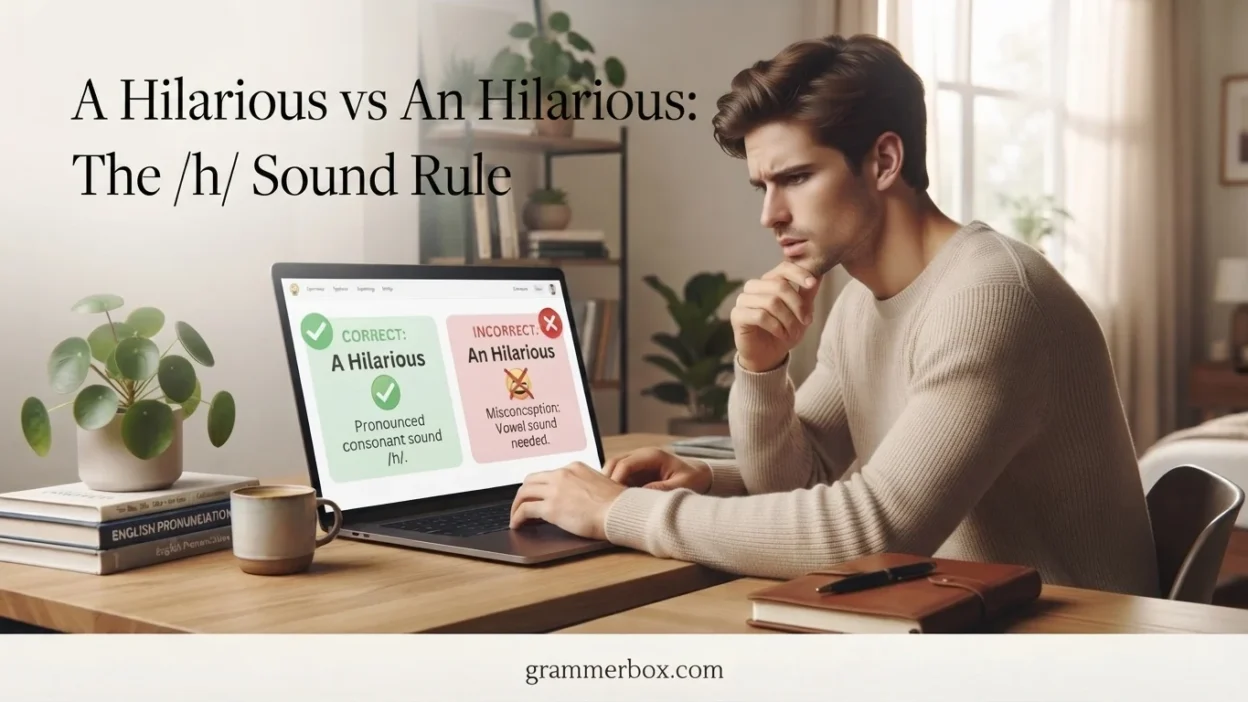
The standard and grammatically correct expression is “a hilarious.” We use a because hilarious begins with a pronounced /h/ sound, making its opening sound consonantal. For example, you would say, “She told a hilarious story,” not “She told an hilarious story.” This article explains the difference between a hilarious vs an hilarious, shows when to use each form, and provides practical examples so you can use the correct indefinite article confidently.
Quick Answer
“A hilarious” is correct, while “an hilarious” is generally incorrect in standard modern English. The word hilarious begins with a pronounced h sound, so it takes a, not an. Say “a hilarious joke” and “a hilarious story.”
Why People Confuse It
The confusion comes from the spelling of hilarious. Since the word starts with the letter h, some learners may focus on the letters that follow it and assume an should be used.
English articles do not depend only on the first letter. They depend on the first sound of the following word.
Compare:
- a hilarious joke — correct
- an hilarious joke — generally incorrect
- a happy child — correct
- an honest child — correct
Notice that honest begins with a vowel sound because its h is silent. Hilarious, however, has a clearly pronounced h sound.
First Word: “A Hilarious”
“A hilarious” is the standard correct form.
The indefinite article a is used before words that begin with a consonant sound. Because hilarious starts with a pronounced /h/ sound, a is the appropriate article.
Examples
- That was a hilarious joke.
- We watched a hilarious movie last night.
- He told a hilarious story at dinner.
- She made a hilarious comment.
- It was a hilarious mistake.
A useful way to think about it is to say the phrase aloud. You naturally hear the consonant sound at the beginning: a hilarious.
Second Word: “An Hilarious”
“An hilarious” is not the normal form in contemporary standard English.
The article an is used before a word beginning with a vowel sound, such as:
- an apple
- an interesting idea
- an unusual event
- an honest answer
Although hilarious begins with the letter h, the important point is that its h is pronounced. Therefore, an hilarious does not follow the normal article rule.
You may occasionally encounter “an hilarious” in older writing, dialectal usage, or text influenced by historical pronunciation patterns, but it is not the preferred form for modern standard English.
Comparison Table
| Expression | Correct? | Reason |
|---|---|---|
| a hilarious | ✅ Yes | Hilarious begins with a pronounced /h/ sound. |
| an hilarious | ❌ Generally no | Hilarious does not begin with a vowel sound. |
| a hilarious joke | ✅ Yes | “Hilarious” begins with a consonant sound. |
| an honest joke | ✅ Yes | The h in honest is silent. |
| a happy person | ✅ Yes | Happy begins with a pronounced /h/ sound. |
| an interesting joke | ✅ Yes | Interesting begins with a vowel sound. |
When to Use Each
Use “a hilarious” when:
Use a before hilarious whenever you are describing one singular countable noun.
Examples:
- a hilarious joke
- a hilarious story
- a hilarious scene
- a hilarious video
- a hilarious comedian
- a hilarious situation
Avoid “an hilarious” in standard English
For normal academic writing, professional communication, essays, articles, and everyday modern English, choose a hilarious.
For example:
The comedian told a hilarious story about his childhood.
Not:
The comedian told an hilarious story about his childhood.
Examples of “A Hilarious”
Here are more examples showing the correct usage:
- We watched a hilarious comedy together.
- Sarah shared a hilarious story from her vacation.
- That was a hilarious joke.
- He made a hilarious observation during the meeting.
- The children created a hilarious video.
- I read a hilarious article this morning.
- They had a hilarious conversation.
- The actor delivered a hilarious performance.
- My brother made a hilarious mistake.
- She posted a hilarious comment online.
- We heard a hilarious story at lunch.
- The movie included a hilarious scene.
Common Mistakes
Mistake 1: Choosing “an” because of the spelling
Some writers see the first vowel in hilarious and choose an.
Incorrect: an hilarious joke
Correct: a hilarious joke
Mistake 2: Assuming every “h” word uses “an”
This is another common misconception.
Words such as happy, hilarious, helpful, historical, and hungry can begin with a pronounced /h/ sound.
But words such as honest, honor, and hour have a silent h, so they take an.
Mistake 3: Applying the rule to letters instead of sounds
The key question is not:
“What letter does the word start with?”
Instead, ask:
“What sound does the word start with?”
That simple change will help you choose a or an correctly.
Memory Trick
Use this simple rule:
Consonant sound → a
Vowel sound → an
Since hilarious starts with an audible h sound:
hilarious → /h/ sound → a hilarious
You can remember it with this sentence:
“Hear the H? Use A.”
Compare:
- a hilarious joke → pronounced H
- an honest joke → silent H
American vs British English
In both American English and British English, the standard modern form is “a hilarious.”
There is no major standard dialect difference that changes the normal article choice here. In both varieties, hilarious begins with a pronounced h sound.
You may encounter “an hilarious” in older texts or unusual stylistic contexts, but it should not normally be used in contemporary standard English.
Similar Words
Understanding similar examples can make the a vs. an rule easier.
Words that use “a”
- a hilarious story
- a happy child
- a helpful teacher
- a historical event
- a humorous comment
- a healthy meal
These words begin with a pronounced consonant sound.
Words that use “an”
- an honest person
- an honorable decision
- an hour
- an heir
- an unusual event
- an interesting story
These words begin with a vowel sound, even when their spelling may initially look confusing.
The same principle applies to other words: listen to the pronunciation rather than relying only on the first written letter.
Final Verdict
The correct expression in standard modern English is “a hilarious,” not “an hilarious.”
The reason is simple: hilarious begins with a pronounced /h/ consonant sound. Therefore, it follows the same article pattern as happy, helpful, and humorous.
If you’re writing an essay, email, website article, social media post, or formal document, choose a hilarious. The phrase “an hilarious” may appear occasionally in historical or nonstandard usage, but it is not the normal modern form.
FAQs:
Is “a hilarious” grammatically correct?
Yes. “A hilarious” is grammatically correct because hilarious begins with a pronounced /h/ consonant sound.
Is “an hilarious” correct?
Generally, no. “An hilarious” is not the standard modern English form. Use a hilarious instead.
Why do we say “a hilarious” instead of “an hilarious”?
English uses a before consonant sounds and an before vowel sounds. Hilarious begins with a pronounced /h/ sound, so it takes a.
Is it “a hilarious joke” or “an hilarious joke”?
The correct phrase is “a hilarious joke.”
Is the H in hilarious silent?
No. The h in hilarious is pronounced, which is why the word takes a rather than an.
Do Americans and British people use different forms?
No. Both standard American and British English normally use “a hilarious.”
What is the easiest way to remember a vs. an?
Focus on the sound, not the spelling. If the next word starts with a consonant sound, use a. If it starts with a vowel sound, use an.
Remember This
A hilarious ✅
An hilarious ❌
The first sound matters, not simply the first letter. Because hilarious has a pronounced H, the correct phrase is “a hilarious joke,” “a hilarious story,” or “a hilarious movie.”
Conclusion
The difference between a hilarious vs an hilarious is easy to solve once you understand the relationship between articles and pronunciation. Although hilarious begins with the letter h, that H is pronounced, giving the word a consonant sound at the beginning. That is why a hilarious is the standard grammatical choice.
When you’re unsure whether to use a or an, say the phrase aloud and listen to the first sound. This approach works far better than simply looking at the first letter. Remember: “a hilarious” is the correct modern English form, while “an hilarious” should generally be avoided.