Have you ever wondered whether to use awaiting vs. waiting in a sentence? Both words describe situations in which someone expects something to happen or remains until something arrives. However, they differ in grammatical structure, tone, and the way they connect to the expected event. Understanding this distinction can help you write more naturally in emails, professional documents, academic assignments, and everyday conversations.
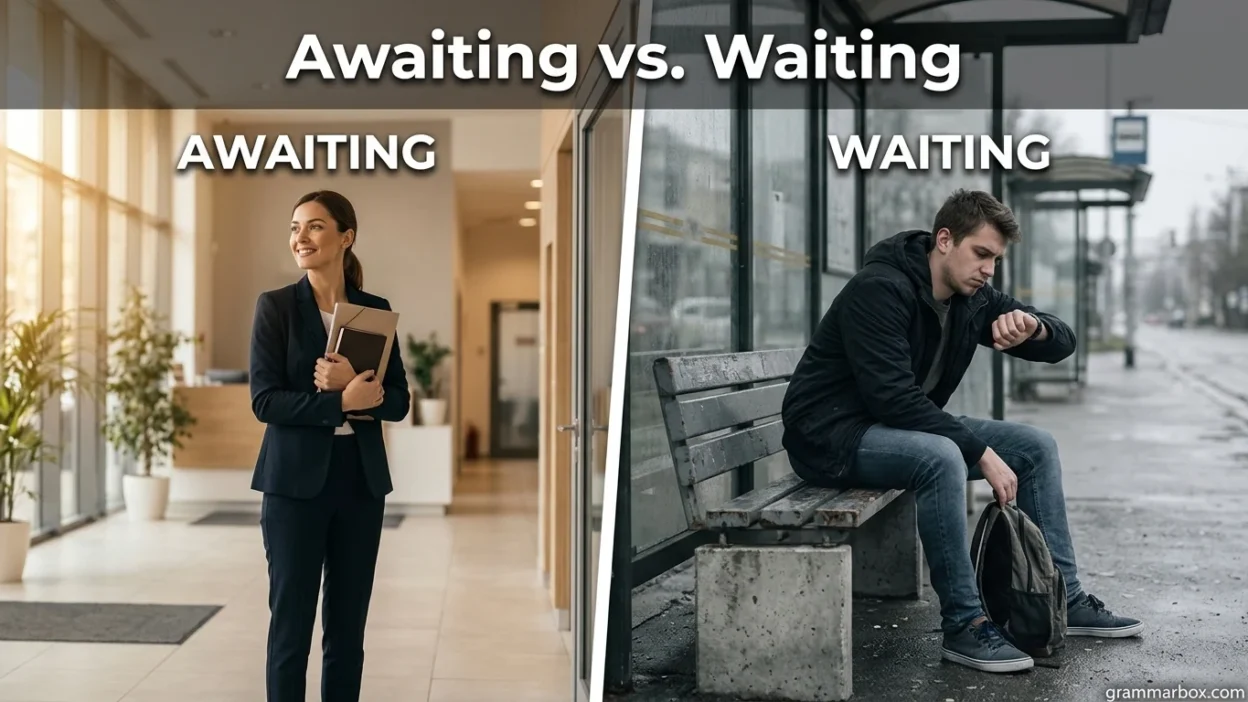
The main difference is that awaiting usually takes a direct object, while waiting commonly appears with for when identifying the person or thing someone expects. For example, you can say, “I am awaiting your response” or “I am waiting for your response.” Both sentences are correct, but the first sounds more formal, while the second is more conversational. Learning when to use each expression will help you avoid common grammar mistakes and choose the most appropriate wording for different situations.
Quick Answer
Awaiting vs. waiting differs mainly in sentence structure and tone. Awaiting means expecting something and usually takes a direct object without a preposition. Waiting often uses for before the expected person or thing. Both can describe the same situation, but awaiting generally sounds more formal.
Why People Confuse It
People often confuse awaiting and waiting because both words describe a period of expectation. They can communicate nearly identical ideas, especially when someone expects news, a decision, an arrival, or a response.
For example:
- “We are awaiting the results.”
- “We are waiting for the results.”
Both sentences are grammatically correct and convey the same basic message. The difference lies in their construction and tone.
There are three main reasons for this confusion:
- Similar meanings: Both words can describe expecting something to happen.
- Different sentence structures: Awaiting usually takes a direct object, whereas waiting often uses for.
- Different levels of formality: Awaiting is common in formal writing, while waiting is widely used in everyday speech.
Understanding these differences makes it easier to select the right word without changing your intended meaning.
First Word: Awaiting
Awaiting is the present participle of the verb await. It means expecting something to happen or remain available until something arrives, occurs, or becomes known.
The word is often used in formal, professional, and written English. It commonly appears in business emails, official announcements, news reports, and descriptions of pending decisions.
How to Use Awaiting
The basic structure is:
Subject + form of be + awaiting + object
Examples:
- I am awaiting your reply.
- She is awaiting the final decision.
- We are awaiting further instructions.
- The company is awaiting approval.
- They are awaiting the examination results.
Notice that awaiting connects directly to the expected thing. You do not normally insert for between awaiting and its object.
Correct: “I am awaiting your response.”
Incorrect in standard usage: “I am awaiting for your response.”
When Awaiting Is Appropriate
Use awaiting when you want your writing to sound formal, concise, or professional.
Common contexts include:
- Business communication: “We are awaiting your confirmation.”
- Official updates: “The application is awaiting review.”
- Academic writing: “The researchers are awaiting the final data.”
- News reporting: “The defendant is awaiting trial.”
- Everyday writing: “I am awaiting the results of my test.”
Although awaiting is useful in formal contexts, it is also perfectly acceptable in ordinary conversation.
Second Word: Waiting
Waiting is the present participle of the verb wait. It describes remaining in a place, delaying an action, or allowing time to pass until something happens.
It is extremely common in everyday English and works naturally in both casual and professional communication.
How to Use Waiting
When referring to an expected person, event, or thing, the usual structure is:
Subject + form of be + waiting + for + object
Examples:
- I am waiting for your reply.
- She is waiting for the final decision.
- We are waiting for further instructions.
- The company is waiting for approval.
- They are waiting for the examination results.
Unlike awaiting, the verb waiting commonly uses the preposition for before the expected thing.
When Waiting Is Appropriate
Use waiting when describing an ordinary situation, a delay, or an expectation.
Common examples include:
- Everyday conversation: “I am waiting for my friend.”
- Travel: “We are waiting for the bus.”
- Workplace communication: “I am waiting for your approval.”
- Customer service: “Your order is waiting for collection.”
- Personal situations: “She is waiting for the right moment.”
The word waiting can also appear without for when the sentence describes the action or situation rather than naming the expected object.
For example, “I am waiting outside” and “Please keep waiting” are both correct.
Awaiting vs. Waiting: Comparison Table
| Feature | Awaiting | Waiting |
|---|---|---|
| Basic meaning | Expecting something to happen or arrive | Remaining until something happens or arrives |
| Grammar | Usually takes a direct object | Often uses for before the expected object |
| Common structure | Awaiting + noun | Waiting for + noun |
| Tone | Often formal | Neutral and conversational |
| Common contexts | Official updates, reports, business writing | Daily conversation, travel, work, and general situations |
| Example | I am awaiting your response. | I am waiting for your response. |
| Preposition before the object | Usually no preposition | Usually for |
| Can describe remaining in a place? | Not usually in the same sense | Yes: “I am waiting outside.” |
The key point is that both words can express expectation, but their grammatical patterns are different.
When to Use Each
Choosing between awaiting and waiting depends on your sentence structure and the tone you want to achieve.
Use Awaiting for Formal Expectations
Choose awaiting when referring directly to something expected, especially in official or professional writing.
Examples:
- We are awaiting your confirmation.
- The proposal is awaiting approval.
- The committee is awaiting the final report.
- The patient is awaiting test results.
These sentences are concise and appropriate for formal communication.
Use Waiting for Everyday Situations
Choose waiting when talking naturally about people, transportation, appointments, or expected events.
Examples:
- I am waiting for my brother.
- She is waiting for a taxi.
- We are waiting for the meeting to begin.
- They are waiting for the food to arrive.
These expressions sound natural in ordinary conversation.
Can You Use Both in the Same Sentence Context?
Yes. In many cases, both words are grammatically correct, although their structures differ.
- “I am awaiting your decision.”
- “I am waiting for your decision.”
Both sentences communicate that the speaker expects a decision. The first is more formal, while the second sounds more conversational.
However, the words are not interchangeable in every construction. For example, “I am waiting outside” is natural, whereas “I am awaiting outside” does not express the same idea correctly.
Examples of Awaiting vs. Waiting
The following examples show how both words work in different contexts.
Examples With Awaiting
- I am awaiting your response to my email.
- The students are awaiting their examination results.
- We are awaiting approval from the manager.
- The company is awaiting a decision from the board.
- She is awaiting news about her application.
- The passengers are awaiting further instructions.
- The team is awaiting confirmation of the schedule.
- The patient is awaiting the doctor’s report.
- The project is awaiting final approval.
- The court is awaiting additional evidence.
Examples With Waiting
- I am waiting for your response to my email.
- The students are waiting for their examination results.
- We are waiting for approval from the manager.
- The company is waiting for a decision from the board.
- She is waiting for news about her application.
- The passengers are waiting for further instructions.
- The team is waiting for confirmation of the schedule.
- The patient is waiting for the doctor’s report.
- The children are waiting for the school bus.
- I am waiting for my friend outside the restaurant.
Examples Where Waiting Does Not Need For
Waiting is not always followed by for. The construction depends on what you want to express.
- We are waiting outside the office.
- Please keep waiting until your name is called.
- I cannot keep waiting forever.
- She spent an hour waiting at the station.
- The guests were waiting patiently.
These examples show why it is important to learn the full grammatical pattern rather than memorizing a single rule.
Common Mistakes
Even experienced English learners sometimes confuse these words. Here are the mistakes to avoid.
1. Adding For After Awaiting
Incorrect: “I am awaiting for your reply.”
Correct: “I am awaiting your reply.”
Why? Await normally takes a direct object, so the preposition for is unnecessary.
2. Forgetting For After Waiting
Less natural in standard English: “I am waiting your reply.”
Correct: “I am waiting for your reply.”
Why? When wait refers to an expected person or thing, it normally requires for.
3. Assuming Awaiting Is Always Better
Some writers believe awaiting sounds more intelligent or professional in every situation. However, waiting is also correct in professional communication.
For example, “We are waiting for your confirmation” is perfectly acceptable in a business email.
4. Using Awaiting to Describe a Physical Location
Incorrect: “I am awaiting at the station.”
Correct: “I am waiting at the station.”
Why? Waiting naturally describes remaining at a particular place. Awaiting usually needs an object representing the expected event or thing.
5. Confusing Awaiting With Await
Remember that await is the base form, while awaiting is its -ing form.
- “We await your decision.” — Simple present.
- “We are awaiting your decision.” — Present continuous.
Both can be correct, depending on the sentence.
Memory Trick
Use this simple trick to remember the difference between awaiting vs. waiting:
Awaiting = no “for.” Waiting = usually “for.”
Think of these examples:
- Awaiting approval.
- Waiting for approval.
- Awaiting a reply.
- Waiting for a reply.
Remember that this is a useful rule for sentences involving an expected person or thing, not a rule that every use of waiting must include for.
Another helpful reminder is to associate awaiting with formal messages and waiting with everyday situations. This is a general tendency, not an absolute rule.
American vs. British English
There is no significant difference between American and British English in the basic usage of awaiting and waiting. Both varieties follow the same main grammatical patterns.
| Situation | American English | British English |
|---|---|---|
| Expecting a response | I am awaiting your response. | I am awaiting your response. |
| Expecting a response conversationally | I am waiting for your response. | I am waiting for your response. |
| Remaining at a location | I am waiting outside. | I am waiting outside. |
| Expecting approval | We are awaiting approval. | We are awaiting approval. |
Both varieties use awaiting in formal writing and waiting in everyday communication. Differences may occur in individual preferences or the surrounding vocabulary, but the core grammar remains the same.
You do not need to learn separate American and British rules for these two words.
Similar Words
Several related words can help you express expectation, delay, or anticipation more precisely.
| Word or phrase | Meaning | Example |
|---|---|---|
| Expecting | Believing something will happen | I am expecting a reply. |
| Anticipating | Looking forward to or expecting something | We are anticipating a positive result. |
| Pending | Not yet decided, completed, or resolved | The application is pending approval. |
| In anticipation of | In expectation of something | She prepared in anticipation of the guests’ arrival. |
| Holding on | Waiting, often temporarily | Please hold on for a moment. |
| Standing by | Remaining ready or available | The team is standing by for instructions. |
| Looking forward to | Feeling pleased about something expected | I am looking forward to meeting you. |
These expressions are related to awaiting and waiting, but they are not always interchangeable. Choose the word that best expresses whether you are expecting something, remaining ready, experiencing a delay, or feeling excited about a future event.
FAQs:
1. Is awaiting or waiting correct?
Both are correct. Awaiting normally takes a direct object, as in “I am awaiting your reply.” Waiting usually takes for before the expected thing, as in “I am waiting for your reply.”
2. Is it awaiting your response or waiting for your response?
Both phrases are grammatically correct. “Awaiting your response” sounds more formal and concise, while “waiting for your response” sounds more conversational.
3. Can I say awaiting for?
In standard English, you should generally avoid awaiting for when awaiting is followed by its expected object. Write “awaiting approval,” not “awaiting for approval.”
4. Should I say waiting your reply or waiting for your reply?
Use waiting for your reply. The verb wait normally takes the preposition for when you identify the person or thing you are expecting.
5. Is awaiting more formal than waiting?
Generally, yes. Awaiting is common in formal emails, reports, official statements, and professional writing. Waiting is more common in everyday conversation, although both can be used professionally.
6. What is the difference between await and awaiting?
Await is the base form of the verb, while awaiting is its -ing form. For example, “We await your decision” uses the simple present, whereas “We are awaiting your decision” uses the present continuous.
7. Can waiting and awaiting be used interchangeably?
Sometimes. Both can describe expecting a decision, reply, or result. However, their grammatical structures differ, and waiting can describe remaining in a location or delaying an action in ways that awaiting generally cannot.
Final Verdict
The difference between awaiting vs. waiting is mainly grammatical and stylistic. Awaiting usually takes a direct object without for, as in “I am awaiting your approval.” Waiting commonly uses for when naming the expected person or thing, as in “I am waiting for your approval.” Both forms are correct when used according to their grammatical patterns.
If you are writing a formal email, business report, or official statement, awaiting can be a concise choice. For everyday conversations and descriptions of delays or locations, waiting often sounds more natural. Rather than choosing one word in every situation, focus on the meaning, sentence structure, and tone you want to communicate.
Remember This
- Awaiting + object: Awaiting your reply.
- Waiting + for + object: Waiting for your reply.
- Formal tone: Awaiting is often preferred.
- Everyday English: Waiting is widely used.
- Physical location: “Waiting outside” is correct.
- Common mistake: Avoid “awaiting for your reply” in standard English.