
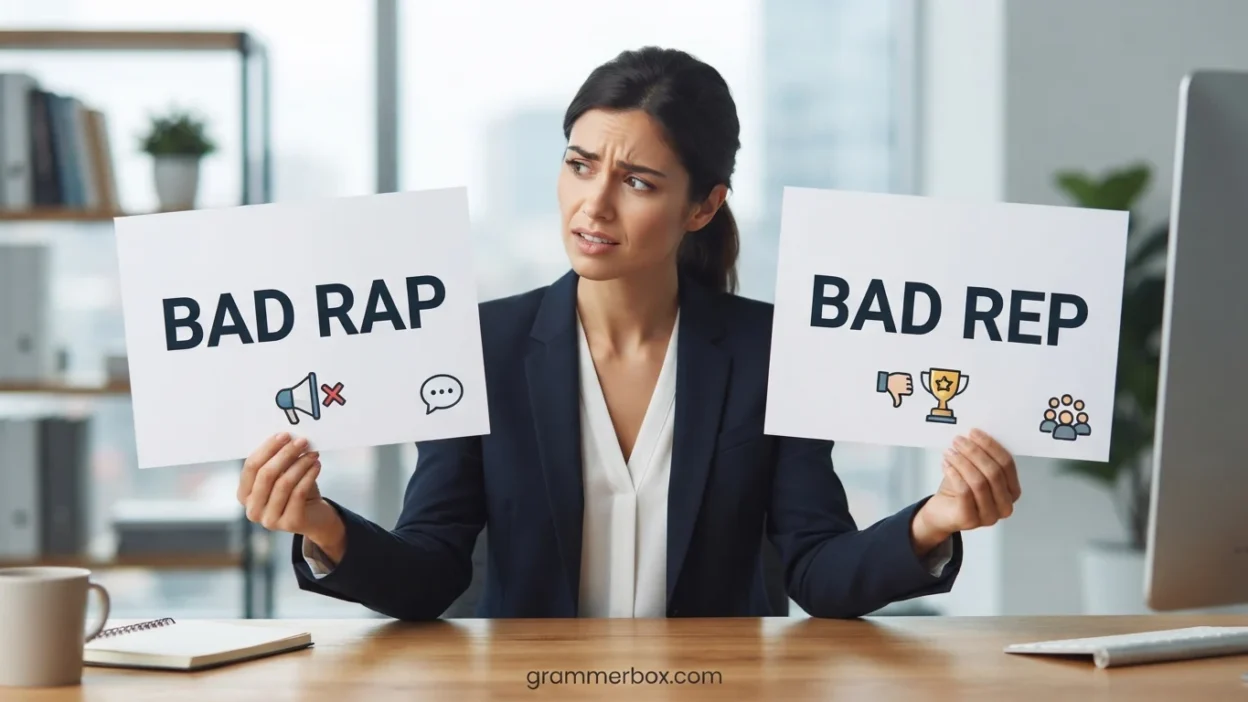
If you have ever heard someone say a person or company has a “bad rap,” you may have wondered if bad rep is actually the correct expression. Both forms appear in everyday English, and they sound almost identical when spoken. That makes this phrase especially easy to confuse in writing. The good news is that there is a clear difference in standard usage.
Bad rap is the traditional and widely accepted expression meaning an unfairly negative reputation, criticism, or judgment. Bad rep is also used, particularly as an informal shortening of “bad reputation,” but it is less established in this fixed expression. Understanding the distinction can help you choose the most natural wording in essays, professional writing, conversations, and online content.
Quick Answer
“Bad rap” is the traditional and generally preferred expression when you mean an unfairly negative reputation or criticism. “Bad rep” is an informal shortening of “bad reputation” and is common in casual speech, but “bad rap” is usually the safer choice in standard writing.
Why People Confuse It
The confusion comes mainly from pronunciation.
When people say rap and rep quickly, the difference can be difficult to hear. Since “rep” is commonly used as a shortened form of reputation, many people naturally assume that “bad rep” must be the correct spelling.
There is also a second reason: both expressions can communicate a similar idea. Someone with a bad reputation can certainly be described as having a bad rep, while bad rap traditionally means receiving unfair criticism or an undeservedly negative reputation.
So, although the meanings overlap, the expressions have different histories and levels of standard usage.
First Word: Bad Rap
Bad rap is an established idiom meaning an unfairly negative reputation, criticism, or judgment.
Here, rap does not mean a musical style. In this expression, it is associated with blame, criticism, or a negative assessment.
Examples of “Bad Rap”
- The restaurant gets a bad rap, but the food is actually excellent.
- Technology often gets a bad rap for making people less social.
- He has a bad rap at school, although he is actually very helpful.
- Don’t give the new manager a bad rap before you get to know her.
The expression can suggest that the negative reputation is undeserved or exaggerated, although it can also be used more generally for negative criticism.
Second Word: Bad Rep
Bad rep is an informal shortening of bad reputation.
For example:
The company has a bad rep for poor customer service.
Here, rep is short for reputation, just as “info” is short for “information.”
“Bad rep” is understandable and widely used in informal English, particularly in conversation, texting, social media, and casual writing. However, when you are specifically using the established idiom, bad rap is generally the preferred form.
For formal writing, an even clearer choice may be bad reputation.
Comparison Table
| Expression | Meaning | Usage | Example |
| Bad rap | Unfairly negative reputation or criticism | Established idiom | She gets a bad rap. |
| Bad rep | Bad reputation | Informal shortening | The brand has a bad rep. |
| Bad reputation | Negative public opinion | Standard and formal | The company has a bad reputation. |
When to Use Each
Use “Bad Rap” for the Idiom
Choose bad rap when you mean that someone or something is receiving negative criticism or an unfairly negative reputation.
Example:
The movie got a bad rap from critics.
This is the safest choice when writing the familiar expression get a bad rap or give someone a bad rap.
Use “Bad Rep” in Casual Contexts
Use bad rep when you are informally shortening bad reputation.
Example:
That neighborhood has a bad rep.
It sounds conversational and is easily understood, but it is less formal than “bad reputation.”
Use “Bad Reputation” in Formal Writing
For academic, business, or professional writing, bad reputation is often the clearest option.
Example:
The company developed a bad reputation for unreliable service.
Examples of Bad Rap vs Bad Rep
- The actor gets a bad rap because of his controversial roles.
- The restaurant has a bad rap, but I actually enjoyed my meal.
- Don’t give her a bad rap without hearing her side of the story.
- The city sometimes gets a bad rap from tourists.
- The company has a bad rep among local customers.
- That brand has developed a bad rep for slow delivery.
- He has a bad rap at work, but his coworkers respect him.
- The neighborhood has a bad rep after several negative news reports.
- Social media often gets a bad rap for its effect on communication.
- The old computer system gets a bad rap, but it still works well.
- She received a bad rap after one misunderstanding.
- The business has a bad rep because of its customer service.
Notice that bad rap works naturally in the established expression “get a bad rap,” while bad rep functions more directly as an informal form of “bad reputation.”
Common Mistakes
Mistake 1: Assuming “Rap” Means Music
In bad rap, “rap” is not referring to hip-hop or a musical performance.
❌ The singer got a bad rap because his music was terrible.
✅ The singer got a bad rap because people misunderstood his comments.
Mistake 2: Thinking “Bad Rep” Is Always Wrong
Bad rep is not meaningless. It is commonly understood as an informal abbreviation of bad reputation.
However, replacing bad rap with bad rep in the established idiom can make your writing sound less conventional.
Mistake 3: Using “Bad Rap” When You Simply Mean Reputation
Sometimes bad reputation is the better choice.
The company has a bad reputation for late deliveries.
This is clearer and more appropriate for formal contexts.
Mistake 4: Confusing “Rap” With “Wrap”
These words sound alike but have completely different meanings.
- Rap = criticize, knock, or the word used in the idiom
- Wrap = cover or enclose something
Memory Trick
Bad rap = bad criticism or an unfair negative reputation.
Think:
Rap = Reputation attacked
If you are talking about the established phrase “get a bad rap,” use rap.
If you are casually shortening reputation, rep can work:
reputation → rep → bad rep
For formal writing, however, bad reputation is the safest and clearest option.
American vs British English
Bad rap is widely recognized in both American and British English.
The expression is especially common in everyday American English, but British speakers also use it. Bad rep is likewise understandable as an informal abbreviation of bad reputation, although it is not normally the preferred spelling of the established idiom.
The important point is that this is not primarily an American-versus-British spelling difference. The distinction is more about idiomatic usage versus informal abbreviation.
Similar Words
Several expressions can communicate ideas similar to bad rap or bad reputation:
- Bad reputation — a generally negative public image
- Poor reputation — a more neutral or formal alternative
- Negative reputation — commonly used in professional contexts
- Bad name — an unfavorable reputation
- Bad press — negative media attention
- Unfair criticism — criticism that is not deserved
- Poor image — an unfavorable public perception
- Negative perception — how people view someone or something unfavorably
Bad Rap vs Bad Reputation
These are closely related but not always identical.
Bad reputation simply describes a negative reputation. Bad rap can emphasize that the negative judgment is unfair, undeserved, or exaggerated.
FAQs:
Is “bad rap” or “bad rep” correct?
Bad rap is the traditional and established expression, especially in phrases such as “get a bad rap.” Bad rep is an informal shortening of “bad reputation.”
Is “bad rep” grammatically correct?
Yes, bad rep can be grammatically acceptable in informal English when “rep” means “reputation.” However, it is not usually the preferred form of the established idiom “bad rap.”
Does “bad rap” mean bad reputation?
Yes. Bad rap generally refers to negative criticism or an unfavorable reputation, often suggesting that the criticism is unfair or undeserved.
Should I use “bad rap” in formal writing?
Yes, if you are deliberately using the established idiom. However, bad reputation may be clearer and more formal in academic or professional writing.
Is “get a bad rap” correct?
Yes. Get a bad rap is a standard and widely used expression meaning to receive unfair or negative criticism or to develop an unfavorable reputation.
What is the difference between rap and rep?
Rap is the traditional word in the idiom bad rap, while rep is commonly used as an informal abbreviation for reputation.
Is “bad rep” a misspelling of “bad rap”?
Not necessarily. Bad rep can be an informal shortening of “bad reputation.” However, if you mean the established idiom, bad rap is the conventional choice.
Remember This
Bad rap = the established idiom for negative or unfair criticism.
Bad rep = informal shorthand for bad reputation.
Bad reputation = the clearest formal choice.
So, if you’re writing “He gets a ___,” choose bad rap.
Conclusion
The difference between bad rap and bad rep becomes much easier once you separate the established idiom from the informal abbreviation. Bad rap is the conventional expression used when someone or something receives negative criticism or an unfair reputation, while bad rep is commonly understood as a shortened form of “bad reputation.”
For everyday writing, bad rap is usually the safest choice when using the idiom. If you are writing something formal, choosing bad reputation can make your meaning even clearer. By remembering “bad rap = established idiom” and “bad rep = informal reputation,” you can avoid one of the most common confusing word choices in English.