
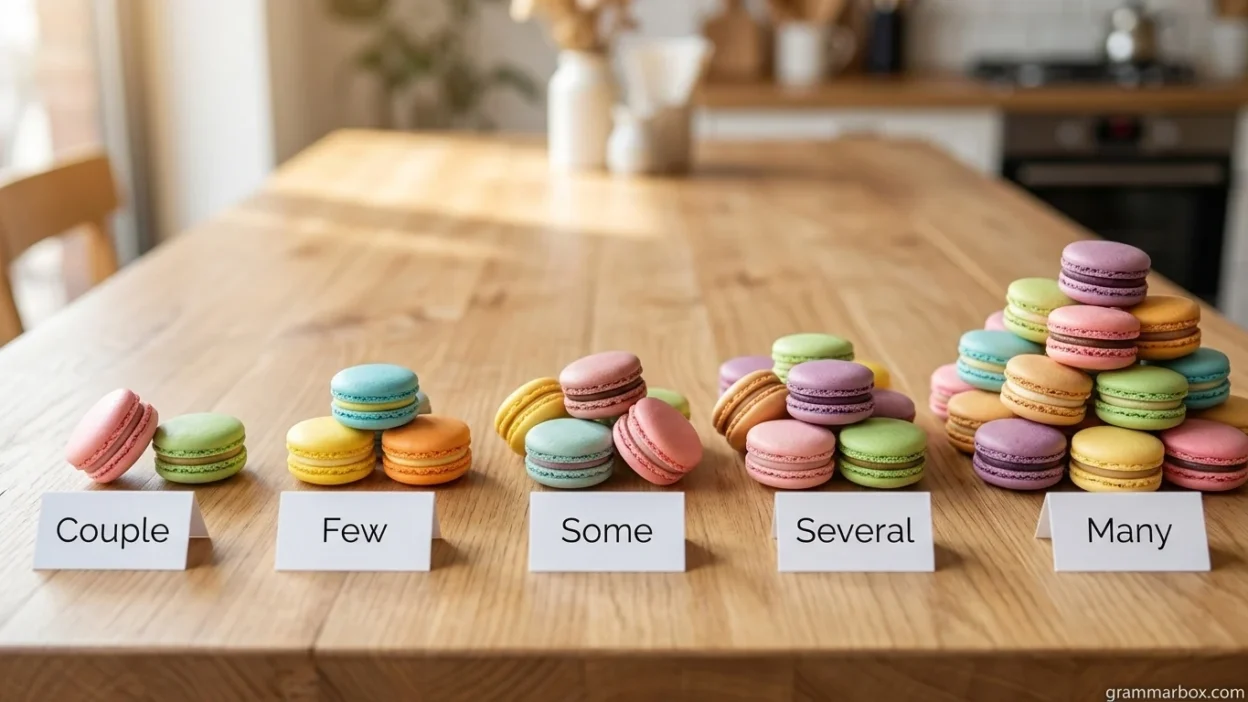
Choosing between couple vs few vs some vs several vs many can be confusing because all five expressions describe quantities, but they do not communicate exactly the same amount. For example, a couple usually means two, a few refers to a small number, some indicates an unspecified quantity, several suggests more than a few, and many describes a large number. Understanding these differences helps you express yourself more clearly in everyday conversations, academic writing, and professional communication.
Although these words may seem interchangeable, each has its own meaning and usage. The correct choice depends on how many people or things you are describing, whether the exact number matters, and the context of your sentence. Learning when to use couple, few, some, several, and many will help you avoid common grammar mistakes and make your English sound more natural. In this guide, you will discover their meanings, differences, practical examples, and simple memory tricks to help you choose the right expression.
Quick Answer
A couple usually means two, a few means a small number, some refers to an unspecified quantity, several suggests more than a few but not a large number, and many indicates a large number. The best choice depends on the quantity, context, and noun being described.
Why People Confuse It
People often confuse these expressions because they all refer to quantities rather than exact measurements. In everyday English, their meanings can overlap, especially when the speaker does not need to provide a precise number.
For example, someone might say, “I have a few books,” or “I have several books.” Both sentences are correct, but several generally suggests a somewhat larger number than a few.
Another source of confusion is that some does not specify a particular amount. Depending on the situation, some could refer to two items, five items, or a much larger quantity.
Here are the main differences:
- Couple: Usually two people or things.
- Few: A small number of countable items.
- Some: An unspecified quantity or number.
- Several: More than a few in many contexts, but not necessarily a large number.
- Many: A large number of countable items.
Understanding these distinctions makes it easier to select the right word without overthinking your sentence.
First Word: Couple
The word couple commonly means two people or things considered together. It is frequently used in everyday English when talking about small quantities.
For example, “I need a couple of minutes” usually means that the speaker needs approximately two minutes. Similarly, “She bought a couple of notebooks” normally suggests two notebooks.
Meaning of Couple
As a quantity expression, couple usually means two, although informal usage can sometimes be less precise.
It can also refer to two people in a relationship, such as a married couple or a young couple.
Examples:
- I have a couple of questions.
- We ordered a couple of sandwiches.
- Give me a couple of minutes to finish.
- A couple of students arrived late.
- They are a happy couple.
How to Use Couple Correctly
In many everyday sentences, couple is followed by of and a plural countable noun.
Correct:
- I bought a couple of apples.
- We watched a couple of movies.
In informal conversation, people sometimes omit of, as in “a couple minutes.” However, “a couple of minutes” is the safer choice in standard writing.
Remember that couple is not generally used for an unspecified large quantity. If you mean twenty or fifty items, many may be more appropriate.
Second Word: Few
The word few means a small number of people or things. It is used with plural countable nouns, such as books, friends, chairs, and questions.
For example, “I have a few friends in London” means that the speaker has a small number of friends there.
Meaning of Few
Few generally suggests that the number is small. Depending on the context, it can also imply that the number is smaller than expected or desirable.
Compare these sentences:
- Few people attended the meeting. This suggests that attendance was low.
- A few people attended the meeting. This means that some people attended, even if the number was small.
The difference between few and a few is important.
Few often has a negative or limiting meaning, while a few usually communicates that there are at least some.
Examples of Few
- Few students understood the difficult question.
- I have a few errands to run.
- A few guests arrived early.
- Few people know the complete story.
- We have a few options available.
Use few when the quantity is small. Use a few when you want to emphasize that a small number exists or is available.
Comparison Table
The following table summarizes the differences between couple, few, some, several, and many.
| Word | General meaning | Typical quantity | Example |
|---|---|---|---|
| Couple | Usually two | About 2 | I bought a couple of pens. |
| Few | A small number | Often around 3–5, depending on context | I have a few questions. |
| Some | An unspecified quantity | Varies | She bought some flowers. |
| Several | More than a few in many contexts | Often around 4–7, depending on context | Several guests arrived. |
| Many | A large number | Depends on context | Many people attended. |
Important: These numerical ranges are only rough illustrations, not strict grammatical rules. Few, some, and several do not have universally fixed numerical boundaries. Their meanings depend on context and the speaker’s perspective.
Third Word: Some
The word some refers to an unspecified quantity or number. It is useful when you know that something exists or is available but do not need to state the exact amount.
Unlike couple and few, some can be used with both plural countable nouns and uncountable nouns.
Examples of countable nouns include books, people, and apples. Examples of uncountable nouns include water, money, and information.
Meaning of Some
Some can mean an unknown or unspecified number of items, or an amount of something.
Examples:
- I bought some books yesterday.
- We need some water.
- Some students prefer online classes.
- She gave me some useful advice.
- There are some cookies in the kitchen.
Notice that some works naturally with both books and water. This makes it more flexible than few or several.
When to Use Some
Use some when the precise quantity is not important or is not known.
It is common in affirmative statements:
- I have some work to finish.
- They invited some friends.
- We need some information about the course.
Some also appears in questions when making offers or requests:
- Would you like some tea?
- Could I have some water?
In these situations, some helps make the question sound natural and polite.
Fourth Word: Several
The word several refers to more than a few people or things, usually a number that is greater than two but not especially large. Its exact quantity depends on context.
For instance, “Several employees attended the workshop” indicates that multiple employees attended, but it does not specify exactly how many.
Meaning of Several
Several is useful when you want to indicate a noticeable number of items without giving an exact figure.
Examples:
- Several students asked questions.
- We visited several museums during our trip.
- She has several years of experience.
- Several people contacted the office.
- The company introduced several changes.
Several is generally used with plural countable nouns. In expressions such as “several years,” it refers to a number of individual years.
Several vs Few
These expressions overlap, but several often suggests a somewhat larger number than a few.
Compare:
- A few people came to the party. A small number attended.
- Several people came to the party. A number of people attended, often suggesting more than just a few.
Neither expression gives an exact count. If the actual number matters, state it directly.
Fifth Word: Many
The word many refers to a large number of people, objects, events, or other countable things. It is commonly used with plural countable nouns.
For example, “Many students applied for the scholarship” indicates that a large number of students submitted applications.
Meaning of Many
Many emphasizes quantity. What counts as many depends on the situation. Ten people might be many for a small meeting, while ten people would be few for a large public event.
Examples:
- Many people use smartphones every day.
- She has many books in her library.
- Many students participated in the competition.
- We received many applications.
- There are many reasons to learn English.
How to Use Many Correctly
Many is normally followed by a plural countable noun.
Correct:
- Many people attended the event.
- Many cars were parked outside.
- Many questions remained unanswered.
Incorrect:
- Many water is needed.
- Many information was provided.
Use much or some with uncountable nouns instead:
- Much water is needed.
- Some information was provided.
In everyday English, many is especially common in questions and negative statements:
- How many students are in your class?
- We do not have many options.
It is also natural in affirmative statements, especially in formal writing and expressions such as “many people” or “many different reasons.”
When to Use Each
Choosing the correct expression becomes easier when you focus on the amount you want to communicate.
Use Couple for Approximately Two
Choose couple when you mean two people or things, especially in casual conversation.
Examples:
- I need a couple of minutes.
- She bought a couple of dresses.
- We have a couple of ideas.
Use Few for a Small Number
Choose few when you want to emphasize a small number of countable items.
Examples:
- Few students passed the test.
- A few guests stayed overnight.
- I have a few suggestions.
Remember that few and a few can communicate different attitudes toward the quantity.
Use Some for an Unspecified Amount
Choose some when the exact number or amount is not important.
Examples:
- I need some paper.
- She bought some oranges.
- Some people disagree with the decision.
Some works with countable and uncountable nouns.
Use Several for a Noticeable Number
Choose several when you mean more than a small handful in the context, without specifying the exact number.
Examples:
- Several customers complained.
- We considered several possibilities.
- He has visited several countries.
Use Many for a Large Number
Choose many when you want to emphasize a large number of countable things.
Examples:
- Many children enjoy stories.
- Many businesses use digital marketing.
- We received many responses.
A Simple Decision Guide
Ask yourself these questions:
- Do I mean two? Use a couple of.
- Do I mean a small number? Use a few or few, depending on the intended meaning.
- Is the quantity unspecified? Use some.
- Do I mean a noticeable number, without an exact count? Use several.
- Do I mean a large number? Use many.
This guide provides a useful starting point, but context remains important because the boundaries between these expressions are flexible.
Examples: Couple vs Few vs Some vs Several vs Many
Here are 15 examples showing how these expressions work in everyday English.
Couple Examples
- I need a couple of minutes to prepare my presentation.
- They purchased a couple of tickets for the concert.
- We invited a couple of friends to dinner.
Few Examples
- Few employees understood the new procedure.
- I have a few ideas for our next project.
- A few birds were sitting on the fence.
Some Examples
- Please bring some water for the journey.
- She bought some fresh vegetables from the market.
- Some people prefer reading printed books.
Several Examples
- Several students participated in the debate.
- We visited several historical buildings.
- He sent several emails to the manager.
Many Examples
- Many people attended the annual festival.
- The teacher answered many questions after class.
- Many families moved to the city for better opportunities.
Comparing the Expressions in Similar Sentences
The following examples show how changing the quantity word affects the meaning.
- A couple of guests arrived. Usually two guests arrived.
- A few guests arrived. A small number of guests arrived.
- Some guests arrived. An unspecified number of guests arrived.
- Several guests arrived. A noticeable number of guests arrived.
- Many guests arrived. A large number of guests arrived.
All five sentences can be grammatically correct. The difference lies in the quantity suggested by each expression.
Common Mistakes
Even proficient English speakers sometimes use quantity expressions imprecisely. These are the mistakes worth avoiding.
1. Treating Couple as a Large Number
Incorrect for the intended meaning: “I have a couple of fifty books.”
Correct: “I have about fifty books.”
Couple usually means two, so it is not suitable when describing fifty books.
2. Confusing Few With A Few
Compare:
- Few people came. The number was small, possibly disappointing.
- A few people came. Some people came, and the statement is generally more positive or neutral.
The article a can change the emphasis significantly.
3. Using Many With Uncountable Nouns
Incorrect: “She gave me many advice.”
Correct: “She gave me some advice.”
Advice is uncountable in standard English, so many advice is incorrect. You can say “many pieces of advice” if you want to count individual pieces.
4. Assuming Some Always Means a Small Number
Incorrect assumption: Some always means two or three.
Correct understanding: Some refers to an unspecified quantity, which may be small or large depending on the situation.
For example, “The company received some applications” does not reveal how many applications arrived.
5. Assuming Several Has an Exact Number
Incorrect assumption: Several always means exactly five.
Correct understanding: Several generally indicates more than a few, but its precise numerical meaning is not fixed.
6. Using Few With Uncountable Nouns
Incorrect: “I have few money.”
Correct: “I have little money.”
Use few with plural countable nouns and little with uncountable nouns. You can also say “I have a little money” when emphasizing that some money is available.
Memory Trick
A simple way to remember these words is to imagine a group of objects growing in number.
- Couple = Two: Picture two apples in your hand.
- Few = Small group: Imagine three or four books on a desk.
- Some = Unknown amount: Picture a bag containing an unspecified number of items.
- Several = Noticeable group: Imagine a small crowd gathered outside.
- Many = Large group: Picture a busy stadium filled with people.
Remember that the images are examples, not exact numerical definitions.
You can also memorize this sequence:
Couple → Few → Some → Several → Many
This sequence is a helpful general guide for thinking about increasing quantities, but some does not always fall neatly between few and several. Its meaning depends on context rather than a fixed position on a numerical scale.
American vs British English
The meanings of couple, few, some, several, and many are broadly the same in American and British English. There is no major regional difference that changes the basic grammar of these expressions.
Both varieties commonly use:
- “A couple of minutes”
- “A few friends”
- “Some information”
- “Several people”
- “Many opportunities”
There can be small differences in informal usage, pronunciation, and individual preferences, but the central meanings remain consistent.
For example, speakers in both the United States and the United Kingdom understand “I will be ready in a couple of minutes” as meaning approximately two minutes.
For formal writing, use the standard forms and pay attention to countable and uncountable nouns. The same grammatical principles apply in both varieties of English.
Similar Words
Several other English expressions describe quantities. Learning them alongside couple, few, some, several, and many can improve your vocabulary.
A Pair
A pair usually refers to two things that belong together or are used together.
Example: “She bought a pair of shoes.”
Unlike couple, pair often emphasizes that the two items form a set.
A Little
A little refers to a small amount of an uncountable noun.
Example: “There is a little milk in the refrigerator.”
Use a little with milk, water, time, and money when treating them as uncountable quantities.
Little
Little means a small amount and can suggest that the amount is insufficient.
Example: “We have little time left.”
A Lot of
A lot of refers to a large quantity or number and works with both countable and uncountable nouns.
Examples:
- A lot of students attended.
- A lot of work remains.
Numerous
Numerous means many and is often used in formal or professional writing.
Example: “The report identifies numerous challenges.”
Plenty of
Plenty of means enough or more than enough.
Examples:
- We have plenty of time.
- There are plenty of seats available.
A Handful
A handful usually means a small number or amount, although its precise meaning depends on context.
Example: “Only a handful of people attended the meeting.”
These alternatives allow you to express quantity more precisely and avoid repeating the same words throughout your writing.
FAQs:
1. What is the difference between couple and few?
A couple usually means two, while few refers to a small number that is not necessarily two. For example, “a couple of books” generally means two books, whereas “a few books” means a small number of books.
2. Is several more than a few?
Generally, yes. Several often suggests a somewhat larger number than a few. However, neither expression has a universally fixed numerical limit, so their meanings can overlap depending on the context.
3. Is some more than a few?
Not necessarily. Some indicates an unspecified quantity, whereas a few specifically suggests a small number. Some could describe two items, several items, or a larger quantity.
4. Does couple always mean two?
Couple usually means two, especially in standard writing. In informal conversation, it can sometimes be used approximately, as in “a couple of minutes.” If the exact number matters, use a specific number instead.
5. Can I use many with uncountable nouns?
No, not directly in standard English. Many is normally used with plural countable nouns, such as books and people. Use much or some with uncountable nouns, such as water, money, and information.
6. What is the difference between few and a few?
Few often emphasizes that the number is smaller than expected or insufficient. A few means that a small number exists and usually sounds more positive or neutral. For example, “Few students passed” contrasts with “A few students passed.”
7. Which word should I use in formal writing?
The best word depends on the meaning. Use couple for approximately two, few for a small number, some for an unspecified quantity, several for a noticeable number, and many for a large number. When precision matters, state the exact number.
Final Verdict
The difference between couple vs few vs some vs several vs many comes down to the quantity you want to communicate. Couple usually means two, few describes a small number, some indicates an unspecified quantity, several suggests a number greater than a few in many contexts, and many emphasizes a large number. Although their meanings can overlap, each expression serves a different purpose in clear English communication.
To choose the right word, consider the context, the noun you are describing, and whether you want to emphasize a small, unspecified, or large quantity. Remember that couple, few, and several are not exact numerical measurements in every situation, while some is especially flexible. With regular practice, these distinctions will become easier to recognize in conversation, academic writing, and professional communication.
Remember This
- Couple: Usually two.
- Few: A small number.
- Some: An unspecified quantity.
- Several: More than a few in many contexts.
- Many: A large number.
The easiest way to choose correctly is to focus on the meaning you want to express rather than trying to assign every word an exact numerical value.