Have you ever wondered whether to use presume or assume when talking about something you believe to be true? These two words are closely related, and people often use them interchangeably in everyday conversations. However, there is a subtle difference between their meanings. Understanding when to use each word can help you communicate more clearly, write more accurately, and sound more confident in professional and academic settings. Although both words involve accepting something as true without complete proof, they often suggest different levels of evidence or expectation.
The word presume generally suggests that you have some reason, evidence, or reasonable expectation for believing something is true. In contrast, assume often means accepting something as true without verifying it first. For example, you might presume someone has arrived because their car is outside, but you might assume they are home simply because they usually arrive at that time. Learning the difference between presume and assume will help you choose the right word for different situations, avoid common grammar mistakes, and express your thoughts more precisely.
Quick Answer: Presume vs. Assume
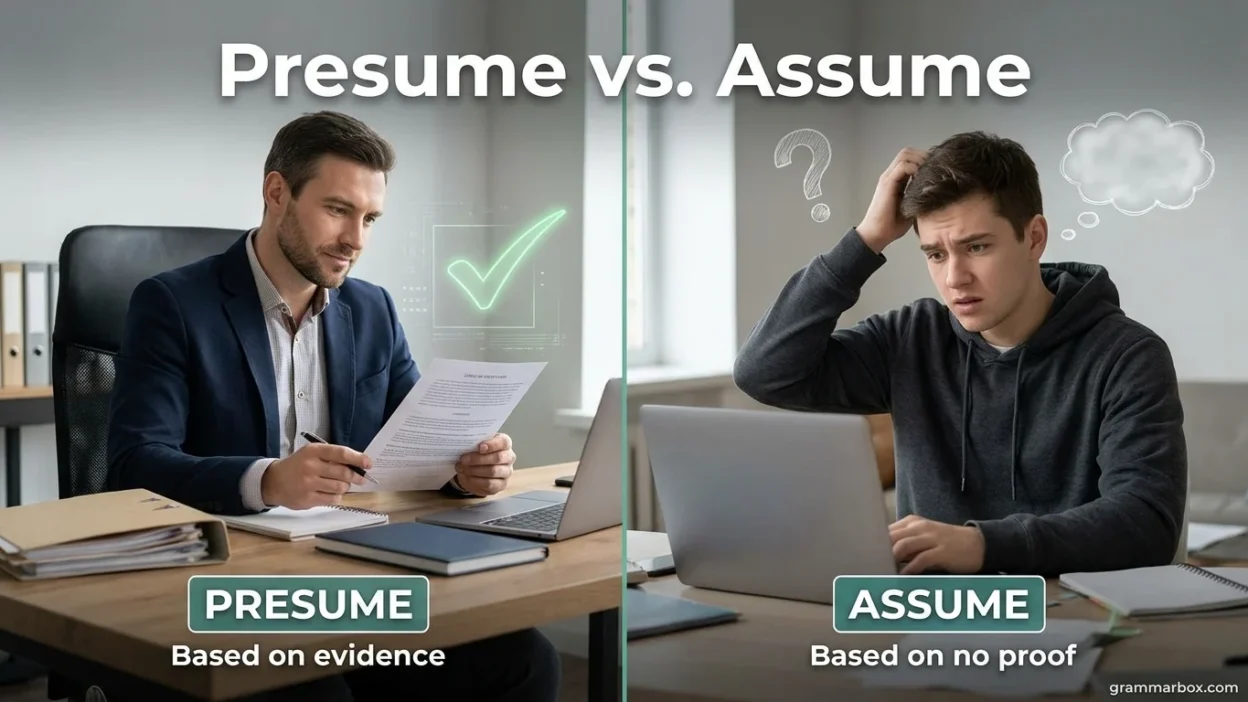
Presume means to believe something is true based on reasonable evidence, probability, or expectation. Assume means to accept something as true without necessarily checking whether it is correct. Although both words express belief without complete certainty, presume often suggests a stronger reason for believing something, while assume can involve an unverified idea or supposition.
Why People Confuse It
People confuse presume and assume because both words describe believing something without having complete proof. They can also appear in similar sentence structures, such as “I presume he is busy” and “I assume he is busy.”
The difference often lies in the reasoning behind the belief.
- Presume: You have a reasonable basis for your belief or consider something likely.
- Assume: You accept something as true without confirming it, sometimes based on habit, expectation, or incomplete information.
For example, if you see someone’s office lights on and their car parked outside, you might presume they are working. If you believe they are working simply because they usually work late, you might assume they are there.
These distinctions are useful, but they are not absolute. In everyday English, the words sometimes overlap, and context determines the most natural choice.
First Word: Presume
Presume is a verb meaning to believe or accept that something is true based on reasonable grounds, probability, or an established expectation.
It can suggest that a conclusion is justified by the information available, even when complete proof is missing.
Meaning of Presume
According to its common usage, presume can mean:
- To believe something is probably true.
- To accept something as true based on available evidence.
- To expect something to happen under normal circumstances.
- To take something for granted because it seems reasonable.
Examples of Presume in Sentences
- I presume you have already read the report.
- We presume the meeting will begin at nine.
- Since the lights are on, I presume someone is home.
- I presume she received your email yesterday.
- The law may presume a person innocent until proven guilty.
- I presume you are familiar with the company’s policies.
- Given his experience, we presume he can handle the assignment.
- I presume everything went well during your interview.
In these examples, the speaker has some reason to believe the statement or considers it a reasonable expectation. However, presume does not guarantee that the belief is correct.
What Does Presume Mean in Formal English?
In formal English, presume frequently appears in legal, academic, and professional contexts.
For example:
- Legal: The defendant is presumed innocent until proven guilty.
- Professional: We presume all participants have reviewed the guidelines.
- Academic: Researchers may presume that the sample represents the larger population, provided the sampling method supports that conclusion.
Presume can also mean taking liberties or acting without permission, particularly in the expression “presume upon” or in certain uses of “presumptuous.”
For example: “He presumed to speak on behalf of the entire team.”
Here, the word suggests that someone acted as though they had the authority or right to do something.
Second Word: Assume
Assume is a verb meaning to accept something as true without confirming it, or to suppose that something is the case.
An assumption may be reasonable, but it can also be incorrect because it is based on limited information or personal expectations.
Meaning of Assume
Common meanings of assume include:
- To accept something as true without proof.
- To suppose something is likely to happen.
- To take something for granted.
- To adopt a particular role, responsibility, or position.
- To take on a particular appearance or characteristic.
The last two meanings are important because assume has uses that presume generally does not share.
Examples of Assume in Sentences
- I assumed you knew about the schedule change.
- Don’t assume everyone agrees with your opinion.
- She assumed the train would arrive on time.
- We assumed the restaurant was open because the lights were on.
- He assumed responsibility for the team’s mistake.
- The building assumed a different appearance after renovation.
- I assumed you would bring the documents.
- They assumed the project would be completed within a week.
The first four examples involve accepting an idea as true without checking it. The last four demonstrate other common uses of assume, including taking responsibility and describing a change in appearance.
What Does Assume Mean in Everyday English?
In everyday conversations, assume often describes a belief formed without direct confirmation.
For example, consider this sentence:
“I assumed you were busy, so I didn’t call.”
The speaker believed the other person was busy but did not necessarily have evidence to support that belief.
Similarly:
“Never assume that someone understands your instructions.”
This sentence warns against treating an unverified belief as a fact.
Assume is not always negative or careless. It can describe a practical starting point when making plans, solving problems, or discussing possibilities.
For example: “Let’s assume the journey takes two hours and plan accordingly.”
In this case, the assumption is a working estimate rather than a claim of certainty.
Comparison Table: Presume vs. Assume
| Feature | Presume | Assume |
|---|---|---|
| Basic meaning | Believe something is likely or reasonable | Accept something as true or suppose it |
| Evidence | Often suggests some supporting reason | May involve little or no verification |
| Certainty | Suggests a reasonable expectation in many contexts | Depends on the situation and the speaker |
| Common usage | Formal, legal, professional, everyday | Everyday, academic, professional |
| Negative implication | Can suggest overstepping one’s authority | Can suggest making an unsupported judgment |
| Example | I presume she is at work because her car is outside. | I assume she is at work because she usually works late. |
| Additional meaning | Can suggest taking liberties | Can mean taking responsibility or adopting a role |
| Related noun | Presumption | Assumption |
Key distinction: Presume often emphasizes a reasonable basis for belief, while assume emphasizes accepting or supposing something to be true. Neither word automatically indicates that a belief is correct.
When to Use Each
Choosing between presume and assume becomes easier when you consider why you believe something and what you want to communicate.
When to Use Presume
Use presume when you want to express a belief that seems reasonable based on evidence, probability, or an established expectation.
Examples:
- “I presume you have received the invitation.”
- “We presume the road is safe because authorities have reopened it.”
- “I presume the manager will approve the request.”
In each case, the speaker treats the conclusion as reasonably likely, although it has not necessarily been confirmed.
Presume is also common in legal expressions, especially “presumed innocent,” and in formal situations where a conclusion is treated as justified unless contrary evidence appears.
When to Use Assume
Use assume when you want to describe accepting an idea without checking it or using a supposition as a starting point.
Examples:
- “I assumed you had already booked the tickets.”
- “Don’t assume that expensive products are always better.”
- “Let’s assume the price remains unchanged.”
The first example describes an unverified belief, the second warns against an unsupported generalization, and the third establishes a hypothetical condition.
Use assume when describing responsibilities or roles, too:
- “She will assume responsibility for the department.”
- “He assumed the position of team leader.”
These meanings are distinctive and cannot normally be replaced with presume without changing the sentence or making it unnatural.
Can Presume and Assume Be Used Interchangeably?
Sometimes, yes. Both words can express a belief about something that has not been confirmed.
For example:
- “I presume he is on his way.”
- “I assume he is on his way.”
Both sentences are grammatically correct. Presume may sound as though the speaker has a reasonable basis for the belief, while assume may sound more like a supposition.
The difference is one of emphasis, not an inflexible grammar rule.
Examples: Presume vs. Assume in Sentences
The following examples show how the two words work in everyday conversations, academic writing, and professional situations.
Examples Using Presume
- I presume you have finished your homework.
- We presume the guests will arrive before dinner.
- Since she has extensive experience, I presume she can lead the project.
- I presume you know why the meeting was postponed.
- The court may presume innocence unless evidence establishes guilt.
- I presume the package has been delivered because the tracking status says so.
- Given the weather forecast, we presume the event will take place indoors.
- I presume you are familiar with the new company policy.
- The organizers presume that registered participants will attend.
- I presume everything is ready for tomorrow’s presentation.
Examples Using Assume
- I assumed you were already at the office.
- Never assume that silence means agreement.
- We assumed the shop would remain open until evening.
- She assumed that I had understood her explanation.
- Let’s assume the population grows by two percent each year.
- He assumed responsibility for the delayed shipment.
- The sky assumed a reddish color at sunset.
- I assumed you would tell me if your plans changed.
- They assumed the assignment would be easy.
- You should not assume that every online source is reliable.
Paired Examples Showing the Difference
| Presume | Assume |
|---|---|
| I presume he is home because his car is in the driveway. | I assume he is home because he usually arrives by now. |
| We presume the application is complete because all required documents were submitted. | We assume the application is complete without reviewing the documents. |
| I presume you agree because you approved the proposal. | I assume you agree because you haven’t objected. |
| She presumed the event would be successful based on the strong registrations. | She assumed the event would be successful without checking attendance figures. |
| The law may presume innocence under applicable legal principles. | We assume the figures are accurate for this preliminary calculation. |
These comparisons illustrate typical differences rather than universal rules. In some contexts, either verb would be acceptable.
Common Mistakes
Even fluent English speakers sometimes choose presume and assume without considering their precise meanings. Here are common mistakes to avoid.
1. Treating the Words as Completely Identical
Although the words overlap, they do not have identical meanings in every context.
Incorrect reasoning: “Presume and assume always mean exactly the same thing.”
Better approach: Consider whether you want to emphasize a reasonable basis for belief or an unverified supposition.
2. Thinking Presume Always Requires Strong Evidence
Presume does not necessarily mean that something has been proved. It can express an expectation or a conclusion based on probability.
For example: “I presume the office is closed today.”
The speaker may have a reason for this belief, but the sentence does not establish that the office is actually closed.
3. Thinking Assume Is Always Wrong
An assumption is not necessarily careless or inaccurate. People use assumptions to plan, estimate, and explore hypothetical situations.
For example: “Assume that the cost of materials remains constant.”
This is a useful instruction in a mathematical or economic calculation.
4. Using Presume for Every Meaning of Assume
Assume has meanings beyond believing something to be true.
Correct: “She assumed responsibility for the project.”
The word assume means that she took responsibility. Replacing it with presume would not express the intended meaning naturally.
5. Confusing Presume With Presumptuous
Presume is a verb, while presumptuous is an adjective describing someone who oversteps appropriate boundaries or behaves as though they have more authority than they do.
Example: “It was presumptuous of him to invite guests without asking the host.”
The adjective describes the behavior, not simply the act of believing something.
6. Forgetting That Context Matters
Neither word guarantees certainty or tells you exactly how much evidence exists.
For example, “I presume she is right” and “I assume she is right” can both be appropriate, depending on the speaker’s reasoning and intended emphasis.
Memory Trick: How to Remember Presume vs. Assume
Use this simple memory trick:
Presume = probability or a reasonable basis.
Think of presume as a conclusion that seems reasonable given the circumstances.
Example: “I presume the train is delayed because the station display says so.”
Assume = accept or suppose without checking.
Think of assume as an idea you accept as true, even if you have not verified it.
Example: “I assumed the train was delayed because it hadn’t arrived yet.”
A second helpful trick is to remember the phrase “assume nothing.” It reminds you that assumptions can be mistaken when you do not verify the facts.
However, remember that this is a learning aid, not an absolute rule. Presume can be used without strong evidence, and assume can be supported by reasonable information.
American vs. British English
There is no major difference between American and British English in the meanings or spelling of presume and assume.
Both varieties use the words in similar ways:
- American English: “I assume the meeting starts at nine.”
- British English: “I presume the meeting starts at nine.”
These examples illustrate possible usage choices, not exclusive regional rules. Both sentences are acceptable in either variety of English.
Differences are more likely to arise from tone, context, and personal preference than from national spelling conventions.
Both forms also share the same standard spellings:
- Presume
- Assumed
- Presuming
- Assumption
- Assume
- Presumed
- Presuming
- Presumption
Notice that the noun forms are presumption and assumption. These nouns follow the same broad distinction as their related verbs, although their meanings can overlap.
For accurate writing, focus on the intended meaning rather than trying to identify one word as exclusively American or British.
Similar Words: Presume vs. Assume
Several English words are related to presume and assume, but each carries its own shade of meaning.
1. Suppose
Suppose means to think that something is likely to be true or to consider a possibility.
Example: “I suppose she will join us later.”
Suppose is often conversational and can express a less firm belief.
2. Guess
Guess means to form an opinion or answer without having enough information to be certain.
Example: “I guess the package will arrive tomorrow.”
It often suggests uncertainty more explicitly than presume.
3. Presuppose
Presuppose means to require or take something as an existing condition or prior assumption.
Example: “The argument presupposes that everyone has equal access to education.”
It is common in academic, philosophical, and analytical writing.
4. Infer
Infer means to reach a conclusion from evidence or reasoning.
Example: “From the dark clouds, we inferred that rain was approaching.”
Infer emphasizes the process of drawing a conclusion from available information.
5. Conclude
Conclude means to reach a judgment after considering facts, evidence, or reasoning.
Example: “The investigators concluded that the equipment had failed.”
It often suggests that the reasoning process has reached a result, though the conclusion may still be incorrect.
6. Speculate
Speculate means to form ideas or theories without having enough evidence to establish them.
Example: “Journalists speculated about the cause of the delay.”
Speculate generally places more emphasis on uncertainty than presume.
Understanding these related words will help you choose more precise language in conversations, essays, reports, and professional communication.
FAQs:
1. What is the main difference between presume and assume?
Presume often suggests believing something is likely based on reasonable grounds or expectations. Assume generally means accepting something as true without confirming it. However, the two words overlap, and their precise meanings depend on context.
2. Is it better to say “I presume” or “I assume”?
Both expressions are correct. Use “I presume” when you want to suggest a reasonable expectation or inference. Use “I assume” when you want to express a supposition that has not been confirmed. In many everyday situations, either works.
3. Does presume mean you have evidence?
Not necessarily. Presume often suggests a reasonable basis for belief, but it does not require conclusive evidence. The word can also express an expectation or a belief that something is probably true.
4. Is assume a negative word?
No. Assume is a neutral verb. It can describe an unsupported belief, but it can also introduce a useful hypothetical situation, such as “Assume the distance is ten kilometers.” It can additionally mean taking on a responsibility or role.
5. What is the difference between presumption and assumption?
A presumption is a belief or conclusion accepted as likely or reasonable, sometimes under a legal or formal rule. An assumption is something accepted as true or used as a starting point without necessarily being verified. Their meanings can overlap.
6. Can presume and assume be used in formal writing?
Yes. Both are appropriate in formal writing, including academic papers, business reports, and professional correspondence. Choose the word that best expresses your intended meaning, and support important claims with evidence when necessary.
7. What is the opposite of assume?
There is no single opposite that fits every use of assume. Depending on the context, possible opposites include verify, confirm, question, or establish. For example, you can verify information instead of assuming it is true.
Remember This
- Presume: Believe something is likely or reasonable based on the circumstances.
- Assume: Accept something as true or suppose it is true without necessarily verifying it.
- Both: Express beliefs that may not be fully confirmed.
- Best tip: Consider the context, and verify important information rather than relying on either presumption or assumption.
Conclusion
Learning the difference between presume and assume can improve your vocabulary, grammar, and communication skills. Although the two verbs share similar meanings, presume often emphasizes reasonable grounds or expectations, while assume frequently emphasizes accepting an idea without confirmation. Recognizing this difference helps you communicate your reasoning more clearly and choose words that match your intended message.
Ultimately, there is no need to treat the distinction as an inflexible rule. Both words are widely used in American and British English, and their meanings sometimes overlap. Pay attention to context, use assume for hypothetical conditions and taking responsibility, and consider presume when expressing a reasonable expectation. Most importantly, remember that believing something is true does not make it a fact.