A restrictive modifier is a word, phrase, or clause that provides essential information about a noun or pronoun. Without that information, the reader may not know exactly which person, place, thing, or group you mean. Because restrictive modifiers are closely connected to meaning, understanding them can help you write clearer and more precise sentences.
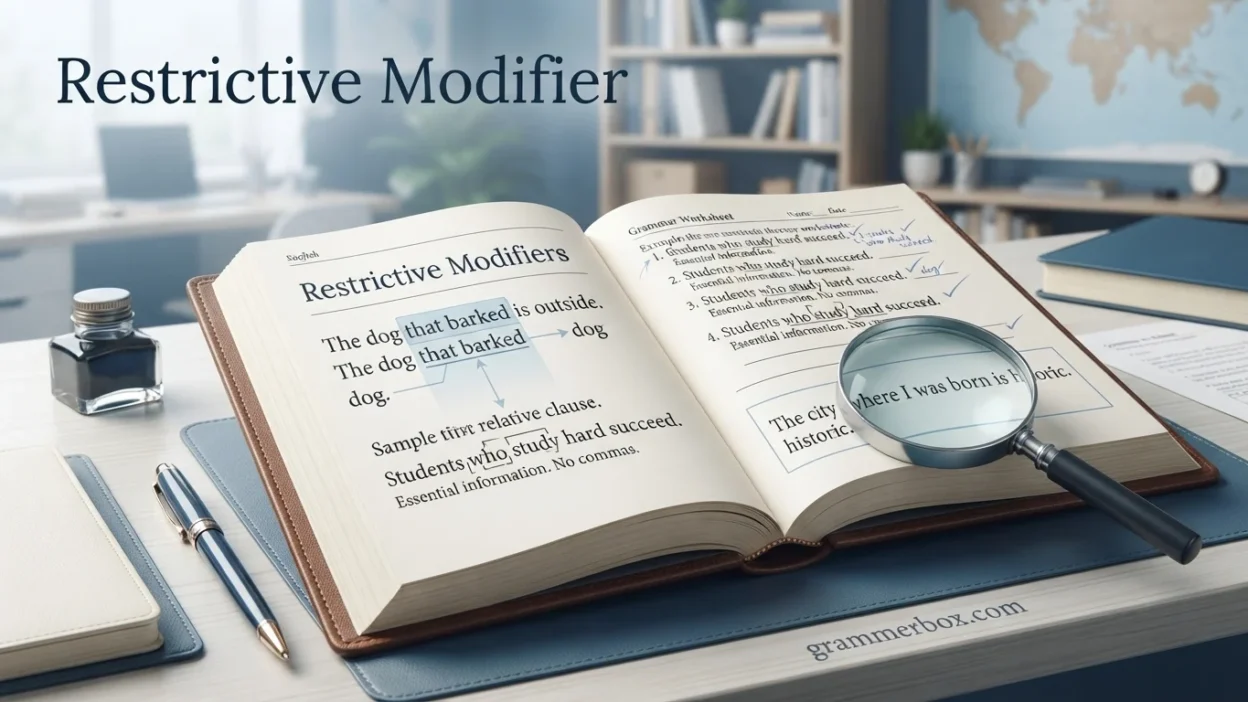
Restrictive modifiers can appear as adjectives, phrases, or relative clauses. One of the most common examples is a restrictive relative clause, such as “The students who studied passed the exam.” Here, “who studied” identifies which students passed. Removing it changes the meaning of the sentence. Restrictive modifiers are also important when deciding whether commas should be used. In this guide, you’ll learn what a restrictive modifier means, how it works, how it differs from a nonrestrictive modifier, and how to avoid common punctuation mistakes.
Quick Answer
A restrictive modifier is a word, phrase, or clause that gives essential information about a noun or pronoun. It restricts or identifies exactly what the writer means. Because the information is necessary to the sentence’s meaning, restrictive modifiers are generally not separated by commas.
Why People Confuse Restrictive Modifiers
Restrictive modifiers can be confusing because they often look very similar to nonrestrictive modifiers.
Compare these sentences:
- The employees who arrived early received coffee.
- The employees, who arrived early, received coffee.
The first sentence says that only the employees who arrived early received coffee. The modifier who arrived early identifies a particular group.
The second sentence suggests that the employees had already been identified and that they all arrived early. The information between the commas is additional rather than essential.
The difference is therefore not simply punctuation. Commas can change the meaning of the sentence.
What Is a Restrictive Modifier?
A restrictive modifier limits or identifies the meaning of the noun it modifies.
It answers questions such as:
- Which person?
- Which thing?
- Which students?
- Which book?
- Which house?
- Which employees?
For example:
The book that you recommended was excellent.
The phrase that you recommended tells us which book was excellent. If several books are being discussed, this information is essential.
A restrictive modifier can take several forms.
Restrictive Adjective
The red car belongs to Sarah.
“Red” identifies which car.
Restrictive Prepositional Phrase
The students in Room 12 are waiting outside.
“In Room 12” identifies which students.
Restrictive Relative Clause
The woman who lives next door is a doctor.
“Who lives next door” identifies which woman.
The Role of the Restrictive Modifier
The key function of a restrictive modifier is identification.
Consider:
The dog with the blue collar is mine.
If there are several dogs, “with the blue collar” tells the reader exactly which dog you mean.
Without the modifier:
The dog is mine.
The sentence is grammatically complete, but the intended identification may be unclear.
A restrictive modifier therefore makes language more precise.
Comparison Table
| Feature | Restrictive Modifier | Nonrestrictive Modifier |
|---|---|---|
| Purpose | Identifies or limits the noun | Adds extra information |
| Information | Essential to the intended meaning | Nonessential |
| Usually uses commas? | No | Yes |
| Can often be removed? | Removing it may change the meaning | Usually yes |
| Example | The students who studied passed. | James, who studied, passed. |
| Main function | Identification | Additional description |
When to Use a Restrictive Modifier
Use a restrictive modifier when your reader needs the modifier to understand which noun or group you mean.
Use it when there are multiple possibilities
The house on the corner is for sale.
If there are several houses, the phrase identifies the particular one.
Use it to identify a specific group
Employees who work remotely must complete the form.
The modifier identifies the employees being discussed.
Use it when removing the modifier changes the intended meaning
The articles that contain errors need revision.
This does not necessarily refer to every article. It refers specifically to the articles containing errors.
Use it for precise writing
Restrictive modifiers are particularly useful in:
- Academic writing
- Business writing
- Legal documents
- Technical writing
- News writing
- Educational content
Examples of Restrictive Modifiers
Here are more than 10 examples showing how restrictive modifiers work:
- The students who completed the assignment received extra credit.
- The laptop on the desk belongs to my brother.
- The woman wearing a blue jacket is my teacher.
- The books that I ordered arrived today.
- People who exercise regularly may improve their overall fitness.
- The restaurant near the station closes at midnight.
- The employee with the highest score won the award.
- The car that we rented broke down yesterday.
- The children playing in the garden are my cousins.
- The documents in this folder are confidential.
- The students from Class A will take the test first.
- The movie that you suggested was surprisingly good.
- The keys beside the computer are mine.
- The applicants who meet the requirements will be contacted.
- The road leading to the village is closed.
Notice that each modifier helps narrow down the noun.
Restrictive Relative Clauses
A restrictive relative clause is one of the most common types of restrictive modifiers.
It often begins with:
- who
- that
- which
- whose
- whom
For example:
The teacher who taught us grammar retired.
The clause “who taught us grammar” identifies the teacher.
Compare:
My teacher, who taught us grammar, retired.
Here, “who taught us grammar” is presented as additional information about an already identified teacher.
Restrictive “That”
In American English, that is commonly used for restrictive relative clauses referring to things or sometimes people.
The phone that I bought is broken.
The clause identifies which phone.
Restrictive “Who”
Who is commonly used for people.
The student who won the competition received a trophy.
Again, the clause identifies which student.
Common Mistakes
1. Adding unnecessary commas
Incorrect for the intended restrictive meaning:
The students, who studied hard, passed the exam.
If the writer means only the students who studied hard, the commas change the interpretation.
Better:
The students who studied hard passed the exam.
2. Assuming every relative clause needs commas
Relative clauses do not automatically require commas.
The important question is whether the information is essential or additional.
3. Removing an essential modifier
Consider:
The employees who work weekends receive additional pay.
Removing the modifier creates:
The employees receive additional pay.
That may suggest that all employees receive additional pay, which is a different meaning.
4. Confusing restrictive and nonrestrictive meaning
Punctuation should reflect the intended meaning rather than being added simply because a clause is long.
5. Using “which” and “that” without considering style
In formal American English, that is frequently used for restrictive clauses involving things:
The computer that I purchased is fast.
“Which” can also appear in restrictive constructions, depending on the variety of English and style guide:
The computer which I purchased is fast.
The important point is to follow the conventions appropriate to your audience and maintain consistency.
Memory Trick
Remember:
Restrictive = Required for Identification.
Both words begin with R:
Restrictive → Required
If removing the modifier makes it unclear which person or thing you mean, the modifier is probably restrictive.
Think:
Restrictive = “Which one?”
If the modifier answers “Which one?” or “Which ones?”, it is often restrictive.
American vs British English
The basic concept of restrictive modification is the same in both American and British English.
However, punctuation and relative-pronoun preferences can vary by style guide and publication.
American English commonly uses that in restrictive relative clauses:
The book that I bought is expensive.
British English also uses that, but which may be more common in some contexts:
The book which I bought is expensive.
British English may also use punctuation conventions that differ slightly from American editorial styles.
For formal writing, the safest approach is to follow the style guide required by your school, workplace, publisher, or publication.
Similar Terms
Understanding related grammar terms makes restrictive modifiers easier to recognize.
Restrictive Clause
A clause that provides information essential to identifying the noun.
The people who arrived first got seats.
Nonrestrictive Clause
A clause that provides additional information.
Maria, who arrived first, got a seat.
Modifier
A word, phrase, or clause that describes, limits, or gives more information about another word.
Relative Clause
A clause that modifies a noun or pronoun, often beginning with who, whom, whose, which, or that.
Essential Information
Information necessary for the intended identification or meaning.
Nonessential Information
Information that can generally be removed without changing which person or thing is being discussed.
FAQs:
What is a restrictive modifier in grammar?
A restrictive modifier is a word, phrase, or clause that provides essential information about a noun or pronoun. It limits or identifies exactly what the writer means.
Does a restrictive modifier need commas?
Usually, no. Restrictive modifiers are generally not separated from the noun by commas because their information is essential to the intended meaning.
What is an example of a restrictive modifier?
“The students who studied passed the test” contains a restrictive modifier. “Who studied” identifies which students passed.
What is the difference between restrictive and nonrestrictive modifiers?
A restrictive modifier identifies or limits the noun, while a nonrestrictive modifier simply adds extra information about an already identified noun.
Can a restrictive modifier be a phrase?
Yes. Restrictive modifiers can be single words, phrases, or clauses. For example, “The man in the black coat is my uncle” contains a restrictive prepositional phrase.
Is a restrictive relative clause the same as a restrictive modifier?
A restrictive relative clause is one type of restrictive modifier. Restrictive modifiers can also be adjectives, participial phrases, prepositional phrases, and other structures.
Are restrictive modifiers important in formal writing?
Yes. They help writers communicate precisely by identifying exactly which person, thing, or group they are discussing.
Remember This
Restrictive modifier = essential identifying information.
Ask yourself:
“Do I need this information to know which person or thing the writer means?”
If the answer is yes, you likely have a restrictive modifier.
When it is restrictive, avoid automatically putting commas around it.
Conclusion
Restrictive modifiers are an important part of clear English grammar because they help readers identify exactly which noun or pronoun a sentence refers to. They can be short adjectives such as “red,” phrases such as “on the table,” or complete relative clauses such as “who won the competition.”
The easiest way to recognize one is to focus on meaning rather than punctuation alone. Ask whether the modifier is necessary for identification. If removing it changes which person, thing, or group the sentence refers to, you are dealing with restrictive information. Mastering this distinction will make your writing more precise, readable, and professional.