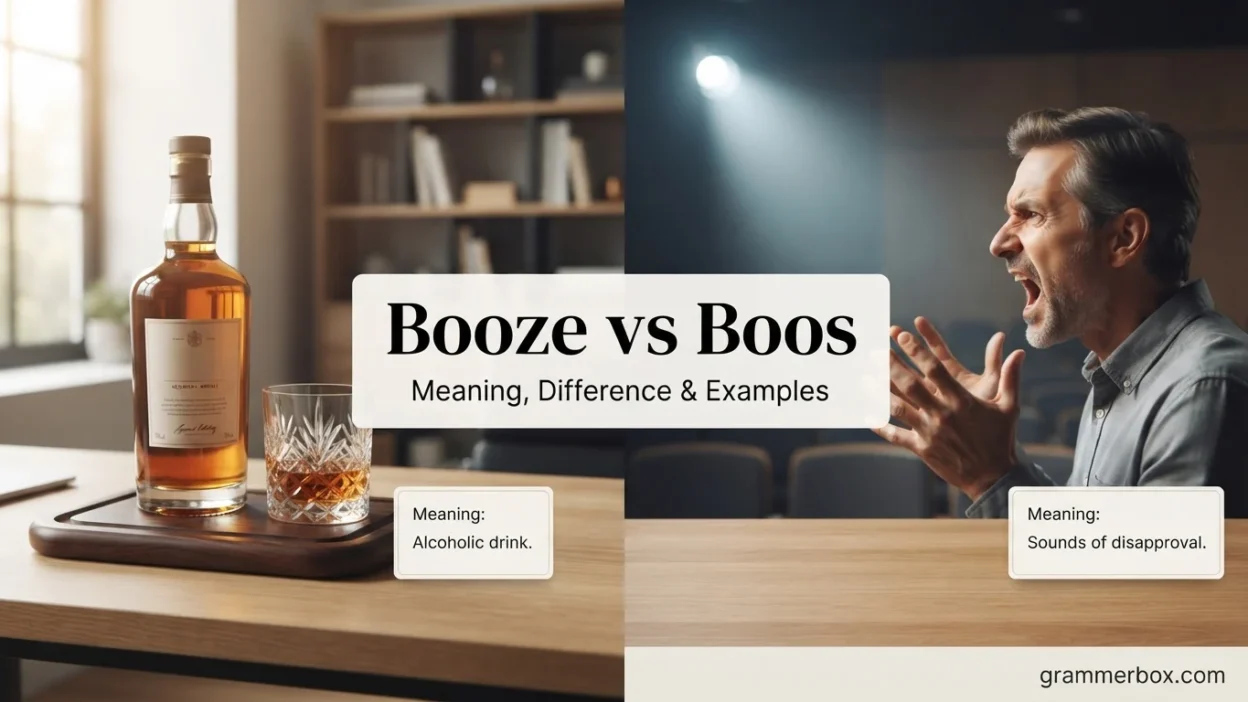
When you hear “booze” and “boos,” they can sound almost identical in everyday speech. However, these two words have completely different meanings and functions. One is commonly used as an informal word for alcoholic drinks, while the other refers to expressions of disapproval from an audience. Knowing the difference can help you avoid confusion in writing, conversations, and online communication.
The confusion usually comes from pronunciation. Booze rhymes with words such as “choose” and “news,” while boos is the plural of “boo” or the third-person singular form of the verb “boo.” Although both words can appear in casual conversations, they belong to different contexts. In this guide, we’ll explain booze vs boos, their meanings, pronunciation, grammatical roles, examples, common mistakes, and an easy memory trick to help you remember the difference.
Quick Answer
Booze means alcoholic drinks or alcohol in general. Boos refers to sounds or expressions of disapproval, or it can mean that someone expresses disapproval by saying “boo.” They sound similar but have completely different meanings.
Why People Confuse It
The main reason people confuse booze and boos is their similar pronunciation.
Both words contain the long “oo” sound, and in some accents they can sound very close in casual speech.
However, their meanings are easy to separate:
- Booze = alcohol or alcoholic drinks
- Boos = expressions of disapproval
- Booze is usually a noun
- Boos can be a plural noun or a verb
For example:
They bought some booze for the party.
But:
The player received loud boos from the crowd.
Understanding the context usually makes the intended word clear.
Booze
Booze is an informal word meaning alcoholic drinks or alcohol.
It is generally used as an uncountable noun when referring to alcohol in general.
Examples of “Booze”
- They brought some booze to the party.
- The store sells beer, wine, and other booze.
- He decided to give up booze for a month.
- There was too much booze at the celebration.
- The hotel does not allow guests to bring their own booze.
Booze as a Verb
Booze can also be used as a verb meaning to drink alcohol, especially heavily or regularly.
For example:
They spent the evening boozing with friends.
The verb form is informal and is more common in casual conversation than formal writing.
Boos
Boos has a completely different meaning.
It is commonly the plural form of boo, meaning sounds or cries used to show that you dislike or disapprove of something.
For example:
The referee was met with loud boos.
Here, boos means expressions of disapproval from the crowd.
“Boos” as a Verb
Boos can also be the third-person singular form of the verb boo.
For example:
The crowd boos the performer.
This means the crowd expresses disapproval.
Other forms include:
- boo — base form
- boos — he/she/it form
- booed — past tense
- booing — present participle
Booze vs Boos: Comparison Table
| Word | Meaning | Part of Speech | Example |
|---|---|---|---|
| Booze | Alcohol or alcoholic drinks | Noun | They bought some booze. |
| Booze | To drink alcohol | Verb | They were boozing all night. |
| Boos | Sounds of disapproval | Plural noun | The player heard boos. |
| Boos | Expresses disapproval | Verb | The crowd boos the team. |
When to Use Each
Use booze when your sentence is about alcohol or drinking alcohol.
We need to buy some booze for the party.
Use boos when your sentence involves disapproval, criticism, or a negative audience reaction.
The singer was greeted with boos.
A simple context test can help:
Is the sentence about alcohol? → Use booze.
Is the sentence about people showing disapproval? → Use boos.
Booze vs Boos: 12 Example Sentences
- They bought some booze before the party.
- The restaurant has a wide selection of booze.
- He decided to stay away from booze.
- There was plenty of booze at the wedding.
- They were caught boozing late at night.
- The referee received loud boos from the crowd.
- The actor walked onto the stage to a mixture of cheers and boos.
- The team heard boos after losing the match.
- The audience boos whenever the controversial player touches the ball.
- The politician was met with boos during the speech.
- The concert ended with cheers rather than boos.
- They had enough booze for everyone at the gathering.
Common Mistakes
Mistake 1: Using “boos” for alcohol
Incorrect:
We bought some boos for the party.
Correct:
We bought some booze for the party.
Mistake 2: Using “booze” for audience disapproval
Incorrect:
The player received loud booze from the crowd.
Correct:
The player received loud boos from the crowd.
Mistake 3: Confusing “boo” with “booze”
Boo can be a noun or verb related to an expression of disapproval.
Booze refers to alcohol or drinking.
Compare:
The crowd began to boo.
They bought some booze.
The extra “z” in booze helps distinguish it from boo in writing.
Memory Trick
Use this simple trick:
Booze = booze you drink.
Think of booze as an informal word for alcohol.
Boos = boos from a crowd.
If an audience dislikes something, you may hear boos.
Remember:
Booze = alcohol
Boos = disapproval
This quick association makes the spelling much easier to remember.
American vs British English
Both booze and boos are used in both American and British English.
Booze is an informal term for alcohol in both varieties of English. Boos is also commonly used in both American and British English to describe expressions of disapproval.
The main difference is not spelling but context and level of formality. Since booze is informal, terms such as alcohol or alcoholic beverages may be more appropriate in formal writing.
Similar Words
Several words are related to booze and boos but have different meanings.
Words Related to Booze
- Alcohol — a broad, standard term
- Liquor — distilled alcoholic drinks
- Beer — a specific alcoholic beverage
- Wine — an alcoholic drink made from fermented grapes or other fruits
- Drinks — can refer to alcoholic beverages depending on context
Words Related to Boos
- Jeers — mocking or insulting cries
- Taunts — remarks intended to provoke or criticize
- Hisses — sharp sounds sometimes used to show disapproval
- Catcalls — shouted comments, often directed at performers or people
- Cheers — expressions of approval or encouragement, the opposite of boos in many contexts
FAQs:
Is “booze” a slang word?
Yes. Booze is an informal word for alcohol or alcoholic drinks. It is common in casual conversation but may be unsuitable for some formal contexts.
What does “boos” mean?
Boos usually means sounds or expressions of disapproval. It can also be the third-person singular form of the verb boo.
Are “booze” and “boos” pronounced the same?
They can sound very similar, but pronunciation can vary by accent. In writing, their meanings are clearly different from context.
Is booze singular or plural?
Booze is generally treated as an uncountable noun when it means alcohol in general. You would normally say “some booze,” not “a booze.”
What is the past tense of “boo”?
The past tense is booed.
The crowd booed the player.
Can “booze” be a verb?
Yes. Informally, booze can mean to drink alcohol, especially heavily or socially.
What is the opposite of boos?
Depending on the context, cheers or applause can represent approval rather than disapproval.
Final Verdict
The difference between booze and boos is straightforward once you connect each word with its meaning. Booze refers to alcohol or drinking alcohol, while boos refers to expressions of disapproval or the act of expressing disapproval.
Although their pronunciation can cause confusion, their spelling and context make the distinction clear. When writing, always consider what your sentence is actually describing: alcohol means booze; audience disapproval means boos.
Remember This
- Booze = alcohol
- Boos = expressions of disapproval
- Booze can also be a verb meaning to drink alcohol.
- Boos can be the plural of “boo” or the verb form meaning “expresses disapproval.”
- If you’re talking about a party and alcohol, choose booze.
- If you’re talking about an unhappy crowd, choose boos.