
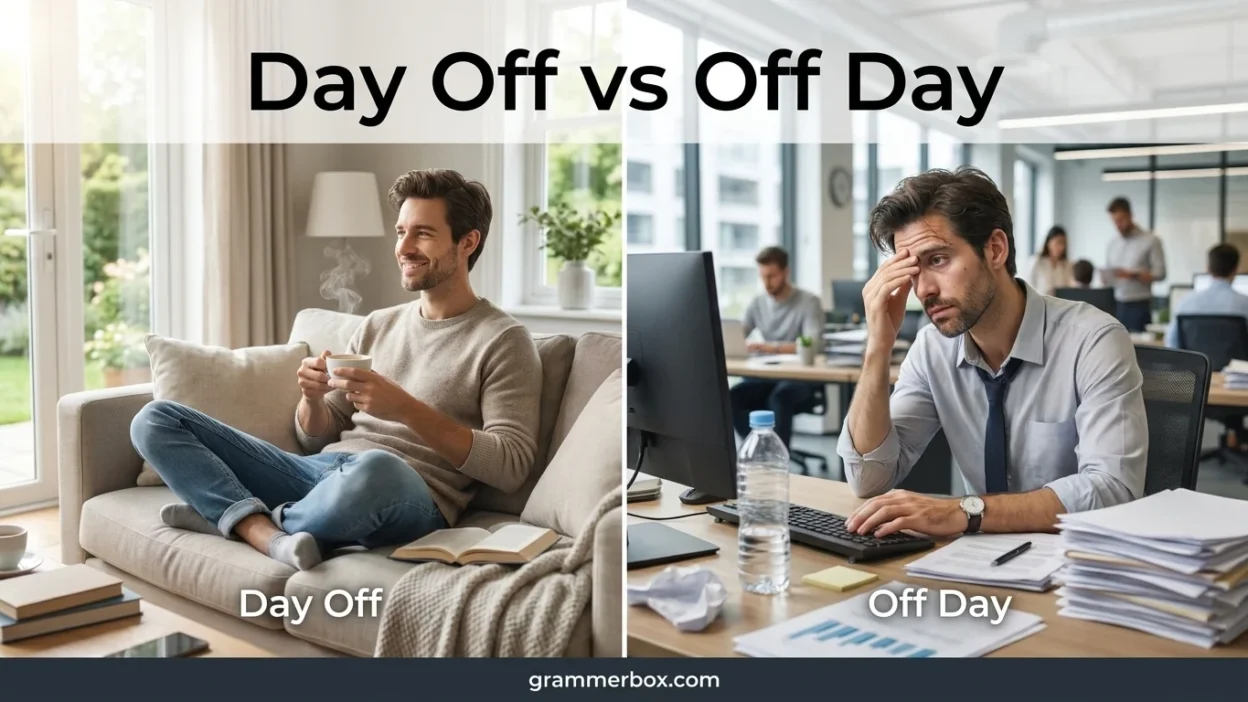
When talking about breaks from work, school, or regular responsibilities, you may hear both “day off” and “off day.” Because the two phrases contain the same words, it is easy to assume they mean exactly the same thing. However, they are used differently in everyday English. Knowing the distinction can help you sound more natural and avoid awkward sentences.
The phrase “day off” usually means a day when you do not have to work or attend your usual duties. For example, “I have a day off tomorrow” means you are free from work tomorrow. “Off day,” on the other hand, commonly refers to a day when someone performs poorly, feels unwell, or simply is not at their usual best. It can also have a different meaning in some varieties of English. In this guide, we’ll explain day off vs off day, with clear examples, common mistakes, and simple memory tricks.
Quick Answer
“Day off” means a scheduled break from work, school, or regular duties. “Off day” usually means a day when someone is performing below their normal standard or does not feel their best. For example, “Friday is my day off,” but “I’m having an off day.”
Why People Confuse “Day Off” and “Off Day”
The confusion comes from the fact that both expressions contain day and off, but their meanings depend on word order.
Compare:
- I have a day off. → I do not have to work.
- I’m having an off day. → I am not performing or feeling normally.
English has many expressions where changing the word order changes the meaning. Day off is primarily about having free time, while off day often describes an unusual or disappointing day.
Another reason for confusion is that “off” can have several meanings. It can describe something that is not operating, something that is away from normal activity, or something that is unusual or unsatisfactory.
First Word: Day Off
“Day off” is a noun phrase meaning a day when you are free from your normal work or responsibilities.
It is commonly used for:
- Work schedules
- School breaks
- Vacations or personal time
- Regular days without duties
- Rest and relaxation
Examples
- I have a day off on Friday.
- She took a day off to visit her family.
- Tomorrow is my day off.
- He needs a day off after working all week.
- Can I take a day off next Monday?
The phrase is especially common when discussing employment and schedules.
Common Patterns
You will often see:
- have a day off
- take a day off
- get a day off
- have the day off
- give someone a day off
For example:
I’m going to take a day off tomorrow.
This means the speaker will not work tomorrow.
Second Word: Off Day
“Off day” usually refers to a day when someone is not performing as well as usual or does not feel like themselves.
For example:
I’m sorry I made so many mistakes. I’m just having an off day.
Here, the person is not saying they are free from work. Instead, they mean they are having a difficult or unusually poor day.
Examples
- I’m having an off day today.
- The player had an off day during the match.
- Everyone has an off day sometimes.
- She seemed distracted because she was having an off day.
- The chef had an off day, and the food wasn’t as good as usual.
“Off day” can describe poor performance, low energy, unusual mistakes, or simply not feeling your best.
Day Off vs Off Day: Comparison Table
| Feature | Day Off | Off Day |
|---|---|---|
| Basic meaning | A free day from normal duties | A day when you feel or perform below normal |
| Main idea | Rest or time away from work | Poor performance or unusual condition |
| Common context | Work, school, schedules | Mood, performance, sports, daily life |
| Example | I have a day off tomorrow. | I’m having an off day. |
| Usually planned? | Often yes | Not necessarily |
| Refers to free time? | Yes | Usually no |
| Refers to poor performance? | No | Yes |
When to Use Each
Use “Day Off” for a Break
Use day off when you mean that someone does not have to work or perform their normal duties.
Correct:
I have a day off tomorrow.
Meaning: Tomorrow is a free day from work.
You can also use it for school or other regular obligations:
The students have a day off from school.
Use “Off Day” for an Unusually Bad Day
Use off day when someone is feeling, behaving, or performing worse than normal.
I usually play well, but today is an off day.
The person is not necessarily taking time away from work. They are simply not performing at their usual level.
A Simple Test
Ask yourself:
“Am I talking about being free?”
If yes → day off
“Am I talking about performing or feeling differently than usual?”
If yes → off day
Day Off vs Off Day: 12 Examples
Here are some practical examples to make the difference clear:
- I have a day off tomorrow.
→ I don’t have to work tomorrow. - I’m taking a day off next week.
→ I’m taking time away from work. - Friday is my regular day off.
→ Friday is my scheduled free day. - She took a day off to recover from a busy week.
→ She took time away from her duties. - My boss gave me a day off.
→ My boss allowed me to take a free day. - I’m having an off day today.
→ I’m not feeling or performing normally. - The goalkeeper had an off day.
→ The goalkeeper performed poorly. - Everyone has an off day occasionally.
→ Everyone sometimes has a less-than-usual day. - He made several unusual mistakes because he was having an off day.
→ His performance was worse than normal. - I have a day off, so I’m going to relax at home.
→ The speaker is free from work. - The team had an off day and lost the game.
→ The team performed poorly. - I’m not normally this tired; I think I’m having an off day.
→ The speaker does not feel normal today.
Common Mistakes
Mistake 1: Using “off day” to Mean a Free Day
Incorrect:
Tomorrow is my off day because I don’t work.
This may be understood in some varieties of English, but day off is the safer and more standard choice when you mean a scheduled break.
Better:
Tomorrow is my day off.
Mistake 2: Using “day off” for Poor Performance
Incorrect:
I played badly because I had a day off.
This sounds like you were not working or playing that day.
Better:
I played badly because I was having an off day.
Mistake 3: Confusing “Take a Day Off” With “Have an Off Day”
These expressions are completely different:
- Take a day off = deliberately take time away from work or duties.
- Have an off day = experience a day when you are not at your best.
Mistake 4: Assuming Word Order Doesn’t Matter
In English, word order can change meaning significantly. Day off and off day are a good example of this.
Memory Trick: Free vs Not at Your Best
Use this simple trick:
Day OFF = work is OFF for you.
I have a day off.
→ I don’t have to work.
OFF day = you are OFF your usual form.
I’m having an off day.
→ I’m not feeling or performing normally.
Remember:
American vs British English
Both day off and off day are understood in American and British English, but usage can vary depending on context.
In both varieties, day off is a very common way to describe a day away from work:
The expression off day is also widely understood when describing poor performance or a day when someone is not feeling their best.
However, regional differences can sometimes affect how people use off day to refer to a scheduled non-working day. Because of this variation, day off is generally the clearest choice when you specifically mean a day free from work.
Similar Words and Expressions
Several related expressions can be useful when discussing rest, work schedules, and performance.
Day Off
A day when you are free from your usual duties.
I have a day off tomorrow.
Off Day
A day when someone is not performing or feeling normally.
I’m having an off day.
Day Away
A day spent away from a particular place or activity.
We spent the day away from the office.
Rest Day
A day intentionally used for rest, especially in exercise or sports.
Today is my rest day.
Holiday
A day or period when people do not work because of an official celebration or vacation.
Monday is a public holiday.
Vacation
A longer period away from work, usually for rest or travel.
We’re going on vacation next month.
FAQs:
Is it “day off” or “off day”?
Both are correct, but they have different meanings. Day off normally means a free day away from work or duties, while off day usually means a day when someone is not feeling or performing at their normal level.
Is “I have an off day” correct?
Yes, but it usually means you are having a difficult day or are not performing as well as usual. If you mean you don’t have to work, say “I have a day off.”
Is “Friday is my day off” correct?
Yes. “Friday is my day off” means you are normally free from work or other regular duties on Friday.
What does “I’m having an off day” mean?
It means you are not feeling, thinking, behaving, or performing as well as you normally do.
Can “off day” mean a day off work?
In some regional varieties of English, off day can be used to mean a scheduled non-working day. However, day off is the clearest and most widely understood choice for this meaning.
What is the difference between “take a day off” and “have an off day”?
Take a day off means intentionally take time away from your normal duties. Have an off day means you are having a day when your performance, mood, or condition is below normal.
Which is more common: “day off” or “off day”?
Day off is the standard phrase when talking about a break from work or responsibilities. Off day is commonly used when talking about poor performance or not feeling your best.
Final Verdict
The difference between day off vs off day is mainly about meaning and context. A day off is a free day when you do not have to perform your normal work or duties. An off day is generally a day when you are not feeling or performing as well as usual.
When discussing your work schedule, choose day off: “I have a day off tomorrow.” When describing a bad, unusual, or less productive day, choose off day: “I’m having an off day.” Keeping this distinction in mind will make your everyday English sound more natural and precise.
Remember This
Day off = a free day.
Off day = a day when you’re not at your best.
If you’re talking about your schedule, use day off. If you’re talking about your performance, mood, or condition, off day is usually the better choice.