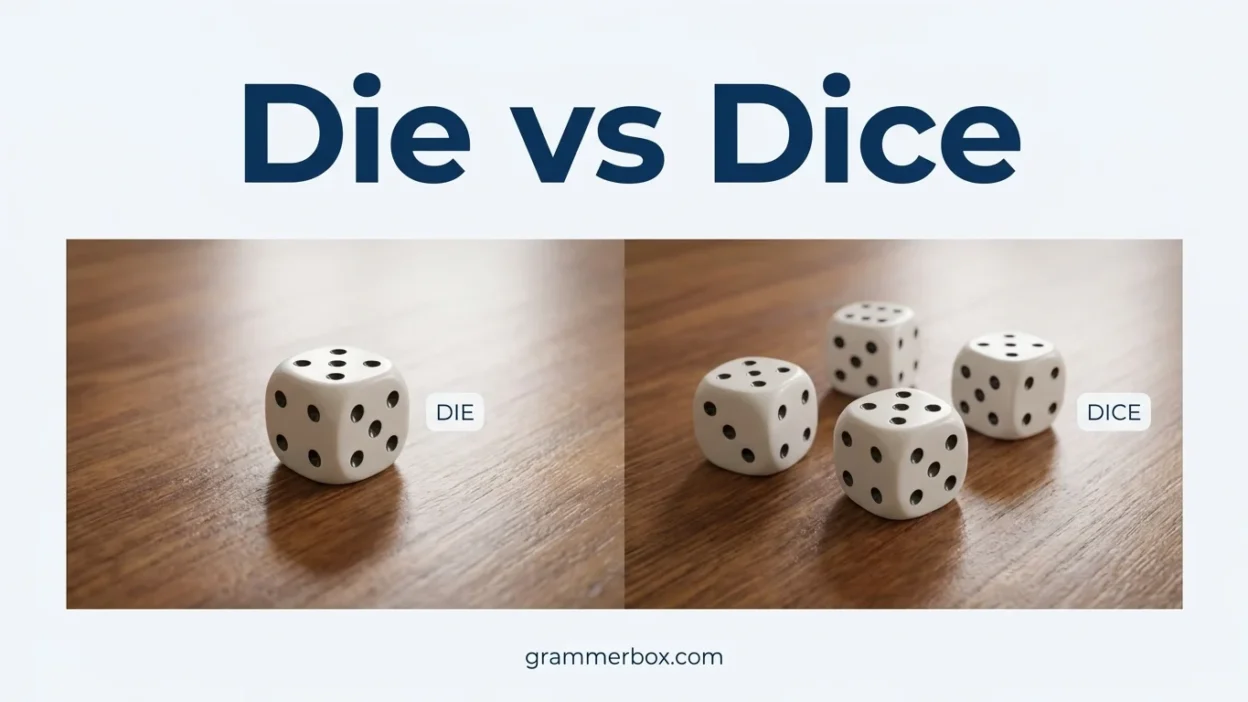
Die or Dice explains an English grammar difference: die is singular, while dice is plural in everyday speech and writing. In vocabulary and terminology, these nouns describe a small, cube-shaped object or game piece used in gaming, games, tabletop activities, board games, and casino settings. A standard die is a six-sided cube with six faces, and its dots or pips show one, two, three, four, five, or six. When talking about a single cube, use die, but multiple cubes are called dice. This simple distinction helps learners understand the correct singular form and plural form.
A player or group of players may be playing a game and throw, toss, or roll a die, while several dice can form a pair or set. A random roll, rolling, or tosses can create a chance-based outcome, while the result may affect the score, scoring, points, or point total during a turn. The land or landing of the cube determines which face appears, while its markings produce a random number or random numbers. In mathematics, probability, chance, and odds help describe how likely each number or outcome may be. From my experience explaining this topic, learners often remember die as one game piece and dice as several game pieces.
The distinction also applies to gambling, casino activities, and ordinary board games. Randomization can produce different results, while the exact outcomes depend on the numbers shown after the rolled cubes land. A standard die means one cube with six possible faces, whereas standard dice means more than one. The basic noun rule is therefore clear: die is singular, and dice is plural. Keeping these forms separate makes the English grammar rule easier to understand and use correctly in everyday vocabulary.
Quick Answer
A die is traditionally the singular form of the small numbered cube used in games, while dice is the plural form. For example, you roll one die but two dice. In modern informal English, however, dice is sometimes used as both singular and plural.
Why People Confuse Die and Dice
The confusion between die and dice mainly comes from irregular plural forms in English.
Most English nouns simply add -s to become plural. For example:
- Book → books
- Game → games
- Card → cards
However, die does not become dies when referring to a gaming cube. Its traditional plural form is dice.
Another reason for confusion is that dice is increasingly used as a singular noun in casual English. You may hear someone say, “Roll the dice,” even when referring to only one cube. Although this usage is common, die remains the traditional singular form.
Die: Meaning and Usage
What Does Die Mean?
When discussing games, a die is a small cube with marked sides, usually containing numbers or dots. It is commonly used in board games, tabletop games, and other games of chance.
For example:
- Roll the die.
- The die landed on six.
- She picked up a single die from the table.
A standard die usually has six sides, with numbers represented by dots called pips.
Other Meanings of Die
The word die also has completely different meanings.
As a verb, die means to stop living.
For example:
- The plant may die without water.
- Many animals die from natural causes.
As a noun in manufacturing, a die can also mean a specialized tool used for cutting, shaping, or stamping materials.
For example:
- The metal was shaped using a steel die.
Therefore, context is important when determining the meaning of die.
Dice: Meaning and Usage
What Does Dice Mean?
Traditionally, dice is the plural form of die when referring to gaming cubes.
For example:
- Roll the dice.
- Two dice fell onto the floor.
- The players took turns throwing the dice.
The word usually refers to two or more numbered cubes used in games.
Can Dice Be Singular?
In modern English, dice is sometimes used as both a singular and plural noun, especially in informal speech.
For example, some people might say:
- Roll a dice.
However, traditional grammar generally considers this less formal than:
- Roll a die.
If you are writing for school, professional purposes, or formal publications, it is usually safer to use die for one gaming cube and dice for more than one.
Die vs Dice: Comparison Table
| Feature | Die | Dice |
|---|---|---|
| Traditional number | Singular | Plural |
| Meaning in games | One numbered cube | Two or more numbered cubes |
| Example | Roll one die | Roll two dice |
| Modern informal usage | Standard singular | Sometimes used as singular |
| Other meanings | Death, manufacturing tool | Mainly gaming cubes |
When to Use Die vs Dice
Use die when you are referring to one gaming cube.
Examples:
- He rolled a die.
- The die showed the number four.
- I found one die under the table.
Use dice when referring to two or more gaming cubes.
Examples:
- She rolled two dice.
- The dice landed on the board.
- Put the dice back in the box.
Simple Rule
One = die
More than one = dice
This traditional rule works well in formal writing and grammar-focused contexts.
Examples of Die and Dice in Sentences
Here are several examples showing how to use both words correctly.
- He rolled one die and moved his game piece.
- She picked up the die from the floor.
- The die landed on the number six.
- We need another die to complete the game.
- A single die was missing from the box.
- Roll the dice to start the game.
- The two dice landed on different numbers.
- He shook the dice inside a cup.
- The players waited for the dice to stop rolling.
- These dice are made from plastic.
- She bought a new set of colorful dice.
- The dice rolled across the table.
- One die fell under the chair.
- The game requires three dice.
- He carefully placed the die beside the board.
Common Mistakes
Mistake 1: Using “Dies” as the Plural of a Gaming Die
Incorrect:
- I rolled two dies.
Correct:
- I rolled two dice.
The plural form of the gaming noun die is traditionally dice, not dies.
Mistake 2: Confusing the Noun and Verb “Die”
Incorrect understanding:
- He rolled a die, meaning someone stopped living.
Correct understanding:
The noun die in gaming has a completely different meaning from the verb die, which means to stop living.
Mistake 3: Using “A Dice” in Formal Writing
Informal:
- Roll a dice.
Traditional and formal:
- Roll a die.
While singular dice is increasingly common in casual speech, die remains the safest traditional singular form.
Mistake 4: Thinking Dice Always Means Exactly Two
The word dice means more than one die. It can refer to two, three, four, or many gaming cubes.
For example:
- The game uses five dice.
Memory Trick for Die vs Dice
A simple way to remember the difference is:
One cube = die
Many cubes = dice
You can also remember that dice sounds like it refers to a collection or group.
Think of this example:
- One die
- Two dice
The irregular change is similar to other English words with unusual plural forms, although die → dice is especially important in gaming vocabulary.
Die vs Dice in American and British English
Both American English and British English traditionally use die as the singular form and dice as the plural form when referring to gaming cubes.
For example:
American English:
- Roll the dice.
British English:
- Roll the dice.
The traditional distinction is generally the same in both varieties of English.
However, informal speech in different regions may use dice as a singular collective-style noun. This does not significantly change the standard grammar rule used in dictionaries, educational writing, and formal contexts.
Similar Words and Related Terms
Understanding related vocabulary can make the difference between die and dice easier to remember.
Cube
A cube is a three-dimensional shape with six equal square sides. A traditional die is usually cube-shaped.
Pips
Pips are the small dots on the sides of many dice.
For example:
- The die has five pips on this side.
Roll
To roll dice means to throw or move them so they land randomly.
For example:
- Roll the dice and see what number you get.
Game Piece
A game piece is an object moved during a board game. Dice often determine how far a player can move a piece.
Spinner
A spinner is another game tool used to produce a random result, but it is different from a die or dice.
Final Verdict: Die vs Dice
The traditional difference is simple: die is singular, while dice is plural when referring to the small numbered cubes used in games.
Use die when talking about one cube:
- I rolled one die.
Use dice when talking about more than one:
- I rolled two dice.
Although singular dice is becoming more common in informal English, die remains the standard and traditional singular form. If you want to be grammatically precise, especially in formal writing, follow the rule: one die, two or more dice.
FAQs:
Is dice singular or plural?
Traditionally, dice is plural, while die is singular. However, modern informal English sometimes uses dice as a singular noun.
What is the singular form of dice?
The traditional singular form of dice is die.
Can I say “one dice”?
In informal speech, some people use one dice, but traditional grammar recommends one die.
Is “dies” the plural of die?
No, not when referring to gaming cubes. The traditional plural of a gaming die is dice.
Why is the singular of dice called die?
The word developed through historical changes in English and French. Over time, die became the traditional singular form, while dice became the plural form.
What does die mean besides a gaming cube?
As a verb, die means to stop living. As a noun, it can also refer to a specialized tool used for cutting, shaping, or stamping materials.
Are die and dice used differently in American and British English?
Not significantly. Both American and British English traditionally use die for one gaming cube and dice for more than one.
Conclusion
The difference between die vs dice is easy to understand once you remember the traditional singular and plural forms. A die refers to one numbered gaming cube, while dice refers to two or more. This distinction is useful in board games, tabletop games, educational writing, and formal English.
Although modern speakers sometimes use dice as a singular noun, the traditional rule remains the clearest choice: one die, two dice. By using the correct form based on number and context, you can avoid a common English vocabulary mistake and communicate more accurately.
Remember This
Use “die” for one gaming cube and “dice” for two or more.
One die → Two dice