The English words entitled and titled look similar, but they have different meanings and uses. Both words can appear when discussing books, articles, legal rights, and official documents. However, choosing the wrong word can change the meaning of your sentence. Understanding the difference between entitled vs. titled will help you write more clearly and avoid common grammar mistakes.
The main difference is that entitled can mean having a right to something or being given a particular title, while titled usually means having a specific name or title. For example, a person may be entitled to receive a refund, while a book may be titled The Power of Words. These words are not interchangeable in most situations. Whether you are writing an essay, creating website content, or improving your everyday English, learning when to use each word will make your writing more accurate and natural.
Quick Answer
Entitled means having a right to something or, in certain contexts, being given a particular title. Titled means having a name or title, especially when referring to a book, article, film, or other work. For example, you may be entitled to compensation, while a novel may be titled The Silent River.
Why People Confuse It
People often confuse entitled and titled because both words contain the word title and can relate to naming or designation.
However, their meanings depend on context.
- Entitled: Commonly refers to having a right, privilege, or claim to something.
- Titled: Usually refers to the name given to a book, article, film, song, or other work. It can also describe someone who holds a formal title, such as Lord or Lady.
For example:
- Correct: Employees are entitled to paid leave.
- Correct: The article is titled How to Improve Your Writing.
The first sentence discusses a right, while the second identifies the name of an article.
Remember that a person who feels entitled may believe they deserve special treatment. This meaning is different from having a formal title or naming a piece of writing.
First Word: Entitled
Entitled has several meanings, but it most commonly means having the right to receive or do something.
It can also mean giving something a particular title, although this use is less common in modern everyday English.
Meaning of Entitled
The word entitled is the past tense and past participle of the verb entitle. It is also commonly used as an adjective.
Its main meanings include:
- Having a right: Being legally or officially allowed to receive something.
- Believing you deserve something: Expecting special treatment or privileges.
- Giving something a title: Naming a book, article, or other work.
Examples of Entitled
- Employees are entitled to annual leave.
- You are entitled to ask questions during the meeting.
- Every eligible student is entitled to financial assistance.
- She felt entitled to special treatment.
- The author entitled her latest book A Journey Home.
In the final example, entitled is used as a verb meaning that the author gave the book its title.
When Is Entitled Correct?
Use entitled when discussing rights, benefits, privileges, or expectations.
Examples:
- You are entitled to a refund under the applicable policy.
- Citizens are entitled to equal protection under the law.
- The employee is entitled to receive the agreed payment.
- He acted as though he were entitled to everyone’s attention.
Important: Being entitled to something does not automatically mean you will receive it. It means you have a right or claim to it under the relevant circumstances.
Second Word: Titled
Titled generally means having a particular name or title. It is especially common when referring to books, films, songs, articles, paintings, and other creative works.
It can also describe someone who holds a formal title, such as a noble or aristocratic title.
Meaning of Titled
Titled is the past tense and past participle of the verb title. It can also function as an adjective.
Its common meanings include:
- Having a name: A work has been given a specific title.
- Giving something a name: Someone assigns a title to a book, article, or other work.
- Holding a formal title: A person has a recognized designation, such as Sir, Lord, or Lady in systems where such titles exist.
Examples of Titled
- The book is titled Learning English Made Easy.
- She published an article titled The Future of Education.
- The film is titled Beyond the Horizon.
- He wrote a poem titled A Winter Morning.
- The titled nobleman attended the ceremony.
In the first four examples, titled identifies the name of a creative work. In the last example, it refers to someone who holds a formal title.
When Is Titled Correct?
Use titled when identifying or describing the name of a work.
Examples:
- I read a fascinating article titled The Science of Sleep.
- The museum displayed a painting titled Evening Light.
- Her new song is titled Never Give Up.
- The documentary is titled Our Changing Planet.
You can also use called or named in many of these sentences.
For example:
- The book is titled The Hidden Garden.
- The book is called The Hidden Garden.
Both sentences are correct, although titled can sound more formal in writing.
Comparison Table: Entitled vs. Titled
| Feature | Entitled | Titled |
|---|---|---|
| Main meaning | Having a right or claim to something | Having or being given a title |
| Common use | Rights, benefits, and privileges | Books, articles, films, and other works |
| Part of speech | Verb or adjective | Verb or adjective |
| Example | You are entitled to a refund. | The book is titled New Beginnings. |
| Formal writing | Common in legal and professional contexts | Common in academic and publishing contexts |
| Refers to rights | Yes | No, not in its usual naming sense |
| Refers to a work’s name | Possible when used as a verb | Yes, commonly |
| Similar word | Eligible, authorized | Named, called |
| Common expression | Entitled to something | Titled something or titled something |
The easiest way to distinguish the two is to look at what the sentence describes. If it concerns a right or benefit, entitled is usually the correct choice. If it identifies the name of a work, titled is generally the better choice.
When to Use Each
Although the two words are related, they serve different purposes in English sentences.
Use Entitled for Rights and Benefits
Use entitled to when someone has a right, privilege, or claim to something.
Examples:
- You are entitled to a full explanation.
- Workers are entitled to a safe workplace.
- She is entitled to receive the payment.
- Students may be entitled to financial support.
The expression entitled to is particularly common in legal, workplace, educational, and administrative writing.
Use Entitled for Expectations
You can also use entitled to describe someone who expects special treatment.
Examples:
- He seems entitled to special privileges.
- The entitled customer demanded immediate attention.
- She does not believe she is entitled to special treatment.
This meaning can have a negative tone, especially when describing someone who expects more than they reasonably deserve.
Use Titled for Books and Articles
Use titled to identify the name of a written or creative work.
Examples:
- The report is titled Annual Market Review.
- I found a useful guide titled English Grammar Basics.
- The chapter is titled Understanding Verb Tenses.
This construction is particularly useful in academic writing, journalism, and online publishing.
Use Titled for Creative Works
Titled can also describe films, songs, plays, paintings, and other artistic works.
Examples:
- The movie is titled The Last Journey.
- The song is titled A Better Day.
- The painting is titled Blue Morning.
Can Entitled and Titled Both Be Correct?
Yes, but they must fit the intended meaning.
Consider these sentences:
- The author entitled the book A New Beginning.
- The book is titled A New Beginning.
Both sentences are correct. In the first, entitled is the verb describing the author’s act of giving the book a title. In the second, titled describes the name the book has.
However, you should not use one word simply because it looks similar to the other.
For example:
- Incorrect for the intended meaning: She is titled to a refund.
- Correct: She is entitled to a refund.
The second sentence expresses a right, which is the meaning required here.
Examples of Entitled vs. Titled
Here are 16 practical examples to help you understand the difference.
Examples Using Entitled
- Employees are entitled to paid holidays.
The employees have a right to paid holidays. - You are entitled to express your opinion.
You have the right to share your opinion. - She is entitled to a refund under the store’s policy.
She has a valid claim to a refund. - Eligible students are entitled to financial assistance.
Eligible students have the right to receive assistance under the applicable rules. - He felt entitled to special treatment.
He believed he deserved special treatment. - Every participant is entitled to a copy of the report.
Each participant has the right to receive a copy. - The author entitled her memoir A Life of Courage.
The author gave her memoir that title. - Customers are entitled to clear information about the service.
Customers have a right to receive clear information.
Examples Using Titled
- The novel is titled The Forgotten Path.
The Forgotten Path is the novel’s name. - She wrote an article titled Simple Ways to Learn English.
The article has that title. - The documentary is titled Life Beneath the Ocean.
The documentary’s name is Life Beneath the Ocean. - I enjoyed a poem titled The Silent Night.
The poem has that name. - The report is titled Global Education Trends.
The report has a specific title. - He published a short story titled The Last Letter.
The title identifies the short story. - The exhibition features a painting titled Golden Fields.
Golden Fields is the painting’s name. - The professor assigned a chapter titled Introduction to Linguistics.
The chapter has that title.
These examples show that entitled is especially useful when discussing rights, while titled is common when identifying a work by its name.
Common Mistakes
Even fluent English speakers sometimes confuse these words, particularly when writing quickly. The following mistakes are easy to avoid.
Mistake 1: Using Titled for a Right
Incorrect: She is titled to receive compensation.
Correct: She is entitled to receive compensation.
Why? The sentence describes a right or claim, not a name or formal title.
Mistake 2: Using Entitled Instead of Titled
Incorrect for the intended meaning: The article is entitled Healthy Eating Habits.
Better: The article is titled Healthy Eating Habits.
Why? Both forms can be grammatically correct when naming a work, but titled is the more direct and widely preferred choice in contemporary English for identifying a work’s name.
Mistake 3: Confusing Entitled With Eligible
Incorrect: You are eligible to a refund.
Correct: You are entitled to a refund.
Why? Eligible for means meeting the conditions to qualify for something. Entitled to means having a right or claim to it.
For example:
- You are eligible for the scholarship.
- You are entitled to the benefits specified in your agreement.
Eligibility may be a requirement for receiving a benefit, but the two words do not mean exactly the same thing.
Mistake 4: Assuming Entitled Always Has a Negative Meaning
Incorrect assumption: The word entitled always describes a selfish person.
Correct understanding: Entitled can describe a legitimate right or privilege, as in Employees are entitled to paid leave.
The word has a negative connotation when it describes someone who expects undeserved special treatment.
Mistake 5: Forgetting the Preposition After Entitled
Incorrect: Employees are entitled paid leave.
Correct: Employees are entitled to paid leave.
Why? When entitled means having a right to something, it is normally followed by to and a noun or noun phrase.
Mistake 6: Treating Titled as a Word Only for Books
Incorrect assumption: A film cannot be titled.
Correct understanding: A film, article, song, poem, painting, chapter, or report can be titled.
The word applies to many kinds of creative and written works.
Memory Trick
If you find it difficult to remember the difference between entitled and titled, use this simple trick.
Entitled = Entitlement or a right.
Think of the phrase entitled to a refund. The word points to something a person has a right to receive.
Titled = Title or name.
Think of a book’s title. If a book is titled The Secret Garden, that is the name given to the book.
Remember these two examples:
- Entitled: I am entitled to a day off.
- Titled: The book is titled A Day Off.
The first sentence describes a right. The second identifies the name of a book.
A quick question can help you choose correctly: Am I talking about a right or a name? If it is a right, use entitled. If it is the name of a work, use titled in most cases.
American vs. British English
The distinction between entitled and titled is essentially the same in American and British English.
Both varieties use entitled to describe rights, privileges, or claims. Both also use titled to identify books, articles, films, and other works.
| Context | American English | British English |
|---|---|---|
| Having a right | You are entitled to a refund. | You are entitled to a refund. |
| Naming a book | The book is titled New Beginnings. | The book is titled New Beginnings. |
| Describing a legal benefit | She is entitled to compensation. | She is entitled to compensation. |
| Identifying an article | The article is titled Better Writing. | The article is titled Better Writing. |
There is no major regional spelling difference between these two words.
Are There Differences in Usage?
Some writers prefer titled when identifying a book or article because it is direct and precise. Others use entitled in the same context, particularly in formal or traditional writing.
For example:
- The novel is titled A New World.
- The novel is entitled A New World.
Both are acceptable, although many contemporary editors prefer titled for clarity.
In either variety of English, use entitled to when expressing a right or claim.
Similar Words
Understanding related words can help you use entitled and titled more accurately.
1. Named
Named means given a name or identified by a particular name.
Example: She wrote a book named The Open Road.
For books and articles, titled is often a more natural choice, although named is understandable in many contexts.
2. Called
Called is a common, conversational way to identify something by its name.
Example: I read a book called The Power of Habit.
It can often replace titled in everyday English.
3. Eligible
Eligible means meeting the conditions required to qualify for something.
Example: You are eligible for financial aid.
Unlike entitled, it does not necessarily mean you already have a right to receive the benefit.
4. Authorized
Authorized means officially permitted to do something or take an action.
Example: Only authorized employees can access the records.
It relates to permission rather than the name of a work.
5. Deserving
Deserving means worthy of something because of one’s actions, qualities, or circumstances.
Example: She is deserving of recognition for her hard work.
It can overlap with the idea of deserving a benefit, but it does not always indicate a legal or official right.
6. Designated
Designated means officially selected or assigned for a particular purpose.
Example: This room is designated for staff meetings.
It can relate to an assigned role or status, but it does not mean the same thing as titled in the context of naming a book.
7. Captioned
Captioned means provided with a caption or explanatory text.
Example: The photograph was captioned A Quiet Morning.
A caption is not always the same as a title, although the two may overlap.
FAQs:
1. What is the main difference between entitled and titled?
Entitled usually means having a right or claim to something. Titled usually means having a particular name, especially for a book, article, film, or other work.
Example: You are entitled to a refund, but the book is titled The Lost World.
2. Is it correct to say a book is entitled or titled?
Both expressions are grammatically acceptable when identifying a book’s name.
For example:
- The book is entitled The Secret Garden.
- The book is titled The Secret Garden.
Titled is often preferred in contemporary writing because it directly describes the book’s name.
3. Does entitled mean the same as eligible?
No. Eligible means meeting the conditions to qualify for something, while entitled means having a right or claim to something.
For example, a student may be eligible to apply for a scholarship but not necessarily entitled to receive it.
4. Can entitled have a negative meaning?
Yes. When used to describe someone’s attitude, entitled can mean believing that you deserve special treatment or privileges.
Example: He acted entitled and expected everyone to follow his instructions.
However, entitled is not always negative. In legal and professional contexts, it often describes legitimate rights.
5. Is titled more formal than called?
Titled often sounds more formal and precise when discussing books, articles, academic papers, or creative works. Called is more conversational and works well in everyday English.
Example: The report is titled Annual Review.
Alternatively: The report is called Annual Review.
Both sentences are natural.
6. Is entitled to grammatically correct?
Yes. Entitled to is the standard construction when entitled means having a right or claim to something.
Examples:
- She is entitled to a refund.
- Employees are entitled to paid leave.
- You are entitled to know the relevant details.
7. Do American and British English use entitled and titled differently?
The basic meanings are the same in both varieties. American and British English use entitled for rights and titled for naming works. There is no major difference in spelling between them.
Remember This
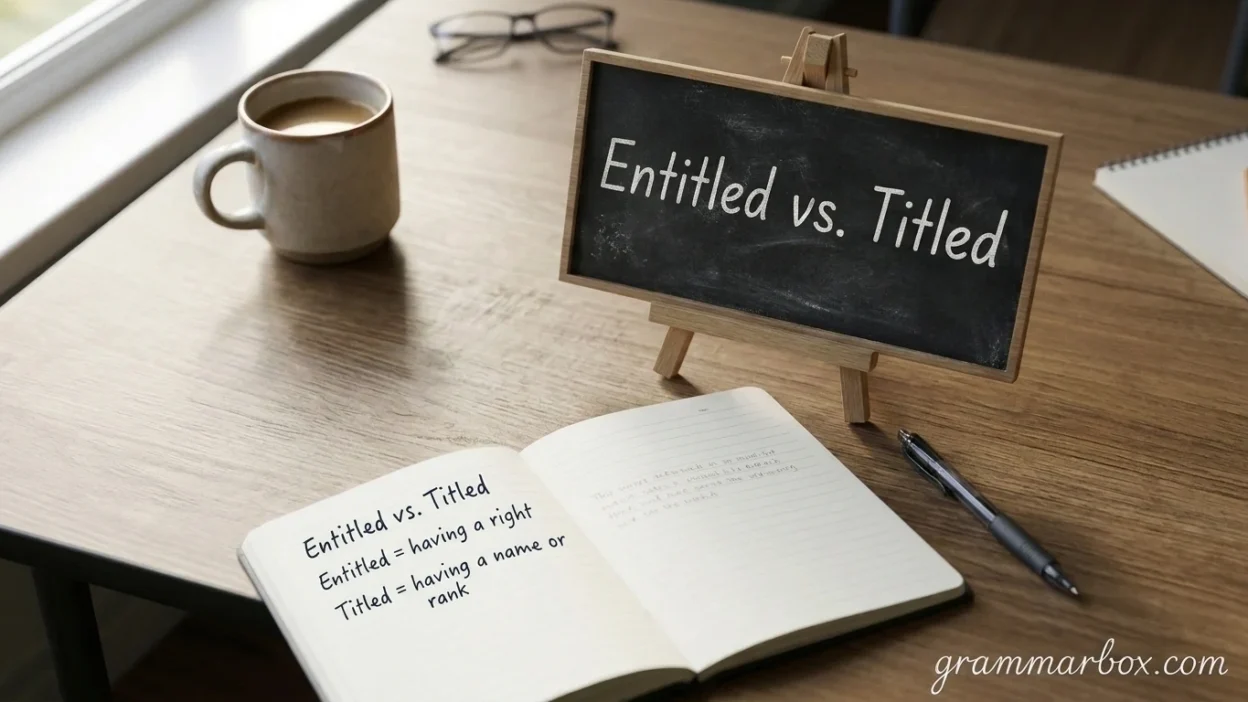
- Entitled = having a right or claim.
- Titled = having or being given a name or title.
- Entitled to a refund is correct.
- A book titled New Beginnings is correct.
When in doubt, ask yourself whether your sentence refers to a right or a name. That simple question will help you choose the correct word.
Conclusion
Understanding entitled vs. titled will improve your English grammar, vocabulary, and writing accuracy. Although the two words share a connection with the concept of a title, they usually serve different purposes. Entitled commonly describes rights and privileges, while titled identifies the name of a book, article, film, or other creative work. Learning their meanings and reviewing practical examples will help you avoid confusion in everyday communication and professional writing.
Remember that context is important. You can correctly say that an employee is entitled to paid leave or that a novel is titled The Hidden World. You can also use entitled as a verb when describing the act of giving a work its title. By paying attention to the intended meaning, you can use both words naturally and confidently in essays, articles, emails, and other forms of writing.