
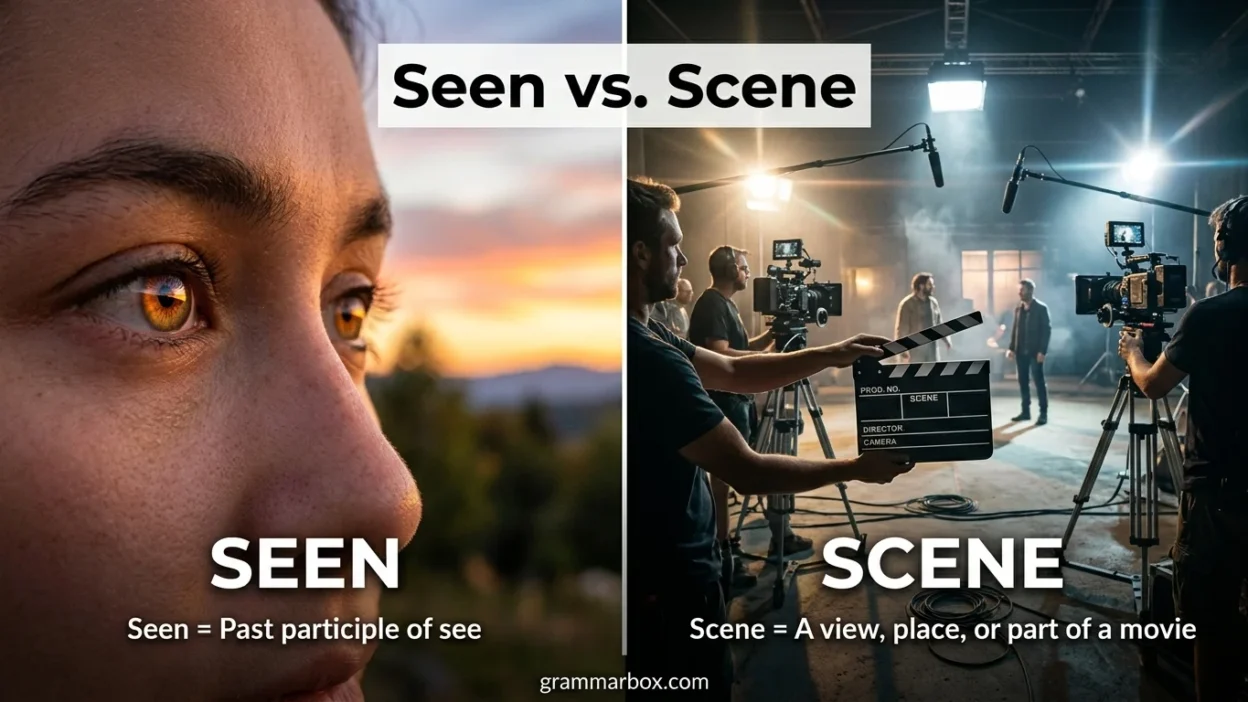
Have you ever wondered if to use seen or scene in a sentence? These two English words sound exactly alike, but they have completely different meanings. Because they are homophones, many English learners, students, and even experienced writers sometimes confuse them. Understanding the difference between seen and scene can help you improve your spelling, grammar, and everyday communication.
The good news is that distinguishing between these words is easier than you might think. Seen is the past participle of the verb see and describes something that someone has viewed or experienced. In contrast, scene is a noun that refers to a place, an event, a part of a movie, or a particular situation. Once you understand their meanings and learn a few simple examples, choosing the correct word becomes much easier. In this guide, you will discover their definitions, grammatical uses, common mistakes, and memory tricks to help you use both words confidently.
Quick Answer
Seen is the past participle of see, meaning to have viewed or noticed something. Scene is a noun referring to a place, event, setting, or part of a movie or play. Both words sound alike, but their meanings, spellings, and grammatical functions are different.
Why People Confuse It
People often confuse seen vs. scene because both words have the same pronunciation. When spoken aloud, there is no difference in how they sound, making it difficult to identify the correct spelling without understanding the context.
Another reason for this confusion is that both words can appear in sentences about movies, events, and experiences. For example, someone might say they have seen a movie or describe a memorable scene from it.
However, their grammatical roles are different:
- Seen: A verb form related to seeing, watching, or noticing something.
- Scene: A noun describing a setting, event, or part of a story.
Remembering these distinctions will help you avoid spelling errors in writing, emails, school assignments, and online content.
First Word: Seen
Seen is the past participle of the irregular verb see. It describes the act of viewing, observing, noticing, or experiencing something.
The verb forms are:
- Present: See
- Past tense: Saw
- Past participle: Seen
Seen is commonly used with helping verbs such as have, has, and had. It can also appear in passive constructions.
Meaning of Seen
The word seen means that something has been viewed, observed, or experienced.
Examples:
- I have seen that movie three times.
- She has seen the new advertisement.
- We had seen the building before it was renovated.
- Have you ever seen a shooting star?
- The missing documents were last seen on the desk.
In these examples, seen describes viewing or observing something.
When to Use Seen
Use seen when discussing something that someone has looked at, watched, noticed, or experienced.
Common expressions include:
- Have you seen it?
- I have never seen that before.
- She has seen better days.
- As seen on television.
- The person was last seen yesterday.
Grammar tip: In standard English, use seen with an appropriate helping verb when forming the present perfect or past perfect.
Correct: I have seen this picture before.
Incorrect: I seen this picture before.
In the second sentence, seen is missing the helping verb have. In standard English, use I saw this picture before or I have seen this picture before, depending on the intended meaning.
Second Word: Scene
Scene is a noun that describes a place, an event, a situation, or a part of a movie, television program, or theatrical performance.
It is often used when talking about storytelling, crime reports, public events, and the environment in which something happens.
Meaning of Scene
The word scene can have several related meanings:
- A part of a movie or play: A section of a performance or story.
- A location: The place where an event happens.
- A situation: An event or occurrence, especially one that attracts attention.
- A view or setting: The surroundings visible in a particular place.
Examples:
- My favorite scene is at the end of the movie.
- The police arrived at the scene of the accident.
- The mountain scene looked beautiful at sunset.
- She caused a scene at the restaurant.
- The opening scene introduces the main characters.
In each sentence, scene refers to a place, setting, event, or part of a performance.
When to Use Scene
Use scene when referring to a location, an event, a visual setting, or a section of a movie or play.
Common expressions include:
- Crime scene
- Movie scene
- Opening scene
- Beach scene
- Scene of the accident
- Make a scene
- Behind the scenes
- Scene from a play
Grammar tip: Because scene is a noun, it can be used with articles such as a and the, or in plural form as scenes.
For example:
- We watched a dramatic scene.
- The scene was beautifully filmed.
- Several scenes were removed from the movie.
Seen vs. Scene: Comparison Table
| Feature | Seen | Scene |
|---|---|---|
| Part of speech | Verb form (past participle) | Noun |
| Meaning | Viewed, observed, or experienced | Place, event, setting, or part of a performance |
| Base word | See | Scene |
| Past tense of related verb | Saw is the past tense of see | Not applicable |
| Common usage | Have seen, has seen, had seen | Movie scene, crime scene, beautiful scene |
| Example | I have seen that bird before. | The bird appeared in the opening scene. |
| Plural form | No ordinary plural form | Scenes |
| Pronunciation | /siːn/ | /siːn/ |
| Typical context | Watching or noticing something | Describing a place or event |
The most important distinction is that seen describes an act of seeing, while scene names a place, event, or setting.
When to Use Each
Choosing between seen and scene becomes easier when you identify what you want to express.
Use Seen When Talking About Observation
Choose seen when someone has viewed, watched, or noticed something.
Examples:
- I have seen your new website.
- Have you seen my keys?
- He has seen the results.
- We have seen this problem before.
In each example, seen relates to the experience of seeing or noticing something.
Use Scene When Describing a Place or Event
Choose scene when naming a setting, location, event, or part of a story.
Examples:
- The final scene was emotional.
- The firefighters reached the scene quickly.
- The artist painted a peaceful scene.
- The actors rehearsed the first scene.
In these sentences, scene identifies something rather than describing the act of seeing it.
A Simple Test
Ask yourself these questions:
- Am I talking about something viewed or experienced? Use seen.
- Am I talking about a place, event, setting, or part of a story? Use scene.
For example:
“I have seen the opening scene.”
Here, seen describes the act of watching, while scene refers to a section of the movie.
Examples of Seen vs. Scene
The following sentences demonstrate how to use both words correctly in everyday English.
Examples Using Seen
- I have seen that movie several times.
- Have you seen my notebook anywhere?
- She has seen the doctor about her cough.
- We had seen the warning signs before the storm.
- He has never seen snow in his life.
- The famous actor was seen leaving the hotel.
- I have seen better results from this method.
- They had seen the painting before it was sold.
- The bird was last seen near the lake.
- Have you ever seen a rainbow at night?
Examples Using Scene
- The opening scene introduces the main character.
- The police examined the scene of the accident.
- My favorite scene takes place in a garden.
- The director filmed the final scene yesterday.
- The mountain scene was breathtaking.
- The actors practiced a difficult scene together.
- The scene became chaotic when the alarm sounded.
- She made a scene at the shopping center.
- The movie contains several memorable scenes.
- The firefighters arrived at the scene within minutes.
Examples Using Both Words
These examples show how both words can appear naturally in the same sentence.
- I have seen the scene from that movie before.
- She had seen the opening scene many times.
- Have you seen the scene where the hero returns home?
- We have seen pictures of the accident scene.
- He had never seen such a beautiful mountain scene.
These sentences highlight the difference: seen expresses viewing or experience, while scene identifies the thing being viewed or described.
Common Mistakes
Even though seen and scene have different meanings, their identical pronunciation makes spelling mistakes common.
Here are some errors to avoid.
Mistake 1: Using Scene Instead of Seen
Incorrect: I have scene that movie before.
Correct: I have seen that movie before.
Why? The sentence describes watching a movie, so the past participle seen is required.
Mistake 2: Using Seen Instead of Scene
Incorrect: The opening seen was exciting.
Correct: The opening scene was exciting.
Why? The sentence refers to a part of a movie, making scene the correct noun.
Mistake 3: Confusing Saw and Seen
Incorrect: I seen him yesterday.
Correct: I saw him yesterday.
Also correct: I have seen him before.
Why? Use saw as the simple past tense of see. Use seen with an appropriate helping verb in perfect constructions.
Mistake 4: Forgetting the Meaning of Scene
Incorrect: The police arrived at the accident seen.
Correct: The police arrived at the accident scene.
Why? The word scene identifies the location where the accident occurred.
Mistake 5: Assuming Both Words Are Interchangeable
Incorrect: I have scene the beautiful landscape.
Correct: I have seen the beautiful landscape.
Incorrect: The landscape seen was beautiful.
Correct: The landscape scene was beautiful.
Why? The first sentence needs a verb form, while the second needs a noun describing the view or setting.
Memory Trick: How to Remember Seen vs. Scene
A simple memory trick can help you remember which spelling belongs in your sentence.
Remember Seen = See
The word seen contains the same letters as see, followed by an n.
Think of this sentence:
“I have seen what you see.”
Both words relate to looking at something.
Remember Scene = Setting
Think of scene as the setting of a movie, play, accident, or event.
For example:
“The scene of the movie was beautiful.”
You can also associate scene with a cinema screen, where movie scenes appear.
The One-Second Rule
Before choosing a word, ask:
- Does the sentence describe viewing something? Choose seen.
- Does the sentence describe a place, event, or part of a story? Choose scene.
Easy reminder: You have seen a movie, but a movie contains many scenes.
American vs. British English
There is no spelling difference between seen and scene in American and British English. Both words have the same spellings and meanings in standard English in the United States and the United Kingdom.
| Word | American English | British English |
|---|---|---|
| Seen | Seen | Seen |
| Scene | Scene | Scene |
| Movie scene | Movie scene | Movie scene |
| Accident location | Scene of the accident | Scene of the accident |
Although British English often uses film where American English commonly uses movie, the word scene remains the same in both varieties.
Examples:
American English: I have seen that movie’s final scene.
British English: I have seen the final scene of that film.
Both sentences use seen and scene correctly. The difference is mainly the preference for movie or film, not the spelling of the two words being compared.
Similar Words
Several English words have similar sounds, related meanings, or spelling patterns. Understanding them can help you avoid additional vocabulary and grammar mistakes.
1. See vs. Saw vs. Seen
These are three forms of the same verb.
- See: Present tense — I see the bird.
- Saw: Simple past tense — I saw the bird yesterday.
- Seen: Past participle — I have seen the bird before.
2. Scene vs. Scenery
Both words can describe visual surroundings, but they are used differently.
- Scene: A particular view, event, setting, or part of a performance.
- Scenery: The natural features or background visible in a place, or the painted backgrounds used in a performance.
Example: The mountain scenery was beautiful, and the opening scene showed the mountains at sunrise.
3. Scene vs. Setting
These words are related but not identical.
- Scene: A specific event, place, or section of a story.
- Setting: The time and place in which a story or event occurs.
Example: The setting is a small village, and the opening scene takes place in its market.
4. Seen vs. Watched
Both words can relate to viewing something, but their usage differs.
- Seen: The past participle of see, often used for experiences or observations.
- Watched: The past tense and past participle of watch, often suggesting sustained attention.
Example: I have seen that movie, but I watched it carefully to understand the ending.
5. Scene vs. Screen
These words sound similar but have different meanings.
- Scene: A part of a movie, an event, or a setting.
- Screen: A surface on which images or videos are displayed.
Example: The scene appeared on the screen.
FAQs:
1. What is the main difference between seen and scene?
Seen is the past participle of see and refers to something viewed or experienced. Scene is a noun that describes a place, event, setting, or part of a movie or play.
2. Is seen or scene correct?
Both words are correct, but they have different meanings. Use seen when referring to viewing or observing something, and use scene when referring to a place, event, or part of a story.
3. Are seen and scene pronounced the same?
Yes. In standard English, seen and scene are homophones, meaning they have the same pronunciation but different meanings and spellings.
4. Is it correct to say “I have scene it”?
No. In standard English, the correct sentence is “I have seen it.” The word seen is the past participle of see, while scene is a noun.
5. How do you use scene in a sentence?
You can use scene to describe a movie section, location, or event. For example: “The final scene of the movie was unforgettable.”
6. What is the past tense of seen?
The simple past tense of see is saw, not seen. For example, say “I saw him yesterday” or “I have seen him before.”
7. Do American and British English spell seen and scene differently?
No. Both American and British English use the same spellings: seen and scene. Their meanings also remain the same.
8. What is an easy way to remember seen vs. scene?
Remember that seen is connected to see, while scene refers to a setting, event, or movie section. For example, you have seen a movie, and the movie contains several scenes.
Final Verdict
The difference between seen vs. scene comes down to meaning and grammar. Seen is the past participle of see and is used when talking about something viewed, noticed, or experienced. Scene is a noun that describes a location, event, visual setting, or part of a movie or play. Although both words sound identical, they cannot be used interchangeably.
To choose the correct word, consider what your sentence means. If you are talking about watching or observing something, seen is usually the right choice. If you are describing a place, event, or part of a story, use scene. Practicing with example sentences and remembering the connection between seen and see will help you spell both words correctly and write with greater confidence.
Remember This
- Seen = The past participle of see: “I have seen that movie.”
- Scene = A place, event, setting, or part of a story: “The final scene was amazing.”
- Quick trick: You have seen a movie, but the movie contains many scenes.
Keep this simple distinction in mind, and you will find it much easier to use seen and scene correctly.