
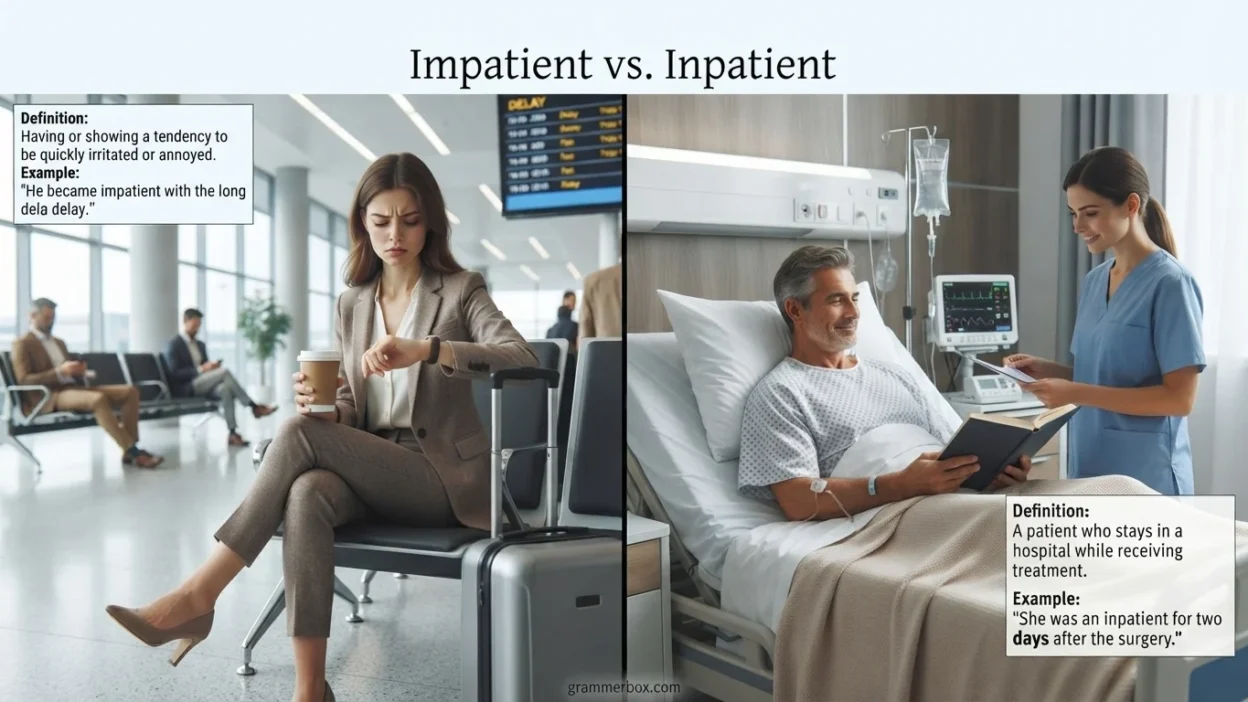
Impatient vs inpatient is a common word confusion because the two words look and sound almost identical. However, they have completely different meanings and functions. Impatient describes someone who is unable to wait calmly or who becomes annoyed when something takes too long. Inpatient, on the other hand, is mainly used in medical contexts to describe a person who stays in a hospital or receives treatment while remaining under hospital care.
Understanding this difference is especially important in writing because using one word instead of the other can completely change the meaning of a sentence. Whether you are writing an email, completing an English assignment, reading a medical report, or improving your vocabulary, knowing when to use impatient and inpatient will help you communicate more accurately. This guide explains their meanings, grammar, examples, common mistakes, and an easy memory trick so you can confidently choose the right word.
Quick Answer
Impatient means unable or unwilling to wait calmly, while inpatient refers to a person receiving medical care while staying in a hospital. Use impatient for behavior and inpatient for hospital-based treatment.
Why People Confuse It
The confusion between impatient and inpatient mainly comes from their similar spelling and pronunciation.
Both words contain patient, which makes it easy to assume that they are related in meaning. The prefix changes the meaning, though:
- Impatient = unable to wait calmly
- Inpatient = a hospital patient who stays for treatment
There is also an important difference in grammar. Impatient is an adjective that describes a person’s attitude or behavior. Inpatient is usually a noun referring to a person receiving hospital care, although it can also function as an adjective.
Compare these examples:
- The children became impatient after waiting for an hour.
- The hospital admitted three inpatients overnight.
The first sentence describes behavior. The second refers to people receiving medical treatment in a hospital.
First Word: Impatient
Impatient means unable to wait patiently or becoming annoyed because something is taking too long.
It can describe a person’s feelings, attitude, or behavior.
Common meanings of impatient
- Unwilling to wait
- Easily annoyed by delays
- Wanting something to happen immediately
- Eager for something to happen
Examples
- She became impatient while waiting for the bus.
- Tom is impatient with slow internet connections.
- The students were impatient to hear the results.
- He grew impatient after waiting for two hours.
Impatient can sometimes mean eager, rather than simply annoyed.
For example:
The children were impatient to open their presents.
Here, impatient to open means they were very eager to open them.
Second Word: Inpatient
Inpatient refers to a person who receives medical treatment while staying in a hospital or another healthcare facility.
It is commonly used in medical and healthcare contexts.
Common meanings of inpatient
- A person admitted to a hospital
- A patient who stays overnight or longer for treatment
- Medical care provided inside a hospital
Examples
- The doctor examined the inpatient before surgery.
- The hospital has 200 inpatient beds.
- She was admitted as an inpatient for further treatment.
- The facility provides both inpatient and outpatient services.
The opposite of inpatient is generally outpatient.
An outpatient receives medical care without staying overnight or being admitted to the hospital.
Impatient vs Inpatient Comparison Table
| Word | Part of Speech | Meaning | Common Context | Example |
|---|---|---|---|---|
| Impatient | Adjective | Unable or unwilling to wait calmly | Everyday situations, emotions, behavior | He became impatient in the long line. |
| Inpatient | Noun/Adjective | A person receiving hospital care while staying there | Medical and healthcare settings | The inpatient received treatment overnight. |
| Outpatient | Noun/Adjective | A patient treated without hospital admission | Medical settings | The outpatient returned home after treatment. |
Simple distinction
Impatient = cannot wait.
Inpatient = stays in a hospital.
When to Use Each
Use “impatient” for waiting or behavior
Choose impatient when someone is frustrated, restless, or eager because they have to wait.
Examples:
- I am getting impatient with this delay.
- The customer became impatient.
- She was impatient to start the meeting.
Use “inpatient” for hospital care
Choose inpatient when discussing someone who has been admitted to a hospital for treatment.
Examples:
- The patient became an inpatient after being admitted.
- The hospital offers specialized inpatient care.
- The doctor reviewed the inpatient records.
Quick test
Ask yourself:
Is the sentence about waiting? → Use impatient.
Is it about staying in a hospital for medical treatment? → Use inpatient.
Examples of Impatient and Inpatient
Here are more examples to make the difference clear:
- The children became impatient after waiting for their parents.
- The hospital admitted a new inpatient this morning.
- I felt impatient because the train was late.
- The nurse checked on every inpatient before midnight.
- She is becoming impatient with the slow service.
- The patient was transferred to the inpatient unit.
- He was impatient to receive the final decision.
- The hospital provides inpatient rehabilitation services.
- The students grew impatient during the long lecture.
- Each inpatient receives a treatment plan.
- My dog became impatient when dinner was delayed.
- The doctor discussed the inpatient admission process with the family.
Notice that the first set describes attitude, waiting, or eagerness, while the second describes medical care and hospitalization.
Common Mistakes
Mistake 1: Using “inpatient” for someone who cannot wait
Incorrect:
I am very inpatient today because the food is taking too long.
Correct:
I am very impatient today because the food is taking too long.
The sentence is about frustration caused by waiting, so impatient is correct.
Mistake 2: Using “impatient” for a hospital patient
Incorrect:
The doctor examined the impatient in room 12.
Correct:
The doctor examined the inpatient in room 12.
Here, the word refers to someone receiving hospital care, so inpatient is needed.
Mistake 3: Thinking “inpatient” means “patient inside”
Although this can be a useful memory aid, inpatient has a specific medical meaning. It does not simply describe anyone who happens to be inside a building.
Mistake 4: Confusing “impatient” with “impatience”
These words are related but have different grammatical roles:
- Impatient = adjective
- Impatience = noun
Example:
His impatience was obvious because he kept checking the clock.
Memory Trick
Use this simple trick:
Impatient = “I’m impatient because I can’t wait.”
The im- in impatient can remind you of being unable to wait patiently.
For inpatient, think:
IN + PATIENT = a patient IN the hospital.
This is not a complete definition, but it is an easy way to remember the medical meaning.
One-line memory rule
Impatient waits badly; inpatient stays for medical care.
American vs British English
The distinction between impatient and inpatient is essentially the same in American and British English.
In both varieties:
- Impatient means unable or unwilling to wait calmly.
- Inpatient refers to someone admitted for hospital treatment.
Medical terminology can vary somewhat between healthcare systems, but the basic meaning of inpatient remains consistent.
For example:
- American English: The patient was admitted as an inpatient.
- British English: The patient was admitted as an inpatient.
Both are grammatically correct.
Similar Words
Understanding related words can make the distinction even easier.
Words related to “impatient”
- Restless
- Irritated
- Frustrated
- Eager
- Hasty
- Unwilling to wait
- Anxious for something to happen
Example:
She was restless and impatient during the delay.
Words related to “inpatient”
- Hospital patient
- Admitted patient
- Hospitalized patient
- Medical patient
- In-hospital patient
The exact synonym depends on the medical context.
Inpatient vs outpatient
These two words form a particularly important pair:
- Inpatient = receives treatment while admitted to a healthcare facility
- Outpatient = receives treatment without being admitted
Example:
The hospital provides both inpatient and outpatient services.
FAQs:
Is “inpatient” one word or two?
Inpatient is normally written as one word when it refers to a hospital patient or hospital-based care.
Is “impatient” related to “patient”?
Yes. Impatient contains the word patient, but its meaning has developed into describing someone who cannot wait calmly or is eager for something to happen.
What is the opposite of impatient?
Depending on the context, the opposite can be patient, calm, or tolerant.
Example:
She was patient while everyone else became impatient.
What is the opposite of inpatient?
The usual contrasting term is outpatient. An inpatient stays in a healthcare facility for treatment, while an outpatient generally receives treatment without being admitted.
Can “inpatient” be an adjective?
Yes. For example:
The hospital expanded its inpatient services.
Here, inpatient describes the type of services.
Can “impatient” describe excitement?
Yes. Impatient can mean eager or very ready for something to happen.
Example:
The children were impatient to see their new teacher.
Is “impatient” a noun?
No. Impatient is normally an adjective. The related noun is impatience.
Final Verdict
The difference between impatient and inpatient is simple once you focus on context.
Use impatient when talking about someone who dislikes waiting, becomes frustrated by delays, or is eager for something to happen. Use inpatient when talking about a person who has been admitted to a hospital or about medical services provided to admitted patients.
The two words may look nearly identical, but they belong to very different situations. If the topic is waiting, frustration, or eagerness, choose impatient. If the topic is hospital admission or medical treatment, choose inpatient.
Remember This
Impatient = unable or unwilling to wait calmly.
Inpatient = a person receiving medical care while staying in a hospital.
Easy rule: If you are talking about waiting, use impatient. If you are talking about hospital care, use inpatient.
Conclusion
Knowing the difference between impatient vs inpatient can prevent an embarrassing or confusing word choice. Although they share the letters patient, their meanings are completely different. Impatient describes a person’s attitude toward waiting, while inpatient belongs primarily to the language of hospitals and healthcare.
The next time you hesitate between these words, think about the context first. Are you describing someone who cannot wait? Choose impatient. Are you describing someone admitted to a hospital? Choose inpatient. With this simple distinction and the memory trick above, you can use both words correctly and confidently.