
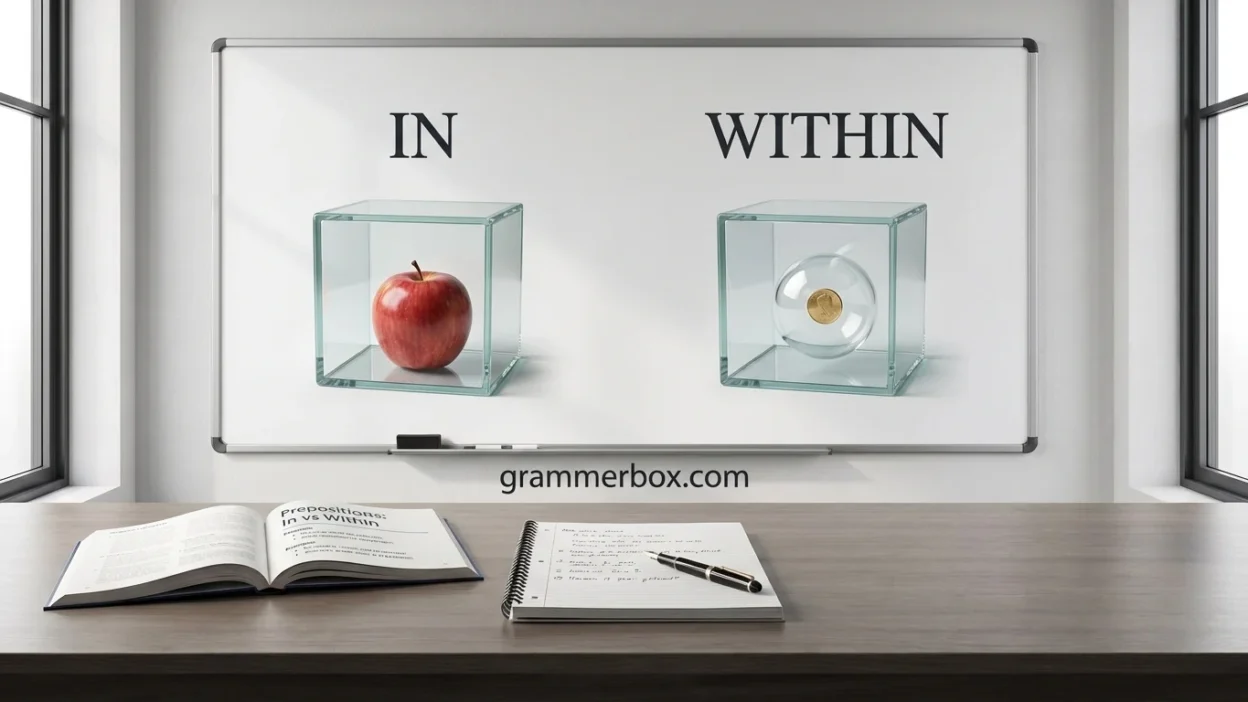
In and within are closely related English words, which is why many learners use them interchangeably. Both can refer to being inside something, but their meanings and usage are not always identical. In is a common and flexible preposition used for location, time, situations, and many everyday expressions. Within, on the other hand, often sounds more formal and usually emphasizes boundaries, limits, or a specific period of time.
Understanding the difference between in vs within can help you write and speak more naturally. While some sentences allow either word, choosing the wrong one may make your sentence sound unnatural or change its meaning slightly. This guide explains their definitions, grammar rules, examples, common mistakes, and the easiest ways to remember when to use each.
Quick Answer
In generally means inside something or during a period of time. Within means inside the limits or boundaries of something, often emphasizing a specific area, distance, amount, or time limit. Use in for general situations and within when referring to clear limits or boundaries.
Why Do People Confuse In and Within?
People confuse in and within because both words can describe something inside a place or during a period of time.
For example:
- She is in the building.
- She is within the building.
Both sentences suggest that she is inside the building. However, within places more emphasis on being inside its boundaries.
The biggest difference is that in is broader and more common, while within usually focuses on a limit, boundary, range, or specified period.
What Does “In” Mean?
In is a very common preposition in English. It usually means inside, during, as part of, or involved in, depending on the context.
Common uses of in:
- Inside a place or object
- During a period of time
- As part of a group or situation
- In a particular condition or state
Examples:
- The keys are in the drawer.
- I was born in July.
- She works in education.
- He is in trouble.
- There are five people in the room.
Because in is flexible and natural in everyday English, it is usually the better choice for general situations.
What Does “Within” Mean?
Within is a preposition that means inside the limits, boundaries, or range of something.
It is commonly used when discussing:
- Physical boundaries
- Time limits
- Distances
- Amounts
- Rules or restrictions
Examples:
- Stay within the marked area.
- Please respond within three days.
- The school is within walking distance.
- Keep the cost within your budget.
- The answer lies within the document.
Compared with in, the word within often sounds more formal and specific.
In vs Within: Comparison Table
| Feature | In | Within |
|---|---|---|
| Basic meaning | Inside or during | Inside the limits or boundaries |
| Common usage | Everyday English | More formal or specific |
| Physical location | Yes | Yes, with emphasis on boundaries |
| Time | During a period | Before a specified time limit |
| Boundaries | Not always emphasized | Clearly emphasized |
| Example | I will finish it in two hours. | I will finish it within two hours. |
The most important distinction is that within usually suggests a limit, while in simply refers to a general period, place, or situation.
When to Use In
Use in when talking about a general location, period, situation, or condition.
1. Use In for General Locations
- The children are in the garden.
- My phone is in my bag.
- She lives in London.
2. Use In for Months, Years, and Longer Periods
- We met in June.
- He graduated in 2020.
- They moved here in the summer.
3. Use In for Situations and Conditions
- She is in danger.
- The company is in financial trouble.
- He is in a good mood.
4. Use In for General Time Periods
- I will call you in an hour.
- The package should arrive in two days.
In these examples, in refers to a general period or situation without strongly emphasizing a boundary.
When to Use Within
Use within when something must happen or exist inside a specific limit, boundary, distance, or time frame.
1. Use Within for Time Limits
- Please complete the form within seven days.
- The results will be available within 24 hours.
- You must apply within the required period.
Here, within means before the end of the specified period.
2. Use Within for Physical Boundaries
- Stay within the fenced area.
- The museum is located within the city limits.
- Keep your belongings within the designated space.
3. Use Within for Limits or Ranges
- Keep your spending within your budget.
- The temperature remained within the normal range.
- Her score was within the acceptable limit.
In vs Within in Time Expressions
Time expressions are one of the most important areas where learners confuse these words.
In two hours
In two hours usually means something will happen after a period of two hours.
- I will leave in two hours.
This means the speaker will leave two hours from now.
Within two hours
Within two hours means something will happen at some point before two hours have passed.
- I will finish the work within two hours.
This means the work will be completed before the two-hour limit ends.
Simple difference:
- In two hours = after two hours
- Within two hours = before two hours have passed
This distinction is especially important in professional writing, instructions, deadlines, and formal communication.
Examples of In and Within
Here are several examples to help you understand the difference between in vs within.
- She found the letter in the drawer.
- Please remain within the safety area.
- I will see you in an hour.
- Please reply within an hour.
- He lives in Pakistan.
- The village is within ten miles of the city.
- There is something interesting in this book.
- The answer can be found within the report.
- She completed the task in three hours.
- You must complete the task within three hours.
- They stayed in the house all day.
- Keep your expenses within your budget.
- He works in the technology industry.
- The problem exists within the system.
- We will meet in the afternoon.
Common Mistakes with In and Within
Mistake 1: Using Within for Every Location
Incorrect:
- I live within London.
Correct:
- I live in London.
For cities, countries, and general places, in is usually more natural.
Mistake 2: Confusing In and Within for Deadlines
Incorrect understanding:
- Submit the form in five days.
This can suggest submitting it five days from now.
Better for a deadline:
- Submit the form within five days.
This clearly means before five days have passed.
Mistake 3: Using In When a Boundary Is Important
Less precise:
- Stay in the marked area.
More precise:
- Stay within the marked area.
Both may be grammatically correct, but within emphasizes that the person should not cross the boundary.
Mistake 4: Overusing Within in Everyday Conversation
Although within is correct in many situations, it can sound overly formal.
Natural:
- I left my keys in the car.
Less natural in casual conversation:
- I left my keys within the car.
In everyday English, in is usually the more natural choice.
Memory Trick for In vs Within
Here is a simple way to remember the difference:
In = Inside
Use in for general places, situations, and periods.
Within = Inside a limit
Think of the word within as containing the idea of a boundary or restriction.
Ask yourself:
Am I simply talking about something inside, or am I emphasizing a limit?
- General inside → in
- Inside a limit → within
For example:
- She is in the room.
- Stay within the room’s designated area.
In vs Within in American and British English
Both in and within are used in American and British English.
There is no major difference in meaning between the two varieties when it comes to standard grammar.
However, within often appears more frequently in:
- Formal writing
- Legal documents
- Business communication
- Academic writing
- Instructions and regulations
For example:
- Please respond within 14 days.
This wording is common in both American and British formal communication.
In casual conversation, speakers in both varieties are more likely to use in when possible.
Similar Words and Expressions
Several words and phrases have meanings related to in and within, depending on the context.
Inside
Inside often means physically within something.
- The children are inside the house.
During
During refers to something happening throughout a period.
- I slept during the movie.
Inside of
This phrase can sometimes replace in, especially when emphasizing physical location.
- The wallet is inside of the bag.
Before the End Of
This phrase can explain the meaning of within in time expressions.
- Finish the work before the end of the week.
Inside the Limits Of
This phrase closely matches within when discussing boundaries.
- Stay inside the limits of the marked zone.
Final Verdict: In or Within?
The choice between in vs within depends mainly on how specific you want to be.
Use in when referring generally to:
- A place
- A period of time
- A situation
- A condition
- A group or category
Use within when emphasizing:
- A physical boundary
- A time limit
- A distance
- A budget or range
- A specific restriction
In many situations, both words are possible, but within usually adds the idea of limits or boundaries.
FAQs:
Is it correct to say in or within?
Both are correct, but they are used differently. In is more general, while within usually emphasizes boundaries, limits, distances, or time frames.
What is the main difference between in and within?
The main difference is that in generally means inside or during, while within means inside a specific boundary, limit, or period.
Is within more formal than in?
Yes. Within often sounds more formal and is commonly used in professional, academic, legal, and official writing.
What is the difference between in two days and within two days?
In two days usually means two days from now. Within two days means at any time before two days have passed.
Can within mean inside?
Yes. Within can mean inside, especially when referring to a specific boundary or enclosed area.
Can I use within for a city?
Usually, in is more natural when talking about living or being located in a city. However, within can be used when referring to city boundaries, such as within the city limits.
Is within used for distance?
Yes. Within is commonly used for distance limits.
For example:
- The hotel is within five miles of the airport.
Which word should I use in everyday conversation?
In most everyday situations, in is the more natural and common choice. Use within when you specifically need to emphasize a limit, boundary, or deadline.
Remember This
Use “in” for general places, times, and situations. Use “within” when you mean inside a specific limit, boundary, distance, range, or deadline.
A quick formula is:
General inside → In
Inside a limit → Within
Conclusion
The difference between in vs within may seem small, but understanding it can make your English clearer and more precise. In is the more common and flexible word, making it suitable for general locations, time periods, situations, and conditions.
Within, however, is best when boundaries or limits matter. Whether you are discussing a deadline, distance, budget, physical area, or acceptable range, within adds precision. When choosing between the two, remember that in is general, while within focuses on limits.