
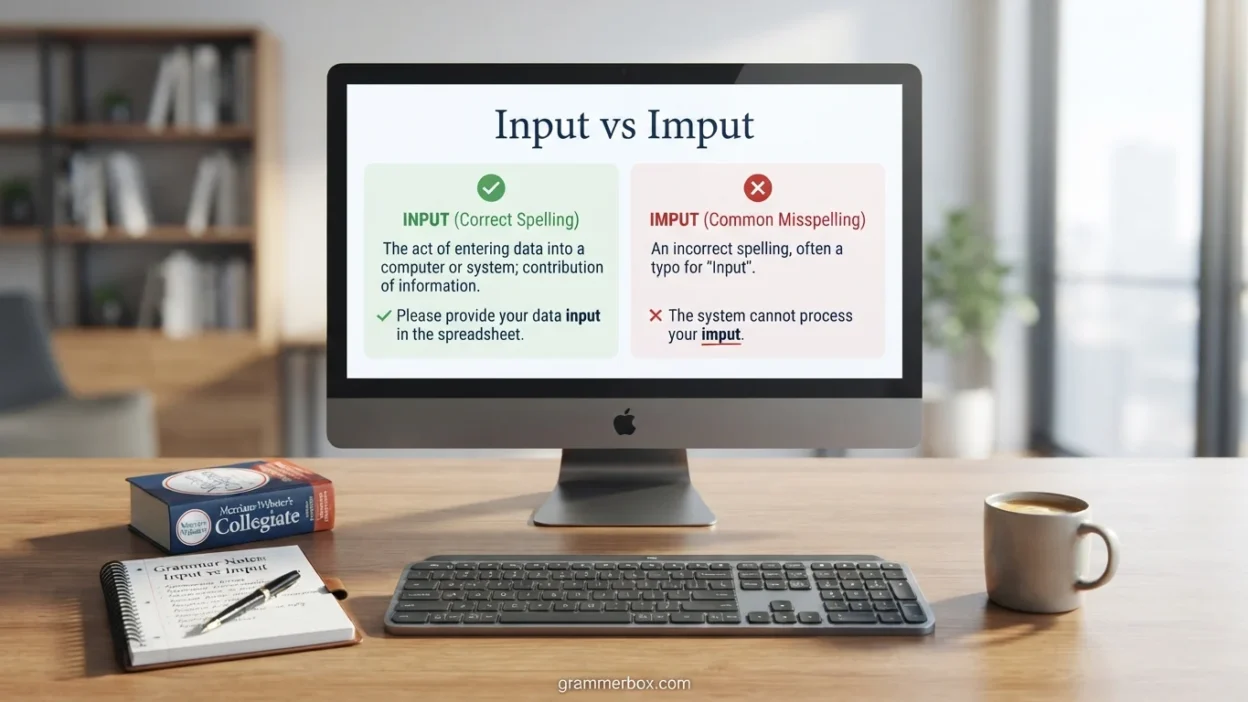
If you have ever typed “imput” instead of “input,” you are not alone. The two spellings look remarkably similar, especially when typing quickly or relying on pronunciation.
However, there is an important difference: input is the correct standard English word, while imput is generally considered a misspelling. The word input is widely used in everyday English, technology, business, education, and professional communication.
Understanding input vs imput is useful because input can function as both a noun and a verb. It can refer to information entered into a computer, someone’s opinion or contribution, or the act of entering data. Once you know the correct spelling and meaning, avoiding this common spelling mistake becomes much easier.
Quick Answer
Input is the correct spelling. Imput is a common misspelling and should generally be avoided in standard English. Use input for information entered into a system, an opinion or contribution, or the act of entering data.
Why People Confuse It
People often confuse input and imput because the pronunciation of input can make the n less noticeable in rapid speech.
Several factors contribute to the confusion:
- Input is sometimes pronounced quickly, making the consonants blend together.
- The spelling imput may seem logical because of the sound.
- People may write the word based on pronunciation rather than its standard spelling.
- Frequent typing errors can reinforce the incorrect form.
- Learners may confuse the word with other words beginning with im-.
Despite its occasional appearance online, imput is not the standard spelling you should use in formal English.
First Word: Input
Input is the correct spelling.
It has several related meanings.
As a noun
Input can mean information, data, or material entered into a system.
- “Please enter your input into the form.”
- “The computer processes the user’s input.”
It can also mean an opinion, suggestion, or contribution.
- “We need your input before making a final decision.”
- “Her input improved the project.”
As a verb
Input can also mean to enter information into a computer or system.
- “Please input your password.”
- “The employee input the customer data into the database.”
Although enter is often more natural in everyday instructions, input is perfectly valid.
Second Word: Imput
Imput is generally an incorrect spelling of input in standard English.
You may encounter imput in informal online writing, comments, messages, or user-generated content, but that does not make it the accepted spelling.
For professional writing, academic work, websites, emails, resumes, and other formal contexts, use input.
If you are wondering, “Is imput a word?” the safest answer is: No, not as the standard spelling of the common English word meaning information or a contribution. Use input instead.
Input vs Imput: Comparison Table
| Feature | Input | Imput |
|---|---|---|
| Correct standard spelling | Yes | No |
| Common English word | Yes | No |
| Can be a noun | Yes | No |
| Can be a verb | Yes | No |
| Used for data entry | Yes | No |
| Used for opinions or contributions | Yes | No |
| Recommended in formal writing | Yes | No |
| Commonly seen as a typo | No | Yes |
When to Use Each
Use “input” when:
- You mean information entered into a computer or system.
- You mean an opinion, suggestion, or contribution.
- You mean the act of entering data.
- You are writing an email, essay, report, or professional document.
- You are discussing technology or data processing.
Avoid “imput” when:
- Writing academic assignments.
- Preparing business documents.
- Writing website content.
- Sending professional emails.
- Completing applications or forms.
- Communicating in formal English.
A simple rule works in almost every situation: If you mean the standard English word, spell it “input.”
Input Examples: 12 Sentences
Here are some examples showing how input works naturally in different contexts:
- “Please input your email address in the required field.”
- “The manager asked for everyone’s input before approving the plan.”
- “Your input helped us identify the problem.”
- “The software processes user input automatically.”
- “Please input the correct security code.”
- “We value your input on this important decision.”
- “The keyboard allows users to input text quickly.”
- “She provided valuable input during the meeting.”
- “The system rejected the input because it was incomplete.”
- “I need your input before I finalize the article.”
- “The technician input the data into the database.”
- “The program uses customer input to improve its results.”
Notice that input can describe both technical information and human opinions.
Common Mistakes
One of the most common mistakes is writing imput when you mean input.
Incorrect:
“Please imput your information.”
Correct:
“Please input your information.”
Another mistake is assuming that because imput appears in online searches or informal writing, it must be an alternative spelling. In standard modern English, it is better treated as a spelling error.
Also remember that input can be both a noun and a verb, so you do not need to replace it with imput when using it as an action.
Memory Trick
Here is an easy way to remember the correct spelling:
INPUT = IN + PUT
Think of it as putting something in.
- IN → something goes inside
- PUT → place something
- INPUT → put information in
For example:
“I input the data into the system.”
The spelling input contains the familiar word put, which can help you remember that the word needs a p, not an m.
American vs British English
There is no meaningful American English vs British English spelling difference between input and imput.
Both American and British English use:
- input as the standard spelling
- input as a noun
- input as a verb
The incorrect spelling imput should not be used simply because of regional English differences.
So whether you are writing for an American audience, a British audience, or an international English-speaking audience, input is the correct choice.
Similar Words
Several words are related to input, especially in technology and communication.
Enter
Enter means to put information into a system.
“Enter your username.”
It is often more natural than input in computer instructions.
Data
Data refers to facts, figures, or information that can be processed.
“The system stores customer data.”
Information
Information is knowledge or facts communicated to someone.
“Please provide the requested information.”
Feedback
Feedback is an opinion or response about something.
“We appreciate your feedback.”
Contribution
A contribution is something someone adds to a discussion, project, or effort.
“Her contribution was extremely valuable.”
Output
Output is the result produced by a system or process.
“The program generates an output file.”
A useful technology pair to remember is:
Input → Process → Output
Final Verdict
When choosing between input vs imput, the answer is straightforward: input is correct. It is the standard English spelling used for data entered into a system, a person’s opinion or contribution, and the act of entering information.
Imput is generally a misspelling and should be corrected to input in formal and professional writing. If you remember the simple connection IN + PUT = INPUT, you will have an easy way to avoid this spelling error.
FAQs
Is “imput” a correct English word?
No. Imput is generally considered a misspelling of input when referring to information, data, or a contribution.
Is it “input” or “imput”?
The correct spelling is input. Use it in both formal and informal standard English.
What does input mean?
Input can mean information entered into a system, an opinion or contribution, or the action of entering information.
Can “input” be used as a verb?
Yes. Input can be used as a verb meaning to enter information into a computer or system.
Is “imput” a common spelling mistake?
Yes. People sometimes write imput because the pronunciation of input can make the n difficult to notice, especially in fast speech.
Is “input” the same in American and British English?
Yes. Both American and British English use input as the standard spelling.
How can I remember the spelling of input?
Think of IN + PUT = INPUT. The word contains put, which helps you remember the correct spelling.
Remember This
Input = correct ✅
Imput = misspelling ❌
Think: IN + PUT = INPUT.
Conclusion
The input vs imput confusion is easy to solve once you recognize that only input is the standard spelling. Whether you are talking about computer data, entering information, or asking for someone’s opinion, input is the form you should use. The spelling imput is best treated as a typo rather than an alternative English word.
When proofreading your writing, pay particular attention to words that sound different from the way they are spelled. Remembering IN + PUT gives you a quick mental check: if you mean putting information in, the correct word is input.