
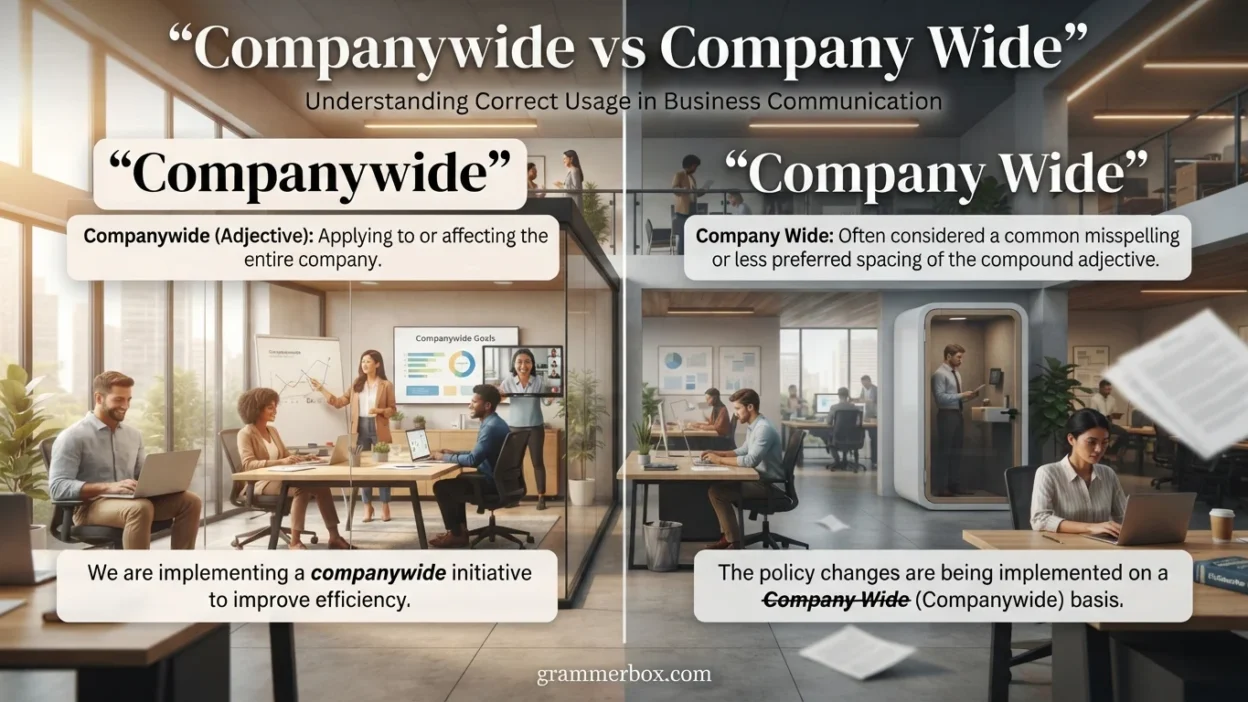
When writing about policies, announcements, meetings, or changes that affect an entire organization, you may wonder whether companywide or company wide is correct. The two forms look almost identical, but standard English usage favors one spelling when you mean “involving or affecting the whole company.” This small spelling choice can make business writing look more polished and professional.
The confusion often comes from similar compounds such as company-wide, nationwide, and worldwide. In everyday workplace communication, you may see all three forms of this expression: companywide, company-wide, and company wide. Understanding when each form works will help you write clearer emails, reports, policies, and announcements. In this guide, we’ll explain the meaning of companywide, compare it with company wide, examine common mistakes, and provide practical examples you can use in professional English.
Quick Answer
Companywide is the preferred one-word form when you mean “affecting, involving, or relating to the entire company.” Company-wide is also commonly accepted, especially when used as an adjective. Company wide is generally not the preferred spelling for this meaning.
Why People Confuse It
People often confuse companywide and company wide because wide can function as an ordinary adjective in English.
For example:
- The company is wide enough to operate across several regions.
- The new policy is companywide.
In the second sentence, companywide is a compound word meaning throughout the entire company.
The confusion is also understandable because English has many compound words that can appear as one word, two words, or hyphenated words depending on usage and style.
Common examples include:
- nationwide
- worldwide
- industry-wide
- companywide
- organization-wide
For professional writing, choosing the established compound form makes your meaning immediately clear.
Companywide: Meaning and Usage
Companywide means affecting, involving, applying to, or taking place throughout an entire company.
It is commonly used as an adjective and can also function as an adverb.
As an adjective
When companywide describes a noun, it tells readers that something applies to the whole company.
Examples:
- The CEO announced a companywide policy.
- We are introducing a companywide training program.
- The company conducted a companywide survey.
As an adverb
Companywide can also describe an action that happens throughout the organization.
Examples:
- The announcement was distributed companywide.
- The new rules will be implemented companywide.
- The software update will roll out companywide.
This form is especially useful in business communication because it is concise and easy to understand.
Company Wide: Meaning and Usage
Company wide is generally not the preferred form when you intend to say “throughout the entire company.”
In standard business writing, use companywide or, depending on the style guide and sentence structure, company-wide instead.
For example:
- Preferred: We introduced a companywide policy.
- Also commonly used: We introduced a company-wide policy.
- Generally avoid: We introduced a company wide policy.
However, two separate words can occasionally appear when wide has its ordinary meaning rather than forming the compound companywide. The intended meaning and grammatical structure determine the spelling.
Companywide vs Company Wide: Comparison Table
| Form | Correct for “throughout the company”? | Typical Use | Example |
|---|---|---|---|
| companywide | Yes | Adjective or adverb | We announced a companywide change. |
| company-wide | Yes | Hyphenated compound adjective | We announced a company-wide change. |
| company wide | Usually no | Not preferred for the compound meaning | We announced a company wide change. |
Which form should you choose?
For most modern professional writing, companywide is an excellent choice when it works naturally in the sentence.
Use company-wide when your organization’s style guide prefers hyphenated compound modifiers or when you want the compound structure to be especially clear.
Avoid company wide when you mean “affecting the entire company.”
When to Use Each
Use “companywide” when you mean the entire company
Choose companywide when an action, policy, program, change, or event involves the organization as a whole.
- companywide meeting
- companywide policy
- companywide announcement
- companywide survey
- companywide training
- companywide initiative
Use “company-wide” when your style guide prefers the hyphen
The hyphenated form is also widely used, particularly when company-wide directly modifies a noun.
For example:
The company launched a company-wide initiative.
The hyphen connects the words so readers immediately understand that they work together as one modifier.
Avoid “company wide” for the compound meaning
Although you may encounter company wide online, it is generally less desirable in polished business writing when the intended meaning is “throughout the company.”
Companywide Examples
Here are more than 10 natural examples showing how companywide works in professional English:
- The CEO announced a companywide policy on remote work.
- We conducted a companywide survey to collect employee feedback.
- The new training program will be available companywide.
- A companywide meeting is scheduled for Friday.
- The software update will be installed companywide next month.
- Management introduced a companywide initiative to improve customer service.
- The safety guidelines apply companywide.
- Employees received a companywide announcement about the changes.
- The company launched a companywide training program.
- The new benefits package will take effect companywide.
- Human Resources sent the policy to employees companywide.
- We need a companywide strategy for improving communication.
- The survey revealed strong support for the companywide changes.
- All departments participated in the companywide event.
- The new security requirements are being implemented companywide.
These examples show that companywide can naturally appear before a noun or after a verb.
Common Mistakes
Mistake 1: Writing “company wide” as the standard compound
❌ The new policy applies company wide.
✅ The new policy applies companywide.
Mistake 2: Assuming the hyphenated form is always wrong
The form company-wide is also used and is not inherently incorrect. Some dictionaries, publishers, and style guides favor the closed form companywide, while others retain the hyphen in compound modifiers.
Mistake 3: Using “companywide” when you mean one department
Companywide means the whole company, not a single team or department.
❌ The accounting department introduced a companywide procedure for its own staff.
✅ The accounting department introduced a department-wide procedure for its own staff.
Mistake 4: Confusing “companywide” with “worldwide”
These words have related structures but different meanings:
- companywide = throughout a company
- worldwide = throughout the world
For example:
The companywide policy applies to employees in every country.
The policy affects the company, while its geographic reach may be worldwide.
Memory Trick
Think of companywide as meaning:
company + wide = the whole company
When wide means “throughout” or “across the whole organization,” remember the closed compound:
You can use the same mental pattern with words such as nationwide and worldwide.
A quick test is to replace the word with “throughout the company.”
If the sentence still makes sense, companywide is probably what you need.
American vs British English
The spelling differences between American and British English are usually less important here than individual dictionary and style-guide preferences.
Companywide is an established form in English and is widely suitable for professional writing.
You may also encounter company-wide, particularly when writers or editorial styles prefer a hyphenated compound adjective.
The two forms can therefore coexist:
- companywide policy
- company-wide policy
For consistent business writing, follow the style guide used by your employer, school, publication, or organization. Most importantly, avoid switching randomly between companywide and company-wide within the same document.
Similar Words
Several words have a similar structure or meaning to companywide.
Organization-wide
Means affecting the entire organization.
The organization-wide policy begins next month.
Department-wide
Means affecting an entire department.
The department-wide meeting starts at noon.
Team-wide
Means affecting an entire team.
The team-wide training session was successful.
Nationwide
Means affecting or involving an entire nation.
The company launched a nationwide campaign.
Worldwide
Means affecting or involving the entire world.
The brand has a worldwide customer base.
Enterprise-wide
Means affecting the entire enterprise or business organization.
The company adopted an enterprise-wide security system.
These compounds follow a similar pattern, but their meanings depend on the noun they modify.
FAQs:
Is “companywide” one word?
Yes. Companywide is an established one-word form meaning “affecting or involving the entire company.” It is commonly used in professional and business writing.
Is “company wide” grammatically correct?
When you mean “throughout the entire company,” company wide is generally not the preferred spelling. Companywide or company-wide is usually better.
Is “company-wide” correct?
Yes. Company-wide is a commonly used hyphenated form, especially when it functions as a compound adjective before a noun. Whether to use it or companywide can depend on the preferred style guide.
Which is better: companywide or company-wide?
Both are used, but companywide is a standard closed compound and is often the simplest choice. If your organization’s style guide prefers hyphens in compound modifiers, use company-wide.
Should I write “companywide meeting” or “company-wide meeting”?
Both forms can be found in professional English. Companywide meeting is concise, while company-wide meeting clearly shows the compound modifier. Follow your preferred style guide consistently.
What does companywide mean?
Companywide means “throughout the entire company” or “affecting all parts or employees of a company.”
Is “companywide” an adjective or an adverb?
It can function as both an adjective and an adverb.
- Adjective: a companywide policy
- Adverb: implemented companywide
Final Verdict
If you’re deciding between companywide and company wide, choose companywide when you mean “throughout or involving the entire company.” It is a clear, concise, and established form for professional English.
Company-wide is also a legitimate and widely encountered alternative, particularly when a style guide favors hyphenated compound adjectives. Company wide, however, is generally best avoided for this intended meaning.
Remember This
Companywide = throughout the entire company.
- ✅ companywide — standard closed form
- ✅ company-wide — commonly accepted hyphenated form
- ⚠️ company wide — generally avoid when expressing the compound meaning
Conclusion
Choosing between companywide and company wide may seem like a tiny grammar question, but these details matter in polished workplace communication. When you mean something affects the entire organization, companywide is the safest straightforward choice. It works naturally in phrases such as companywide policy, companywide meeting, and companywide announcement.
Remember that company-wide is also commonly used, especially according to particular editorial or organizational style preferences.
The key is consistency. If your workplace has a style guide, follow it; otherwise, companywide is a clear and professional option. Once you connect the word with the meaning “throughout the whole company,” choosing the correct form becomes much easier.