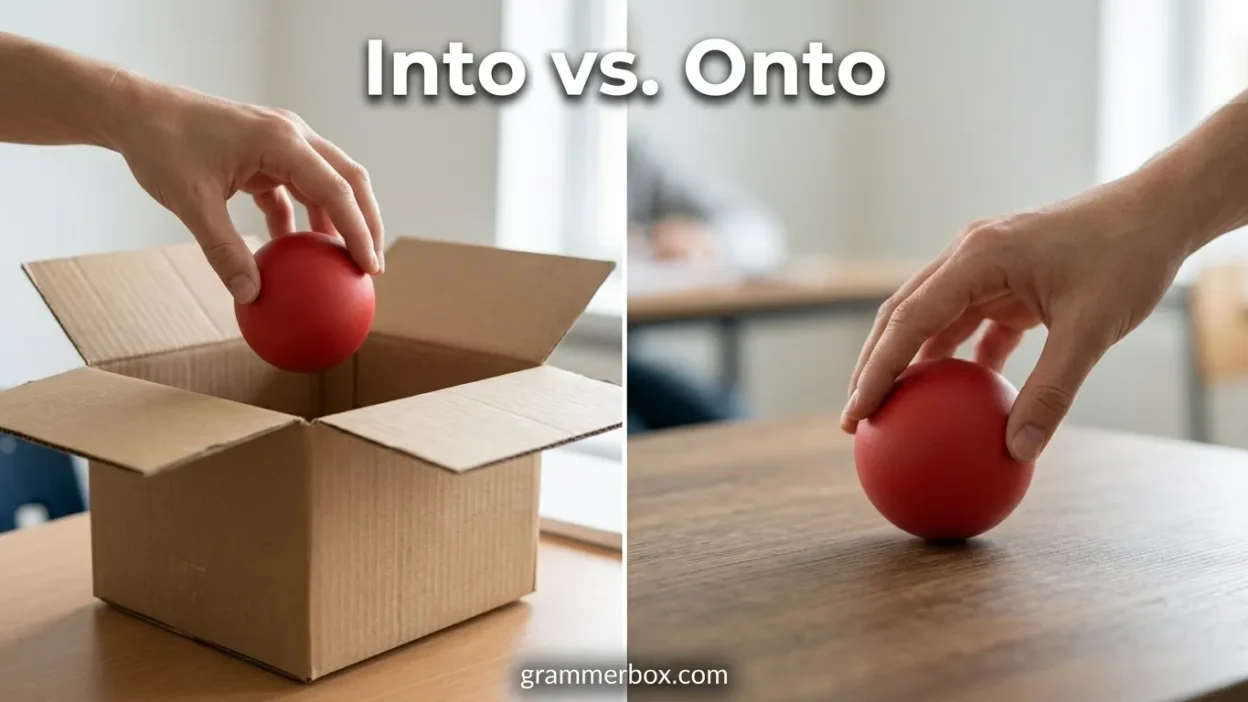
Choosing between into and onto can be confusing because both prepositions describe movement toward or into a place. However, they communicate different types of movement. The word into generally describes movement from the outside to the inside of something, while onto describes movement toward a surface or position on something. Understanding this small difference can make your English writing and speaking much clearer.
For example, you would say, “She walked into the room” because she entered an enclosed space. However, you would say, “She climbed onto the roof” because she moved to the surface of the roof. These words may sometimes appear in similar sentences, but they are not interchangeable in every situation. In this guide, you will learn the meanings of into and onto, their grammatical uses, common mistakes, and practical examples to help you choose the correct preposition confidently.
Quick Answer
Into describes movement from outside to inside a place or thing. Onto describes movement toward and onto a surface. For example, “Put the keys into the drawer” means inside it, while “Put the keys onto the table” means on its surface.
Why People Confuse It
People often confuse into and onto because both words contain the preposition to and describe movement toward a destination.
However, the main difference is the position reached after the movement.
- Into: Indicates entering an enclosed space or moving inside something.
- Onto: Indicates reaching or moving onto a surface.
Consider these examples:
- The cat jumped into the box. (The cat entered the box.)
- The cat jumped onto the box. (The cat landed on top of the box.)
The difference becomes easier to understand when you focus on whether something ends up inside a space or on a surface.
First Word: Into
Into is a preposition that describes movement from the outside toward the inside of a place, container, or object.
It can also describe a change in condition, transformation, involvement, or direction.
Meaning of Into
Into generally means:
- Moving from outside to inside.
- Entering a particular place or area.
- Changing from one form or condition to another.
- Becoming involved in an activity or situation.
Examples of Into
- She walked into the classroom quietly.
- He poured the milk into the glass.
- The children jumped into the swimming pool.
- Please put your clothes into the suitcase.
- The dog ran into the garden.
- Water turned into ice during the experiment.
- She translated the document into English.
- He got into trouble at school.
- The car crashed into a tree.
- They moved into a new house last week.
When to Use Into
Use into when describing:
- Entering a place: He went into the office.
- Putting something inside: Place the books into the bag.
- Transformation: The caterpillar changed into a butterfly.
- Involvement: She is getting into photography.
- Direction of movement: The ball rolled into the corner.
Remember that into focuses on movement toward an interior space or a change from one state to another.
Second Word: Onto
Onto is a preposition that describes movement toward a surface or position on something.
It indicates that a person, animal, or object moves to a position supported by or located on another surface.
Meaning of Onto
Onto generally means:
- Moving to the top of something.
- Reaching a surface.
- Moving to a particular position on something.
- Transferring or placing something on a surface.
Examples of Onto
- The cat jumped onto the sofa.
- She placed her phone onto the desk.
- The boy climbed onto the horse.
- He stepped onto the platform.
- The bird landed onto the roof.
- The child spilled juice onto the floor.
- She put the blanket onto the bed.
- The basketball bounced onto the sidewalk.
- He carefully climbed onto the ladder.
- The actor walked onto the stage.
When to Use Onto
Use onto when describing:
- Movement to a surface: The book fell onto the floor.
- Climbing: The child climbed onto the chair.
- Landing: The bird landed onto a branch.
- Placing something: Put the bag onto the table.
- Moving to a platform: The passengers stepped onto the train.
The important idea is that onto describes movement toward a surface or position on something rather than movement into an enclosed space.
Into vs. Onto: Comparison Table
Although into and onto both describe movement, their meanings and grammatical uses are different.
| Feature | Into | Onto |
|---|---|---|
| Main meaning | To the inside | To a surface |
| Movement | Outside to inside | Toward or onto a surface |
| Position | Within something | On top of or on something |
| Common use | Entering a room | Climbing onto a roof |
| Transformation | Yes | Generally no |
| Example | Walk into the house | Walk onto the stage |
| Opposite idea | Out of | Off |
Easy distinction: Use into when something enters an area or container. Use onto when something moves to a surface.
When to Use Each
Choosing the correct preposition depends on the destination and type of movement.
Use Into for Entering an Enclosed Space
When someone or something moves from outside to inside, use into.
Examples:
- She walked into the kitchen.
- The child crawled into the tent.
- He threw the letter into the mailbox.
Use Onto for Reaching a Surface
When something moves to a surface or position on something, use onto.
Examples:
- She climbed onto the roof.
- The keys fell onto the carpet.
- He stepped onto the stage.
Use Into for Transformation
Use into when one thing changes into another form or condition.
Examples:
- The ice melted into water.
- The writer turned the story into a movie.
- The company transformed the old building into a hotel.
Use Into for Involvement
Into can also describe becoming interested in or involved with something.
Examples:
- My brother is really into football.
- She got into photography last year.
- He is looking into the problem.
Use Onto for Movement to a Position
Use onto when someone or something moves to a particular position on a surface or platform.
Examples:
- The gymnast jumped onto the mat.
- The worker climbed onto the truck.
- The child stepped onto the stage.
Examples of Into vs. Onto in Sentences
Here are 15 practical examples to help you understand the difference between these two prepositions.
- Into: The teacher walked into the classroom.
Onto: The teacher stepped onto the platform. - Into: She put the vegetables into the refrigerator.
Onto: She placed the vegetables onto the kitchen counter. - Into: The dog ran into the house.
Onto: The dog jumped onto the couch. - Into: He dropped his wallet into the bag.
Onto: He dropped his wallet onto the table. - Into: The children jumped into the pool.
Onto: The children climbed onto the diving board. - Into: The bird flew into the cage.
Onto: The bird landed onto the window ledge. - Into: She poured the water into the bottle.
Onto: She poured the water onto the floor. - Into: He got into his car.
Onto: He climbed onto his motorcycle. - Into: The students entered into the examination hall.
Onto: The students stepped onto the stage. - Into: The company expanded into new markets.
Onto: The workers moved the equipment onto the platform. - Into: The caterpillar developed into a butterfly.
Onto: The butterfly landed onto a flower. - Into: She translated the book into French.
Onto: She transferred the photograph onto the computer screen. - Into: The ball rolled into the garage.
Onto: The ball rolled onto the driveway. - Into: He looked into the box.
Onto: He looked onto the balcony. - Into: She walked into the store.
Onto: She walked onto the sidewalk.
These examples show that the correct preposition depends on the intended meaning, not simply the verb being used.
Common Mistakes
Even experienced English learners sometimes use into and onto incorrectly. Here are some common mistakes and their corrections.
1. Using Into Instead of Onto
Incorrect: The cat jumped into the table.
Correct: The cat jumped onto the table.
Explanation: The cat lands on the table’s surface rather than entering it.
2. Using Onto Instead of Into
Incorrect: She walked onto the room.
Correct: She walked into the room.
Explanation: A room is an enclosed space, so into is appropriate.
3. Confusing Movement With Position
Incorrect: The book is into the desk.
Correct: The book is in the desk.
Explanation: Use in to describe an existing position inside something. Use into to describe movement toward the inside.
4. Forgetting the Difference Between On and Onto
Incorrect: He climbed on the roof. (When specifically emphasizing movement toward the roof.)
Better: He climbed onto the roof.
Explanation: On often describes a position, while onto emphasizes movement to that position.
5. Using Onto for Every Type of Movement
Incorrect: She poured the juice onto the glass.
Correct: She poured the juice into the glass.
Explanation: The juice goes inside the glass, not onto its outside surface.
Memory Trick: How to Remember Into vs. Onto
A simple memory trick can help you choose between these two words without thinking too much.
- INTO = IN: Think about entering something or moving inside.
- ONTO = ON: Think about reaching a surface or moving on top of something.
Remember these two sentences:
- The boy jumped into the pool. (He entered the water.)
- The boy jumped onto the diving board. (He landed on its surface.)
Whenever you are unsure, ask yourself one question:
Is the object moving inside something or onto a surface?
If it moves inside, choose into. If it moves onto a surface, choose onto.
American vs. British English
There is no major difference between American and British English when it comes to the meanings of into and onto.
Both varieties use these prepositions in essentially the same way.
| Usage | American English | British English |
|---|---|---|
| Entering a room | Walk into the room | Walk into the room |
| Moving to a surface | Jump onto the table | Jump onto the table |
| Entering a car | Get into the car | Get into the car |
| Climbing a platform | Step onto the platform | Step onto the platform |
Some differences may appear in everyday expressions, pronunciation, or writing preferences, but the basic grammatical rules remain consistent.
Therefore, whether you are writing American or British English, you should use into for movement inside something and onto for movement to a surface.
Similar Words
Understanding related prepositions can make the difference between into and onto even clearer.
1. In vs. Into
In describes a position inside something, while into describes movement toward the inside.
- In: The keys are in the drawer.
- Into: She put the keys into the drawer.
2. On vs. Onto
On describes a position on a surface, while onto describes movement toward that surface.
- On: The book is on the table.
- Onto: He placed the book onto the table.
3. Inside vs. Into
Inside refers to the interior of something, while into generally describes movement toward that interior.
- Inside: The children are inside the house.
- Into: The children ran into the house.
4. Upon vs. Onto
Upon generally means on or immediately after something, often in more formal or literary language. Onto emphasizes movement to a surface or position.
- Upon: Once upon a time, there was a king.
- Onto: The cat jumped onto the wall.
5. Out of vs. Off
These expressions describe movement away from different positions.
- Out of: She walked out of the room.
- Off: He jumped off the table.
FAQs:
1. What is the main difference between into and onto?
The main difference is the destination. Into describes movement from outside to inside something, while onto describes movement toward a surface or position on something.
2. Is it into the room or onto the room?
The correct expression is into the room when describing someone entering it. A room is an enclosed space, so into is the appropriate preposition.
3. Is it onto the table or into the table?
Use onto the table when something moves to the table’s surface. Use into the table only when something actually enters or penetrates the table.
4. Can into and onto be used interchangeably?
No. They have different meanings and are not generally interchangeable. Into indicates movement inside something, whereas onto indicates movement to a surface.
5. Is onto one word or two words?
Onto is one word. It is a standard preposition used to describe movement toward a surface or position.
6. What is the difference between in and into?
In describes where something is located, while into describes movement toward the inside of something.
For example:
- The cat is in the box.
- The cat jumped into the box.
7. Is it correct to say get onto the bus or get into the bus?
Both expressions can be correct, but they emphasize different things. Get onto the bus is the usual expression when boarding public transportation. Get into the bus can emphasize entering its interior, although it is less common in ordinary travel contexts.
Final Verdict
The difference between into and onto is simple once you understand the type of movement each word describes. Use into when someone or something moves from the outside to the inside of a place, container, or space. Use onto when someone or something moves toward a surface or position on another object.
Both prepositions are important in everyday English, academic writing, and professional communication. Instead of memorizing complicated grammar rules, focus on the destination of the movement. With regular practice and attention to sentence meaning, you can use into and onto naturally and confidently.
Remember This
- Into = Inside: She walked into the house.
- Onto = On a Surface: She climbed onto the roof.
- In = Position Inside: The keys are in the drawer.
- On = Position on a Surface: The keys are on the table.
The easiest way to remember the difference is: Into means going in, while onto means moving on.