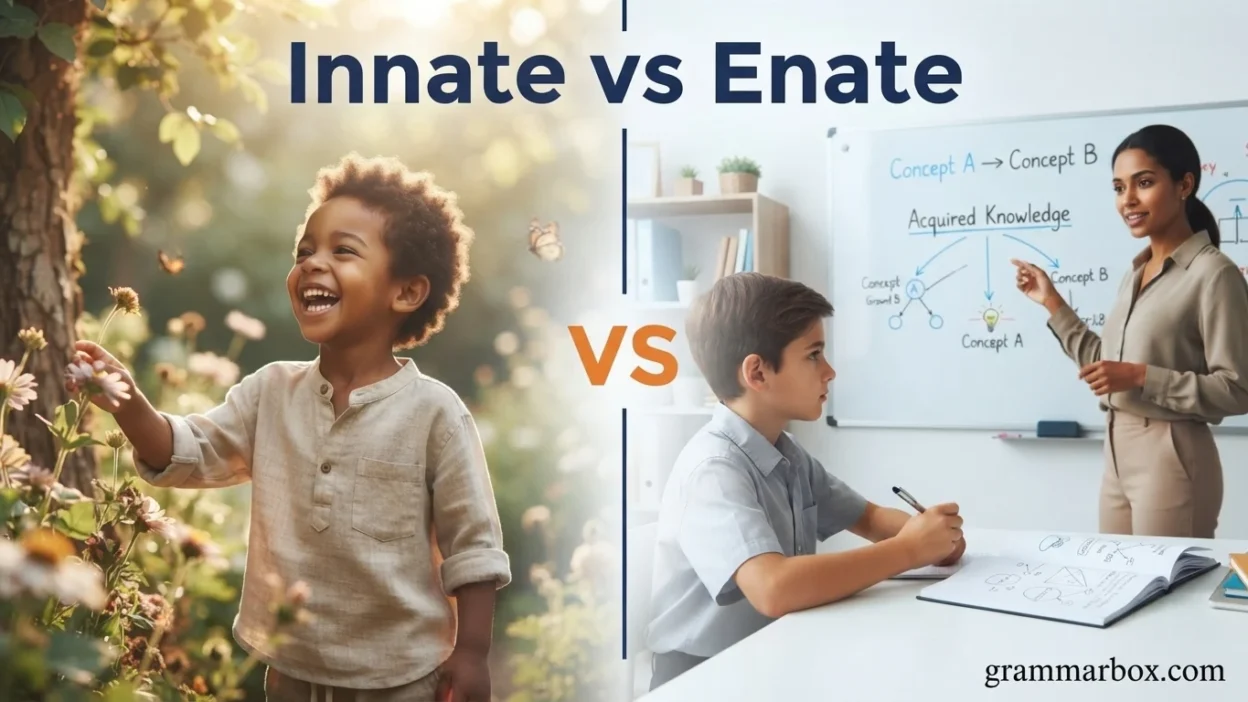
Have you ever come across the words innate and enate and wondered whether they mean the same thing? Although they look and sound somewhat similar, these words have different meanings and are used in different contexts. Understanding the difference between innate vs enate can help you choose the right word in academic writing, everyday communication, and specialized discussions. One word is commonly associated with natural abilities, qualities, and characteristics, while the other has a much narrower meaning related to family relationships.
The confusion often arises because both words are relatively uncommon in everyday conversation, and their spellings differ by only a few letters. However, choosing the wrong word can change the meaning of your sentence entirely. Whether you are a student, an English learner, a writer, or simply someone who enjoys expanding their vocabulary, learning how to distinguish these terms is worthwhile. In this guide, you will discover their definitions, grammatical uses, practical examples, common mistakes, and simple memory tricks to help you use each word correctly.
Quick Answer
Innate means natural, inborn, or present from birth, such as an innate talent or instinct. Enate is a rare term referring to relatives on the mother’s side of a family. The words are not interchangeable: use innate for natural characteristics and enate when discussing maternal family relationships.
Why People Confuse It
The confusion between innate and enate mainly comes from their similar spelling and pronunciation. Both words contain similar sounds, but their meanings belong to entirely different categories.
Here are three common reasons for the confusion:
- Similar spelling: Both words contain the letters n, a, and e, making them easy to mix up.
- Unfamiliar vocabulary: Most English speakers encounter innate more often than enate.
- Different subject areas: Innate commonly appears in psychology, biology, education, and everyday descriptions. Enate is mainly used in discussions of genealogy and maternal ancestry.
The easiest way to avoid confusion is to identify what you want to describe. If you mean a natural quality or ability, choose innate. If you mean relatives connected through your mother, enate may be appropriate.
First Word: Innate
Innate is an adjective meaning natural, inborn, or existing from birth rather than acquired through learning or experience.
It is frequently used to describe abilities, instincts, characteristics, tendencies, and qualities that appear to be inherent in a person or living thing.
Examples of Innate in Sentences
- She has an innate ability to understand complex problems.
- Babies display an innate tendency to respond to certain stimuli.
- His innate curiosity encouraged him to explore new ideas.
- The animal relies on its innate instincts to survive.
- Good teachers often recognize a student’s innate potential.
Common Contexts for Innate
The word innate appears in several fields:
- Psychology: Innate behavior, natural tendencies, and inborn characteristics.
- Biology: Innate immune responses and naturally occurring traits.
- Education: Innate talent, ability, and potential.
- Everyday English: An innate sense of fairness or an innate desire to learn.
Remember that innate does not always mean a characteristic is completely fixed or cannot change. It generally emphasizes a natural or inborn quality rather than one developed entirely through experience.
Second Word: Enate
Enate is a rare adjective and noun associated with relatives on the mother’s side of a family. It comes from terminology used to describe maternal relationships and ancestry.
As an adjective, it can describe a relationship traced through the maternal line. As a noun, it can refer to a relative connected through that line.
Because enate is uncommon in modern everyday English, readers may be more familiar with phrases such as maternal relatives or relatives on the mother’s side.
Examples of Enate in Sentences
- The historian examined the family’s enate connections.
- Their genealogy records included several enate relatives.
- The researcher traced the inheritance through the enate line.
- The family tree distinguished enate relationships from paternal ones.
- The genealogist documented both maternal and paternal ancestry.
These examples illustrate the specialized meaning of enate. In ordinary conversation, expressions such as maternal relatives will usually sound clearer and more natural.
Common Contexts for Enate
- Genealogy: Describing family connections through the mother’s side.
- Family history: Identifying maternal relatives in historical records.
- Specialized writing: Discussing kinship, ancestry, or family relationships.
Do not use enate as a synonym for innate. A maternal family relationship is not the same thing as a natural ability or characteristic.
Comparison Table
| Feature | Innate | Enate |
|---|---|---|
| Part of speech | Adjective | Adjective and noun |
| Main meaning | Natural or inborn | Related to the mother’s side |
| Common context | Psychology, biology, everyday English | Genealogy and kinship |
| Example phrase | Innate talent | Enate relatives |
| Frequency | Common | Rare |
| Similar expression | Inborn, inherent | Maternal, related through the mother |
| Can they be interchanged? | No | No |
The central distinction is straightforward: innate describes a quality or characteristic, whereas enate concerns maternal family relationships.
When to Use Each
Choosing between innate and enate becomes much easier when you focus on the intended meaning.
Use Innate for Natural Qualities
Choose innate when describing something that is natural, inborn, or inherent.
Examples:
- She possesses an innate sense of rhythm.
- The child showed an innate interest in music.
- Researchers studied innate responses to environmental changes.
- His innate leadership qualities impressed the team.
A useful test is to ask whether you could replace the word with inborn or natural. If the sentence still makes sense, innate is probably the correct choice.
Use Enate for Maternal Family Connections
Choose enate when the subject concerns relationships traced through the mother’s side of a family.
Examples:
- The family historian recorded the enate line.
- The genealogical chart identified several enate relatives.
In everyday writing, however, maternal relatives or the mother’s side of the family will usually communicate the meaning more effectively.
Quick Decision Guide
- Describing a natural ability? Use innate.
- Talking about an inborn characteristic? Use innate.
- Discussing relatives connected through the mother? Use enate.
- Unsure whether your audience knows the word enate? Consider using maternal instead.
Examples: Innate vs Enate in Sentences
The following examples demonstrate how the two words function in different contexts.
Examples Using Innate
- Her innate creativity helped her develop original designs.
- Some animals possess innate behaviors that support survival.
- The student demonstrated an innate ability to recognize patterns.
- His innate kindness made others feel welcome.
- Researchers investigated innate immune responses.
- The musician seemed to have an innate sense of timing.
- Children often show an innate curiosity about the world.
- She trusted her innate judgment when making the decision.
- The coach recognized his player’s innate athletic potential.
- An innate preference for certain stimuli may develop early in life.
- His innate determination helped him overcome setbacks.
Examples Using Enate
- The genealogist mapped the family’s enate relationships.
- Historical documents revealed several enate relatives.
- The researcher distinguished the enate line from the paternal line.
- The family archive preserved records of their enate ancestry.
Examples Showing the Difference
- Her innate talent for painting developed further with practice.
- The historian investigated his enate connections to an old family.
- The report discussed innate characteristics separately from family ancestry.
Notice that the words do not perform the same job. Innate describes natural characteristics, while enate identifies a particular type of family connection.
Common Mistakes
Even experienced writers can confuse unfamiliar words. These mistakes are easy to avoid once you understand the distinction.
Mistake 1: Using Enate to Mean Inborn
Incorrect: He has an enate ability to solve puzzles.
Correct: He has an innate ability to solve puzzles.
Why? The sentence describes a natural ability, not a maternal family relationship.
Mistake 2: Using Innate for Maternal Relatives
Incorrect: She researched her innate relatives.
Correct: She researched her enate relatives.
More natural: She researched her maternal relatives.
Why? The intended meaning concerns family ancestry, not an inborn quality.
Mistake 3: Assuming Both Words Are Equally Common
Although both words exist, innate is much more familiar in general English. Enate is a specialized term and may confuse readers who have not encountered genealogical vocabulary.
Mistake 4: Thinking Innate Means Unchangeable
An innate quality is generally understood as natural or inborn, but that does not necessarily mean it cannot develop or change. Natural abilities may improve through education, practice, and experience.
Mistake 5: Choosing an Unfamiliar Word When a Clearer One Works
In ordinary communication, maternal relatives is often easier to understand than enate relatives. Prefer clarity unless the specialized term is necessary for your subject.
Memory Trick
Use this simple memory trick to remember the difference between innate and enate.
Innate = Inborn
Both words begin with the letter combination in. Think of an ability or quality that is already present naturally.
Example: She has an innate talent for storytelling.
Enate = Extended maternal family
Associate enate with your mother’s family line. This is a memory aid rather than the word’s literal etymological definition.
Example: The researcher traced the family’s enate connections.
One-Line Reminder
- Innate: Something natural or inborn.
- Enate: A relative or relationship on the mother’s side.
If you remember only one thing, remember that innate describes characteristics, while enate describes maternal kinship.
American vs British English
The distinction between innate and enate does not depend on whether you are writing American or British English.
Both varieties use innate with the meaning of natural or inborn. The specialized word enate is also associated with maternal relationships, although it is rare in everyday writing in either variety.
| Usage | American English | British English |
|---|---|---|
| Natural ability | Innate ability | Innate ability |
| Inborn characteristic | Innate trait | Innate trait |
| Mother’s side of the family | Enate relatives or maternal relatives | Enate relatives or maternal relatives |
| More familiar everyday alternative | Maternal relatives | Maternal relatives |
There is no standard American-versus-British spelling difference between these two words. Do not choose enate simply because you are writing for a British audience, or innate because you are writing for an American audience.
Similar Words
Learning related vocabulary can make the difference between these words easier to remember.
Words Similar to Innate
- Inborn: Present naturally from birth.
- Inherent: Existing as a natural or essential part of something.
- Natural: Existing without being artificially created or acquired through instruction.
- Instinctive: Done or felt naturally, without deliberate reasoning.
- Intrinsic: Belonging naturally to the essential nature of something.
- Inherited: Received genetically or passed down from earlier generations, depending on context.
These words overlap in meaning, but they are not always interchangeable. For example, inherent often describes an essential feature, while inherited may refer specifically to something passed down from parents or ancestors.
Words Similar to Enate
- Maternal: Related to a mother.
- Matrilineal: Traced through the mother’s line of descent.
- Paternal: Related to a father.
- Kinship: A relationship based on family connections.
- Ancestry: A person’s family origins or line of descent.
- Genealogy: The study or record of family descent and relationships.
Of these terms, maternal is usually the most useful everyday alternative to enate. The word matrilineal is especially appropriate when discussing descent traced through the mother’s line.
FAQs:
1. What is the difference between innate and enate?
Innate means natural or inborn, while enate refers to relatives or relationships on the mother’s side of a family. They have different meanings and cannot be used interchangeably.
2. Is innate a real word?
Yes. Innate is a standard English adjective widely used in everyday conversation, academic writing, psychology, and biology to describe natural or inborn qualities.
3. Is enate a real word?
Yes. Enate is a legitimate but rare English term associated with maternal relatives and ancestry. It is mainly found in specialized discussions of kinship and genealogy.
4. Does innate mean present from birth?
Generally, yes. Innate describes a quality, tendency, or characteristic considered natural or inborn rather than acquired entirely through learning or experience. Its exact meaning depends on context.
5. Can innate and inherent be used interchangeably?
Sometimes. Both can describe qualities that belong naturally to something. However, innate often emphasizes an inborn quality, while inherent emphasizes an essential or inseparable characteristic.
6. What is another word for enate?
Maternal is a useful alternative when describing a relationship connected to the mother. Depending on the sentence, maternal relatives or the mother’s side of the family may be clearer.
7. Is there a spelling difference between American and British English?
No. Both American and British English use innate and enate with the same spellings and basic meanings. Their difference is semantic, not regional.
Final Verdict
The difference between innate vs enate comes down to meaning and context. Innate is the familiar word for natural or inborn qualities, such as innate intelligence, innate curiosity, or innate talent. Enate is a rare, specialized term for relationships connected through the mother’s side of a family. Although their spellings look similar, they serve entirely different purposes in English.
When writing for a general audience, choose innate for natural characteristics and consider maternal instead of enate when discussing family relationships. This approach keeps your writing accurate, clear, and easy to understand. By remembering the meanings and reviewing a few practical examples, you can confidently avoid confusing these two words in your future writing.
Remember This
- Innate = Inborn: A natural quality, ability, or characteristic.
- Enate = Maternal: A relative or relationship connected through the mother’s side.
- No regional spelling difference: American and British English use the same spellings.
- Choose clarity: Use maternal relatives when the rare term enate might confuse your readers.