English has many words that seem similar but carry slightly different meanings. Invaluable vs. valuable is a common example because both words describe something important, useful, or worthy of appreciation. However, they are not interchangeable in every situation. Understanding the difference can help you communicate more clearly, choose the right vocabulary, and avoid common writing mistakes.
The main distinction is that valuable describes something worth a lot in money, usefulness, importance, or personal significance, while invaluable means extremely useful or important, often to the point that its worth is difficult or impossible to measure. Surprisingly, invaluable does not mean worthless. Although the prefix “in-” often indicates a negative meaning, it does not work that way in this word. If you are writing an academic essay, preparing a professional email, or having a daily conversation, knowing when to use each term will make your English more accurate and natural. Let’s explore their meanings, examples, differences, and practical usage rules.
Quick Answer
Valuable means worth a lot because of its monetary value, usefulness, or importance. Invaluable means extremely useful or important, with a worth that cannot easily be measured. For example, a valuable painting may sell for thousands of dollars, while invaluable advice can make a life-changing difference.
Why People Confuse It
People often confuse invaluable and valuable because both words express worth, importance, and usefulness. They can describe objects, experiences, information, relationships, and services.
Another reason is the prefix “in-.” In many English words, this prefix indicates the opposite, as in inaccurate or incomplete. Readers may assume that invaluable means “not valuable,” but that interpretation is incorrect.
The words also overlap in certain contexts. For instance, a teacher’s guidance can be valuable or invaluable, depending on the degree of importance the speaker wants to emphasize.
Remember these basic distinctions:
- Valuable: Worth a lot or highly useful.
- Invaluable: Extremely useful or important; practically beyond measure.
- Not valuable: Of little or no worth.
First Word: Invaluable
Meaning of Invaluable
Invaluable is an adjective that describes something so useful, important, or beneficial that its worth cannot be measured easily.
It often refers to something that provides exceptional help, knowledge, support, or an advantage.
Examples:
- Her experience was invaluable during the difficult project.
- The professor gave us invaluable advice before the examination.
- My grandmother’s stories are invaluable to our family.
- The research provided invaluable information about the disease.
In each sentence, the word emphasizes exceptional importance rather than a specific financial price.
When to Use Invaluable
Use invaluable when you want to emphasize that something is exceptionally helpful, significant, or beneficial.
Common expressions include:
- Invaluable advice
- Invaluable experience
- Invaluable information
- Invaluable support
- Invaluable assistance
- Invaluable contribution
- Invaluable resource
Example in a professional setting: “Your feedback was invaluable in helping us improve the final report.”
This sentence suggests that the feedback made a particularly important contribution to the outcome.
Second Word: Valuable
Meaning of Valuable
Valuable is an adjective that describes something worth a considerable amount of money, something useful, or something important.
Unlike invaluable, it can refer directly to measurable financial worth. However, it can also describe knowledge, time, relationships, and experiences.
Examples:
- The antique watch is extremely valuable.
- She shared valuable information during the meeting.
- Education provides valuable opportunities for personal growth.
- Spending time with family is valuable to me.
The word’s meaning depends on context. A valuable object may have a high market price, while valuable advice may simply be useful and beneficial.
When to Use Valuable
Use valuable when discussing monetary worth, practical usefulness, or general importance without necessarily suggesting that the worth is immeasurable.
Common expressions include:
- Valuable possessions
- Valuable information
- Valuable lessons
- Valuable resources
- Valuable experience
- Valuable time
- Valuable feedback
Example in a professional setting: “The training gave employees valuable skills for their future careers.”
This means the training provided useful skills that employees can apply in their work.
Comparison Table
| Feature | Invaluable | Valuable |
|---|---|---|
| Meaning | Extremely important or useful | Worth a lot or useful |
| Degree of emphasis | Often exceptionally high | General or considerable worth |
| Financial value | Not necessarily monetary | Can refer directly to money |
| Typical usage | Exceptional help or importance | Worth, usefulness, or importance |
| Example | Her support was invaluable. | Her advice was valuable. |
| Synonyms | Indispensable, priceless | Worthwhile, useful, precious |
| Opposite idea | Of little practical importance | Worthless or of little value |
The key difference is the degree of emphasis. Valuable describes worth or usefulness, whereas invaluable often highlights exceptional worth that is difficult to measure.
When to Use Each
Choosing between invaluable and valuable depends on what you want to communicate.
Use Invaluable for Exceptional Importance
Choose invaluable when something has made an extraordinary contribution or provided essential help.
Examples:
- The nurse’s experience was invaluable during the emergency.
- His knowledge proved invaluable to the research team.
- The historical documents are invaluable to historians.
These examples emphasize a level of importance that goes beyond ordinary usefulness.
Use Valuable for Worth or Usefulness
Choose valuable when describing something useful, beneficial, important, or financially expensive.
Examples:
- The company owns several valuable properties.
- Reading provides valuable knowledge.
- She offered valuable suggestions for improving the presentation.
These sentences communicate worth without necessarily suggesting that it is impossible to measure.
Can Both Words Describe the Same Thing?
Yes. Both words can describe the same person, object, or experience, but the emphasis changes.
Consider these sentences:
- “His advice was valuable.” This means his advice was useful or important.
- “His advice was invaluable.” This emphasizes that his advice was exceptionally helpful.
Neither sentence is automatically incorrect. The second simply expresses stronger appreciation.
Examples of Invaluable vs. Valuable
Here are 16 examples showing how to use both words correctly.
Examples With Invaluable
- Her guidance was invaluable when I started my new business.
- The documentary provides invaluable insight into ancient civilizations.
- My parents’ encouragement has been invaluable throughout my education.
- The technician’s experience proved invaluable during the repair.
- The library contains invaluable historical records.
- His advice was invaluable in resolving the disagreement.
- Volunteers made an invaluable contribution to the community.
- The internship gave me invaluable practical experience.
Examples With Valuable
- The necklace is one of the most valuable items in the collection.
- She learned valuable lessons from her mistakes.
- The workshop offers valuable information for new employees.
- Time is a valuable resource that should be used wisely.
- The museum displays valuable paintings from the nineteenth century.
- His comments provided valuable feedback on my essay.
- Good communication is a valuable skill in the workplace.
- The company invested in valuable equipment for its laboratory.
Side-by-Side Examples
- Valuable: The book contains valuable information about grammar.
- Invaluable: The book was invaluable to students preparing for their final examinations.
- Valuable: The consultant offered valuable recommendations.
- Invaluable: The consultant’s recommendations were invaluable in preventing a costly mistake.
These comparisons show that the choice depends on the level of importance you want to convey.
Common Mistakes
Writers sometimes misunderstand invaluable because of its spelling or use the two adjectives without considering their intended meaning.
Mistake 1: Thinking Invaluable Means Worthless
Incorrect interpretation: “The prefix in- means invaluable is the opposite of valuable.”
Correct understanding: Invaluable means exceptionally useful or important.
Example: “Her assistance was invaluable during the crisis.”
Mistake 2: Using Invaluable for Every Important Thing
Although invaluable is a strong word, it should not replace valuable in every sentence.
For example, “The pen is invaluable” may sound exaggerated if you simply mean that the pen is useful.
Better: “The pen is valuable to me because it was a gift from my father.”
Use invaluable when the exceptional importance is justified.
Mistake 3: Confusing Importance With Financial Price
A financially expensive item is not automatically invaluable.
For example:
- The diamond is valuable because it has a high market price.
- The family photograph is invaluable because of its personal significance.
The photograph may have little financial value but enormous emotional worth.
Mistake 4: Assuming the Words Are Never Interchangeable
Both words can describe advice, information, experience, and support. The difference is often one of emphasis rather than a completely separate category of meaning.
Memory Trick
Use this simple memory trick to remember the difference:
Valuable = Worth a lot.
Invaluable = So important that its worth is hard to measure.
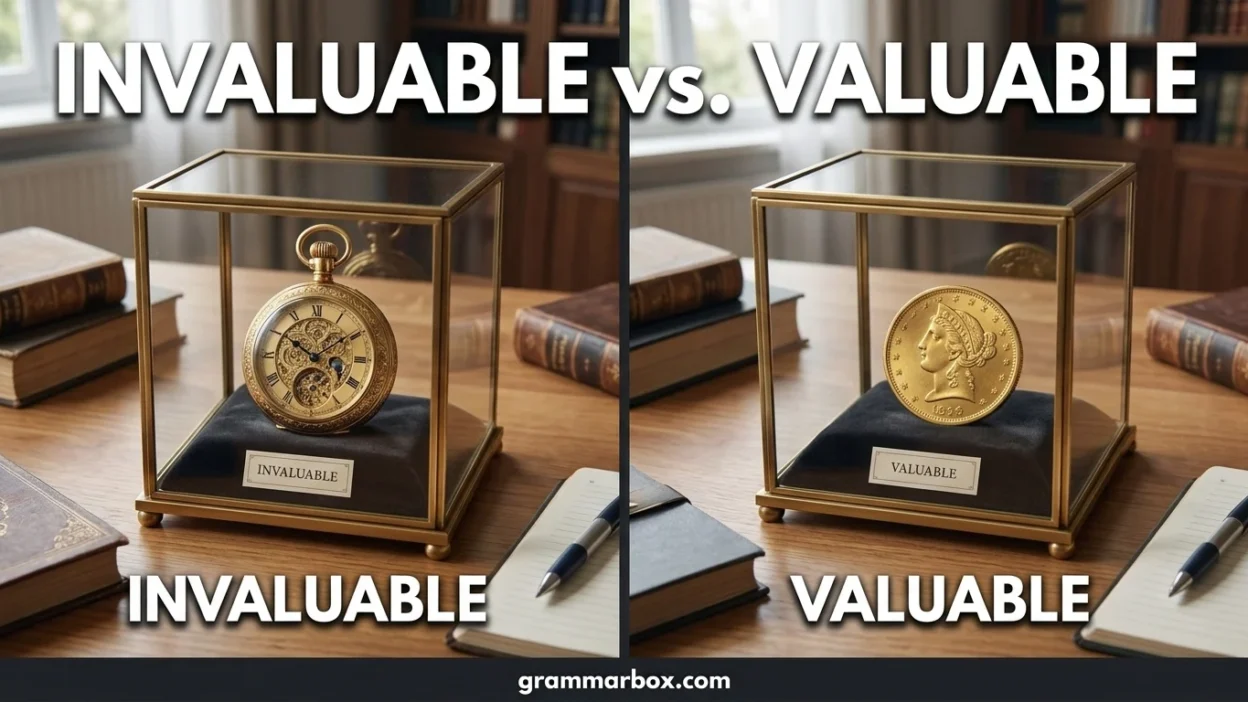
Imagine two things: an expensive gold watch and advice from someone who helped you through a difficult period.
The gold watch may be valuable because of its price. The advice may be invaluable because of its exceptional personal importance.
One more reminder: never assume that invaluable means “not valuable.” It is a positive word that expresses extraordinary worth or usefulness.
American vs. British English
There is no meaningful difference between American and British English in the standard meanings of invaluable and valuable.
Both varieties use the words in the same general way:
- American English: “Her advice was invaluable to the team.”
- British English: “Her advice was invaluable to the team.”
- American English: “The museum contains valuable paintings.”
- British English: “The museum contains valuable paintings.”
The spelling of both words is also the same in American and British English. Unlike pairs such as color/colour or organize/organise, these words do not have standard regional spelling alternatives.
Writers in both varieties should choose the word that best communicates the intended degree of worth or importance.
Similar Words
Several English words have meanings related to invaluable and valuable, but each carries a slightly different emphasis.
| Word | Meaning | Example |
|---|---|---|
| Priceless | So precious that a price cannot adequately express its worth | The family heirloom is priceless. |
| Precious | Highly valued or deeply cherished | Their friendship is precious to me. |
| Useful | Helpful for a particular purpose | This guide is useful for beginners. |
| Worthwhile | Worth the time, effort, or expense | The course was worthwhile. |
| Important | Having considerable significance | Clear communication is important. |
| Indispensable | Absolutely necessary or essential | Her expertise is indispensable to the team. |
| Beneficial | Producing a helpful or positive result | Exercise is beneficial to health. |
| Costly | Expensive or involving a significant cost | The company purchased costly equipment. |
Which synonym should you choose?
- Use priceless for something whose worth cannot be adequately expressed in money.
- Use useful for something that helps accomplish a task.
- Use indispensable when something is essential.
- Use worthwhile when the benefits justify the effort or cost.
- Use precious when emotional attachment or special significance matters.
These alternatives can improve your vocabulary and help you express subtle differences in meaning.
FAQs:
1. Is invaluable more positive than valuable?
Both words have positive meanings. However, invaluable often expresses a stronger degree of importance or usefulness, suggesting that something is exceptionally beneficial or difficult to measure in worth.
2. Does invaluable mean not valuable?
No. Invaluable means extremely valuable, useful, or important. It does not mean worthless or lacking value. The prefix in- can be misleading because it has a negative meaning in many other English words.
3. Can I use invaluable and valuable interchangeably?
Sometimes. Both can describe advice, knowledge, experience, and support. However, invaluable generally emphasizes exceptional importance, while valuable can express ordinary usefulness, significance, or financial worth.
4. Is invaluable the same as priceless?
They are similar but not identical. Invaluable usually emphasizes exceptional usefulness or importance, while priceless often emphasizes something whose monetary or personal worth cannot be adequately measured.
5. Can a person be invaluable?
Yes. A person can be described as invaluable when their skills, knowledge, support, or contribution is exceptionally important.
Example: “She is an invaluable member of our research team.”
6. Is valuable an adjective?
Yes. Valuable is an adjective that describes something worth a lot, useful, or important.
Example: “The report contains valuable information.”
7. Which word should I use in formal writing?
Both are appropriate for formal writing. Use valuable for general worth or usefulness, and invaluable when emphasizing exceptional importance or a contribution that is difficult to measure.
Conclusion
Understanding invaluable vs. valuable will help you make more precise vocabulary choices in everyday conversations, academic writing, and professional communication. Although the two adjectives overlap, valuable is the more general term for worth and usefulness, while invaluable places stronger emphasis on exceptional significance or benefit.
When deciding which word to use, consider whether you are describing something useful or important in general or something whose contribution is extraordinarily meaningful. With regular practice and attention to context, you can use both words confidently and avoid the common misconception that invaluable means worthless.
Remember This
- Valuable: Worth a lot, useful, or important.
- Invaluable: Exceptionally useful or important; difficult to measure in worth.
- Key rule: Invaluable is a positive word, not the opposite of valuable.
Quick tip: If you mean “worth a lot,” choose valuable. If you mean “so important that its worth is difficult to measure,” choose invaluable.