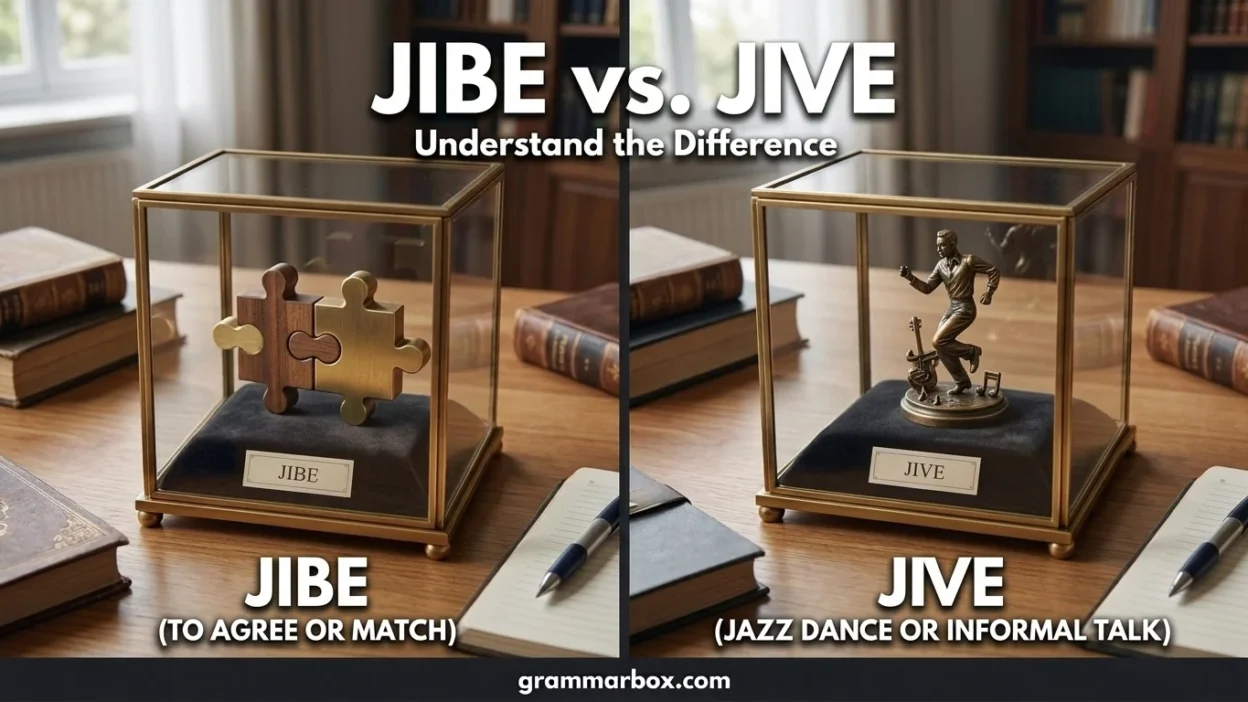
The English words jibe and jive look and sound similar, so it is easy to mix them up in everyday writing. However, they have different meanings and uses. Knowing the difference between jibe vs. jive can help you choose the correct word when describing agreement, compatibility, playful speech, or music. Although some dictionaries recognize overlapping uses, the two words are not always interchangeable.
The confusion often occurs because both words appear in casual conversations, books, and online writing. For example, you might say that someone’s explanation does not jibe with the available evidence, meaning the explanation does not agree with the facts. On the other hand, jive can refer to a lively style of music and dance or to misleading, insincere talk. Understanding these distinctions makes your writing clearer and more precise. In this guide, you will learn the meanings of jibe and jive, discover when to use each word, and explore practical examples, common mistakes, and memory tricks to remember the difference.
Quick Answer
Jibe usually means to agree, correspond, or be consistent with something. Jive commonly refers to a lively style of music and dance or informal, misleading talk. Although the words sometimes overlap in meaning, jibe is generally the better choice when discussing whether facts, statements, or ideas agree.
Why People Confuse It
People often confuse jibe and jive because the words have similar pronunciations and nearly identical spellings. Both are short, familiar words, but their meanings differ depending on the context.
Another reason for the confusion is that jive has occasionally been used to mean jibe, particularly in informal American English. This overlap appears in dictionaries, but it does not mean the words are interchangeable in every situation.
Here are the main differences:
- Jibe: To agree, correspond, or be consistent with something.
- Jive: A type of music or dance, or informal speech that may be deceptive or insincere.
- Jibe with: A common expression meaning to agree with or match something.
- Jive talk: Informal or exaggerated language, sometimes intended to mislead.
Choosing the appropriate word depends on what you want to communicate.
First Word: Jibe
Jibe is a verb that usually means to agree with, match, or be consistent with something. It is particularly useful when comparing information, statements, explanations, or actions.
For example, if someone’s account of an event matches the evidence, their account jibes with the evidence.
Meaning of Jibe
The most common modern meaning of jibe is to correspond or agree.
Examples include:
- Her explanation does not jibe with the facts.
- The witness’s statement jibes with the police report.
- His actions do not jibe with his promises.
- The figures should jibe with the final budget.
In each sentence, jibe expresses agreement or consistency.
Jibe as a Noun
Jibe can also be a noun meaning a mocking or insulting remark.
For example:
- He made a sarcastic jibe about my presentation.
- Her comment was a sharp jibe at his driving skills.
This noun meaning is different from the verb meaning “to agree.”
How to Use Jibe Correctly
Use jibe when you want to communicate that two things match or are consistent with each other.
Common expressions include:
- Jibe with the facts
- Jibe with the evidence
- Jibe with expectations
- Jibe with the original plan
- Jibe with someone’s account
Example: The manager’s explanation does not jibe with the company’s official records.
This sentence means that the explanation conflicts with the records.
Second Word: Jive
Jive is a word associated with music, dance, and informal speech. It can function as a noun, verb, or adjective, depending on the context.
Meaning of Jive
One familiar meaning of jive relates to a lively style of music and dance associated with jazz and swing traditions.
For example:
- The dancers performed an energetic jive.
- We listened to classic jazz and jive music.
- She learned to jive at a dance workshop.
Another meaning relates to insincere, misleading, or exaggerated talk.
For example:
- I do not believe his jive.
- Stop giving me that jive and tell me the truth.
- The salesman tried to impress the customers with jive talk.
In these sentences, jive refers to talk that the speaker considers untrustworthy or meaningless.
Jive as a Verb
As a verb, jive can mean to perform the associated dance or engage in a particular style of informal speech.
Examples:
- They learned to jive to the music.
- The performers jived together on stage.
In informal American usage, some speakers also use jive to mean “agree” or “match.” However, when writing formally, jibe is usually the clearer choice for that meaning.
How to Use Jive Correctly
Use jive when discussing:
- A lively dance style
- Music associated with jive
- Informal or deceptive talk
- Certain forms of slang or playful speech
Example: The band played swing music while the dancers performed the jive.
Here, jive refers to dancing rather than agreement.
Comparison Table
| Feature | Jibe | Jive |
|---|---|---|
| Main meaning | Agree or correspond | Music, dance, or insincere talk |
| Common grammatical use | Verb | Noun, verb, or adjective |
| Agreement example | The facts jibe with his story. | Informal use may mean the facts jive with his story. |
| Music and dance | Not the usual choice | The dancers performed a jive. |
| Insulting remark | A jibe can mean a mocking remark | Jive can mean misleading talk |
| Formal writing | Preferred for agreement | Preferred for music, dance, or its other established meanings |
| Memory clue | Think “match” | Think “music” |
When to Use Each
Understanding the context is the easiest way to choose between jibe and jive.
Use Jibe When Something Agrees
Choose jibe when you are discussing whether two things match or are consistent.
Examples:
- The results jibe with our predictions.
- Her explanation does not jibe with the available evidence.
- His schedule does not jibe with mine.
- The research findings jibe with earlier studies.
In formal, academic, and professional writing, this is generally the preferred usage.
Use Jibe for a Mocking Remark
When used as a noun, jibe can describe a sarcastic or insulting comment.
Examples:
- His jibe about my accent was unnecessary.
- She ignored the jibe and continued speaking.
Use Jive for Music and Dance
Choose jive when talking about the dance, music, or a related cultural style.
Examples:
- They practiced the jive before the competition.
- The dance instructor demonstrated how to jive to swing music.
Use Jive for Insincere Talk
In informal conversation, jive can describe nonsense, deception, or language that someone does not believe.
Examples:
- I am tired of his jive.
- The customer refused to listen to the salesperson’s jive.
What About “Jive With”?
You may encounter sentences such as “That explanation doesn’t jive with the facts.” This usage is established in informal English, and some dictionaries recognize it as a variant of jibe.
Nevertheless, “That explanation doesn’t jibe with the facts” is the safer choice in formal writing because it avoids confusion with the more familiar music, dance, and slang meanings of jive.
Examples: Jibe vs. Jive in Sentences
The following examples show how each word works in context.
Examples Using Jibe
- The witness’s account does not jibe with the security footage.
- Her explanation jibes with the information in the report.
- The final expenses should jibe with the original budget.
- His behavior does not jibe with the values he promotes.
- The new schedule does not jibe with my availability.
- Their conclusions jibe with the results of the experiment.
- The evidence failed to jibe with the suspect’s story.
- The proposal seems to jibe with our long-term goals.
- He made a sarcastic jibe about my old laptop.
- She responded calmly to his personal jibe.
Examples Using Jive
- The dancers performed an impressive jive at the competition.
- My grandparents enjoy listening to traditional swing and jive music.
- The instructor taught us how to jive to the rhythm.
- The salesman tried to impress us with his jive talk.
- I could tell he was giving me the same old jive.
- The musicians played while the dancers jived across the floor.
- She dismissed his promises as nothing but jive.
- The couple practiced the jive before their dance performance.
- In casual conversation, he said the numbers did not jive with the report.
- The audience enjoyed the lively music and energetic jive dancing.
Notice that the first ten examples demonstrate jibe as a verb or noun, while the next ten illustrate the different meanings and uses of jive.
Common Mistakes
Even experienced writers sometimes confuse these words. Here are the mistakes to watch for.
1. Using Jive for Agreement in Formal Writing
Incorrect or less suitable for formal writing:
“The witness’s statement does not jive with the evidence.”
Better choice:
“The witness’s statement does not jibe with the evidence.”
Although the first sentence occurs in informal English, jibe is the more precise choice in formal contexts.
2. Using Jibe When Referring to Dance
Incorrect:
“They performed a beautiful jibe at the dance competition.”
Correct:
“They performed a beautiful jive at the dance competition.”
The dance is called the jive.
3. Confusing Jibe With Jive Talk
Incorrect:
“He was speaking jibe when he tried to deceive us.”
Better:
“He was speaking jive when he tried to deceive us.”
Here, jive refers to misleading or insincere talk.
4. Forgetting That Jibe Has Two Meanings
Jibe does not always mean agreement. It can also mean a mocking remark when used as a noun.
For example:
“His jibe about her mistake embarrassed her.”
The word describes a sarcastic comment, not agreement.
5. Assuming the Words Are Always Interchangeable
Although jive is sometimes used to mean “agree,” that does not make it appropriate in every sentence containing jibe.
Remember the context:
- Facts and evidence: usually jibe
- Dance and music: jive
- Mocking remark: jibe
- Insincere talk: jive
Memory Trick: How to Remember Jibe vs. Jive
A simple memory trick can help you distinguish the words without memorizing complicated dictionary definitions.
Jibe = Join or match.
Think of jibe as two pieces of information joining together. When a statement jibes with the evidence, the two agree.
Jive = Jazz and dance.
Think of jazz music and energetic dance movements. The word jive is commonly associated with music, dance, and informal slang.
Here is an easy way to remember the difference:
- Jibe: The facts jibe with the story.
- Jive: The dancers perform the jive.
You can also remember the expression “jive talk” when thinking about insincere or misleading language.
If you are unsure which word to use, ask yourself whether you mean agreement or music and slang. That simple question will usually point you toward the right choice.
American vs. British English
The distinction between jibe and jive is relevant in both American and British English, although frequency and preferred usage may vary.
American English
In American English, jibe is widely used to mean “agree” or “be consistent with.”
Example: “The new figures don’t jibe with our earlier estimates.”
American English also commonly uses jive in contexts involving music, dancing, slang, and insincere talk. Informal speakers may use jive with to mean “agree with.”
British English
British English also recognizes jibe as a verb meaning “agree or correspond” and as a noun meaning a mocking remark. Jive is used for the dance and related musical or slang meanings.
Example: “His explanation doesn’t jibe with the available evidence.”
The meanings are broadly similar across the two varieties of English, so the distinction is more about context and register than a strict American-versus-British spelling difference.
Important: Neither jibe nor jive is simply the British or American spelling of the other. They are separate words with distinct established meanings.
Similar Words
Learning a few related words can help you express agreement, inconsistency, or criticism more precisely.
| Word | Meaning | Example |
|---|---|---|
| Agree | To have the same opinion or be consistent | The figures agree with the report. |
| Match | To correspond or be similar | Her account matches the evidence. |
| Correspond | To be consistent with something | The results correspond to our expectations. |
| Align | To be in agreement or harmony | The plan aligns with our goals. |
| Coincide | To occur together or agree in relevant respects | Their accounts coincide on key details. |
| Conflict | To be incompatible or contradictory | His statement conflicts with the evidence. |
| Contradict | To oppose or deny a statement | The records contradict his claim. |
| Taunt | To mock or provoke someone | They taunted him about his mistake. |
| Mock | To ridicule someone or something | He mocked the proposal. |
| Nonsense | Language or ideas lacking sense | She dismissed the claim as nonsense. |
These alternatives are useful when you want to avoid repetition or make your meaning more specific.
FAQs:
1. What is the main difference between jibe and jive?
Jibe usually means to agree, match, or be consistent with something. Jive commonly refers to a style of music or dance, or to insincere and misleading talk. Context determines the appropriate word.
2. Is it jibe with or jive with?
Jibe with is the preferred expression in formal writing when you mean “agree with” or “be consistent with.” Jive with is also used informally with the same meaning, and some dictionaries recognize it as a variant.
3. Does jibe mean agree?
Yes. As a verb, jibe means to agree, correspond, or be consistent with something.
Example: “Her explanation jibes with the facts.”
4. Does jive mean nonsense?
It can. In informal English, jive can refer to insincere, misleading, or meaningless talk.
Example: “I don’t believe his jive.”
5. Is jibe a noun or a verb?
Jibe can be both. As a verb, it means to agree or correspond. As a noun, it can mean a mocking or sarcastic remark.
6. Is jive a noun or a verb?
Jive can function as a noun or a verb, and it also has adjectival uses. It may refer to a dance, music, slang, or misleading talk, depending on the sentence.
7. Are jibe and jive pronounced the same?
They are generally pronounced the same in common English pronunciation, which contributes to the confusion. Their spellings and meanings, however, differ.
8. Which word should I use in academic writing?
Use jibe when explaining that evidence, results, or statements agree with one another. Use jive for its established meanings involving music, dance, or slang.
Final Verdict
The difference between jibe and jive becomes much easier to understand when you focus on meaning rather than spelling. Use jibe when discussing agreement or consistency, such as when evidence matches a witness’s account. Remember that jibe can also mean a mocking remark when used as a noun.
Use jive when referring to a lively dance, related music, or informal talk that may be insincere or misleading. Although informal speakers sometimes use jive to mean “agree,” jibe with remains the clearer option in formal and professional writing. Learning these distinctions will help you communicate more accurately and avoid common word-choice mistakes.
Remember This
- Jibe = Agree or match. The facts jibe with the evidence.
- Jibe = Mocking remark. He made a sarcastic jibe.
- Jive = Music or dance. They performed the jive.
- Jive = Insincere talk. She refused to believe his jive.
The easiest rule: When you mean “agree with,” choose jibe. When you mean music, dance, or insincere talk, choose jive.