
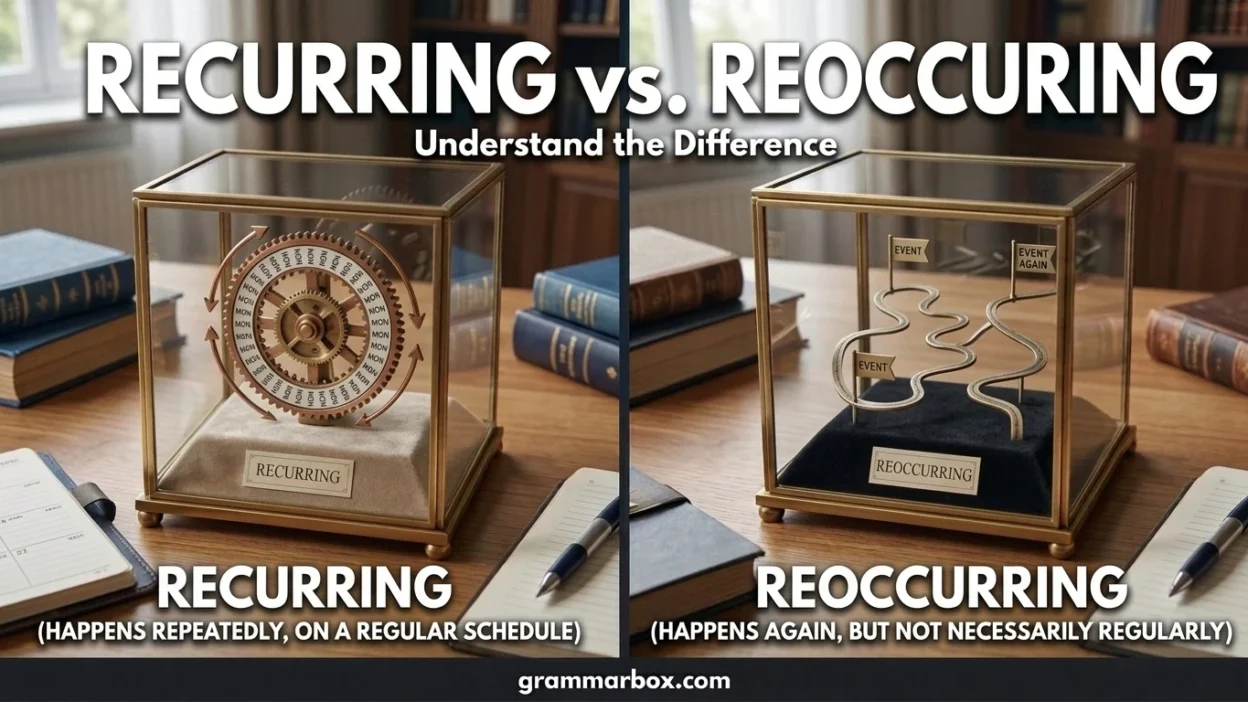
The words recurring vs. reoccurring often confuse English learners because both describe something that happens again. They look similar, share the same root word, and can sometimes be used interchangeably. However, there is a subtle difference in how people typically use them. Understanding this distinction can help you choose the right word in academic writing, professional communication, and everyday conversations.
Although both words refer to events or situations that happen more than once, recurring usually describes something that happens repeatedly or regularly, while reoccurring emphasizes something happening again after it has happened before. For example, a recurring monthly meeting takes place on a regular schedule, whereas a reoccurring problem may return after it seemed to have disappeared. In practice, their meanings overlap, and context often determines which word sounds more natural. In this guide, you will learn the definitions, differences, examples, common mistakes, and practical memory tricks to help you use both words correctly.
Quick Answer
Recurring usually means happening repeatedly, often at regular intervals, while reoccurring means happening again after a previous occurrence. Both words are correct, and their meanings overlap. Use recurring for regular events, habits, and patterns, and reoccurring when emphasizing that something has happened again.
Why People Confuse It
People confuse recurring and reoccurring for several reasons:
- Similar meanings: Both words describe something that happens again.
- Related word forms: Both come from the verb occur, meaning to happen or take place.
- Overlapping usage: In many sentences, either word can communicate the same basic idea.
- Subtle distinction: Recurring often suggests repetition or a pattern, whereas reoccurring emphasizes another occurrence.
For example, you might describe a weekly staff meeting as a recurring event because it happens regularly. If a technical issue returns after being fixed, you might call it a reoccurring problem.
Neither word is inherently incorrect. The best choice depends on what you want to emphasize.
Recurring
Recurring is an adjective and the present participle of the verb recur. It generally describes something that happens repeatedly, returns, or follows a recognizable pattern.
It is especially common when discussing scheduled events, ongoing problems, repeated thoughts, and familiar patterns.
Examples of Recurring
- We have a recurring meeting every Monday morning.
- She experiences recurring headaches during stressful weeks.
- The company has a recurring monthly expense for software subscriptions.
- A recurring theme in the novel is the importance of family.
- He keeps having a recurring dream about flying.
- The team identified a recurring error in the software.
- Rent is a recurring payment that must be made every month.
- The teacher noticed a recurring pattern in the students’ mistakes.
- Recurring appointments help patients maintain consistent care.
- The same recurring issue continues to affect the website.
Common Contexts for Recurring
Use recurring when describing:
- Regular meetings and appointments
- Monthly bills and subscription payments
- Repeated symptoms or concerns
- Patterns in behavior, literature, or data
- Thoughts or dreams that return frequently
Simple definition: Recurring means happening repeatedly or returning over time.
Reoccurring
Reoccurring is an adjective and the present participle of reoccur. It describes something that happens again after an earlier occurrence.
It often emphasizes the return of an event, problem, symptom, or situation. Unlike recurring, it does not necessarily suggest a regular schedule or predictable pattern.
Examples of Reoccurring
- The reoccurring problem returned shortly after the repair.
- We are investigating a reoccurring error in the application.
- The reoccurring noise disturbed everyone in the office.
- She was frustrated by the reoccurring issue with her internet connection.
- The doctor asked about her reoccurring symptoms.
- A reoccurring delay affected several deliveries.
- The manager addressed a reoccurring complaint from customers.
- The reoccurring leak damaged the ceiling again.
- The team developed a new solution for the reoccurring technical fault.
- His reoccurring doubts made it difficult to make a decision.
Common Contexts for Reoccurring
Use reoccurring when you want to emphasize that something has happened again, particularly after an earlier instance.
Common examples include:
- Problems that return after being addressed
- Technical errors that appear again
- Complaints that arise repeatedly
- Symptoms that return
- Unexpected events that happen more than once
Simple definition: Reoccurring means happening again after a previous occurrence.
Recurring vs. Reoccurring: Comparison Table
| Feature | Recurring | Reoccurring |
|---|---|---|
| Basic meaning | Happening repeatedly | Happening again |
| Main emphasis | Repetition or a pattern | Another occurrence |
| Regular schedule | Often associated with regular intervals | Not necessarily regular |
| Typical examples | Recurring meetings, bills, themes | Reoccurring problems, errors, events |
| Correctness | Correct English | Correct English |
| Meaning overlap | Yes | Yes |
| Best use | Established patterns and repeated events | Emphasizing that something has happened again |
The main distinction is emphasis rather than a strict grammatical rule. Both words can describe repeated events, and many writers use them interchangeably.
When to Use Each
Choosing between recurring and reoccurring becomes easier when you consider the situation.
Use Recurring for Regular Events and Patterns
Choose recurring when an event repeats as part of a schedule, habit, or recognizable pattern.
Examples:
- A recurring weekly meeting
- A recurring monthly subscription
- A recurring theme in a story
- A recurring pattern in customer behavior
Sentence: The business pays a recurring fee for its accounting software.
The word recurring fits because the payment repeats according to a regular schedule.
Use Reoccurring to Emphasize Something Happening Again
Choose reoccurring when you want to highlight that an event or problem has appeared another time.
Examples:
- A reoccurring software error
- A reoccurring maintenance problem
- A reoccurring complaint
- A reoccurring interruption
Sentence: The reoccurring error appeared again after the update.
Here, reoccurring emphasizes that the error returned.
Can You Use Them Interchangeably?
Yes. In many situations, both words are acceptable.
For example:
- The recurring problem needs attention.
- The reoccurring problem needs attention.
Both sentences are grammatically correct. Recurring may sound more natural when describing an ongoing pattern, while reoccurring can emphasize another instance of the problem.
Examples of Recurring vs. Reoccurring in Sentences
Here are 12 examples to help you understand the difference in everyday and professional English.
- Recurring: The company schedules recurring training sessions every quarter.
- Reoccurring: A reoccurring technical problem interrupted the presentation again.
- Recurring: She has recurring appointments with her language tutor.
- Reoccurring: The reoccurring issue returned despite several repairs.
- Recurring: A recurring character appears throughout the television series.
- Reoccurring: The reoccurring noise started again late at night.
- Recurring: The organization tracks recurring expenses to manage its budget.
- Reoccurring: The reoccurring error appeared after the system restarted.
- Recurring: The author explores a recurring theme of friendship.
- Reoccurring: The manager received another report about a reoccurring complaint.
- Recurring: Recurring reminders help me remember important deadlines.
- Reoccurring: The reoccurring delay affected the delivery schedule once again.
Notice that the examples often describe similar situations. The choice depends on whether you want to emphasize a repeated pattern or the return of an earlier event.
Common Mistakes
Even though both words are correct, writers sometimes use them in ways that create confusion.
1. Assuming Reoccurring Is Incorrect
Incorrect assumption: Reoccurring is not a real English word.
Correction: Reoccurring is a valid English word. It is the present participle of reoccur.
2. Treating Recurring as Exclusively Scheduled
Recurring often describes regular events, but it can also describe repeated thoughts, symptoms, themes, or problems that do not follow a precise schedule.
Example: She had a recurring feeling that something was wrong.
3. Thinking Reoccurring Always Means Unexpected
Reoccurring can describe an unexpected event, but it can also refer to a predictable or regular event. The word itself does not require surprise.
4. Using the Wrong Verb Form
Remember the related forms:
- Recur: The problem may recur.
- Recurring: The problem is recurring.
- Reoccur: The problem may reoccur.
- Reoccurring: The problem is reoccurring.
Choose the form that fits your sentence’s tense and grammatical structure.
5. Overlooking the Context
Do not choose a word simply because it sounds more sophisticated. Think about the meaning you intend to communicate.
For a regular monthly payment, recurring is generally the more natural choice. For a problem that has returned after being fixed, reoccurring may better express your intended emphasis.
Memory Trick
Use this simple trick to remember recurring vs. reoccurring.
Recurring = Repeating
Think of a repeated pattern, routine, or schedule. A recurring event happens again and again.
Reoccurring = Occurring again
Focus on the idea of another occurrence. Something happened before and is happening again.
Quick memory sentence: A recurring meeting repeats on the calendar; a reoccurring problem shows up again.
This trick highlights the usual difference, although the two words can overlap in real usage.
American vs. British English
Recurring and reoccurring are both accepted in American and British English.
Unlike spelling pairs such as color and colour, the difference between recurring and reoccurring is not primarily a regional spelling distinction.
| Usage | American English | British English |
|---|---|---|
| Recurring | Correct | Correct |
| Reoccurring | Correct | Correct |
| Regular meetings | Recurring is natural | Recurring is natural |
| Returning problems | Both are possible | Both are possible |
In both varieties, recurring is common when describing regular events, repeated patterns, and ongoing issues. Reoccurring is also acceptable when emphasizing that something happens again.
For formal writing, consistency and clarity matter more than choosing one word based on regional preferences.
Similar Words
Several English words have meanings related to recurring and reoccurring, but each has its own emphasis.
| Word | Meaning | Example |
|---|---|---|
| Repeated | Done or happening more than once | The repeated interruptions were frustrating. |
| Repetitive | Involving the same action or pattern again and again | The job became repetitive. |
| Periodic | Happening at intervals | The machine requires periodic maintenance. |
| Frequent | Happening often | Frequent delays affected the service. |
| Recurrent | Happening repeatedly, often over time | The patient reported recurrent pain. |
| Repeatedly | Again and again | He repeatedly asked the same question. |
| Intermittent | Happening occasionally, with breaks in between | The connection was intermittent. |
| Continuous | Continuing without interruption | Continuous rain flooded the road. |
Recurring vs. recurrent: These words are especially close in meaning. Recurrent is common in medical, scientific, and formal contexts, while recurring is widely used in everyday English.
Recurring vs. repeated: Repeated simply means something happened more than once. Recurring often suggests a continuing pattern or something that returns over time.
FAQs:
1. Is recurring or reoccurring correct?
Both are correct. Recurring usually emphasizes repeated events or patterns, while reoccurring emphasizes something happening again. The appropriate choice depends on context.
2. What is the main difference between recurring and reoccurring?
Recurring generally suggests repetition over time, often in a pattern. Reoccurring emphasizes another occurrence after something has happened before. Their meanings overlap considerably.
3. Is reoccurring a real word?
Yes. Reoccurring is the present participle of the verb reoccur. It is an accepted word in modern English and is not a spelling mistake.
4. Should I write recurring problem or reoccurring problem?
Both expressions are correct. Recurring problem is a common choice for an issue that repeatedly arises. Reoccurring problem can emphasize that the issue has returned after an earlier occurrence.
5. Is recurring more common than reoccurring?
Recurring is widely used in everyday, business, financial, and academic writing. Reoccurring is also used, particularly when writers want to emphasize that something has happened again.
6. Are recurring and recurrent the same?
They have similar meanings. Both describe something that happens repeatedly or returns. Recurrent is often used in medical and technical contexts, while recurring is common in general conversation.
7. Can recurring describe something that happens unexpectedly?
Yes. Recurring can describe an event or problem that repeats without following a predictable schedule. For example, recurring technical failures may occur at irregular intervals.
Final Verdict
The difference between recurring and reoccurring is subtle, but understanding their usual emphasis can make your writing clearer. Recurring is generally the best choice for repeated events, routines, scheduled payments, and recognizable patterns. Reoccurring is useful when you want to emphasize that something has happened again, especially when a previous issue or event returns.
However, you do not need to treat these words as completely separate categories. Their meanings overlap, and both are grammatically correct. Instead of worrying about a rigid rule, consider the context, your intended meaning, and the phrasing that sounds most natural to your readers.
Remember This
- Recurring: Focus on repetition, regularity, or a pattern.
- Reoccurring: Focus on something happening again.
- Both: Correct English words with overlapping meanings.
- Best writing tip: Use recurring for regular events and patterns, and reoccurring when emphasizing the return of something that happened before.