
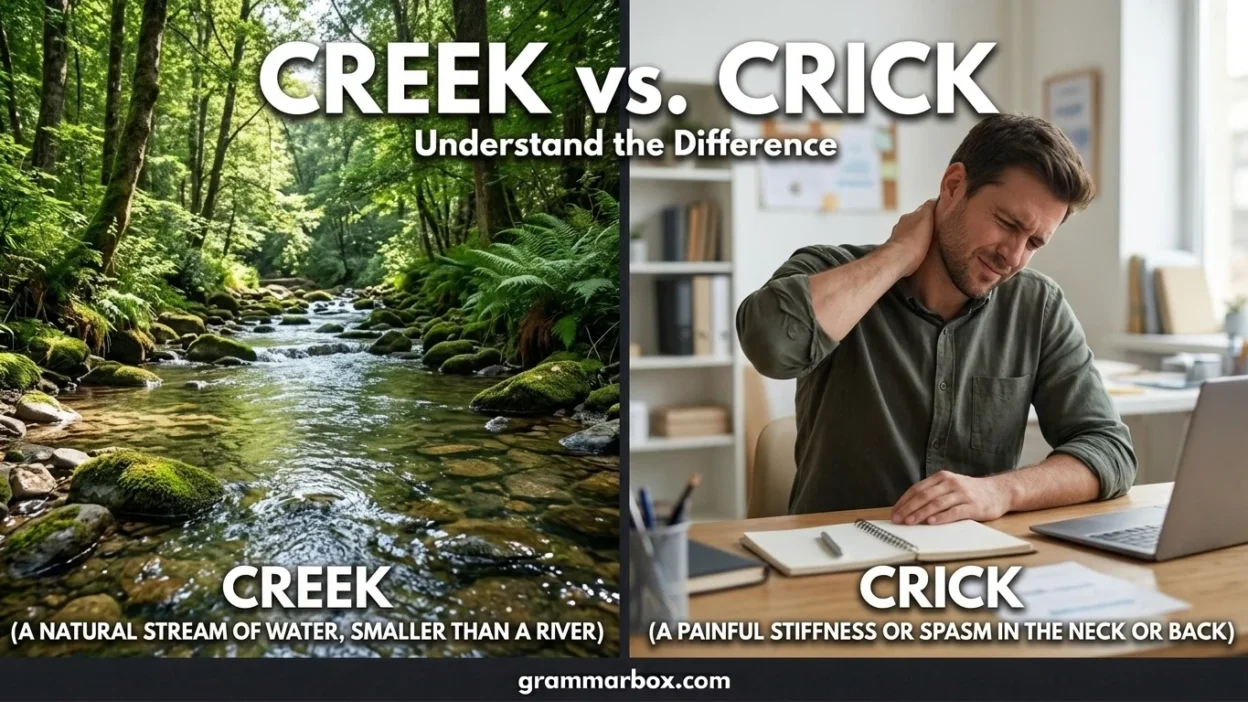
The words creek vs. crick can confuse English learners because they look and sound similar, and both are associated with small streams of water. However, their usage depends on regional pronunciation, dialect, and context. Understanding the difference can help you choose the right word when writing essays, describing landscapes, or having everyday conversations.
In American English, creek is the standard spelling for a small stream of water. Crick is a regional or dialectal pronunciation of creek in some parts of the United States. However, crick is also a recognized informal word for a muscle cramp or stiffness, especially in the neck. This second meaning makes the distinction worth learning. Whether you are writing a formal article, speaking casually with friends, or improving your vocabulary, knowing when to use creek and when crick is appropriate will help you communicate more clearly.
Quick Answer
Creek is the standard word for a small stream of water. Crick is a regional pronunciation of creek in some American dialects. It can also mean a painful stiffness or cramp in the neck. Use creek in formal writing, while crick is appropriate in regional speech or when describing neck stiffness.
Why People Confuse It
People often confuse creek and crick for three main reasons:
- Similar meanings: Both words can refer to a small stream of water.
- Regional pronunciation: Some American speakers pronounce creek as crick, even when they mean the same geographical feature.
- Different dictionary meanings: Crick also has an informal meaning related to muscle stiffness, which creek does not share.
The confusion becomes especially common when people write words the way they pronounce them. Someone who regularly says “crick” when referring to a stream might assume that it is the standard spelling.
In most formal writing, however, creek is the preferred choice for a small watercourse.
Creek
Creek is a noun that generally refers to a small stream of water flowing through a natural channel. It may flow into a river, lake, or another body of water.
The exact meaning can vary by region. In some places, particularly in Australia and parts of North America, creek can describe waterways of different sizes.
Examples of Creek in Sentences
- We walked beside the creek during our afternoon hike.
- The children enjoyed skipping stones across the creek.
- A wooden bridge crosses the creek near our house.
- Heavy rain caused the creek to rise overnight.
- The farmer built a fence along the creek.
- Several fish were swimming in the clear creek.
- We found a quiet picnic spot beside the creek.
- The trail follows the creek through the forest.
- The old cabin stands near a narrow creek.
- The creek eventually flows into a larger river.
When to Use Creek
Use creek when you are:
- Writing formal or academic English.
- Describing a small stream or natural watercourse.
- Writing geographical reports or travel articles.
- Communicating with an international audience.
- Unsure whether a regional spelling is appropriate.
Example: “The hikers followed the creek until they reached the waterfall.”
This sentence uses the standard spelling and is suitable for both formal and informal contexts.
Crick
Crick is an informal, regional word with two common uses. In some American dialects, it is pronounced and used in place of creek when referring to a stream. It can also refer to a painful stiffness or muscle cramp, especially in the neck.
Although crick is a recognized English word, its suitability depends on the intended meaning and audience.
Examples of Crick in Sentences
- Grandpa grew up playing beside the crick near his home.
- We crossed the shallow crick on our way to the farm.
- The children caught frogs in the little crick.
- A narrow crick ran behind the old barn.
- The road followed the crick through the valley.
- I woke up with a crick in my neck.
- Sleeping on the couch gave me a painful crick.
- She turned her head carefully because of the crick in her neck.
- A warm compress helped relieve the crick in his neck.
- He complained about a crick after working at his desk all day.
When to Use Crick
Use crick when:
- Reproducing regional American speech or dialogue.
- Writing a character who naturally uses a regional dialect.
- Referring informally to stiffness or a painful cramp in the neck.
- Discussing the word itself or explaining regional vocabulary.
Example: “I woke up with a crick in my neck.”
Here, crick refers to muscle stiffness rather than a stream.
Comparison Table
| Feature | Creek | Crick |
|---|---|---|
| Main meaning | A small stream of water | Regional word for a stream; also neck stiffness |
| Part of speech | Noun | Noun |
| Standard spelling for a watercourse | Yes | Usually regional or dialectal |
| Common in formal writing | Yes | Generally avoided for a stream |
| American English | Standard spelling | Regional usage |
| British English | Recognized word for a small stream | Not the usual word for a stream |
| Example | We sat beside the creek. | I have a crick in my neck. |
When to Use Each
Choosing between creek and crick depends on what you mean and how you are communicating.
Use Creek for a Stream
Choose creek when describing a natural watercourse in standard English.
- Correct for formal writing: “The creek flows through the village.”
- Correct for school assignments: “Several birds live near the creek.”
- Correct for travel writing: “Visitors can explore the trails beside the creek.”
Use Crick for Regional Speech
In some American communities, crick is a familiar regional pronunciation of creek.
For example:
“My uncle lives near a little crick.”
This sentence may reflect the speaker’s local dialect. In standard edited writing, however, creek is generally the safer spelling for a stream.
Use Crick for Neck Stiffness
When describing a stiff or painful neck, crick is appropriate in informal English.
For example:
“I must have slept awkwardly because I have a crick in my neck.”
Replacing crick with creek would change the meaning and make the sentence incorrect for the intended expression.
Examples: Creek vs. Crick
Here are 12 examples showing how the two words work in context.
- Creek: The creek runs behind our school.
- Crick: My grandfather calls the creek a crick.
- Creek: We went fishing in the creek yesterday.
- Crick: The old farmer walked down to the crick.
- Creek: The creek became muddy after the storm.
- Crick: A crick in my neck made driving uncomfortable.
- Creek: The campsite is located beside a beautiful creek.
- Crick: She said she had a crick after sleeping on two pillows.
- Creek: The map shows a creek running through the valley.
- Crick: In his regional accent, he pronounced creek as crick.
- Creek: The hikers stopped to drink water near the creek.
- Crick: He gently stretched his neck to ease the crick.
These examples demonstrate that creek is the standard choice for a stream, while crick may represent regional speech or neck stiffness.
Common Mistakes
Even fluent English speakers sometimes misunderstand these words. Here are some mistakes to avoid.
1. Assuming Crick Is Always Incorrect
Crick is a real English word. It is simply less suitable than creek in standard writing when referring to a stream.
2. Using Creek for Neck Stiffness
Incorrect: “I woke up with a creek in my neck.”
Correct: “I woke up with a crick in my neck.”
3. Treating Regional Pronunciation as Standard Spelling
A person may pronounce creek as crick in everyday conversation. That does not mean crick is the preferred spelling in a formal report.
4. Assuming Every Creek Is Small in Every Region
The exact size implied by creek varies geographically. The word does not always refer to the same size of watercourse everywhere.
5. Confusing Accent With Grammar
Pronouncing creek as crick can reflect a speaker’s dialect rather than a lack of English knowledge. Regional speech patterns are a normal part of language.
Memory Trick
Remember this simple trick to distinguish creek from crick:
- Creek = water. Think of a stream flowing through a green landscape.
- Crick = neck stiffness or regional speech. Think of a stiff neck when you wake up after sleeping awkwardly.
Another useful reminder is that creek is the safer spelling whenever you are writing about a stream for a general audience.
Easy rule: If you mean flowing water, write creek. If you mean neck stiffness, write crick.
American vs. British English
The distinction between creek and crick is particularly noticeable in American English.
American English
In the United States, creek is the standard spelling for a small stream. However, some speakers in regional communities pronounce it as crick and may use that spelling in informal writing or dialogue.
Crick is also used informally to describe neck stiffness, as in “a crick in my neck.”
British English
In British English, creek is a recognized word for a small stream or waterway. Depending on the geographical context, the word can also refer to a narrow inlet or tidal waterway.
Crick is not the usual standard term for a stream in British English. The neck-stiffness meaning may be understood, but other expressions such as “a stiff neck” are often more straightforward for general readers.
Which Spelling Should You Choose?
For international audiences, academic work, professional writing, and SEO articles, choose creek when discussing a stream. Use crick when the regional dialect or the neck-stiffness meaning is specifically intended.
Similar Words
Several English words are related to creek or crick, but their meanings and uses differ.
| Word | Meaning | Example |
|---|---|---|
| Stream | A body of flowing water | We followed the stream. |
| Brook | A small stream | A brook ran through the garden. |
| Rivulet | A very small stream | A rivulet crossed the path. |
| River | A larger natural watercourse | The river flows toward the sea. |
| Inlet | A narrow body of water extending into land | The boat entered the inlet. |
| Channel | A passage through which water flows | Water moved through the channel. |
| Stiff neck | Painful or restricted neck movement | I woke up with a stiff neck. |
| Cramp | A sudden, painful muscle contraction | He experienced a muscle cramp. |
These words are not always interchangeable. Choose the one that most accurately expresses the meaning you intend.
FAQs:
1. Is creek or crick correct?
Creek is the standard spelling for a small stream of water. Crick is a regional variant used by some American speakers and is also an informal word for neck stiffness.
2. Is crick a real word?
Yes. Crick is a recognized English noun. It can refer to a stream in regional American usage or to painful stiffness, especially in the neck.
3. Why do some Americans say crick instead of creek?
Some American dialects have pronunciation patterns that change the vowel sound in creek. The pronunciation crick is a regional speech feature that may also appear in informal writing.
4. Does crick mean the same thing as creek?
Sometimes. When used regionally to describe water, crick can mean the same thing as creek. However, crick also has a separate meaning related to neck stiffness.
5. Is creek British or American English?
Creek is used in both British and American English. Its exact geographical meaning can vary, but it commonly refers to a small stream or waterway.
6. Can I use crick in formal writing?
You can use crick when its meaning is appropriate, such as in the expression “a crick in my neck.” For a stream, creek is generally preferred in formal writing.
7. What is the plural of creek and crick?
The plural of creek is creeks, while the plural of crick is cricks. The correct form depends on the meaning and context.
Conclusion
Learning the difference between creek and crick is a simple way to improve your English vocabulary. Although the words can refer to the same type of watercourse in some American dialects, they are not interchangeable in every situation. Creek remains the standard spelling for a stream, while crick has additional regional and informal uses.
The next time you describe a stream, choose creek for clarity and correctness. If you hear someone say crick, remember that it may reflect their local accent rather than an error. And if someone complains about a crick in their neck, you will know they are talking about stiffness, not a body of water.
Remember This
- Creek: The standard word for a small stream of water.
- Crick: A regional American variant for a stream or an informal word for neck stiffness.
- Best writing tip: Use creek for water in formal and general writing, and crick when the intended meaning or dialect calls for it.