
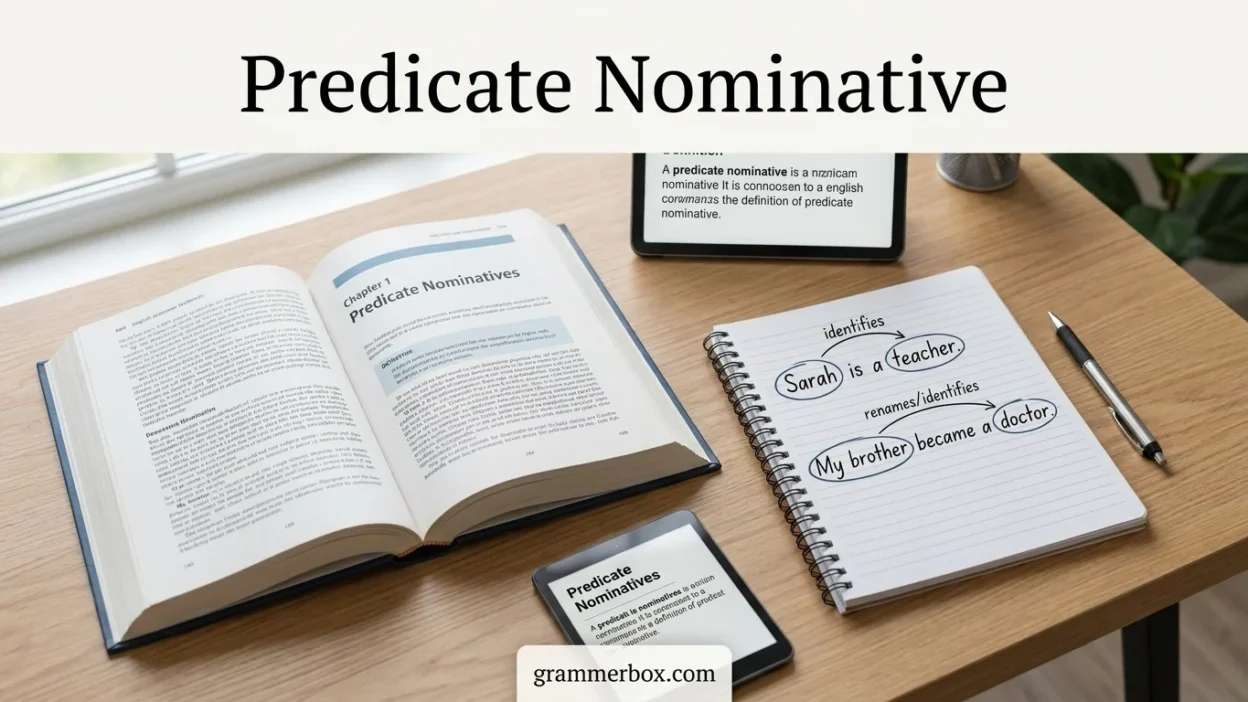
A predicate nominative is a grammar term that can sound complicated, but the idea is surprisingly simple. It is a noun, pronoun, or noun phrase that comes after a linking verb and identifies or renames the subject of a sentence. For example, in “Maria is a doctor,” the word doctor is a predicate nominative because it tells us what Maria is. Once you understand the relationship between the subject and the word that follows the linking verb, predicate nominatives become much easier to recognize.
Learning about predicate nominatives is useful because they appear frequently in everyday English, academic writing, and formal communication. They are especially common with linking verbs such as be, become, remain, seem, and appear. In this guide, you will learn how predicate nominatives work, how they differ from predicate adjectives and direct objects, common mistakes to avoid, and simple tricks for identifying them quickly.
Quick Answer
A predicate nominative is a noun or pronoun that follows a linking verb and renames or identifies the sentence’s subject. In “James became a teacher,” teacher is the predicate nominative because it identifies James. Predicate nominatives commonly follow forms of be and other linking verbs.
Why Do People Confuse Predicate Nominatives?
Predicate nominatives are often confusing because they appear after a verb, just like objects can. However, their grammatical job is different.
Consider these two sentences:
- Sarah is a nurse.
- Sarah called a nurse.
In the first sentence, nurse identifies Sarah. Therefore, it is a predicate nominative.
In the second sentence, a nurse receives the action of the verb “called.” It is a direct object.
The key question is:
If yes, you probably have a predicate nominative.
Another source of confusion is the difference between a predicate nominative and a predicate adjective:
- Daniel is a musician. → Predicate nominative
- Daniel is talented. → Predicate adjective
A musician is a noun that identifies Daniel, while talented is an adjective that describes him.
What Is a Predicate Nominative?
A predicate nominative is a noun, pronoun, or noun phrase that follows a linking verb and identifies, renames, or explains the subject.
The basic structure is:
Subject + Linking Verb + Predicate Nominative
For example:
- Emma is a student.
- My brother became a doctor.
- That building is the library.
In each sentence, the word or phrase after the linking verb refers back to the subject.
Common Linking Verbs
Predicate nominatives commonly appear after linking verbs, including:
- am
- is
- are
- was
- were
- be
- become
- became
- remain
- seem
- appear
- grow
- turn
The verb connects the subject with another noun rather than expressing an action performed on an object.
First Word: Predicate
The word predicate refers to the part of a sentence that says something about the subject.
For example:
Michael is a teacher.
- Michael = subject
- is a teacher = predicate
The predicate contains the linking verb is and the noun phrase a teacher.
In the term predicate nominative, “predicate” tells us where the word appears in the sentence structure. It generally occurs within the predicate, after the linking verb.
Second Word: Nominative
The word nominative relates to naming or identifying.
In:
Michael is a teacher.
The noun teacher identifies or renames Michael. Therefore, teacher is nominative in function.
Think of it this way:
Predicate + Nominative = a naming word in the predicate
This makes the term much less intimidating. A predicate nominative essentially gives another name or identity to the subject.
Predicate Nominative Comparison Table
| Grammar Term | Function | Example | Key Question |
|---|---|---|---|
| Predicate nominative | Renames or identifies the subject | Anna is a doctor. | Does it identify the subject? |
| Predicate adjective | Describes the subject | Anna is kind. | Does it describe the subject? |
| Direct object | Receives the action | Anna helped a doctor. | Does it receive the action? |
| Subject complement | Completes the meaning of the subject | Anna is a doctor. | Does it complete the subject? |
| Indirect object | Indicates who receives something | Anna gave John a book. | Who received something? |
A predicate nominative is a type of subject complement because it completes the meaning of the subject by identifying or renaming it.
When to Use a Predicate Nominative
Use a predicate nominative when you want to connect a subject with another noun or noun phrase that identifies it.
1. To State Someone’s Occupation
- My sister is a lawyer.
- David became a chef.
- Her father was an engineer.
2. To Identify a Person or Thing
- That woman is our principal.
- The winner was James.
- This building is the museum.
3. To Explain Someone’s Role
- Sarah became the team captain.
- Mark is our new manager.
- Emily remained the class representative.
4. To Rename a Subject
- My favorite author is Maya Angelou.
- The winner was my cousin.
- His biggest inspiration is his grandfather.
Predicate Nominative Examples
Here are more than 10 straightforward examples.
- John is a teacher.
Teacher identifies John. - My sister is a doctor.
Doctor renames or identifies my sister. - That animal is a fox.
Fox identifies the animal. - The winner was Sarah.
Sarah identifies the winner. - My father became an engineer.
Engineer identifies my father’s profession. - Our neighbor is a musician.
Musician identifies the neighbor. - The tall building is the hotel.
Hotel identifies the building. - She became the captain.
Captain identifies her role. - His brother is a pilot.
Pilot identifies his brother. - The man at the door is our teacher.
Teacher identifies the man. - The person responsible was David.
David identifies the person responsible. - My best friend is an artist.
Artist identifies my best friend. - Their dog became the neighborhood mascot.
Mascot identifies the dog’s new role. - The main problem is the lack of communication.
Lack of communication identifies the problem. - Her dream became a reality.
Reality identifies what her dream became. - The winner is our team.
Team identifies the winner. - That person seems a mystery.
This construction is uncommon and awkward in modern English; “That person seems mysterious” is more natural because mysterious is a predicate adjective.
Common Mistakes With Predicate Nominatives
Mistake 1: Confusing a Predicate Nominative With a Direct Object
A direct object receives the action of a transitive verb.
- Lisa is a teacher. → teacher = predicate nominative
- Lisa met a teacher. → teacher = direct object
The verb is is linking the two identities, while met describes an action directed toward an object.
Mistake 2: Calling Every Word After “Is” a Predicate Nominative
Not every word after a linking verb is a noun.
- He is happy. → Predicate adjective
- He is a doctor. → Predicate nominative
Ask whether the word names the subject or describes it.
Mistake 3: Forgetting Pronouns Can Function as Predicate Nominatives
Pronouns can also identify a subject.
For example:
- The person responsible was he.
- The winner was she.
In everyday modern English, however, many speakers naturally use object forms:
- “The winner was her.”
Formal grammatical analyses may distinguish traditional subject-complement pronoun rules from common modern usage.
Mistake 4: Assuming Every Linking Verb Has a Predicate Nominative
Linking verbs can also be followed by adjectives.
- She became a manager. → Predicate nominative
- She became angry. → Predicate adjective
The first noun identifies her new role; the second describes her condition.
Memory Trick
Use this simple trick:
“Nominative = Naming”
When you see:
Subject + Linking Verb + Noun
ask:
Does the noun give the subject another name or identity?
If it does, you probably have a predicate nominative.
For example:
Tom is a musician.
Ask:
What is Tom?
Answer: a musician.
Therefore, musician is the predicate nominative.
Another useful test is the equals sign:
Tom = musician
If the sentence creates this kind of identification, the noun after the linking verb is likely a predicate nominative.
American vs. British English
The concept of a predicate nominative is essentially the same in American English and British English. Both varieties use predicate nominatives after linking verbs to identify or rename subjects.
For example:
- American English: She is a teacher.
- British English: She is a teacher.
There is no meaningful grammatical difference in the definition.
Differences may sometimes appear in pronoun usage or stylistic preferences. For example, formal traditional grammar may favor “It was I” in certain constructions, while everyday English in both the United States and United Kingdom commonly uses “It was me.”
The underlying concept of the predicate nominative remains the same.
Similar Words and Grammar Terms
Understanding related grammar terms can make predicate nominatives much easier.
Subject Complement
A subject complement completes the meaning of the subject. Predicate nominatives and predicate adjectives are both common types of subject complements.
Predicate Adjective
A predicate adjective describes the subject after a linking verb.
- The soup is hot.
- Maria became tired.
Direct Object
A direct object receives the action of a verb.
- James bought a car.
- Sarah opened the door.
Subject
The subject is the person, place, thing, or idea that the sentence is about.
- James is a teacher.
- The building is a school.
Linking Verb
A linking verb connects the subject with information that identifies or describes it.
Common examples include be, become, seem, remain, appear, and feel.
Final Verdict
A predicate nominative is simply a noun, pronoun, or noun phrase that follows a linking verb and identifies or renames the subject. In “Maria is a doctor,” the word doctor is a predicate nominative because it tells us what Maria is.
The easiest way to recognize one is to look for a linking verb and then ask whether the word following it names or identifies the subject. If it does, you have a predicate nominative. If it describes the subject instead, you probably have a predicate adjective.
FAQs:
1. What is a predicate nominative in simple terms?
A predicate nominative is a noun or pronoun that follows a linking verb and renames or identifies the subject.
Example: “John is a teacher.” The word teacher is the predicate nominative.
2. How do I identify a predicate nominative?
Find the linking verb, then look at what comes after it. If that noun identifies or renames the subject, it is a predicate nominative.
Example:
Sarah is a scientist.
Sarah = scientist, so scientist is the predicate nominative.
3. What verbs are commonly followed by predicate nominatives?
Forms of be are the most common, including am, is, are, was, and were. Other linking verbs such as become, remain, and seem can also occur in appropriate constructions.
4. Is a predicate nominative the same as a subject complement?
A predicate nominative is a type of subject complement. A subject complement can be a noun that identifies the subject or an adjective that describes it.
5. What is the difference between a predicate nominative and a predicate adjective?
A predicate nominative renames or identifies the subject, while a predicate adjective describes the subject.
- She is a doctor. → Predicate nominative
- She is kind. → Predicate adjective
6. Can a predicate nominative be a pronoun?
Yes. A pronoun can function as a predicate nominative when it identifies the subject, although pronoun choice can vary between traditional formal grammar and everyday English usage.
7. Can a predicate nominative be more than one word?
Yes. It can be a noun phrase.
Example:
Michael is the captain of our team.
The entire phrase the captain of our team functions as the predicate nominative.
Remember This
Predicate nominative = a naming word after a linking verb.
Use this formula:
Subject + Linking Verb + Noun That Renames the Subject = Predicate Nominative
Example:
Emma is a student.
- Emma = subject
- is = linking verb
- a student = predicate nominative
When in doubt, ask:
If the answer is yes, you have likely found a predicate nominative.
Conclusion
Predicate nominatives may sound like an advanced grammar concept, but they follow a straightforward pattern. They appear after linking verbs and provide another name, identity, profession, role, or classification for the subject. Once you learn to recognize linking verbs and ask whether the following noun identifies the subject, these sentences become much easier to analyze.
The most important distinction is between naming and describing. A predicate nominative names or identifies the subject, while a predicate adjective describes it. Keep that difference in mind, use the “equals sign” test, and practice with real sentences. With a little practice, identifying predicate nominatives will become a quick and natural grammar skill.