
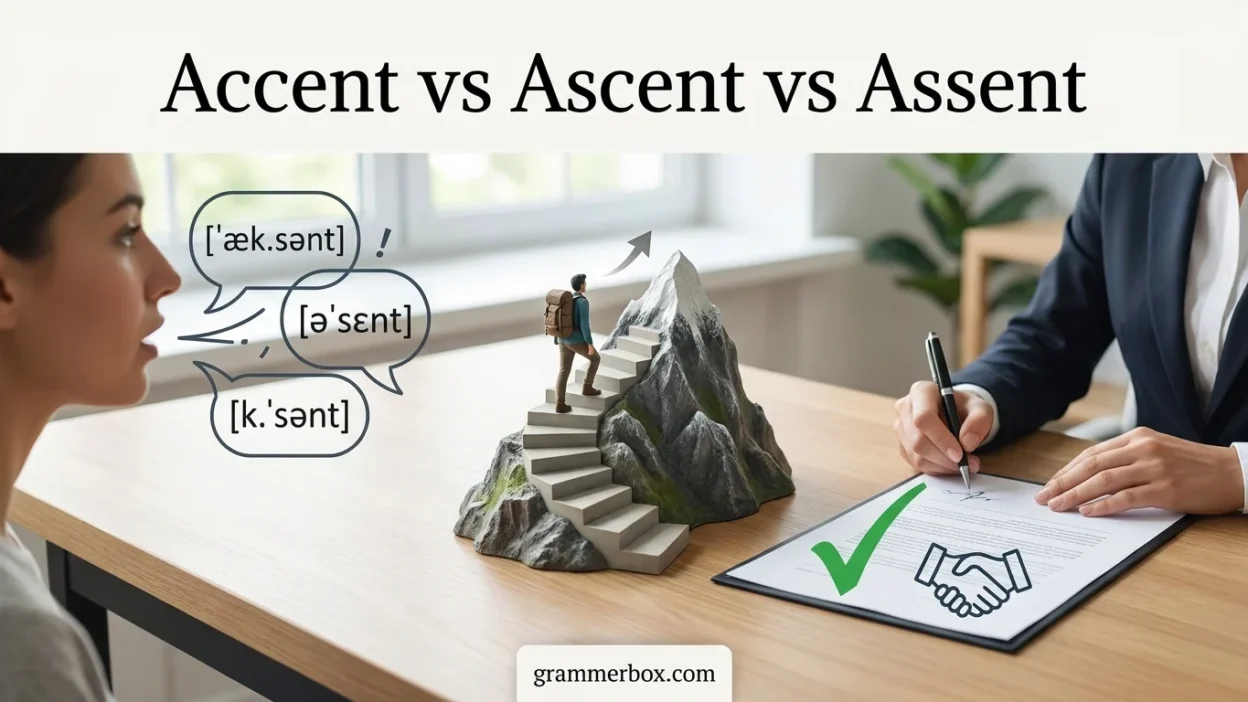
English has many words that sound similar but have completely different meanings. Accent vs ascent vs assent is a perfect example. These three words can easily confuse learners because they have similar spellings and pronunciations, yet they belong to different parts of speech and describe completely different ideas. Knowing the difference can help you write more accurately and avoid common vocabulary mistakes.
Accent usually relates to pronunciation, emphasis, or a distinctive way of speaking. Ascent refers to the act of climbing or moving upward, while assent means agreement or approval. Although these words may sound alike in some varieties of English, their meanings and uses are easy to separate once you understand the context. This guide explains each word clearly, compares accent, ascent, and assent, and provides practical examples and memory tricks to help you use them confidently.
Quick Answer
Accent means a way of pronouncing words or special emphasis. Ascent means an upward movement or climb. Assent means agreement or approval. Remember: accent relates to speech, ascent goes upward, and assent means saying yes.
Why People Confuse It
The main reason people confuse accent, ascent, and assent is their similar spelling and pronunciation.
- Accent begins with acc- and relates to speech or emphasis.
- Ascent begins with asc- and refers to going upward.
- Assent begins with ass- and means agreement.
- Ascent and assent are especially easy to mix up because they can sound nearly identical in many accents.
- Context usually makes the intended meaning clear.
A useful approach is to focus on the first few letters and meaning, rather than relying only on pronunciation.
First Word: Accent
Accent is a noun and, in some contexts, a verb.
As a noun, it commonly refers to the distinctive way someone pronounces a language. It can also mean emphasis placed on a particular syllable, word, or idea.
Common meanings of accent
- A way of speaking
- She has a strong Australian accent.
- Emphasis in pronunciation
- The accent falls on the second syllable.
- Special emphasis or importance
- The designer placed an accent on the entrance.
- To emphasize something
- The lighting accents the painting.
Examples of accent
- I could tell from his accent that he had lived abroad.
- Which syllable receives the accent in this word?
- Her French accent was easy to recognize.
- The speaker accented the final point in her presentation.
Second Word: Ascent
Ascent is a noun meaning the act of going upward or a climb to a higher position or place.
It is commonly used when talking about mountains, stairs, aircraft, balloons, or anything that moves upward.
Common meanings of ascent
- A climb up a mountain
- Movement toward a higher level
- The upward movement of an aircraft
- Progress toward a higher position
Examples of ascent
- The hikers began their ascent before sunrise.
- The plane’s ascent was smooth.
- The steep ascent took nearly two hours.
- Her rapid ascent in the company surprised everyone.
A helpful related verb is ascend, which means “to go upward.”
Third Word: Assent
Assent means agreement, approval, or acceptance.
It can be used as both a noun and a verb.
As a noun
Assent means agreement or approval.
- The proposal was approved with the board’s assent.
As a verb
To assent means to agree with something or give approval.
- The committee assented to the new policy.
Examples of assent
- The parents gave their assent to the plan.
- She nodded in assent.
- The manager assented to the request.
- He gave his assent after reviewing the proposal.
A useful related word is consent, although assent and consent are not always interchangeable.
Accent vs Ascent vs Assent: Comparison Table
| Word | Part of Speech | Meaning | Example |
|---|---|---|---|
| Accent | Noun / Verb | Pronunciation, emphasis, or prominence | She has a British accent. |
| Ascent | Noun | An upward movement or climb | The ascent was difficult. |
| Assent | Noun / Verb | Agreement or approval | They gave their assent. |
Simple distinction
- Accent = speech or emphasis
- Ascent = going up
- Assent = agreeing
When to Use Each
Use “accent” when talking about speech
Use accent when discussing how someone pronounces a language or how emphasis is placed on a sound or word.
He speaks English with a noticeable Irish accent.
Use “ascent” for upward movement
Use ascent when someone or something moves upward.
The mountain ascent was exhausting.
Use “assent” for agreement
Use assent when someone agrees with or approves something.
The director gave her assent to the proposal.
Quick test
Ask yourself:
Is it about speaking? → Accent
Is it about going up? → Ascent
Is it about agreeing? → Assent
Examples of Accent, Ascent, and Assent
- Her accent became stronger after she moved overseas.
- The climbers prepared for a difficult ascent.
- The board gave its assent to the proposal.
- I love listening to his Scottish accent.
- The aircraft began its ascent shortly after takeoff.
- The judge’s decision required the assent of the panel.
- Her accent makes her easy to identify.
- The final part of the mountain ascent was extremely steep.
- The workers acted with the manager’s assent.
- The teacher explained where to place the accent in the word.
- Their ascent to the summit took five hours.
- The committee expressed its assent to the revised plan.
Common Mistakes
Mistake 1: Using “assent” when you mean “ascent”
❌ The hikers began their assent up the mountain.
✅ The hikers began their ascent up the mountain.
The hikers are moving upward, so ascent is correct.
Mistake 2: Using “ascent” for agreement
❌ She gave her ascent to the proposal.
✅ She gave her assent to the proposal.
Here, the person is agreeing, so assent is required.
Mistake 3: Confusing “accent” with “ascent”
❌ His French ascent was easy to recognize.
✅ His French accent was easy to recognize.
The sentence is about pronunciation, so accent is correct.
Mistake 4: Choosing based only on sound
Because ascent and assent can sound alike, pronunciation alone may not help. Look at the meaning and surrounding words.
Memory Trick
Try these three simple associations:
- Accent → A = Audio 🎙️
- Ascent → C = Climb 🧗
- Assent → S = Say yes ✅
Or remember this sentence:
The spelling gives you another clue:
asCENT → think of climbing toward a higher point.
asSENT → think of saying “yes”.
American vs British English
The meanings of accent, ascent, and assent are essentially the same in American and British English.
There can, however, be differences in pronunciation, especially depending on the speaker’s regional accent. This is one reason ascent and assent may be difficult to distinguish when heard in conversation.
The spelling and meaning remain unchanged:
- American English: accent, ascent, assent
- British English: accent, ascent, assent
So when writing, focus on the intended meaning rather than pronunciation.
Similar Words
Understanding related vocabulary can make these distinctions easier.
Words related to accent
- pronunciation
- emphasis
- intonation
- stress
- dialect
- inflection
Words related to ascent
- climb
- rise
- elevation
- upward movement
- ascent
- ascend
Words related to assent
- agreement
- approval
- acceptance
- consent
- permission
- concurrence
Be careful with consent and assent. Both can involve agreement, but their usage and context can differ.
FAQs:
1. What is the difference between accent and ascent?
Accent relates to pronunciation or emphasis, while ascent means an upward movement or climb.
2. What is the difference between ascent and assent?
Ascent means going upward, while assent means agreement or approval.
3. Are ascent and assent pronounced the same?
They can be pronounced very similarly, and in some varieties of English they may be homophones. Context helps distinguish them.
4. Is accent a noun or a verb?
Accent can be both a noun and a verb. As a noun, it can mean a way of pronouncing a language; as a verb, it means to emphasize something.
5. Is ascent a verb?
No. Ascent is a noun. The related verb is ascend.
6. Can assent be a verb?
Yes. Assent can be a noun meaning agreement and a verb meaning to agree or approve.
7. What is an easy way to remember these words?
Think accent = speech, ascent = climb, and assent = agreement.
Final Verdict
The difference between accent, ascent, and assent becomes simple once you connect each word with its meaning. Accent is associated with pronunciation or emphasis. Ascent describes movement upward. Assent expresses agreement or approval.
When you’re unsure, don’t rely on pronunciation alone. Check the context: if the sentence involves speech, choose accent; if something is moving upward, choose ascent; and if someone is agreeing, choose assent. These three associations will help you use the words accurately in everyday writing and formal English.
Remember This
Accent = speech or emphasis
Ascent = upward movement
Assent = agreement or approval
Easy formula:
👉 Accent speaks.
👉 Ascent climbs.
👉 Assent agrees.
Conclusion
Although accent vs ascent vs assent can look and sound confusing, their meanings are clearly different. Accent deals with pronunciation and emphasis, ascent describes movement upward, and assent refers to agreement or approval. Learning these core meanings makes it much easier to choose the correct word.
The next time you encounter one of these words, pause and identify the context. Is the sentence about speech, climbing, or agreement? Once you make that connection, choosing between accent, ascent, and assent becomes much more natural.