
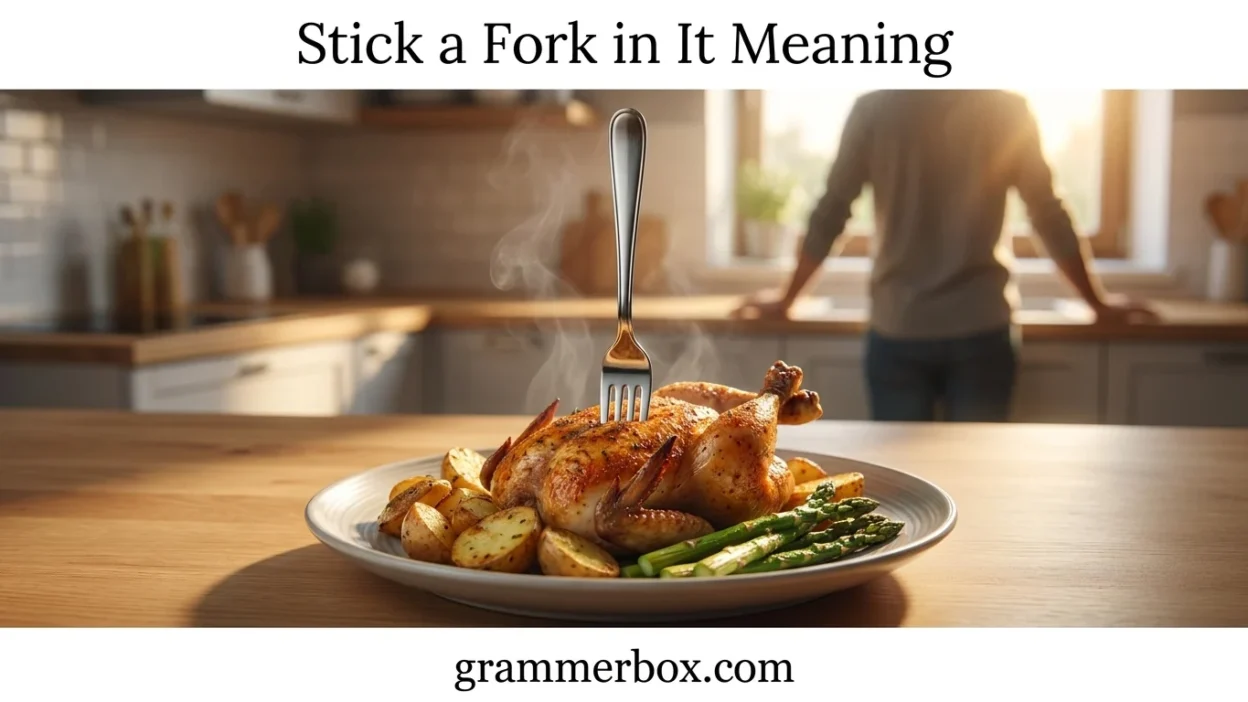
The phrase “stick a fork in it” is an informal English idiom that means something is finished, completed, or effectively over. It is often used when a task, project, event, or situation has reached its natural conclusion. You may also hear the longer expression “stick a fork in it, it’s done,” which makes the meaning especially clear.
The idiom can sound strange if you interpret it literally. After all, sticking a fork into something does not normally mean that it has ended. In everyday conversation, however, the phrase is usually figurative and often carries a casual, humorous tone. Understanding its meaning, context, and common variations can help you recognize it in conversations, articles, television shows, and social media. This guide explains “stick a fork in it” meaning, how to use the expression naturally, common mistakes to avoid, and several practical examples.
Quick Answer
“Stick a fork in it” means that something is finished, completed, or over. It is an informal idiom, often used humorously. For example, “We’ve finished the report, so stick a fork in it” means the report is done and no more work is needed.
Why People Confuse It
People often misunderstand “stick a fork in it” because its literal meaning has little connection to its idiomatic meaning.
Literally, the phrase suggests putting a fork into an object. Figuratively, however, it means to consider something finished or completed.
Another source of confusion is that the expression may appear in different forms:
- Stick a fork in it.
- Stick a fork in it, it’s done.
- You can stick a fork in it; it’s finished.
- Stick a fork in that project.
The expression is generally informal and works best in casual conversations or writing.
First Word: Stick
Stick is a verb with several meanings in English.
In the idiom “stick a fork in it,” it refers literally to inserting or pushing something into an object.
For example:
- Stick the fork in the cake.
- Stick a fork into the potatoes.
But in the complete idiom, stick is part of a fixed expression rather than a literal instruction.
Meaning of “stick”
Depending on context, stick can mean:
- To insert something
- To attach something
- To remain in a place
- To tolerate something
- To place something somewhere
In “stick a fork in it,” the first meaning provides the literal imagery behind the idiom.
Second Word: Fork
A fork is a utensil with several pointed prongs, commonly used for eating.
In the expression, the fork is not actually important as a kitchen utensil. It creates the image of checking whether something is finished.
The phrase is often associated with the idea of checking food while cooking. Once the food is done, you can metaphorically “stick a fork in it.”
So, fork contributes to the humorous imagery of the idiom rather than giving the expression a separate figurative meaning.
Comparison Table
| Expression | Meaning | Tone | Example |
|---|---|---|---|
| Stick a fork in it | It is finished | Informal | Stick a fork in it; we’re done. |
| It’s done | It is completed | Neutral | The project is done. |
| It’s finished | Something has ended | Neutral | The meeting is finished. |
| Call it a day | Stop working | Informal | Let’s call it a day. |
| Wrap it up | Finish something | Informal | Let’s wrap it up. |
| That’s a wrap | Something has ended | Casual | That’s a wrap for today’s filming. |
| Put it to bed | Finish or settle something | Informal | Let’s put this issue to bed. |
When to Use “Stick a Fork in It”
Use this idiom when you want to say that something is finished, completed, or no longer needs attention.
It can describe:
1. A completed task
“We finished all the paperwork. Stick a fork in it.”
2. A completed project
“The website is finally live. Stick a fork in the project.”
3. The end of an event
“The conference is over, so stick a fork in it.”
4. A situation that has effectively ended
“After that final defeat, you can stick a fork in their campaign.”
The expression is usually conversational rather than formal.
Examples of “Stick a Fork in It”
Here are natural examples showing how the idiom works in different contexts:
- We’ve finished the assignment, so stick a fork in it.
- The repairs are complete. Stick a fork in it.
- Dinner is ready—stick a fork in it!
- We’ve solved the problem. You can stick a fork in it.
- The team has completed the project, so stick a fork in it.
- After three hours of work, we can finally stick a fork in it.
- The report is finished. Stick a fork in it and send it to the manager.
- The movie is over, so stick a fork in it.
- Once the final edits are done, we can stick a fork in the article.
- We’ve cleaned the entire house. Stick a fork in it!
- The negotiations have ended, so you can stick a fork in that deal.
- The last chapter is complete. Stick a fork in the book.
Example in dialogue
Emma: Have you finished the presentation?
Jack: Yes. I just added the final slide.
Emma: Great. Stick a fork in it!
Here, Emma means “The presentation is finished.”
Common Mistakes
Mistake 1: Taking the phrase literally
Incorrect interpretation: Someone needs to physically put a fork into something.
The phrase is normally figurative when used as an idiom.
Mistake 2: Using it in formal writing
Because “stick a fork in it” is casual and somewhat humorous, it may not be appropriate for a formal business report or academic essay.
Instead, use:
- Completed
- Finished
- Concluded
- Finalized
- Brought to an end
Mistake 3: Thinking “fork” has a special grammatical meaning
The word fork keeps its ordinary noun meaning. The figurative meaning comes from the entire expression.
Mistake 4: Assuming it always refers to food
Although the imagery may come from checking cooked food, the idiom can describe projects, tasks, events, plans, discussions, and situations.
Memory Trick
Think of a cook checking whether food is ready.
Fork → Check → Done
Imagine someone putting a fork into food to see whether it is finished cooking.
So remember:
Stick a fork in it = It’s done.
This simple association makes the idiom easier to remember.
American vs British English
“Stick a fork in it” is especially familiar in American English and is commonly used in casual American speech.
British English speakers can understand the expression, but other expressions may be more natural depending on the context, such as:
- It’s finished.
- It’s done.
- That’s it.
- Call it a day.
- That’s a wrap.
The expression is not grammatically restricted to American English, but its humorous idiomatic use is strongly associated with American informal English.
Similar Words and Expressions
Several English expressions communicate a similar idea.
“It’s done”
The simplest alternative.
“The job is done.”
“Call it a day”
Means to stop working, usually for the day.
“We’ve done enough. Let’s call it a day.”
“Wrap it up”
Means to finish an activity or discussion.
“We only have five minutes, so let’s wrap it up.”
“That’s a wrap”
Commonly means that an activity, event, or production has ended.
“We’ve filmed the final scene. That’s a wrap!”
“Put it to bed”
Means to finish, settle, or stop dealing with something.
“The issue has been resolved, so let’s put it to bed.”
“Bring it to a close”
A more formal expression meaning to finish something.
“The chair brought the meeting to a close.”
FAQs:
What does “stick a fork in it” mean?
“Stick a fork in it” means something is finished, completed, or over. It is an informal English idiom often used in a humorous way.
What does “stick a fork in it, it’s done” mean?
It means the thing being discussed is completely finished. The added phrase “it’s done” makes the idiomatic meaning explicit.
Is “stick a fork in it” an idiom?
Yes. “Stick a fork in it” is an informal idiomatic expression. Its intended meaning is different from the literal meaning of the words.
Is “stick a fork in it” formal?
No. It is generally casual and conversational. In formal writing, “completed,” “finished,” or “finalized” is usually more appropriate.
Can “stick a fork in it” refer to a person?
Usually, the expression refers to a task, project, event, plan, or situation, rather than literally referring to a person. Context matters because saying it about a person can sound humorous or harsh.
Does “stick a fork in it” mean stop?
It can imply that something should stop because it is finished, but its central meaning is that something has reached completion.
What is a synonym for “stick a fork in it”?
Depending on the context, similar expressions include “it’s done,” “call it a day,” “wrap it up,” “that’s a wrap,” and “bring it to a close.”
Remember This
Stick a fork in it = It’s done.
The phrase is informal, often humorous, and usually means something has been completed or has come to an end.
Conclusion
Understanding idioms like “stick a fork in it” helps you recognize the difference between literal and figurative English. The expression does not normally ask someone to use a fork. Instead, it casually announces that something is finished or can now be considered complete.
When you encounter “stick a fork in it” in conversation, think “It’s done.” Use it with friends, colleagues in casual settings, or in conversational writing, but choose more formal wording when writing academic, professional, or official documents.