
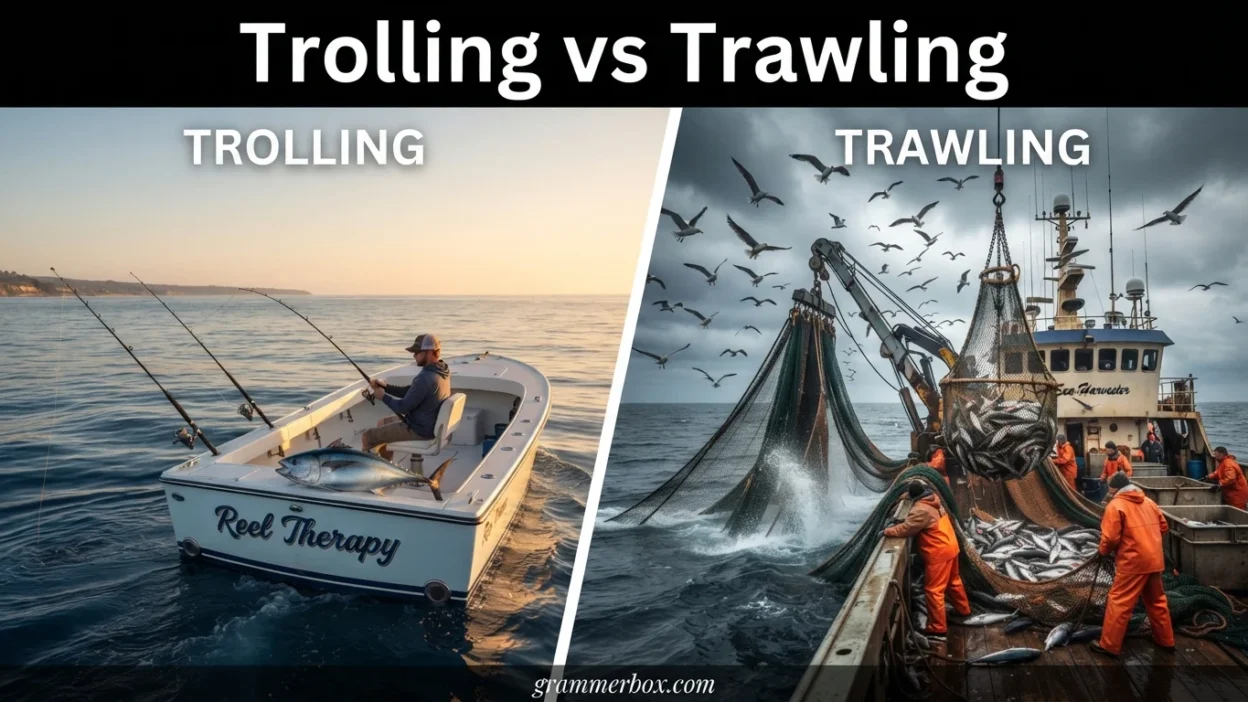
Have you ever seen the words trolling and trawling and wondered whether they mean the same thing? Although these words look and sound similar, they have very different meanings. Trolling usually refers to deliberately provoking people online or fishing by moving bait through the water, while trawling describes fishing with a large net pulled through the water. Understanding the difference helps you choose the correct word in writing, conversations, and professional communication.
The confusion often happens because both words can relate to fishing, and their spellings differ by only a few letters. However, their everyday uses are quite different. Trolling is commonly associated with internet behavior, social media arguments, and intentional provocation.
Trawling, on the other hand, is mainly connected to commercial fishing, marine activities, and searching through large amounts of information. In this guide, you will learn the definitions of trolling and trawling, discover their grammatical uses, explore practical examples, and find simple tricks to remember which word belongs in each situation.
Quick Answer
Trolling means deliberately provoking or annoying people online, or fishing by dragging bait through the water. Trawling means catching fish by pulling a large net through the water. Although both words have fishing-related meanings, trolling is especially common in discussions about internet behavior, while trawling describes net-based fishing.
Why People Confuse It
People often confuse trolling and trawling because their spellings are similar and both words have connections to fishing. Their pronunciation can also seem similar, especially to English learners.
However, the words describe different actions and are not interchangeable in most contexts.
Here are the main reasons for the confusion:
- Similar spelling: Both words begin with “t” and end with “-ling.”
- Fishing terminology: Trolling and trawling are both fishing techniques, but they use different methods.
- Different everyday meanings: Trolling frequently describes online harassment or provocation, whereas trawling can describe dragging a net or searching through information.
- Unfamiliar vocabulary: People who rarely encounter fishing terminology may not recognize the distinction.
The easiest solution is to examine the context. If someone is deliberately provoking others on social media, trolling is usually correct. If a fishing boat is pulling a net through the water, trawling is the appropriate word.
First Word: Trolling
Trolling is the present participle and gerund form of the verb troll. Its meaning depends on the context in which it appears.
1. Trolling in Internet Communication
In online communication, trolling means deliberately posting provocative, offensive, misleading, or irritating content to upset people or provoke reactions.
For example:
- Someone repeatedly posts insulting comments to start arguments.
- A social media user deliberately spreads a ridiculous claim to provoke angry responses.
- A person enters an online discussion solely to annoy other participants.
In these situations, the person is described as trolling.
Example: The user was trolling people in the comments section to start an argument.
Trolling can overlap with cyberbullying, but the terms are not identical. Cyberbullying often involves targeted, repeated harmful behavior, whereas trolling generally focuses on provocation or disruption.
2. Trolling in Fishing
Trolling also has a traditional fishing meaning. It involves pulling one or more baited fishing lines through the water, usually behind a moving boat, to attract fish.
Anglers commonly use trolling to catch species that move through open water.
Example: We spent the morning trolling for salmon along the coastline.
In this context, trolling has nothing to do with internet arguments or deliberately upsetting people.
When to Use Trolling
Use trolling when discussing:
- Provoking people online.
- Deliberately creating arguments on social media.
- Fishing with baited lines pulled through the water.
- The act of trolling, as in “Trolling is discouraged in this forum.”
Second Word: Trawling
Trawling is the present participle and gerund form of the verb trawl. It most commonly refers to fishing with a net that is dragged through the water by a moving vessel.
It can also mean searching through a large quantity of information to find something useful.
1. Trawling in Commercial Fishing
Trawling is a widely recognized commercial fishing technique. A fishing vessel pulls a specially designed net through the water to capture fish and other marine animals.
Two common types are:
- Bottom trawling: A net is dragged along or near the seabed.
- Midwater trawling: A net is pulled through the water column without necessarily touching the seabed.
Trawling methods vary depending on the target species, equipment, and fishing environment. Some methods can also cause significant environmental damage, particularly when poorly managed.
Example: The fishing vessel was trawling for haddock in deep water.
2. Trawling for Information
Trawling can also be used figuratively to describe searching through a large amount of material.
For instance, a researcher might trawl through historical documents, or a journalist might trawl through public records to find evidence.
Example: The journalist spent several days trawling through archived reports.
This meaning is useful in academic research, journalism, investigations, and everyday conversation.
When to Use Trawling
Use trawling when referring to:
- Fishing with a dragged net.
- Commercial fishing operations.
- Searching through records or documents.
- Looking through a large collection of information for something specific.
Comparison Table
| Feature | Trolling | Trawling |
|---|---|---|
| Base verb | Troll | Trawl |
| Main fishing method | Pulling baited lines through water | Pulling a net through water |
| Common online meaning | Provoking or upsetting people | Not usually used for online provocation |
| Figurative meaning | Deliberately provoking reactions | Searching through large amounts of information |
| Common context | Social media, discussions, fishing | Commercial fishing, research, investigations |
| Example | He was trolling online users. | She was trawling through old records. |
The key difference is the action being described: trolling can involve provoking people or fishing with baited lines, while trawling usually involves net fishing or searching through information.
When to Use Each
Choosing between trolling and trawling becomes easier when you identify the intended meaning.
Use Trolling When Someone Is Provoking Others
Choose trolling when a person intentionally tries to upset, annoy, or provoke a reaction from other people.
Examples:
- He enjoys trolling strangers on social media.
- The account was banned for trolling other users.
- Stop trolling your classmates during the discussion.
Use Trolling for Fishing With Lines
If someone is fishing by pulling baited lines through the water, trolling is the appropriate term.
Examples:
- They were trolling for tuna.
- The captain recommended trolling near the reef.
- We caught several fish while trolling behind the boat.
Use Trawling for Net Fishing
Choose trawling when a vessel pulls a fishing net through the water to catch fish.
Examples:
- The crew was trawling for shrimp.
- The company operates several commercial trawling vessels.
- Researchers studied the effects of bottom trawling.
Use Trawling for Searching
When someone searches through a large amount of material, trawling is often suitable.
Examples:
- I spent hours trawling through emails.
- The investigator was trawling through public records.
- She found the reference while trawling through old newspapers.
A useful rule is to focus on the action rather than the subject alone. Both words can appear in fishing contexts, so the fishing method determines which one is correct.
Examples of Trolling vs Trawling
Here are 16 examples showing how to use both words naturally.
Examples of Trolling
- The internet user was trolling people by posting deliberately offensive comments.
- Our teacher warned us against trolling classmates in the online classroom.
- He accused the account of trolling to attract attention.
- The moderator removed several comments because they were trolling other members.
- We went trolling for salmon early in the morning.
- The captain suggested trolling with artificial lures.
- They spent the afternoon trolling for fish offshore.
- The forum has strict rules against trolling and personal attacks.
Examples of Trawling
- The fishing vessel was trawling for cod in the North Atlantic.
- The crew spent the day trawling with a large fishing net.
- Environmental groups raised concerns about destructive bottom trawling.
- The researchers were trawling through historical archives.
- I found the missing message while trawling through my inbox.
- The journalist was trawling public records for supporting evidence.
- The fishing company stopped trawling during the restricted season.
- She spent the weekend trawling through secondhand bookstores for rare editions.
These examples demonstrate that trolling and trawling can both describe fishing-related activities, but they refer to different techniques. They also have distinct figurative uses.
Common Mistakes
Even experienced English users sometimes confuse these words. Understanding the following mistakes will help you avoid them.
Mistake 1: Using Trawling for Online Provocation
Incorrect: He was trawling people on social media.
Correct: He was trolling people on social media.
Why? Trolling is the conventional term for deliberately provoking people online.
Mistake 2: Using Trolling for Net Fishing
Incorrect: The boat was trolling with a large commercial net.
Correct: The boat was trawling with a large commercial net.
Why? Dragging a fishing net through the water is trawling. Trolling typically involves baited lines.
Mistake 3: Assuming Both Words Mean the Same Thing
Incorrect: Trolling and trawling are interchangeable fishing terms.
Correct: Trolling and trawling describe different fishing methods.
Why? Trolling generally uses baited lines, while trawling uses a dragged net.
Mistake 4: Ignoring Figurative Meanings
Incorrect: Trawling can only describe fishing.
Correct: Trawling can also describe searching through records, documents, or other collections.
Why? English often extends the meaning of physical actions to describe information-gathering activities.
Mistake 5: Confusing Trolling With Cyberbullying
Incorrect: Every instance of trolling is necessarily cyberbullying.
Correct: Trolling can involve harmful online behavior, but not every instance meets the definition of cyberbullying.
Why? The terms overlap, but their meanings and circumstances differ.
Memory Trick
Remember these two simple associations:
- Trolling = T for taunting. Think of someone trying to provoke others online. For fishing, remember baited lines being pulled through water.
- Trawling = R for net retrieval. Think of a fishing boat dragging a net to retrieve fish.
You can also memorize these sentences:
- “The troll was trolling the internet.”
- “The trawler was trawling with a net.”
The second sentence connects trawling with both the vessel and the fishing method.
For an even quicker reminder, think of trolling as baited-line fishing and trawling as net fishing. This distinction is especially helpful when reading marine biology articles, fishing guides, or environmental reports.
American vs British English
The meanings of trolling and trawling are broadly consistent in American and British English. Neither spelling is an American-versus-British spelling variation.
| Usage | American English | British English |
|---|---|---|
| Online provocation | Trolling | Trolling |
| Fishing with baited lines | Trolling | Trolling |
| Fishing with a dragged net | Trawling | Trawling |
| Searching through information | Trawling | Trawling |
Both varieties use trolling for online provocation and baited-line fishing. Similarly, trawling refers to net fishing and can describe searching through a large amount of information.
Regional differences may occur in technical fishing terminology, but the basic distinction between these words remains the same.
If you are writing for an American or British audience, focus on choosing the word that matches the intended action rather than changing its spelling.
Similar Words
Several English words are related to trolling and trawling. Knowing their meanings can help you choose more precise vocabulary.
| Word | Meaning | Example |
|---|---|---|
| Trolling | Provoking others or fishing with baited lines | He was trolling online users. |
| Trawling | Fishing with a net or searching extensively | She was trawling through records. |
| Trawler | A vessel designed or used for trawling | The trawler returned to port. |
| Troll | A person who provokes others online; also a verb related to trolling | The troll posted an inflammatory comment. |
| Trawl net | A net dragged through water to catch fish | The crew repaired the trawl net. |
| Angling | Fishing with a rod and line | They enjoy angling on weekends. |
| Dragging | Pulling something along a surface or through an area | The boat was dragging its equipment. |
| Searching | Looking for something | The team was searching for evidence. |
| Baiting | Using bait to attract fish or deliberately provoke someone | He was baiting others into an argument. |
These terms are related, but they are not all interchangeable. For example, angling usually describes fishing with a rod and line, while trawling involves a net. Similarly, baiting can mean provoking someone, but trolling more specifically suggests behavior intended to generate a reaction.
FAQs:
1. What is the main difference between trolling and trawling?
Trolling can mean provoking people online or fishing by pulling baited lines through the water. Trawling usually means fishing with a net dragged through the water or searching through a large amount of information.
2. Is trolling a type of fishing?
Yes. In fishing, trolling involves moving baited lines through the water, often behind a boat. The term also has a separate meaning in internet culture, where it describes deliberately provoking others.
3. What does trawling mean on the internet?
Trawling on the internet generally means searching through large amounts of online information, posts, records, or messages to find something. It is different from trolling, which usually involves provoking people or disrupting discussions.
4. Is trolling the same as cyberbullying?
No. Trolling involves provoking or upsetting people, often to generate a reaction. Cyberbullying generally involves targeted harmful behavior through digital platforms and may include repeated harassment. Some trolling can qualify as cyberbullying, but the terms are not identical.
5. What is a trawler?
A trawler is a fishing vessel designed or used to catch fish by pulling a trawl net through the water. Trawlers are commonly associated with commercial fishing operations.
6. Can trawling mean searching for information?
Yes. Trawling can be used figuratively to describe searching extensively through documents, emails, archives, or databases to locate useful information.
7. Are trolling and trawling pronounced the same way?
No. Their pronunciation is similar, but trolling begins with the sound in “troll,” while trawling begins with the sound in “trawl.” The vowel sounds differ, although accents can affect how clearly the distinction is heard.
8. Which word should I use for a boat pulling a fishing net?
Use trawling. A boat that catches fish by dragging a net through the water is trawling, while a boat pulling baited fishing lines to attract fish is trolling.
Final Verdict
The difference between trolling and trawling comes down to meaning and context. Trolling commonly refers to provoking people online, but it can also describe fishing with baited lines pulled through the water. Trawling refers to catching fish with a net dragged through the water and, figuratively, to searching extensively through information. Although the words look similar, they describe different actions.
When deciding which word to use, ask yourself what the person or boat is doing. If someone is trying to provoke an online reaction or fishing with baited lines, choose trolling. If a boat is pulling a net or someone is searching through a large collection of records, choose trawling. Learning this simple distinction will make your writing more accurate and help you avoid a common English vocabulary mistake.
Remember This
- Trolling: Deliberately provoking people online or fishing with baited lines.
- Trawling: Catching fish with a dragged net or searching extensively through information.
- Easy memory trick: Trolling uses baited lines; trawling uses nets.
- Writing tip: Always check the context before choosing between these similar-looking words.