
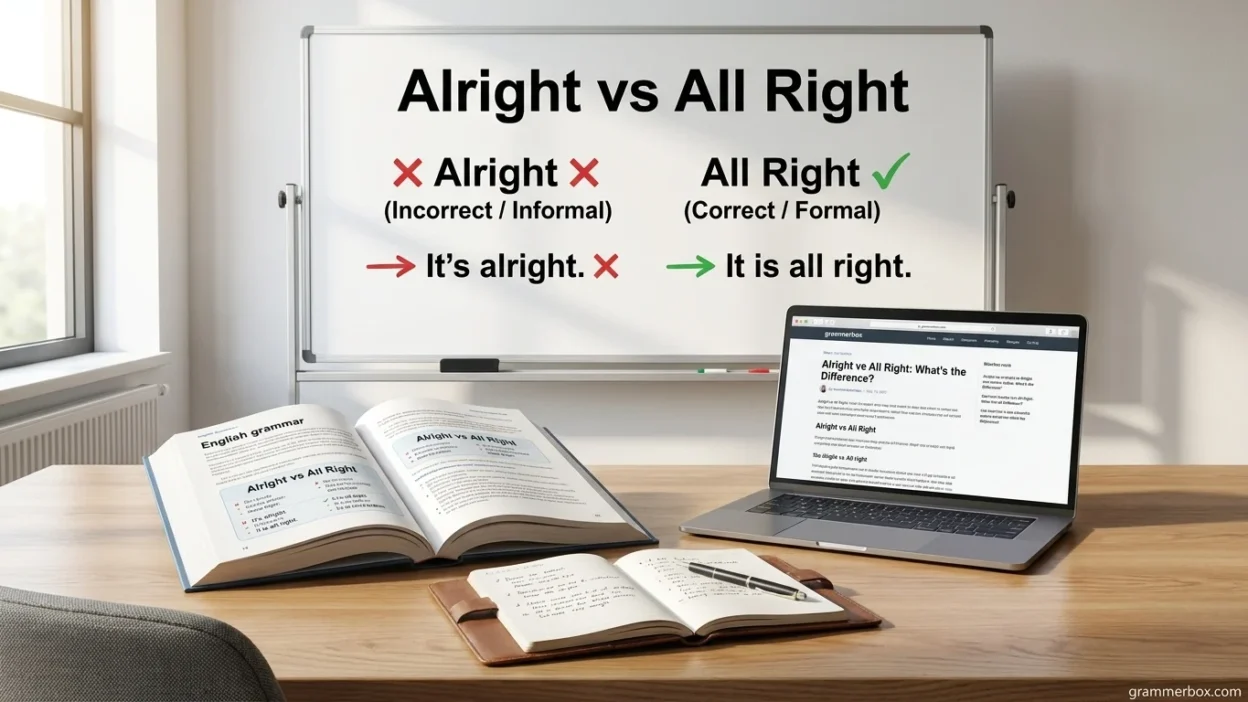
If you have ever hesitated between alright vs all right, you are not alone. These two forms look almost identical and are often used to express agreement, satisfaction, or that something is acceptable. In everyday English, alright has become extremely common, especially in informal writing and conversation. However, all right has a longer history and remains the more widely accepted choice in formal English.
The confusion comes from the fact that both forms can often fit the same sentence. For example, you might write, “Are you all right?” or “Are you alright?” and communicate essentially the same idea. The difference is mainly about standard usage, formality, and style rather than meaning. This guide explains the difference between alright and all right, shows when to use each form, and provides practical examples so you can choose the right spelling with confidence.
Quick Answer
All right is the traditional and safest form, especially in formal or academic writing. Alright is widely used in informal English and is increasingly accepted, but some style guides still prefer all right. When in doubt, choose all right.
Why People Confuse It
The confusion exists because alright appears to be a natural shortened form of all right.
Both expressions can mean:
- Acceptable or satisfactory
- Safe or well
- Agreement or approval
- Completely or adequately
For example:
- “Is everything all right?”
- “Is everything alright?”
In everyday communication, many readers will consider both sentences understandable and natural. The main distinction is that all right is the established standard form, while alright is generally more informal.
Another reason for the confusion is that English contains many contractions and combined spellings that have become standard over time. Writers sometimes assume that alright has followed the same pattern. Its widespread use, however, has not completely replaced the traditional all right.
First Word: Alright
Alright is a single-word form meaning roughly the same thing as all right.
It is common in:
- Casual emails
- Text messages
- Social media
- Dialogue
- Informal blogs
- Everyday conversation
Examples
- “Are you alright after the trip?”
- “It’s alright if you arrive late.”
- “The movie was alright, but not amazing.”
- “Alright, let’s get started.”
- “Everything will be alright.”
Although alright is widely used, some editors and style guides still consider it less formal or nonstandard. Therefore, it may not be the best choice for academic papers, professional reports, or formal correspondence.
Second Word: All Right
All right is the traditional two-word spelling and the safest option in standard written English.
It can function in several ways.
Meaning “okay” or “acceptable”
- “The results are all right.”
- “The food was all right.”
Meaning “safe or well”
- “Are you all right?”
- “She is all right after the accident.”
Showing agreement
- “All right, I’ll help you.”
Meaning “completely” or “properly”
- “Make sure everything is all right before leaving.”
Because all right is accepted across formal and informal contexts, it is usually the better default.
Comparison Table
| Feature | Alright | All Right |
|---|---|---|
| Spelling | One word | Two words |
| Meaning | Okay, acceptable, well | Okay, acceptable, well |
| Formal writing | Less preferred | Preferred |
| Informal writing | Very common | Also common |
| Academic writing | Usually avoid if style requires traditional usage | Recommended |
| Professional writing | Can sound informal | Safest choice |
| Historical usage | More recent | Traditional |
| Best default | Casual contexts | Almost all contexts |
When to Use Each
Use “All Right” When:
Choose all right when you want the safest and most traditionally accepted form.
It is especially appropriate for:
- Academic assignments
- Business writing
- Formal emails
- Professional reports
- Applications
- Edited publications
- Formal correspondence
Example:
“Please confirm that all the information is all right before submitting the form.”
Use “Alright” When:
Alright works well in relaxed, conversational writing.
It is particularly natural in:
- Text messages
- Online conversations
- Informal dialogue
- Social media posts
- Casual personal writing
Example:
“Alright, I’ll see you tomorrow.”
If you are writing something that will be carefully edited or evaluated, however, all right is usually the safer choice.
Examples of Alright vs All Right
Here are examples showing how both forms may appear in similar contexts:
- Are you all right after the long journey?
- Are you alright after the long journey?
- All right, let’s begin the meeting.
- Alright, let’s begin the meeting.
- Everything is all right now.
- Everything is alright now.
- It’s all right to ask questions.
- It’s alright to ask questions.
- The presentation was all right, but it could be better.
- The presentation was alright, but it could be better.
- All right, I understand your point.
- Alright, I understand your point.
The examples demonstrate why the two forms are so easy to confuse: their meanings are generally the same. The important difference is the level of formality and the expectations of your audience.
Common Mistakes
1. Assuming “Alright” Is Always Wrong
This is too absolute. Alright is widely used in modern English, particularly in informal contexts.
2. Using “Alright” in Formal Writing Without Checking Style
Even though many readers accept it, some editors, teachers, and style guides still prefer all right.
3. Thinking the Words Have Different Meanings
In most ordinary uses, alright and all right express the same basic ideas.
4. Treating “All Right” as Only an Adjective
The expression can also function as an interjection.
Example:
“All right! We have a deal.”
5. Changing the Spelling Without Considering the Audience
Your choice should depend partly on where the writing will appear. A casual text and a university essay may require different stylistic choices.
Memory Trick
Here is an easy way to remember the difference:
When you want to be safe, use two words: ALL RIGHT.
Think of it this way:
Formal = ALL RIGHT
If you are writing an essay, report, application, or professional message, choose all right.
For casual communication, alright is common and generally understood.
American vs British English
Both alright and all right appear in American and British English.
However, all right remains the safer traditional form in both varieties, particularly in formal writing. Alright is widespread in contemporary usage and frequently appears in informal communication.
The difference is therefore not simply a matter of American English versus British English. Instead, register and writing style matter more.
If you are unsure which form your audience expects, all right is the most reliable choice.
Similar Words
Several expressions can replace alright or all right, depending on the intended meaning.
When meaning “okay”
- Okay
- Fine
- Acceptable
- Satisfactory
- Adequate
- Reasonable
When meaning “safe or well”
- Well
- Fine
- Safe
- Unhurt
- Healthy
When showing agreement
- Okay
- Sure
- Certainly
- Agreed
- Fine
Be careful with synonyms because they do not always fit every sentence. For example, “Are you acceptable?” does not mean the same thing as “Are you all right?”
FAQs:
Is “alright” grammatically correct?
Alright is widely used and accepted in many forms of modern informal English. However, some traditional style guides still prefer all right, especially in formal writing.
Is “all right” more correct than “alright”?
All right is the traditional and generally safer form. It is accepted in both formal and informal writing.
Can I use “alright” in an essay?
It is better to use all right in an academic essay unless your instructor or style guide specifically permits alright.
Is “alright” one word?
Yes. Alright is written as one word, while all right is written as two words.
Do alright and all right mean the same thing?
In most everyday contexts, yes. Both can mean okay, satisfactory, well, or acceptable.
Which is better for professional writing?
All right is usually the better choice because it is the traditional standard form and is less likely to be questioned by editors.
Is “alright” informal?
It is commonly associated with informal and conversational English, although its use has become widespread in modern writing.
Final Verdict
When choosing between alright vs all right, remember that both forms are widely understood and usually carry the same meaning. The key difference is style and formality. Alright is common in casual modern English, while all right remains the safest and most traditionally accepted spelling.
If you are writing for school, work, or a formal audience, choose all right. If you are writing a casual message, dialogue, or social media post, alright can sound perfectly natural. When there is any doubt, the two-word form is the dependable choice.
Remember This
All right = safest choice for formal and standard writing.
Alright = common in informal, conversational English.
If you only want to remember one rule, remember this: When in doubt, write “all right.”
Conclusion
The difference between alright and all right is less about meaning and more about accepted style. Both can describe something as okay, express agreement, or ask whether someone is well. That is why native speakers often use them interchangeably in casual conversation.
For polished writing, however, all right gives you the safest option. It works in virtually every context, while alright is better suited to informal communication. Understanding this small distinction can help you make your English clearer, more consistent, and more appropriate for your audience.