English learners often hesitate between “she has” and “she have” because both forms come from the same verb, have. The confusion usually appears when talking about possession, experiences, actions, or conditions. However, choosing the correct form is straightforward once you understand subject-verb agreement.
The key is the subject she. In the present simple tense, third-person singular subjects such as she, he, and it normally take has, not have. For example, we say, “She has a new car,” and “She has finished her work.” Understanding this small grammar rule can help you avoid a common English mistake in writing and everyday conversation. In this guide, you’ll learn the difference between she has vs. she have, when each form is appropriate, common errors to avoid, and plenty of practical examples.
Quick Answer
“She has” is correct in standard English when “she” is the subject. Use has with she in the present tense: “She has a dog.” Use have after helping verbs such as does or will: “Does she have a dog?” and “She will have a dog.”
Why People Confuse It
The confusion comes from the fact that have is the base form of the verb, while has is its third-person singular present form.
Compare these subjects:
- I have a book.
- You have a book.
- We have a book.
- They have a book.
- She has a book.
- He has a book.
- It has a problem.
Because she is a third-person singular pronoun, has is normally required in a simple present statement.
The important exception is when another verb, such as does, will, can, or should, controls the verb form. In those constructions, the base form have is used.
First Word: “She Has”
“She has” is the standard correct form when she is the subject and have is the main verb in a present-tense statement.
Uses of “She Has”
You can use she has to express:
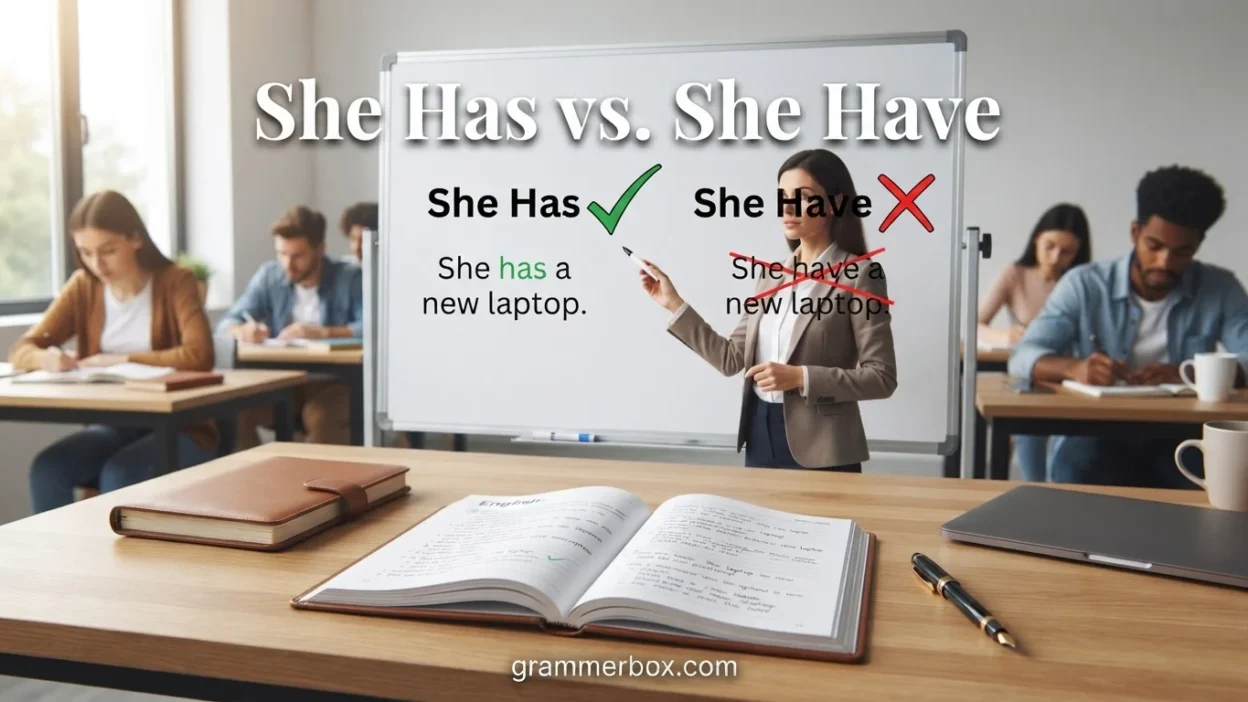
- Possession: She has a new laptop.
- Relationships: She has two sisters.
- Conditions: She has a headache.
- Experiences: She has a lot of experience.
- Features: She has blue eyes.
- Responsibilities: She has several tasks today.
Examples:
- She has a beautiful voice.
- She has three appointments today.
- She has enough money.
- She has a great idea.
- She has a cold.
Second Word: “She Have”
“She have” is generally incorrect when it is used as a simple present statement.
For example:
- ❌ She have a car.
- ✅ She has a car.
However, have can correctly appear with she when another auxiliary or modal verb comes before it.
Examples:
- Does she have a car?
- Will she have enough time?
- Can she have another piece?
- Should she have a doctor’s appointment?
- Did she have breakfast?
So the problem is not that have can never appear with she. Rather, have cannot normally follow she directly as the main verb in a simple present affirmative sentence.
Comparison Table
| Sentence | Correct? | Why |
|---|---|---|
| She has a car. | ✅ | Has agrees with she. |
| She have a car. | ❌ | Have does not agree with she here. |
| Does she have a car? | ✅ | Does takes the third-person marking; have stays in base form. |
| She will have a car. | ✅ | Will is followed by the base form have. |
| She can have a car. | ✅ | Can is followed by the base form have. |
| She had a car. | ✅ | Had is the past form for all subjects. |
| She has had a car for years. | ✅ | Has is the auxiliary; had is the past participle. |
When to Use Each
Use “She Has” in Simple Present Statements
Use she has when have is the main verb and there is no auxiliary controlling the verb.
Examples:
- She has a new job.
- She has plenty of time.
- She has two children.
- She has a good reason.
Use “Have” After Auxiliary or Modal Verbs
Use have after words such as:
- does
- did
- will
- can
- could
- should
- would
- may
- might
- must
Examples:
- Does she have a ticket?
- Did she have lunch?
- Will she have enough time?
- Can she have some water?
- Should she have more practice?
This is a fundamental subject-verb agreement rule in English grammar.
Examples of “She Has” and “She Have”
Here are more than 10 examples to make the distinction clear:
- She has a new phone.
- She has an important meeting today.
- She has two brothers.
- She has a beautiful garden.
- She has enough experience for the job.
- She has a question.
- Does she have your address?
- Does she have enough money?
- Did she have breakfast?
- Will she have time tomorrow?
- Can she have another chance?
- She has already finished the project.
- She has lived here for five years.
- She has never visited London.
- She has to leave early.
Notice how has is used directly after she in affirmative present-tense sentences, while have appears after helping or modal verbs.
Common Mistakes
Mistake 1: Using “She Have” Directly
❌ She have a new computer.
✅ She has a new computer.
Mistake 2: Keeping “Has” After “Does”
❌ Does she has a car?
✅ Does she have a car?
Once does carries the present-tense agreement, the main verb returns to its base form.
Mistake 3: Using “Has” After “Will”
❌ She will has enough money.
✅ She will have enough money.
After will, always use the base form of the verb.
Mistake 4: Confusing “Has” With “Had”
Has is generally used for present situations, while had is the past form.
- She has a dog. → Present
- She had a dog. → Past
Memory Trick
Use this simple formula:
Think of does as taking the “s” from has.
- She has a car.
- Does she have a car?
The same principle applies to other auxiliary verbs:
- She will have a car.
- She can have a car.
- She might have a car.
If a helping verb is already carrying the tense or agreement, use have.
American vs. British English
There is no meaningful difference between American and British English regarding the basic rule for she has and she have.
Both varieties use:
- She has a car.
- Does she have a car?
- She will have a car.
British English does have some additional constructions involving have got, particularly for possession:
- She has got a new phone.
- Has she got a new phone?
American English commonly uses:
- She has a new phone.
- Does she have a new phone?
Despite these stylistic differences, the subject-verb agreement rule remains the same.
Similar Words and Forms
Understanding related forms can make this grammar rule easier.
Have
Have is the base form.
- I have a car.
- They have a house.
- Does she have a car?
Has
Has is the third-person singular present form.
- She has a car.
- He has a house.
- It has a problem.
Had
Had is the past form of have and is used with all subjects.
- She had a car.
- They had a house.
- I had breakfast.
Having
Having is the -ing form.
- She is having lunch.
- They are having fun.
- Having enough time is important.
Final Verdict
The correct choice between “she has” and “she have” depends on the grammatical structure.
For a simple present statement, use she has:
Use have when it follows an auxiliary or modal verb:
Therefore, “she has” is correct when have is the main verb directly following she. “She have” is not correct in that structure.
FAQs:
Is “she has” grammatically correct?
Yes. “She has” is grammatically correct and is the standard third-person singular form of have in the present tense.
Is “she have” ever correct?
Yes, but not as a simple present affirmative statement. It can occur after auxiliary or modal verbs, such as does, did, will, can, and should.
Which is correct: “She has a car” or “She have a car”?
“She has a car” is correct. Since she is third-person singular, use has in this simple present construction.
Should I say “Does she has” or “Does she have”?
Say “Does she have?” When does is used, the main verb stays in its base form.
Why do we use “have” after “does”?
Does already carries the third-person singular present-tense marking. Therefore, the main verb remains in its base form: Does she have…?
Is “she has” used in British English?
Yes. British English uses she has just as American English does. British English may also commonly use has got for possession.
What is the past form of “she has”?
The past form is she had.
- Present: She has a car.
- Past: She had a car.
Remember This
She → has when have is the main verb in a simple present statement.
She → have after a helping or modal verb.
She has a book. ✅
Does she have a book? ✅
She will have a book. ✅
She have a book. ❌
Conclusion
Choosing between she has vs. she have becomes easy once you identify whether another auxiliary or modal verb is present. When she directly takes have as the main verb in a present-tense statement, use has because she is a third-person singular subject. This rule applies consistently in both American and British English.
When a helping verb such as does, did, will, can, or should appears, use have instead. Learning this simple pattern will help you improve subject-verb agreement and avoid one of the most common English grammar mistakes. If you remember “She has” for statements and “Does she have?” for questions, you will get this distinction right in everyday English.