
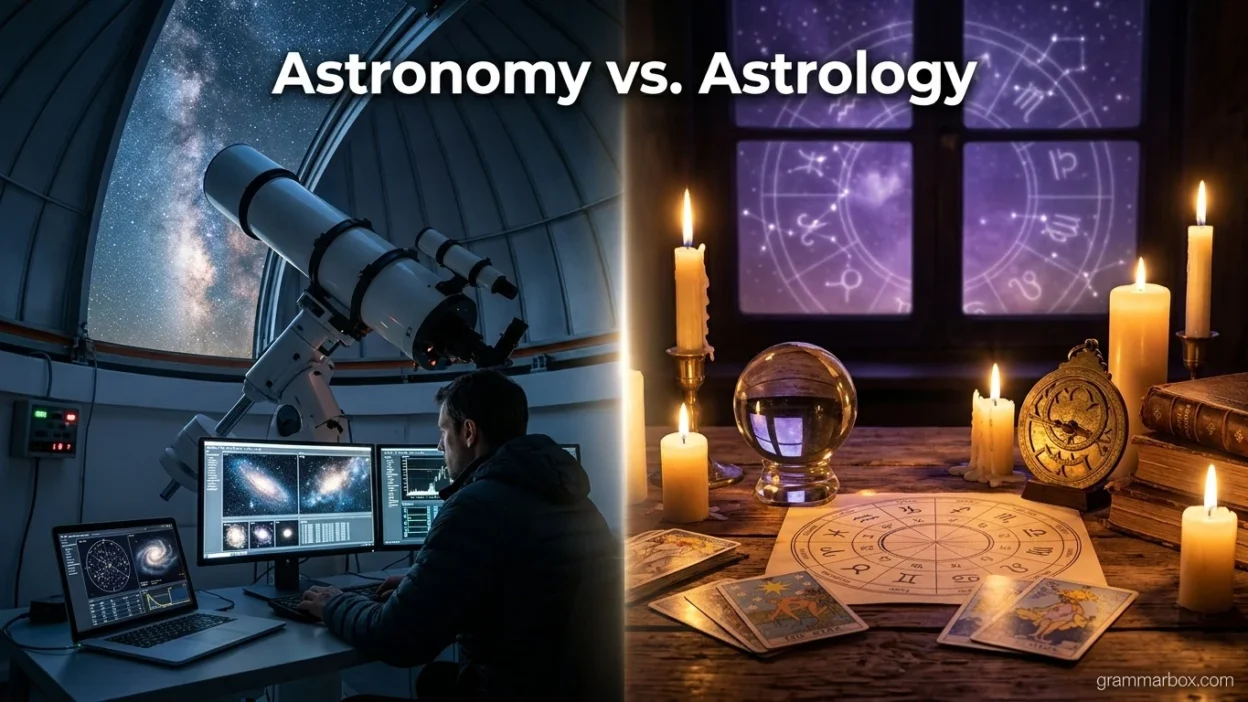
Have you ever wondered about the difference between astronomy vs. astrology? Although these two words look and sound similar, they describe very different ways of understanding the universe. Astronomy is a scientific discipline that studies celestial objects, including stars, planets, galaxies, and black holes. Astrology, on the other hand, is a belief system that interprets the positions and movements of celestial bodies as influences on human personalities, relationships, and life events. Understanding this distinction helps you use both terms correctly in conversations, academic writing, and everyday communication.
The confusion between astronomy and astrology is understandable because both involve the Sun, Moon, planets, and stars. Historically, the two subjects were closely connected, but they eventually developed into separate fields with different methods and purposes. Modern astronomy relies on scientific observation, mathematical calculations, and evidence, while astrology uses symbolic interpretations of celestial positions. Whether you are a student, an English learner, or simply curious about space, learning the difference between these terms will help you understand discussions about the universe more clearly. Let’s explore their meanings, key differences, and practical examples.
Quick Answer
Astronomy is the scientific study of celestial objects, space, and the universe. Astrology is a belief system that interprets celestial positions as meaningful for human personality and future events. Astronomy uses scientific evidence and testing, while astrology relies on symbolic interpretations that have not been scientifically established as reliable predictors of individual lives.
Why People Confuse It
People often confuse astronomy and astrology because both terms relate to celestial bodies, including planets, stars, the Moon, and the Sun. They also share a similar word structure and historical background.
In ancient civilizations, observations of the sky served both practical and interpretive purposes. People studied celestial movements to understand seasons and calendars while also interpreting those movements as signs related to earthly events.
Over time, astronomy developed into a modern scientific discipline, while astrology continued as a tradition of interpreting celestial positions.
Here are three common reasons for the confusion:
- Similar vocabulary: Both words are associated with stars and planets.
- Shared history: Their practices were once closely intertwined in several ancient cultures.
- Different purposes: Both examine celestial arrangements, but they use them to answer different questions.
The simplest distinction is that astronomy investigates how the universe works, whereas astrology interprets what celestial arrangements supposedly mean for human life.
Astronomy
Astronomy is the scientific study of objects and phenomena beyond Earth’s atmosphere. It explores the universe through observation, experimentation, mathematical models, and physical laws.
Astronomers investigate questions such as how stars form, why planets orbit the Sun, how galaxies evolve, and what happens inside black holes.
Examples of Astronomy
- Studying the planets in our solar system.
- Observing distant galaxies through telescopes.
- Calculating when a lunar eclipse will occur.
- Investigating the origins and expansion of the universe.
- Searching for planets outside our solar system.
- Examining the life cycles of stars.
How to Use Astronomy in a Sentence
- My sister studies astronomy at university.
- The observatory organizes public events to introduce visitors to astronomy.
- Modern astronomy helps scientists investigate distant galaxies.
- We watched a documentary about the history of astronomy.
- Advances in astronomy have improved our understanding of black holes.
Remember: Astronomy is a scientific field supported by observations, evidence, and testable explanations.
Astrology
Astrology is a belief system that interprets the positions of celestial bodies as having symbolic relationships with human personalities, relationships, and events.
Astrologers often use birth charts, zodiac signs, planetary positions, and the twelve astrological houses to create interpretations. Some people consult astrology for entertainment, self-reflection, or personal guidance.
However, scientific research has not established astrology as a reliable method for predicting personality traits or future events.
Examples of Astrology
- Reading a daily horoscope based on a zodiac sign.
- Creating a birth chart using a person’s birth date, time, and location.
- Comparing zodiac signs for relationship compatibility.
- Interpreting planetary positions according to astrological traditions.
- Consulting an astrologer for a symbolic reading about career choices.
- Discussing how Mercury retrograde is interpreted in astrology.
How to Use Astrology in a Sentence
- My friend reads about astrology for entertainment.
- The magazine publishes a weekly astrology column.
- She became interested in astrology after learning about zodiac signs.
- Their discussion focused on the history of astrology.
- Some people use astrology to reflect on relationships and personal decisions.
Remember: Astrology interprets celestial positions through a symbolic belief system rather than an established scientific method.
Astronomy vs. Astrology: Comparison Table
| Feature | Astronomy | Astrology |
|---|---|---|
| Meaning | Scientific study of the universe | Interpretation of celestial positions in relation to human life |
| Main purpose | Understand space and celestial phenomena | Interpret personality, relationships, and possible life events |
| Approach | Scientific observation and testing | Symbolic interpretation and traditional beliefs |
| Evidence | Uses measurable, testable evidence | Predictive claims lack reliable scientific support |
| Practitioners | Astronomers and astrophysicists | Astrologers |
| Common tools | Telescopes, satellites, mathematical models | Birth charts, zodiac signs, astrological charts |
| Main topics | Stars, galaxies, planets, black holes | Horoscopes, planetary symbolism, zodiac signs |
| Example | Studying a solar eclipse | Interpreting a horoscope |
| Academic status | Established scientific discipline | Not an established scientific discipline |
The key difference is that astronomy studies what happens in the universe, while astrology assigns symbolic meaning to celestial arrangements in human life.
When to Use Each
Choosing between astronomy and astrology depends on the subject you are discussing.
Use Astronomy When Discussing Science and Space
Use astronomy when referring to scientific research, celestial observations, space exploration, or the physical properties of the universe.
Examples:
- The university offers an introductory course in astronomy.
- Scientists used a telescope to study a distant galaxy.
- She wants to pursue a career in astronomy.
- The documentary explains recent discoveries in planetary science.
If your topic involves measurable celestial phenomena, scientific theories, or the physical universe, astronomy is generally the correct term.
Use Astrology When Discussing Zodiac Signs and Horoscopes
Use astrology when discussing horoscopes, birth charts, zodiac signs, or interpretations of celestial positions according to astrological traditions.
Examples:
- He enjoys reading about astrology in his free time.
- The astrologer prepared a birth chart for the client.
- Their conversation covered astrology and zodiac compatibility.
- She follows a horoscope account for entertainment.
If the subject involves interpreting celestial arrangements as symbols connected to personal life, astrology is the appropriate word.
Examples of Astronomy vs. Astrology
The following examples demonstrate how to distinguish the two words in everyday English.
- Astronomy: My brother studies astronomy to understand how stars form.
- Astrology: My brother reads astrology articles to learn about zodiac signs.
- Astronomy: The researchers observed a distant planet using a powerful telescope.
- Astrology: The astrologer interpreted the positions of the planets in a birth chart.
- Astronomy: Our science teacher explained how a solar eclipse occurs.
- Astrology: My friend checked her horoscope before making weekend plans.
- Astronomy: The university offers a degree program in astronomy.
- Astrology: The magazine features a monthly astrology column.
- Astronomy: Scientists use astronomy to investigate the structure of galaxies.
- Astrology: Some people explore astrology to reflect on their relationships.
- Astronomy: The observatory invited students to observe Saturn through a telescope.
- Astrology: The astrologer discussed the traditional meaning of Saturn in a birth chart.
- Astronomy: Researchers studied the chemical composition of a distant star.
- Astrology: She compared two zodiac signs using astrological compatibility interpretations.
- Astronomy: Advances in astronomy have expanded our understanding of the universe.
- Astrology: He enjoys discussing astrology with friends who share his interest.
More Examples in Context
In education:
- Correct: The student chose astronomy because she enjoys scientific research about space.
- Incorrect for this meaning: The student chose astrology because she wanted to study the physical structure of galaxies.
In entertainment:
- Correct: I read my horoscope because I find astrology entertaining.
- Incorrect for this meaning: I read my horoscope because I find astronomy entertaining.
In scientific research:
- Correct: The research team used astronomical observations to examine a distant star.
- Incorrect for this meaning: The research team used astrology to measure the star’s temperature.
These examples show that the words are not interchangeable, even though both relate to celestial objects.
Common Mistakes
Writers and English learners sometimes use astronomy and astrology incorrectly because the terms share a similar history and vocabulary.
1. Treating Astronomy and Astrology as Synonyms
Incorrect: Astronomy predicts my personality based on my zodiac sign.
Correct: Astrology is the tradition associated with zodiac-based personality interpretations.
Astronomy studies celestial objects scientifically rather than assigning personal meanings to them.
2. Calling Horoscopes Astronomy
Incorrect: I read astronomy every morning to discover my daily horoscope.
Correct: I read my horoscope every morning for fun.
A horoscope is associated with astrology, not astronomy.
3. Assuming Astrology Is a Branch of Astronomy
Incorrect: Astrology is a scientific branch of modern astronomy.
Correct: Astrology and astronomy are distinct fields with different methods and purposes.
Although they share historical connections, astrology is not recognized as a scientific branch of astronomy.
4. Confusing Astronomers With Astrologers
An astronomer studies the universe scientifically. An astrologer interprets celestial positions according to astrological traditions.
For example:
- The astronomer calculated the planet’s orbit.
- The astrologer interpreted the planet’s position in a birth chart.
5. Assuming That Both Fields Use the Same Evidence
Astronomy relies on evidence that can be observed, measured, and tested. Astrological interpretations may refer to actual planetary positions, but claims that these positions reliably determine individual personalities or predict life events have not been scientifically validated.
Understanding this distinction helps you communicate accurately about science and belief systems.
Memory Trick
A simple memory trick can help you remember the difference between astronomy and astrology.
Astronomy = Science of space.
Think of telescopes, planets, stars, galaxies, and scientific discoveries.
Astrology = Signs and symbolism.
Think of zodiac signs, horoscopes, birth charts, and interpretations of personal experiences.
You can also remember these two questions:
- Astronomy: What is happening in the universe?
- Astrology: What might celestial positions symbolize for a person?
Another useful trick is to associate an astronomer with a scientist and an astrologer with a horoscope reader.
These associations make it easier to choose the right word when writing essays, discussing space, or talking about zodiac signs.
American vs. British English
There is no meaningful American-versus-British spelling difference between astronomy and astrology. Both words are spelled the same way in American English and British English.
| Term | American English | British English |
|---|---|---|
| Astronomy | Astronomy | Astronomy |
| Astrology | Astrology | Astrology |
| Astronomer | Astronomer | Astronomer |
| Astrologer | Astrologer | Astrologer |
The meanings also remain consistent across both varieties of English.
Examples:
- American English: She studies astronomy at college.
- British English: She studies astronomy at university.
- American English: He enjoys reading about astrology.
- British English: He enjoys reading about astrology.
Differences may appear in surrounding vocabulary, pronunciation, or educational terminology, but the spelling and fundamental meanings of these words do not change.
Similar Words
Several related terms can help you understand astronomy and astrology more clearly.
| Word | Meaning | Example |
|---|---|---|
| Astronomy | Scientific study of celestial objects and the universe | Astronomy helps explain how planets move. |
| Astrology | Interpretation of celestial positions in relation to human life | Astrology includes zodiac signs and horoscopes. |
| Astrophysics | Application of physics to astronomical objects and phenomena | Astrophysics examines how black holes behave. |
| Cosmology | Study of the universe’s origin, structure, evolution, and overall nature | Cosmology investigates the expansion of the universe. |
| Astronomer | Scientist who studies celestial objects | The astronomer observed a distant galaxy. |
| Astrologer | Person who practices or interprets astrology | The astrologer prepared a birth chart. |
| Horoscope | Astrological interpretation associated with a zodiac sign or celestial chart | She read her horoscope online. |
| Zodiac | A band of the sky used in astronomy and divided into signs in astrology | The zodiac is central to many astrological traditions. |
| Celestial body | Natural object in space, such as a planet or star | Earth is a celestial body. |
| Astrology chart | Chart used to interpret celestial positions in astrology | He examined his natal astrology chart. |
Astronomy vs. Astrophysics
Astronomy is the broader study of celestial objects and phenomena, while astrophysics applies the principles of physics to explain their physical properties and behavior.
For example, an astronomer might observe a star, while an astrophysicist investigates the physical processes occurring inside it.
Astrology vs. Horoscope
Astrology is the broader belief system, while a horoscope is a particular interpretation or chart associated with astrological practices.
For example, astrology includes traditions involving zodiac signs, while a daily horoscope offers a short interpretation for a particular sign.
Understanding these related terms can improve your vocabulary and help you write more accurately about science, space, and astrological beliefs.
FAQs:
1. What is the main difference between astronomy and astrology?
Astronomy is a scientific discipline that studies celestial objects and the universe. Astrology interprets celestial positions as symbolically related to human personalities and life events. Astronomy uses scientific evidence, whereas astrology’s predictive claims lack reliable scientific support.
2. Is astrology a science?
No. Astrology is not considered a scientific discipline because its claims about personality and predictions have not demonstrated reliable, reproducible support through scientific testing.
3. Are astronomy and astrology related?
Yes, historically. Both developed from ancient interests in celestial movements. However, they evolved into different practices, with astronomy becoming an evidence-based science and astrology remaining a system of symbolic interpretation.
4. Can astronomy predict the future?
Astronomy can make accurate predictions about celestial events, such as eclipses, planetary positions, and the appearance of certain astronomical phenomena. It does not establish astrological predictions about an individual’s personality or personal future.
5. What is the difference between an astronomer and an astrologer?
An astronomer studies space and celestial objects using scientific methods. An astrologer interprets celestial positions using astrological traditions, often to discuss zodiac signs, relationships, or personal circumstances.
6. Why do astronomy and astrology have similar names?
Both words come from Greek roots associated with stars and celestial matters. Their shared linguistic and historical background explains their similarity, even though their modern meanings differ significantly.
7. Is a horoscope related to astronomy or astrology?
A horoscope belongs to astrology. It is an interpretation based on zodiac signs or a chart of celestial positions. Astronomy may calculate the actual positions of celestial bodies, but it does not validate horoscope predictions.
8. Which should I study if I want to understand planets and galaxies?
Study astronomy if you want to understand planets, stars, galaxies, and the physical universe through scientific research. If you are interested in zodiac signs and traditional celestial interpretations, astrology is the relevant subject.
Final Verdict
The difference between astronomy vs. astrology comes down to their purpose and methods. Astronomy is the scientific study of space, celestial bodies, and the universe. It uses observation, mathematics, and testable evidence to explain how celestial phenomena work. Astrology, by contrast, interprets the positions of celestial bodies through a belief system associated with zodiac signs, horoscopes, and personal experiences.
Although the two subjects share historical roots and similar vocabulary, they are not interchangeable. Use astronomy when discussing scientific discoveries, planetary motion, or galaxies, and use astrology when referring to birth charts, horoscopes, or zodiac interpretations. Remembering this distinction will help you choose the right word in academic writing, everyday conversations, and discussions about the universe.
Remember This
- Astronomy = the scientific study of space and the universe.
- Astrology = a belief system that interprets celestial positions in relation to human life.
- Astronomer = a scientist who studies celestial objects.
- Astrologer = a person who practices or interprets astrology.
- Horoscope = an interpretation associated with astrology.
Quick tip: If you are discussing scientific evidence about planets and stars, use astronomy. If you are discussing zodiac signs and horoscopes, use astrology.