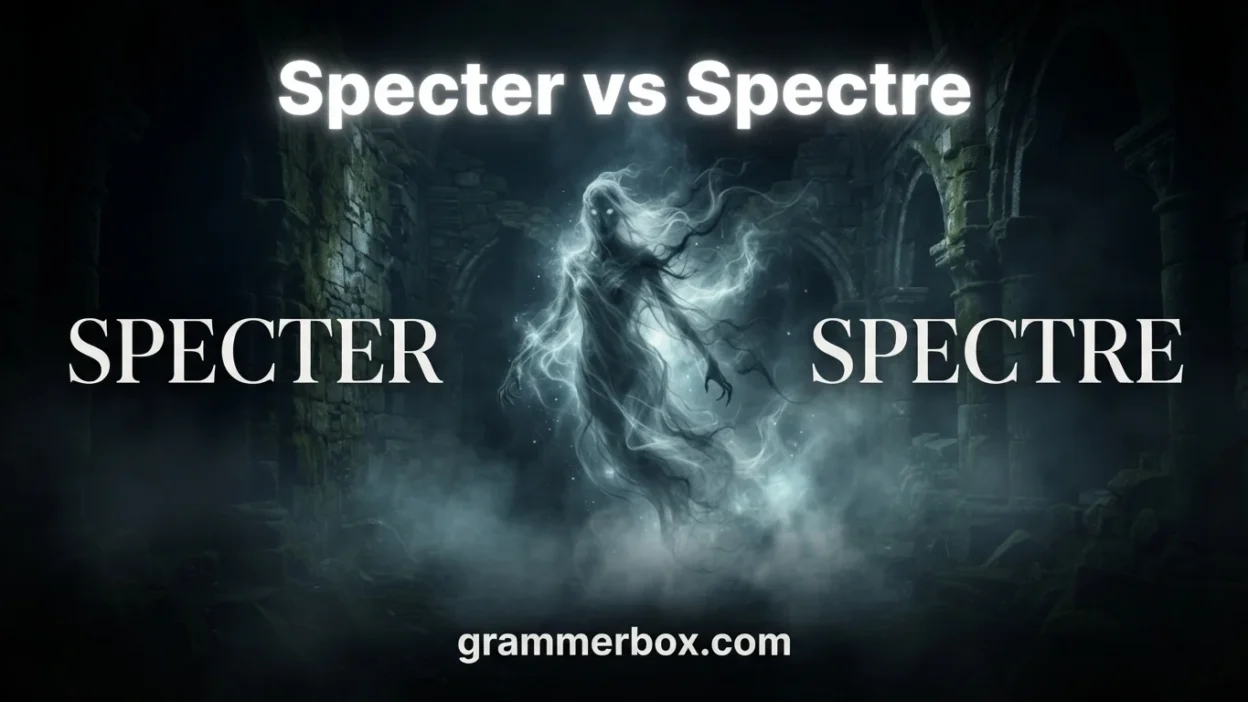
When you see specter and spectre, you may wonder whether they are different words or simply two spellings of the same word. The good news is that both forms are correct. The main difference is where they are commonly used. Understanding this small spelling variation can help you write more accurately for American or British English readers.
Both specter and spectre refer to a ghost, apparition, or frightening supernatural figure. The word can also be used figuratively for something unpleasant or threatening that seems likely to happen. For example, you might read about the “specter of war” or the “spectre of unemployment.” Although the pronunciation is essentially the same, the spelling depends largely on the variety of English you are using.
Quick Answer
Specter and spectre have the same meaning and pronunciation. Specter is the standard American English spelling, while spectre is preferred in British English and many other varieties. Choose the spelling that matches your audience and writing style.
Why People Confuse It
People confuse specter and spectre because they are pronounced the same and have exactly the same basic meaning.
The only major difference is the spelling:
- Specter → American English
- Spectre → British English
- Both mean a ghost, apparition, or threatening presence.
- Both can be used literally or figuratively.
This is similar to other American and British spelling differences, such as color/colour, center/centre, and theater/theatre.
Specter
Specter is the preferred spelling in American English.
A specter can mean a ghost or supernatural apparition that appears frightening or disturbing.
Examples
- A specter appeared in the old house.
- The story describes a terrifying specter in the forest.
- The specter of war worried the entire nation.
- She was haunted by the specter of failure.
The word can also describe an unpleasant possibility that causes fear or concern.
Specter as a Figurative Word
In modern writing, specter is frequently used figuratively.
For example:
The company faced the specter of bankruptcy.
Here, specter does not mean an actual ghost. It refers to the frightening possibility of bankruptcy.
Spectre
Spectre is the preferred spelling in British English.
Like specter, it can refer to a ghost, apparition, or frightening supernatural being. It can also describe an unwelcome possibility or threat.
Examples
- A spectre was said to haunt the castle.
- The villagers feared the spectre of famine.
- The novel features a mysterious spectre.
- The spectre of war returned to the region.
The meaning remains unchanged when you switch from spectre to specter.
Specter vs Spectre: Comparison Table
| Feature | Specter | Spectre |
|---|---|---|
| Meaning | Ghost, apparition, or threatening possibility | Ghost, apparition, or threatening possibility |
| Pronunciation | Same | Same |
| Main usage | American English | British English |
| Part of speech | Noun | Noun |
| Literal meaning | Ghost or apparition | Ghost or apparition |
| Figurative meaning | Threatening possibility | Threatening possibility |
| Example | The specter frightened him. | The spectre frightened him. |
When to Use Each
Use “Specter” in American English
Choose specter when writing for an American audience or following American English spelling conventions.
For example:
- The specter of inflation remains a concern.
- A specter appeared near the cemetery.
Use “Spectre” in British English
Choose spectre when following British English conventions.
For example:
- The spectre of poverty affected the community.
- The castle was supposedly haunted by a spectre.
What About International English?
If you are writing for an international audience, either spelling can be understood. However, consistency is important.
If your article uses American spelling throughout, use specter. If it follows British spelling, use spectre.
Specter vs Spectre Examples
Here are examples showing how both spellings work:
- The villagers claimed they had seen a specter near the cemetery.
- The villagers claimed they had seen a spectre near the cemetery.
- The specter of war frightened many families.
- The spectre of war frightened many families.
- A strange specter appeared in the hallway.
- A strange spectre appeared in the hallway.
- The story centers on a mysterious specter.
- The story centres on a mysterious spectre.
- The company faced the specter of bankruptcy.
- The company faced the spectre of bankruptcy.
- The old mansion was supposedly haunted by a specter.
- The old mansion was supposedly haunted by a spectre.
Notice that changing the spelling does not change the meaning.
Common Mistakes
1. Treating Them as Different Words
The biggest mistake is assuming that specter and spectre have different meanings.
They do not. They are spelling variants.
2. Mixing Spelling Systems
Avoid switching randomly between American and British spelling in the same piece of writing.
For example, using specter, colour, and centre together may create an inconsistent style.
3. Thinking “Spectre” Is Incorrect
Spectre is not a misspelling. It is the standard British spelling.
4. Thinking “Specter” Is Incorrect
Likewise, specter is not wrong. It is the standard American spelling.
Memory Trick
Use this simple trick:
Specter = American English
Spectre = British English
Think of the -er ending in specter as the American version and the -re ending in spectre as the British version.
You can also remember it alongside:
- center → centre
- meter → metre
- theater → theatre
This pattern can make the spelling easier to remember.
American vs British English
The difference between specter and spectre is mainly geographical and stylistic.
American English generally uses:
- specter
- center
- theater
- meter
British English generally uses:
- spectre
- centre
- theatre
- metre
These differences do not normally affect pronunciation or meaning.
The same principle applies to specter/spectre. Neither spelling is inherently more correct; the appropriate choice depends on the English variety being used.
Similar Words
Several words are related to specter and spectre, although they are not always exact synonyms.
- Ghost — the spirit or apparition of a dead person.
- Apparition — a ghostly or mysterious appearance.
- Phantom — an apparition or something that seems unreal.
- Spirit — a supernatural being or the nonphysical part of a person.
- Haunt — a place believed to be visited by a ghost.
- Wraith — a ghost or shadowy apparition.
- Shadow — sometimes used figuratively for something threatening or troubling.
- Threat — a possible source of danger or harm.
In figurative contexts, specter/spectre often suggests a frightening possibility that seems to hang over someone or something.
FAQs:
Is “specter” or “spectre” correct?
Both are correct. Specter is the standard American English spelling, while spectre is the standard British English spelling.
Do specter and spectre mean the same thing?
Yes. Both words can mean a ghost or apparition. They can also describe a frightening or threatening possibility in a figurative sense.
Is spectre British or American?
Spectre is primarily the British English spelling. It is also used in other varieties of English that follow British spelling conventions.
Is specter American English?
Yes. Specter is the preferred spelling in American English.
Are specter and spectre pronounced differently?
Generally, no. They have essentially the same pronunciation despite their different spellings.
Can specter mean a threat?
Yes. In figurative usage, specter can refer to an unpleasant possibility or threat, such as “the specter of war.”
Which spelling should I use in an SEO article?
Use the spelling that matches your target audience and overall English style. If your content follows American English, use specter; for British English, use spectre.
Remember This
Specter = American English 🇺🇸
Spectre = British English 🇬🇧
Same meaning. Same pronunciation. Different spelling convention.
Conclusion
The difference between specter vs spectre is simple once you recognize the American-British English spelling pattern. Both words describe a ghostly figure or, in figurative language, an unwelcome possibility that creates fear or concern.
For American readers, write specter. For British readers, write spectre. Neither spelling is wrong, so your choice should depend on your target audience and the spelling system used throughout your writing.