
Have you ever wondered whether to say “I was born in June” or “I was born on June”? Both expressions may look similar, but only one is correct when referring to a specific date. Understanding the difference between born in vs. born on helps you talk about birthdays, birth years, months, and important dates naturally and accurately. These expressions are common in everyday conversations, school assignments, biographies, and formal writing.
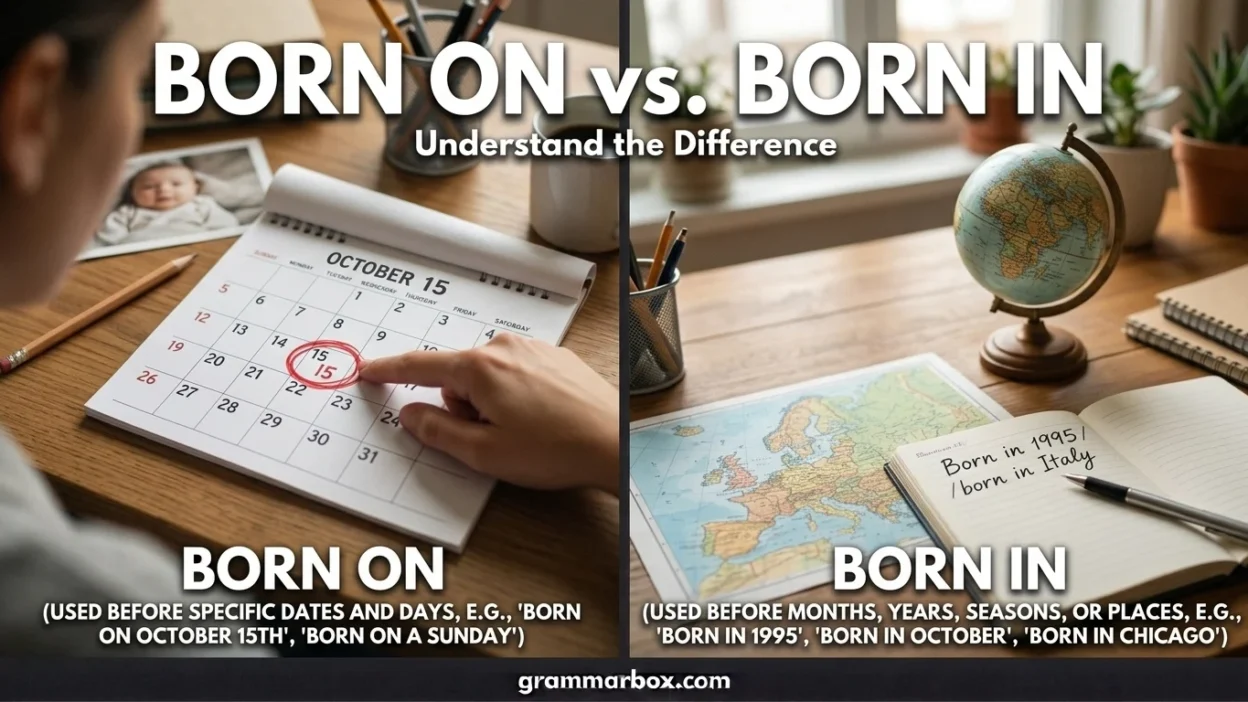
The main difference comes down to how specific the time reference is. We generally use born in when talking about a year, month, season, or a longer period. In contrast, we use born on when mentioning a particular day or date. For example, you might say, “I was born in 2002,” but “I was born on March 15, 2002.” Once you understand this simple grammar rule, choosing the right preposition becomes much easier. This guide explains both expressions with clear examples, common mistakes, and practical memory tricks.
Quick Answer
Use born in for a birth year, month, or season: “I was born in 2000” or “I was born in July.” Use born on for a specific day or date: “I was born on Monday” or “I was born on July 10.” The correct preposition depends on the time reference.
Why People Confuse It
People often confuse “born in” and “born on” because both expressions describe when someone entered the world. The difference is not the meaning of the verb “born” but the time expression that follows it.
English uses different prepositions for different levels of time specificity:
- In refers to a broader period, such as a month, year, or season.
- On refers to a particular day or calendar date.
For example:
- Correct: I was born in October.
- Correct: I was born on October 12.
- Incorrect: I was born on October, if you mean the month without a specific day.
Remember that the preposition changes according to the time reference, not the person’s age or gender.
First Word: Born In
Born in is used when referring to a broader period, including a year, month, season, or historical era. It is one of the most common expressions for describing someone’s birth date without specifying the exact day.
When to Use Born In
Use “born in” in these situations:
1. Birth years
When mentioning the year someone was born, use “in.”
- She was born in 1998.
- My grandfather was born in 1945.
- The famous author was born in 1875.
2. Birth months
Use “in” when you mention a month without a specific date.
- I was born in January.
- He was born in September.
- Their daughter was born in April.
3. Seasons
Use “in” when referring to the season of someone’s birth.
- She was born in spring.
- My brother was born in the summer.
- The baby was born in winter.
4. Longer historical periods
Use “in” for decades, centuries, and historical eras.
- My grandmother was born in the 1930s.
- The poet was born in the nineteenth century.
- He was born in the Victorian era.
More Examples of Born In
- I was born in Pakistan.
- She was born in a small village.
- They were born in the same year.
- My cousin was born in December 2005.
- He was born in the early 1980s.
In these examples, “in” refers to a broader time period or, in some cases, a place of birth.
Second Word: Born On
Born on is used when referring to a particular day or a specific calendar date. It identifies the exact day someone was born.
When to Use Born On
Use “born on” in the following situations:
1. Specific calendar dates
When a date includes a particular day of the month, use “on.”
- I was born on May 6.
- She was born on December 24.
- My son was born on August 17, 2020.
2. Days of the week
Use “on” when mentioning the weekday of someone’s birth.
- He was born on Monday.
- I was born on a Friday.
- Their daughter was born on Sunday morning.
3. Birthdays and special dates
Use “on” when referring to a specific date associated with someone’s birth.
- She was born on Christmas Day.
- My uncle was born on New Year’s Day.
- The actor was born on July 4, 1990.
More Examples of Born On
- I was born on the fifteenth of June.
- He was born on a cold winter morning.
- My sister was born on the last day of February.
- The baby was born on October 31.
- She was born on the same day as her best friend.
The key point is that “on” connects the birth to a particular day, whether the day is identified by its date, weekday, or another specific day-based expression.
Born In vs. Born On: Comparison Table
| Feature | Born In | Born On |
|---|---|---|
| Main use | A broader time period | A specific day |
| Years | Born in 2001 | Not normally used alone with a year |
| Months | Born in March | Born on March 8 |
| Seasons | Born in winter | Born on a winter morning |
| Weekdays | Not normally used with a weekday | Born on Tuesday |
| Decades | Born in the 1990s | Not normally used with a decade |
| Full dates | Born in 2005 | Born on March 8, 2005 |
| Example | She was born in June. | She was born on June 8. |
When to Use Each
Choosing between “born in” and “born on” is straightforward once you identify the time expression.
Use Born In for General Time References
Choose “born in” when the sentence mentions:
- A year: I was born in 2004.
- A month: She was born in November.
- A season: He was born in autumn.
- A decade: They were born in the 1990s.
- A century: The writer was born in the eighteenth century.
Use Born On for Exact Days
Choose “born on” when the sentence mentions:
- A date: I was born on April 9.
- A weekday: She was born on Wednesday.
- A complete date: He was born on April 9, 2004.
- A named day: She was born on Christmas Day.
What If You Mention Both a Month and a Year?
When you mention a month and year but no particular day, use “in.”
- Correct: I was born in March 2001.
- Correct: I was born on March 12, 2001.
- Incorrect: I was born on March 2001.
The first example refers to a month within a year. The second identifies an exact calendar date.
Examples of Born In vs. Born On
Here are 16 examples showing how to use both expressions correctly.
Examples Using Born In
- I was born in 1999.
- My mother was born in July.
- He was born in the spring.
- They were born in the same year.
- The famous scientist was born in the nineteenth century.
- My younger brother was born in December 2010.
- She was born in the 1980s.
- I was born in a small town near Lahore.
Examples Using Born On
- I was born on February 14.
- She was born on Monday.
- My father was born on June 20, 1975.
- The baby was born on a Saturday morning.
- He was born on Christmas Day.
- My twin sisters were born on the same day.
- She was born on October 31, 2002.
- Their son was born on the first day of May.
Practice: Choose the Correct Preposition
Complete each sentence with “in” or “on.”
- I was born ___ 2003.
- She was born ___ September 18.
- My brother was born ___ winter.
- He was born ___ Friday.
- They were born ___ April 2015.
Answers:
- In
- On
- In
- On
- In
These examples reinforce the basic rule: broader periods take “in,” while specific days and dates take “on.”
Common Mistakes
Even fluent English speakers sometimes choose the wrong preposition when talking about birth dates. Here are some frequent mistakes and their corrections.
Mistake 1: Using On With a Month Alone
Incorrect: I was born on August.
Correct: I was born in August.
Use “in” because August is a month, not a specific date.
Mistake 2: Using In With a Specific Date
Incorrect: She was born in March 12.
Correct: She was born on March 12.
A particular calendar date requires “on.”
Mistake 3: Using On With a Year Alone
Incorrect: He was born on 1995.
Correct: He was born in 1995.
A year is a broader time period, so use “in.”
Mistake 4: Using In With a Weekday
Incorrect: I was born in Monday.
Correct: I was born on Monday.
Weekdays take “on” when referring to a specific day.
Mistake 5: Confusing a Month and a Full Date
Incorrect: My sister was born on November 2001.
Correct: My sister was born in November 2001.
Use “on” only when a particular day is included, such as “on November 12, 2001.”
Mistake 6: Forgetting the Preposition
Incorrect: I was born 2000.
Correct: I was born in 2000.
In ordinary sentences, include the appropriate preposition before the time expression.
Memory Trick
The easiest way to remember the difference between “born in” and “born on” is to think about the size of the time period.
IN = a time container
Imagine a year, month, or season as a container. You are placing the birth somewhere inside that period.
- In 2000
- In June
- In winter
ON = a calendar day
Imagine pointing to one specific square on a calendar. That square represents a particular date or day.
- On June 15
- On Monday
- On Christmas Day
Quick memory rule: If you can point to one specific day on a calendar, use “on.” If you are referring to a month, year, or season, use “in.”
American vs. British English
The basic rules for “born in” and “born on” are the same in American and British English. Both varieties use “in” for years and months and “on” for specific dates and weekdays.
However, the way dates are written and spoken can differ.
| Situation | American English | British English |
|---|---|---|
| Date written numerically | 03/08/2000 often means March 8 | 03/08/2000 often means 3 August |
| Date spoken | Born on March 8 | Born on the 8th of March |
| Month and year | Born in March 2000 | Born in March 2000 |
| Weekday | Born on Monday | Born on Monday |
Be careful with numeric dates because American and British date formats often use different day-month orders.
For clarity, spell out the month when writing for an international audience. For example, “born on March 8, 2000” is clear in American English, while “born on 8 March 2000” is a common British format.
The preposition remains unchanged regardless of the variety of English.
Similar Words and Expressions
Several related expressions follow the same time-preposition rules.
Born At
“Born at” is generally used when referring to a specific time or a particular location in certain contexts.
- The baby was born at 6:30 a.m.
- She was born at a local hospital.
When referring to the exact clock time, “at” is the usual choice.
Born During
“Born during” emphasizes that a birth occurred within a particular event or period.
- He was born during the summer holidays.
- She was born during the war.
Born Before
“Born before” indicates that someone’s birth happened earlier than a particular event, date, or time.
- I was born before the new law took effect.
- She was born before 2000.
Born After
“Born after” refers to a birth that occurred later than a particular event or date.
- He was born after the family moved.
- She was born after 2010.
Date of Birth
“Date of birth” is a noun phrase used to identify the day, month, and year when someone was born.
- Please enter your date of birth.
- Her date of birth is June 12, 1998.
These expressions help you describe someone’s birth more precisely in conversation and writing.
FAQs:
1. Is it born in or born on a specific date?
Use born on for a specific date. For example, “I was born on April 12, 2001.” Use “born in” when mentioning only the month or year.
2. Do you say born in January or born on January?
Say born in January when you are referring to the month alone. If you mention an exact date, say “born on January 15.”
3. Is it correct to say born on 2000?
No. The standard expression is “born in 2000.” Use “in” for years and “on” for specific dates.
4. Should I say born in Monday or born on Monday?
Say born on Monday. Days of the week generally take the preposition “on” when referring to a particular day.
5. Is it born in 2005 or born on 2005?
The correct expression is born in 2005 because a year represents a period rather than one specific calendar day.
6. Can I say born in December 2005?
Yes. “Born in December 2005” is correct because you are referring to a month and a year without specifying the exact day.
7. Is born on the same day grammatically correct?
Yes. For example, “We were born on the same day.” The phrase refers to a particular day shared by two or more people.
8. Is there any difference between American and British usage?
The basic grammar rule is the same in both varieties. Both use “born in” for months and years and “born on” for specific dates and weekdays.
Final Verdict
The difference between “born in” and “born on” depends on the time expression that follows. Use “born in” for a year, month, season, decade, or century. Use “born on” for a particular day of the week or a specific calendar date. For example, “I was born in 2001” and “I was born on May 17, 2001” are both correct because each expression follows the appropriate preposition rule.
When you are unsure, look at the time reference before choosing your preposition. If the sentence identifies a broad period, choose “in.” If it identifies one particular day, choose “on.” Practicing with birthdays, historical dates, and everyday conversations will help you apply the rule naturally. With this simple distinction in mind, you can confidently use “born in” and “born on” in emails, essays, biographies, and everyday English.
Remember This
- Born in: Use for years, months, seasons, decades, and centuries.
- Born on: Use for specific dates, weekdays, and named days.
- Born at: Use for exact clock times, such as 8:15 a.m.
- Examples: Born in 2000; born in July; born on July 10; born on Monday; born at 8:15 a.m.
The golden rule: Broad time periods take “in,” specific calendar days take “on,” and exact clock times take “at.”