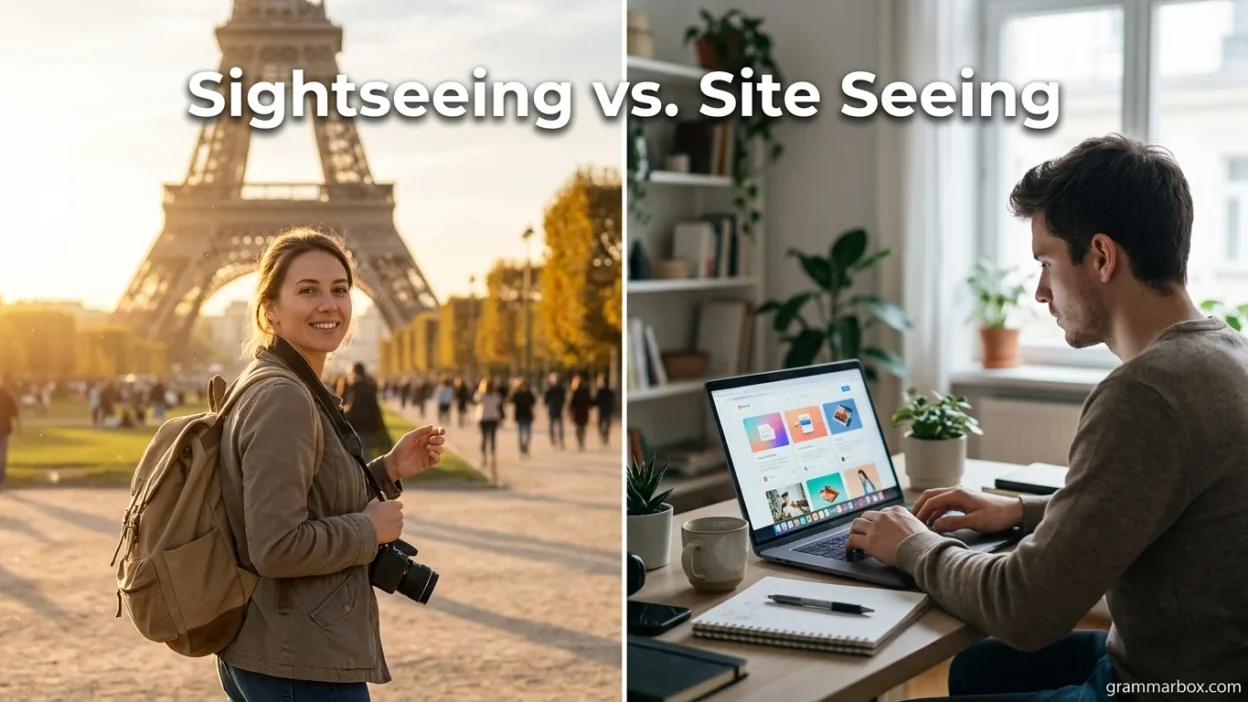
Have you ever wondered whether to write sightseeing or site seeing? These expressions look and sound almost identical, but only one is the standard spelling for visiting interesting places while traveling. Choosing the correct form matters when writing travel blogs, vacation plans, school assignments, or descriptions of tourist activities. A small spelling mistake can make your writing look less professional, especially when discussing popular destinations and memorable experiences.
The confusion usually happens because sightseeing and site seeing share the same pronunciation, while the words “sight” and “site” have different meanings. Sightseeing refers to visiting famous landmarks, historical attractions, museums, and other places of interest. Site seeing, however, is not the conventional spelling of this travel activity, although the two-word combination can occasionally make sense in a specialized context involving viewing a particular site. In this guide, you will learn the difference between sightseeing and site seeing, discover practical examples, and understand how to choose the correct expression in everyday and professional English.
Quick Answer
Sightseeing is the correct and standard spelling when you mean visiting interesting places, landmarks, or tourist attractions. Site seeing is generally incorrect for this meaning because it separates a word that should be written as one. Use “sightseeing” in travel plans, articles, and everyday conversations about exploring destinations.
Why People Confuse It
People often confuse sightseeing vs. site seeing because both expressions sound identical when spoken aloud. Their similar pronunciation makes it difficult to recognize the spelling difference without understanding their meanings.
There are two main reasons for this confusion:
- Similar pronunciation: “Sight” and “site” are homophones, meaning they sound alike but have different meanings.
- Different word structures: Sightseeing is an established compound word, while site seeing is simply a combination of two separate words.
The word “sight” relates to seeing or something worth looking at. The word “site” refers to a particular location or place.
For example, visiting famous monuments during a vacation is called sightseeing. Looking at a construction site or archaeological site might be described as seeing a site, depending on the context.
First Word: Sightseeing
Sightseeing is a noun that refers to the activity of visiting and looking at interesting, famous, or historically significant places, especially when traveling.
It is commonly associated with tourism, vacations, guided tours, and exploring unfamiliar destinations.
Meaning of Sightseeing
Sightseeing means exploring places of interest to appreciate their beauty, history, culture, or importance.
Examples of sightseeing activities include:
- Visiting famous historical monuments.
- Exploring museums and art galleries.
- Taking a guided city tour.
- Photographing natural landmarks.
- Discovering popular tourist attractions.
How to Use Sightseeing in a Sentence
Here are some examples:
- We spent the afternoon sightseeing in London.
- Our family went sightseeing during our summer vacation.
- The tour guide organized a sightseeing trip around the city.
- She enjoys sightseeing whenever she visits a new country.
- We booked a sightseeing tour to explore the historical district.
Notice that sightseeing is written as one word in every example.
Common Expressions With Sightseeing
You will frequently encounter these expressions in travel writing:
- Go sightseeing
- Enjoy sightseeing
- Sightseeing tour
- Sightseeing bus
- Sightseeing trip
- Sightseeing opportunities
- Sightseeing attractions
For instance, “We went sightseeing after checking into our hotel” is a natural and grammatically correct sentence.
Second Word: Site Seeing
Site seeing is generally not the correct spelling when referring to tourism or visiting attractions. In standard English, the intended word is sightseeing.
However, “site seeing” can occasionally occur as a literal combination of a noun and a verb. In such cases, “site” means a location, and “seeing” refers to viewing or inspecting it.
For example:
- The engineer is seeing the site before approving the project.
- The students are seeing the construction site for the first time.
- We are seeing the archaeological site tomorrow.
These sentences are understandable, but they use ordinary grammatical constructions rather than the established tourism term “sightseeing.” In more formal writing, you might choose clearer alternatives such as “inspecting the site,” “visiting the site,” or “viewing the archaeological site.”
Why Site Seeing Is Usually Incorrect
When you want to describe exploring tourist attractions, writing “site seeing” introduces an unnecessary spelling error.
Incorrect: We went site seeing during our holiday.
Correct: We went sightseeing during our holiday.
Incorrect: They enjoyed site seeing around Paris.
Correct: They enjoyed sightseeing around Paris.
The key is to identify the intended meaning before choosing the spelling.
Comparison Table
| Feature | Sightseeing | Site Seeing |
|---|---|---|
| Standard tourism spelling | Yes | No |
| Main meaning | Visiting attractions and places of interest | Literally seeing or viewing a site |
| Word structure | One compound word | Two separate words |
| Common context | Travel and tourism | Specific contexts involving a location |
| Example | We went sightseeing in Rome. | We are seeing the site tomorrow. |
| Recommended for travel articles | Yes | No, when referring to tourism |
The main distinction is that sightseeing is the established word for tourist activities, whereas site seeing is not a standard substitute for it.
When to Use Each
Understanding the context makes it easier to choose between these expressions.
When to Use Sightseeing
Use sightseeing whenever you are talking about exploring attractions, landmarks, or interesting places.
Common situations include:
- Planning a vacation.
- Writing a travel blog.
- Describing a city tour.
- Discussing tourist attractions.
- Sharing holiday experiences.
- Recommending activities to visitors.
Examples:
- We are going sightseeing in New York tomorrow.
- Sightseeing is one of the best ways to explore a historic city.
- The hotel offers several sightseeing packages.
When to Use Site Seeing
Use the words “site seeing” separately only when the sentence genuinely means that someone is seeing or viewing a particular site. Even then, a more precise phrase is often preferable.
Examples:
- We are seeing the construction site tomorrow.
- The architect is seeing the proposed building site this afternoon.
- The students are seeing the historical site with their teacher.
Depending on the intended meaning, you can improve these sentences by writing “visiting the site,” “inspecting the construction site,” or “touring the historical site.”
Practical rule: If you mean tourism, use “sightseeing.” If you mean looking at a specific location, choose a suitable phrase involving “site.”
Examples of Sightseeing vs. Site Seeing
The following examples demonstrate the correct usage in different contexts.
Correct Examples of Sightseeing
- We went sightseeing in Paris during our weekend trip.
- My parents enjoy sightseeing whenever they travel abroad.
- The tourists spent the morning sightseeing near the waterfront.
- Our guide arranged a sightseeing tour of the capital.
- I took several photographs while sightseeing in Rome.
- The family planned a full day of sightseeing in New York.
- Sightseeing is a popular activity among international visitors.
- We rented a bus for sightseeing around the city.
- She prefers sightseeing to spending the entire vacation indoors.
- The travel agency offers affordable sightseeing packages.
- After breakfast, we went sightseeing around the historic district.
- Their vacation included hiking, shopping, and sightseeing.
Examples Involving a Site
These examples show situations in which “site” has its literal meaning.
- The engineer is inspecting the construction site.
- We are visiting the archaeological site tomorrow.
- The architect is reviewing the proposed building site.
- The students are viewing the excavation site with their instructor.
- The project manager is checking the site before construction begins.
These sentences do not use “site seeing” as a tourism expression. Instead, they use more natural constructions to describe viewing, visiting, or inspecting a location.
Incorrect and Correct Sentences
| Incorrect | Correct |
|---|---|
| We went site seeing in Paris. | We went sightseeing in Paris. |
| They planned a site seeing tour. | They planned a sightseeing tour. |
| I love site seeing on vacation. | I love sightseeing on vacation. |
| Our sightseeing trip was wonderful. | Our sightseeing trip was wonderful. |
| We enjoyed site seeing around Rome. | We enjoyed sightseeing around Rome. |
The fourth example is already correct, illustrating that “sightseeing” should remain one word.
Common Mistakes
Even experienced English learners sometimes confuse sightseeing with site seeing. Recognizing common mistakes can help you avoid them.
1. Separating Sightseeing Into Two Words
Incorrect: We spent the day sight seeing.
Correct: We spent the day sightseeing.
When referring to tourism, sightseeing is written as one word.
2. Using Site Instead of Sight
Incorrect: We went site seeing in London.
Correct: We went sightseeing in London.
Remember that “sight” relates to seeing, while “site” refers to a location.
3. Writing Site Seeing Tour
Incorrect: The company offers a site seeing tour.
Correct: The company offers a sightseeing tour.
The established expression for a tour of tourist attractions is “sightseeing tour.”
4. Assuming Both Spellings Are Interchangeable
Although the expressions sound alike, they are not interchangeable in standard travel writing.
Incorrect: Sightseeing and site seeing are two accepted spellings for tourism.
Correct: Sightseeing is the standard spelling for tourism.
5. Confusing Sightseeing With Site Inspection
Sightseeing usually involves exploring attractions for enjoyment or interest. Site inspection involves examining a specific location for a practical purpose.
For example:
- Tourists go sightseeing to explore a city.
- Engineers inspect a construction site to evaluate its condition.
Understanding the purpose of the activity helps you select the appropriate expression.
Memory Trick
A simple memory trick can help you remember the difference between sightseeing and site seeing.
Sightseeing = sights worth seeing.
The word “sight” refers to something you can see, such as a monument, beautiful landscape, or famous building. When you travel to explore these attractions, you go sightseeing.
Site = a specific place.
A site might be a construction area, archaeological location, or proposed building location. When discussing such places, use expressions such as “visiting the site” or “inspecting the site.”
Remember this easy association:
- Sightseeing: Exploring attractions.
- Site: A particular location.
If you are planning a holiday and want to explore famous places, the correct spelling is always sightseeing.
American vs. British English
There is no meaningful American-versus-British spelling difference between sightseeing and site seeing.
Both American English and British English use sightseeing as the standard one-word spelling for visiting tourist attractions.
Examples in American English:
- We went sightseeing in Chicago.
- The city offers excellent sightseeing tours.
Examples in British English:
- We went sightseeing in Edinburgh.
- The tourists enjoyed sightseeing around London.
The spelling remains the same in both varieties of English.
Some other travel-related words differ between American and British English. For example, Americans commonly use “vacation,” while British speakers often use “holiday” for time away from work. However, these differences do not affect the spelling of sightseeing.
For international audiences, travel blogs, school assignments, and professional writing, sightseeing is the appropriate choice regardless of which variety of English you use.
Similar Words
Several English words and expressions are related to sightseeing or can be confused with it. Understanding their meanings can improve your vocabulary.
| Word or Phrase | Meaning | Example |
|---|---|---|
| Sight | The ability to see or something visible | The mountain was a beautiful sight. |
| Site | A particular location | The workers arrived at the construction site. |
| Scenery | Natural features of a landscape | We admired the beautiful scenery. |
| Tourism | Travel for recreation or exploration | Tourism supports the local economy. |
| Tourist attraction | A place visitors want to explore | The castle is a popular tourist attraction. |
| экскур | A short organized trip or visit | The students joined an educational excursion. |
| Tour | A journey around places of interest | We booked a guided tour of the city. |
| Exploration | The act of investigating or discovering something | We spent the afternoon exploring the old town. |
| Sightseeing tour | An organized trip to visit attractions | The sightseeing tour included three museums. |
| Site inspection | An examination of a particular location | The contractor completed a site inspection. |
In the table above, “excursion” is the English word for a short trip or organized visit.
These terms can help you describe travel experiences more precisely. For example, sightseeing emphasizes visiting attractions, scenery describes what a landscape looks like, and tourism refers to travel as a broader activity.
FAQs:
1. Is sightseeing one word or two?
Sightseeing is one word when it refers to visiting tourist attractions or places of interest. Writing “sight seeing” for this meaning is generally considered a spelling mistake.
2. Is site seeing ever correct?
The combination can occur when “site” is a noun and “seeing” is a verb form, but it is not the standard spelling of the tourism term. Phrases such as “visiting the site” or “inspecting the site” are often clearer.
3. What does sightseeing mean?
Sightseeing means visiting and exploring interesting places, such as historical monuments, museums, landmarks, and famous attractions, particularly while traveling.
4. Why do people write site seeing instead of sightseeing?
People often make this mistake because “sight” and “site” are pronounced identically. They may also assume that sightseeing should be separated into two words, even though its standard spelling is one word.
5. Is sightseeing correct in American and British English?
Yes. Both American and British English use “sightseeing” as the standard spelling. There is no regional spelling difference for this word.
6. What is the difference between sightseeing and a site visit?
Sightseeing usually means exploring attractions for enjoyment, education, or interest. A site visit means going to a particular location, often for work, study, inspection, or research.
7. What is the correct phrase: sightseeing tour or site seeing tour?
Sightseeing tour is correct when describing an organized trip to visit tourist attractions. “Site seeing tour” is not the standard spelling for this activity.
8. How can I remember the correct spelling of sightseeing?
Associate sightseeing with “sights worth seeing.” If you are exploring landmarks, monuments, and attractions, write “sightseeing” as one word.
Remember This
- Sightseeing = visiting tourist attractions and interesting places.
- Site = a particular location, such as a construction or archaeological site.
- Sightseeing tour = the correct expression for an organized tour of attractions.
- American and British English = both use “sightseeing.”
- Easy memory trick: Think of sightseeing as exploring “sights worth seeing.”
Whenever you describe exploring a new city or visiting famous landmarks, remember to write sightseeing as one word.
Conclusion
Learning the difference between sightseeing and site seeing is a simple way to improve your spelling and make your travel writing more professional. Although the expressions sound alike, only sightseeing is the standard word for exploring tourist attractions, historical landmarks, and interesting destinations. Understanding the difference between “sight” and “site” will help you avoid this common English mistake.
If you are writing a travel blog, planning a vacation, preparing a school assignment, or sharing your latest adventure, use sightseeing when you mean visiting places of interest. If you need to describe viewing a particular location, choose a more precise phrase, such as “visiting the site” or “inspecting the site.” With this simple distinction in mind, you can write confidently and communicate your meaning clearly.