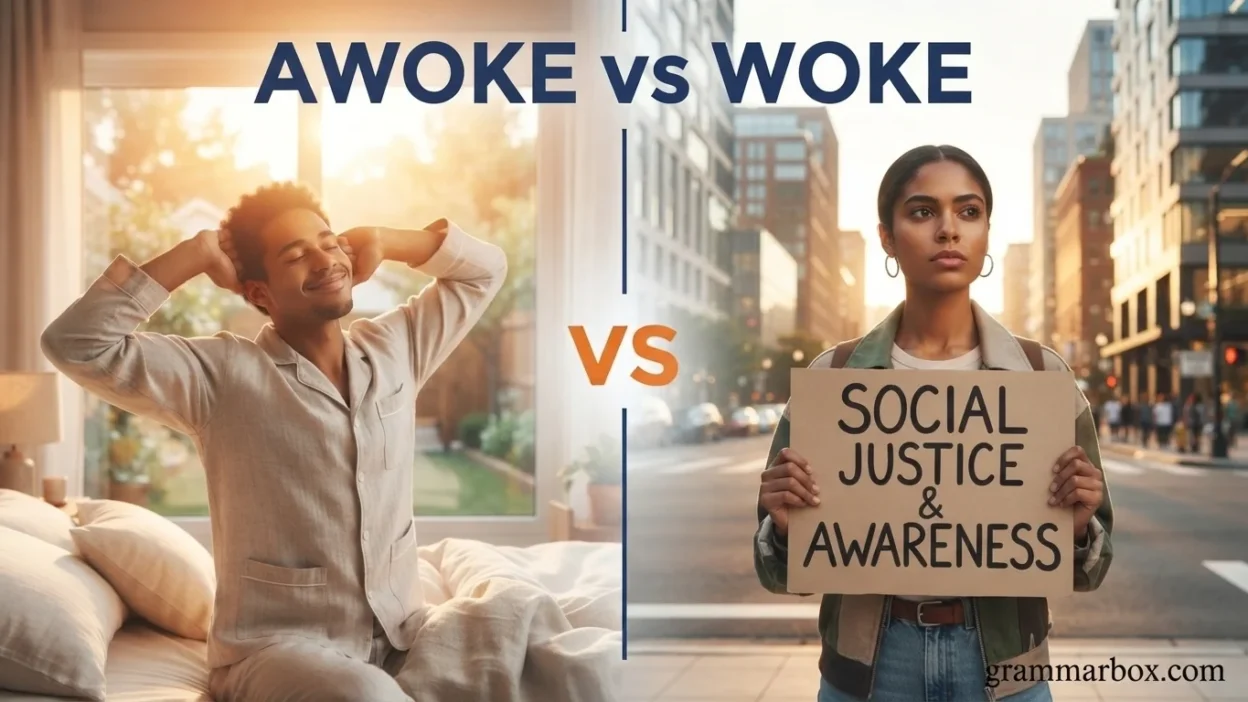
Have you ever wondered whether to write awoke vs woke when describing someone who got out of sleep or suddenly became aware of something? Both words are correct English forms of the verb wake, and they can often be used in similar situations. However, their usage can vary depending on the sentence, writing style, and meaning you want to express. Understanding this small difference can help you write more naturally and avoid common grammar mistakes.
The confusion between awoke and woke is understandable because both words describe something that happened in the past. You might say that someone woke up early or that someone awoke to the sound of an alarm. Both sentences are grammatically correct, but one may sound more natural in a particular context. In this guide, you will learn the meanings of awoke and woke, their grammatical roles, and how to use each word correctly. With clear examples, a comparison table, and practical memory tricks, you will be able to choose the right past tense of wake with confidence.
Quick Answer
Awoke and woke are both correct simple past tense forms of the verb wake. They generally mean to stop sleeping or become aware of something. Woke is common in everyday conversation, while awoke can sound slightly more formal or literary. Both forms are widely accepted in modern English.
Why People Confuse It
People confuse awoke and woke because both words express the same basic action: becoming awake or aware. Unlike regular verbs, which often form their past tense by adding -ed, the verb wake has irregular past tense forms.
For example:
- I woke up at six o’clock.
- I awoke at six o’clock.
Both sentences are correct and communicate the same basic idea.
The confusion often comes from three factors:
- Irregular verb forms: Wake does not follow the usual -ed pattern.
- Similar meanings: Woke and awoke can replace each other in many sentences.
- Differences in tone: Woke is often more conversational, whereas awoke may sound more formal or descriptive.
Remember that neither form is inherently incorrect. The best choice depends on your sentence and preferred writing style.
First Word: Awoke
Awoke is the simple past tense of awake or, more commonly in this context, the verb wake. It describes the moment someone stopped sleeping or became aware of something.
Although it is correct in everyday English, awoke can sound more literary, formal, or descriptive than woke.
Meaning of Awoke
Awoke means woke up, became conscious, or became aware of something.
Examples include:
- She awoke before sunrise.
- He awoke to the sound of thunder.
- I awoke from a strange dream.
- The noise awoke everyone in the house.
In these examples, awoke describes a completed action in the past.
When to Use Awoke
Use awoke when you want a slightly more formal or descriptive tone, especially in storytelling, essays, or narrative writing.
For example:
- The traveler awoke beneath a sky full of stars.
- She awoke to the realization that something had changed.
- The entire village awoke when the church bells rang.
Awoke is particularly useful when describing a sudden awakening or a moment of realization.
Is Awoke Grammatically Correct?
Yes. Awoke is a standard, accepted past tense form of wake. It is not an outdated or incorrect word, although it may be less common than woke in casual conversation.
Second Word: Woke
Woke is also the simple past tense of wake. It is extremely common in everyday spoken and written English.
It can describe waking from sleep, becoming aware of a sound, or realizing something important.
Meaning of Woke
Woke means stopped sleeping or became aware of something.
Examples include:
- I woke up late this morning.
- She woke when the phone rang.
- He woke to the smell of fresh coffee.
- They woke up feeling refreshed.
Woke is also the past participle of wake in some informal or nonstandard usage, but woken is the standard past participle in standard English.
For example:
- Correct: I have woken up early every day this week.
- Standard form: She had woken before the alarm rang.
When to Use Woke
Use woke in most everyday conversations, messages, and straightforward writing.
Examples:
- I woke up at seven today.
- The baby woke during the night.
- We woke early to catch the train.
- He woke up and checked his phone.
Woke is usually the simplest and most natural choice when talking about ordinary waking-up experiences.
Is Woke Grammatically Correct?
Yes. Woke is a standard past tense form of wake. It is not a misspelling of awoke, and you do not need to replace it with awoke to make your writing grammatically correct.
One additional note: woke also has a separate modern sociopolitical meaning associated with awareness of social injustice. That meaning is distinct from its grammatical role as the past tense of wake.
Comparison Table
| Feature | Awoke | Woke |
|---|---|---|
| Base verb | Wake | Wake |
| Grammatical form | Simple past tense | Simple past tense |
| Main meaning | Stopped sleeping; became aware | Stopped sleeping; became aware |
| Everyday usage | Correct, sometimes more literary | Very common and conversational |
| Formal writing | Suitable | Suitable |
| Casual conversation | Correct | Very common |
| Example | She awoke at dawn. | She woke at dawn. |
| Correct past participle | Awoken | Woken |
The main difference is stylistic rather than grammatical. In many sentences, you can use either word without changing the meaning.
When to Use Each
Choosing between awoke and woke is usually straightforward once you consider the tone and structure of your sentence.
Use Awoke for Descriptive or Literary Writing
Awoke can give a sentence a slightly more formal or narrative feel.
Examples:
- The prince awoke in an unfamiliar room.
- She awoke to the gentle sound of rain.
- A strange feeling awoke within him.
The third example uses awoke figuratively to describe a feeling becoming active or noticeable.
Use Woke for Everyday Communication
Woke is a natural choice for daily conversations and simple statements.
Examples:
- I woke up late for work.
- My brother woke me at midnight.
- We woke when the storm began.
These sentences sound natural in ordinary English.
Use Either When Both Sound Natural
Some sentences work equally well with both forms.
- She woke at sunrise.
- She awoke at sunrise.
Both are grammatically correct. The choice depends on personal preference and the tone you want.
Remember the Verb Forms
The basic verb forms are:
| Form | Example |
|---|---|
| Base form | Wake |
| Simple past | Woke or awoke |
| Past participle | Woken or awoken |
| Present participle | Waking |
Examples:
- I wake early every morning.
- I woke early yesterday.
- I have woken early all week.
- I am waking up now.
Examples of Awoke vs Woke
Here are 14 examples showing how both words work in real sentences.
Examples with Awoke
- She awoke at five in the morning to prepare breakfast.
- The child awoke when someone knocked on the door.
- He awoke from a deep sleep after hearing the alarm.
- We awoke to a beautiful view of the mountains.
- The patient awoke shortly after the procedure.
- A sudden noise awoke the entire household.
- She awoke to the realization that she had forgotten her appointment.
Examples with Woke
- I woke up early to study for my exam.
- He woke when his dog started barking.
- They woke up feeling tired after a long journey.
- My sister woke me before sunrise.
- The baby woke twice during the night.
- We woke to find snow covering the garden.
- She woke up and immediately checked her messages.
What Do These Examples Show?
Both forms describe a past action. Awoke may sound more descriptive in a narrative, while woke often sounds more direct and conversational.
However, this is a tendency rather than a strict rule. Either form can be appropriate in both formal and informal writing.
Common Mistakes
Even though awoke and woke are both correct, writers sometimes confuse them with other forms of the verb wake.
Mistake 1: Using Woke Instead of Woken After Have
Incorrect: I have woke up early.
Correct: I have woken up early.
In standard English, the present perfect uses have or has followed by the past participle.
Mistake 2: Using Awoke After Had in a Perfect Tense
Incorrect: She had awoke before sunrise.
Correct: She had awoken before sunrise.
The past perfect requires the past participle, not the simple past tense.
Mistake 3: Assuming Awoke Is Always More Correct
Incorrect assumption: Woke is informal and should never appear in formal writing.
Correct understanding: Both woke and awoke are standard past tense forms. Choose the word that fits your sentence and preferred style.
Mistake 4: Treating Woke as a Misspelling
Incorrect assumption: Awoke is correct, but woke is wrong.
Correct understanding: Both forms are correct and widely used.
Mistake 5: Confusing Wake and Awake
Wake is commonly used as a verb meaning to stop sleeping. Awake can function as an adjective meaning not asleep and can also be used as a verb in certain contexts.
Examples:
- I wake up at seven.
- I am awake already.
Understanding these differences will help you use all the forms correctly.
Memory Trick
Use this simple trick to remember the difference:
Woke = everyday waking. Awoke = an alternative past tense that can sound more descriptive.
Think of the following sentences:
- I woke up late.
- I awoke to the sound of birds singing.
Both are correct, but the second may sound more like a story.
You can also remember the complete sequence:
- Wake: today or generally.
- Woke or awoke: a completed action in the past.
- Woken or awoken: used with helping verbs such as have, has, and had.
- Waking: an ongoing action.
For example, “I woke up yesterday” describes a past event, while “I have woken up early all week” connects a past action to the present.
American vs British English
Both awoke and woke are accepted in American and British English. There is no strict regional rule requiring speakers of one variety to use awoke and speakers of the other to use woke.
| Usage | American English | British English |
|---|---|---|
| Simple past | Woke or awoke | Woke or awoke |
| Past participle | Woken or awoken | Woken or awoken |
| Everyday expression | I woke up early. | I woke up early. |
| More descriptive expression | She awoke at dawn. | She awoke at dawn. |
In both varieties, woke is common in everyday communication. Awoke is also correct and can be preferred in literary or descriptive contexts.
Other spelling differences, such as color versus colour, are associated with regional conventions. The choice between woke and awoke is primarily a matter of usage and style, not American versus British spelling.
Similar Words
Several related words can help you understand the different forms and meanings of wake.
1. Wake
Wake is the base form of the verb.
Example: I usually wake before my alarm.
2. Woken
Woken is the past participle used with helping verbs.
Example: She has woken up early every day this week.
3. Awoken
Awoken is another past participle of wake.
Example: He had awoken before anyone else.
4. Awake
Awake commonly functions as an adjective meaning not asleep.
Example: The children are still awake.
5. Awakening
Awakening can refer to the process of waking up or becoming aware of something.
Example: The experience marked an emotional awakening.
6. Arouse
Arouse can mean to awaken someone or cause a feeling, interest, or reaction.
Example: The announcement aroused everyone’s curiosity.
These words are related, but they are not interchangeable in every sentence. Pay attention to their grammatical roles and meanings.
FAQs:
1. Is awoke or woke correct?
Both are correct. Awoke and woke are accepted simple past tense forms of the verb wake. You can use either to describe someone who stopped sleeping or became aware of something.
2. What is the difference between woke and awoke?
The main difference is style. Woke is very common in everyday English, while awoke can sound slightly more formal or literary. Their basic meanings are generally the same.
3. Is woke the past tense of wake?
Yes. Woke is one of the standard simple past tense forms of wake. For example, “I woke up early yesterday” is grammatically correct.
4. Is awoke the past tense of awake?
Awoke is traditionally used as the simple past tense of awake as well as wake. However, in everyday English, awake is often used as an adjective, as in “I am awake.”
5. Should I write “I woke up” or “I awoke”?
Both are correct. “I woke up” is especially common in everyday conversation, while “I awoke” may sound more formal or literary. Choose whichever fits your writing style.
6. Is “I have awoke” grammatically correct?
In standard English, the preferred form is “I have awoken” or “I have woken.” The present perfect requires a past participle, not the simple past form awoke.
7. What is the past participle of wake?
The standard past participle forms are woken and awoken. Both are used with helping verbs such as have, has, and had.
8. Is awoke more formal than woke?
Awoke can sound more formal or literary in some contexts, but the difference is not absolute. Both words are acceptable in formal and informal writing.
Conclusion
Understanding the difference between awoke and woke is easier than it first appears. Both words are grammatically correct, and neither is automatically better than the other. Although woke is especially common in everyday English, awoke remains a useful alternative in descriptive writing, storytelling, and other contexts where a slightly more literary tone feels appropriate.
The key to using these words confidently is to focus on their grammatical function rather than assuming that one is right and the other is wrong. Use woke or awoke for a completed past action, and use woken or awoken with helping verbs such as have, has, and had. With these simple rules and examples in mind, you can choose the right form naturally and write clearer, more accurate English.
Remember This
- Wake: Base form — “I wake up early.”
- Woke: Simple past — “I woke up early yesterday.”
- Awoke: Alternative simple past — “I awoke before sunrise.”
- Woken: Past participle — “I have woken up.”
- Awoken: Alternative past participle — “I have awoken.”
Bottom line: Woke and awoke are both correct. Use the one that best matches your sentence and tone.